
You can feel a campaign slipping before it's even launched. The content calendar's gone thin, the photos on file look staged, and the budget won't stretch to another polished shoot that still won't persuade buyers the way a real customer can. That's the point where user-generated content campaigns stop being a nice-to-have and start becoming a practical growth channel.
UK audiences are already comfortable with this kind of content. Research cited by Marketing Week found that 60% of UK adults with broadband had accessed user-generated content in the past week, alongside 84% who had read a newspaper in the same period, which places UGC in the mainstream rather than the margins (Sprout Social summary of UK UGC behaviour). The challenge for SMEs isn't whether people will watch, read or trust it, it's whether the brand can collect, clear and deploy it without breaking the workflow.
Why Most UK SMEs Underuse User-Generated Content Campaigns
A hotel manager in Brighton knows the problem before the first booking rush lands. The Instagram grid is half-empty, the freelance videographer quote has arrived, and the next campaign still needs a hero asset that feels local, warm and believable. A cheesemaker in Hampshire faces the same pressure from the other side, one reel can swallow a budget that should be going into stock, not just aesthetics.
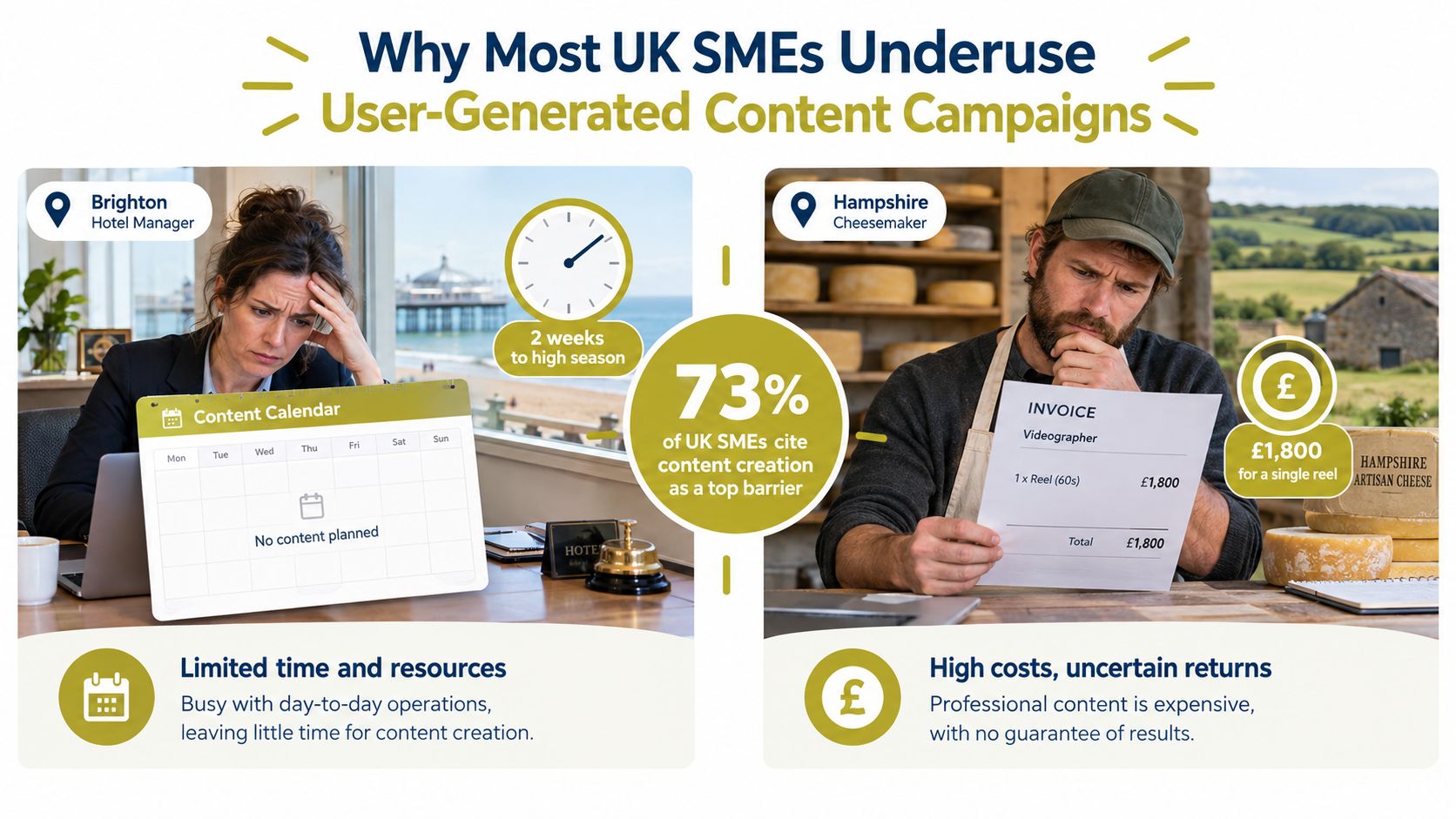
The mistake most SMEs make is treating UGC as a creative extra instead of a procurement channel. Real customers are already producing better evidence than a brand can stage in a studio, but owners often freeze because they don't know who owns moderation, how consent is captured, or where the repurposed content will live. For a quick primer on the basic definition, what is user generated content is a useful reference point, but the operational question is more important: how do you turn it into usable marketing assets?
The fastest path forward is to see UGC as an asset that feeds paid social, product pages, email and replies, not just a hashtag campaign. That's also why a structured ambassador programme can help when a business needs a repeatable source of approved contributors, which is the logic behind Carlos Alba Media's brand ambassador programme.
Practical rule: if a customer already trusts you enough to post about the experience, your job is to make reuse easy, not to start from scratch with another polished asset.
Three things usually block SME adoption. First, fear of legal exposure. Second, no clear moderation owner, so posts pile up in DMs or tagged feeds. Third, confusion between paid creators and organic contributors, which leads to mixed expectations and messy rights handling. Once those are separated, UGC stops looking risky and starts looking like the lowest-friction content source the business already has.
Setting the Strategy Before the Brief
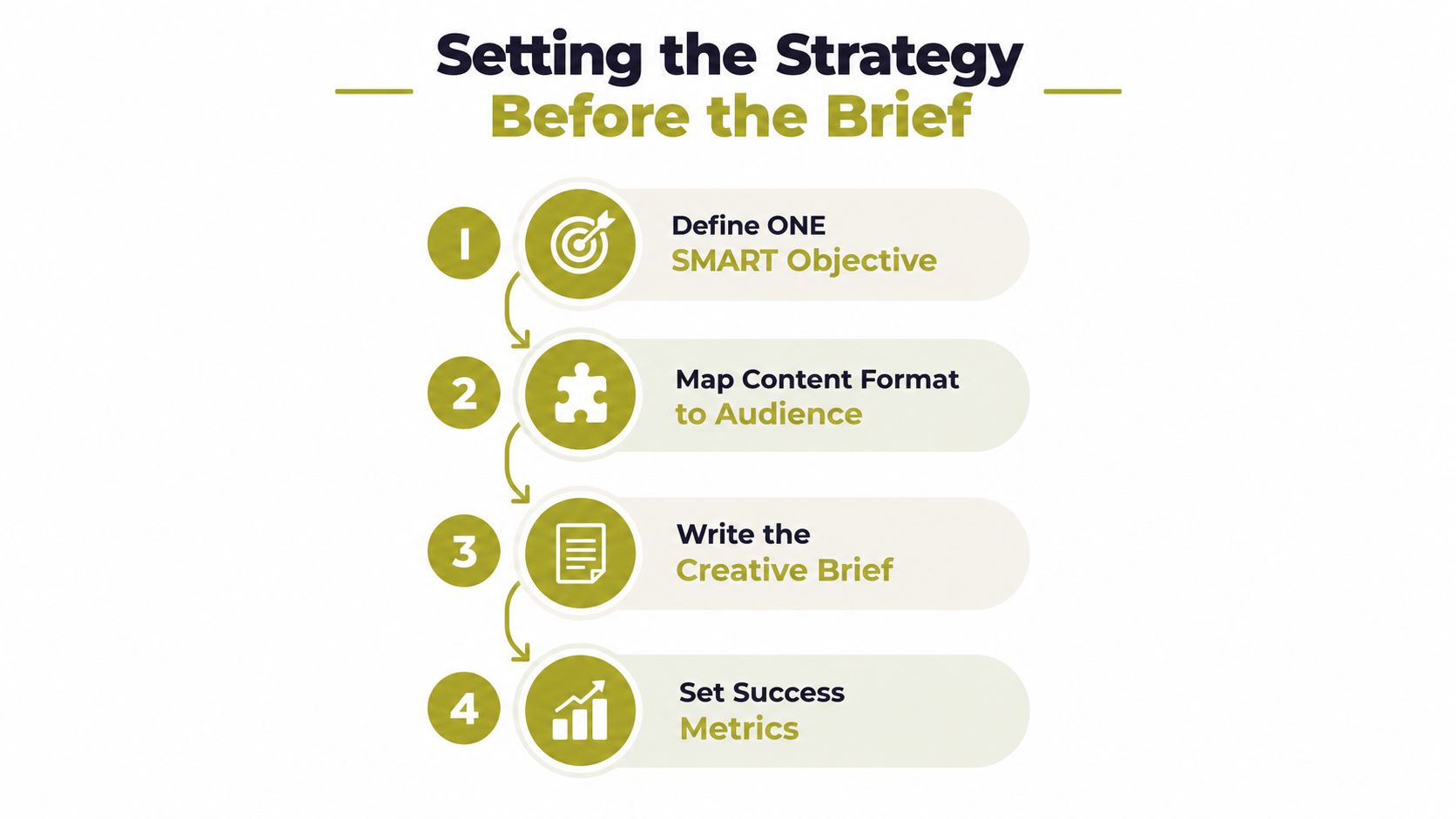
A hotel can collect hundreds of tagged guest photos and still have no usable campaign. Without a defined outcome, audience, approval route and consent process, user-generated content campaigns create activity rather than measurable marketing value. Set those decisions before asking anyone to post.
Lock the objective and audience first
Choose one primary business outcome, such as list growth, repeat bookings, product-page conversion or stronger retargeting assets. A campaign can support several channels, but the brief needs one clear success test. Otherwise, contributors produce attractive material that nobody knows how to assess or reuse.
A Cornwall surf school does not need generic creators with large London followings. It needs people who book coastal weekends, parents planning family trips and visitors who want to see the lesson in real conditions. If the objective is retention, the content should reinforce membership and familiarity. If it is conversion, it should answer practical doubts quickly.
Audience definition should shape the format. Tourism and hospitality brands may need review clips, room walk-throughs and arrival-day moments because those assets address questions that delay a booking. A retail or hospitality SME may get more useful footage from an action-based prompt than from a slogan. The brief should state who the contributor is, what they should show and which customer concern the content must address.
Build the format mix around the funnel
Match each format to its job. Review clips support consideration, unboxings and first-use demonstrations support conversion, and day-in-the-life posts can support retention. Decide the intended placements at the same time, whether TikTok, Instagram, Google Business Profile, product pages or email. Each placement affects framing, editing, disclosure and the permissions required.
A practical brief names the objective, audience, format, prompt and owner. The owner must be able to approve, repost or route an asset promptly. A small business that leaves submissions in a shared inbox for a week will lose timely content and frustrate contributors.
Set the permission trail before launch. Sup's guidance on legal rights for UGC campaigns helps clarify ownership and usage permissions. Carlos Alba Media also discusses how customer data can support marketing planning. The best brief records what was submitted, who approved reuse, where the asset may appear and whether paid promotion is covered.
For regulated sectors, add a moderation checkpoint before publication. Tourism claims, health-related statements and hospitality promotions may need closer review than a casual repost. The strategy should make that responsibility visible, with a named owner and an escalation route.
A good brief removes uncertainty for the customer. It states what to film, where to send it, how consent works and what happens next.
Designing Creative Prompts and Incentives That Work
The strongest prompts feel like an action, not a brand exercise. “Tell us why you love us” usually gets polished fluff. “Show us your morning routine with our coffee” gives someone a real setting, a real object and a natural sequence to film. That's why prompt design matters more than copywriting tone.
Give people a verb, a context and a constraint
A practical prompt has three parts. A verb, such as show, film or unbox. A context, such as after checkout, on arrival, or at breakfast. And a constraint, such as no polish, real kitchen, or one take only. That combination produces footage with less friction and fewer unusable clips.
For tourism and hospitality, the best prompts often invite a moment rather than a claim. “Film the 60 seconds after you check into the room” is better than asking for praise because the customer can show what they did, not perform a script. For SMEs, that's the difference between content you can edit and content you can't use.
Split paid creators from organic contributors
Paid creators are suppliers. They need scope, fee, usage rights and delivery dates in writing. Organic contributors are customers, and they respond better to light-touch rewards, a feature on the brand page, a discount code, a charity donation, or just a proper thank-you message. The incentives are not the same, and mixing them causes confusion.
| Dimension | Paid Creator | Organic Customer Contributor |
|---|---|---|
| Relationship | Commissioned supplier | Existing customer or fan |
| Expectation | Deliverables, dates and rights agreed | Low-friction participation |
| Best incentive | Fee and written usage terms | Visibility, acknowledgement or modest reward |
| Briefing style | Shot list, edit rules, deadlines | Simple prompt and clear republish rules |
| Risk if mishandled | Late delivery or rights disputes | Low-quality, off-brand content |
For testimonial-led work, the mechanics are similar but the proof standard is higher, which is why Carlos Alba Media's customer testimonial videos guidance sits neatly alongside a UGC workflow. The point is to treat each source of content differently, not to lump everyone into one hashtag and hope for the best.
Rule of thumb: if the contributor has to guess what “good” looks like, the brand brief isn't finished yet.
Staying Legal Without Killing Momentum
A guest posts a strong hotel review, the brand sees an obvious paid-social asset, and the campaign stalls because nobody can prove permission was granted. UK UGC campaigns live or die on that trail. Content that works on a public feed may still lack the rights needed for an advert, website, email or booking page, so consent belongs inside the workflow from the first brief.
Use layered consent, not a single vague opt-in
Build permission around the intended use. Start with clear terms and conditions for competitions or giveaways. A campaign hashtag can support the process, but its rules should explain whether posting invites contact or grants any licence. If the brand wants to retain images for later campaigns, use a separate sign-up or rights form that states the channels, territory, duration and ability to withdraw where applicable.
Ask for explicit written consent before reuse. Credit the creator where appropriate, record the approved asset and note where it may appear. A public post does not automatically give a business commercial rights. Consent hidden in a general website footer is difficult to evidence and rarely gives a contributor a clear choice.
A practical approval record should connect the contributor, original post, permission message, approved formats and expiry or withdrawal notes. That record saves time when a tourism image later moves from Instagram into a hotel email or an SME's retargeting campaign.
Know where ASA and GDPR pressure points sit
UK GDPR matters when reused images or video identify people, particularly if the brand stores contact details alongside the asset. ASA requirements also apply when an incentive or paid relationship shapes the content. The audience should be able to recognise the commercial context without guessing. Content featuring children requires tighter consent and review, especially before use in advertising or retargeting.
Carlos Alba Media's first-party data strategy material is relevant here because consent capture, audience data and content reuse often happen in the same workflow.
| Area | Do | Don't |
|---|---|---|
| Customer images | Get explicit written permission | Treat public posting as reuse rights |
| Incentivised content | Disclose the incentive clearly | Hide the commercial relationship |
| Under-18 content | Apply extra consent and review | Place it casually in ads |
| Creator attribution | Keep original credit where possible | Republish without context |
| Approval workflow | Store consent before launch | Leave sign-off until publishing |
Set a pre-publish review window that the team can meet consistently. If the brief identifies ownership, permitted channels and the approver, legal checks stay manageable. If those details are missing, review becomes a bottleneck and the content may go stale before anyone can use it. That delay is preventable.
Running Moderation Without Slowing the Funnel
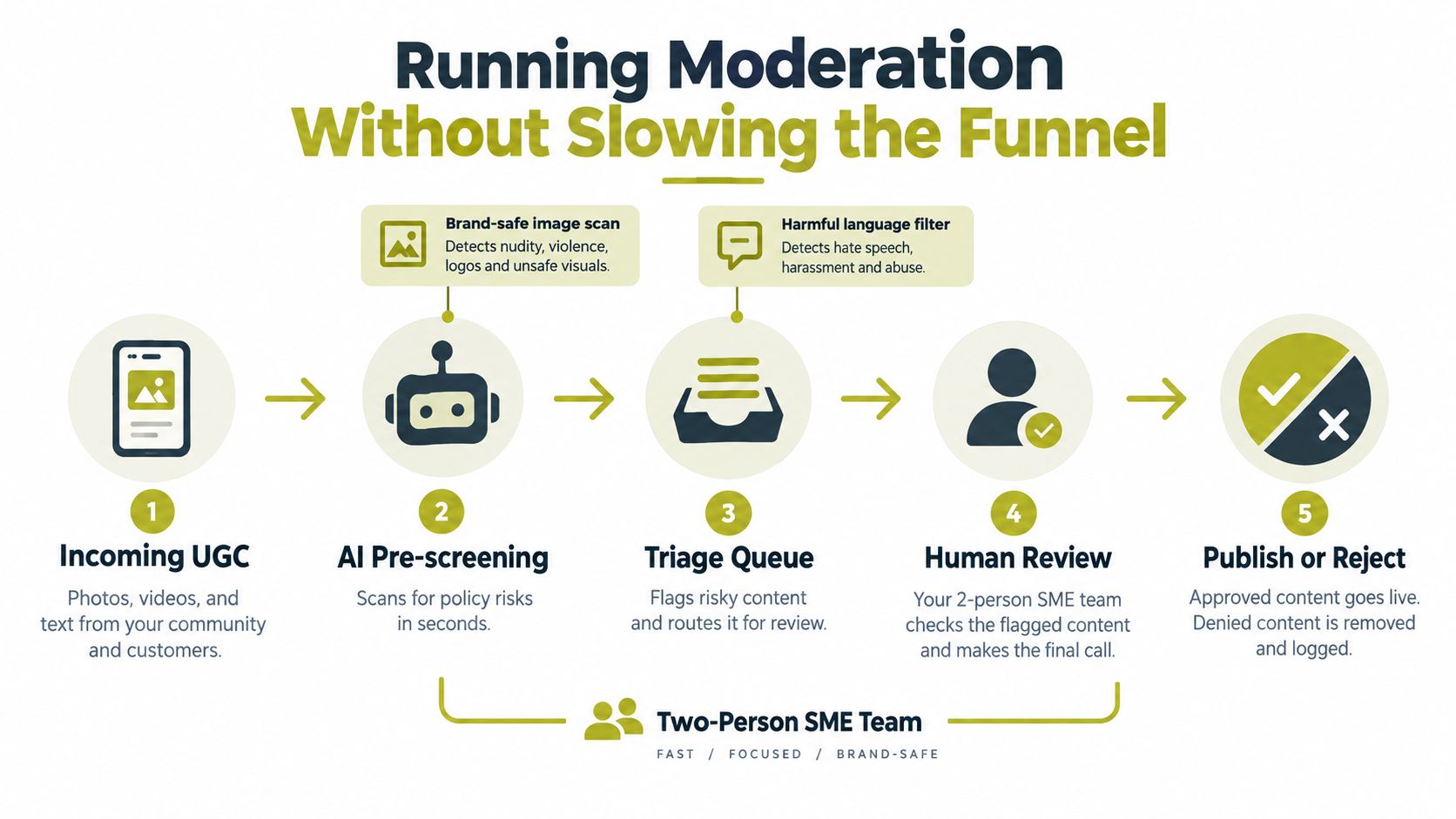
Moderation works best when it behaves like a newsroom desk, not a panic room. One person can triage a small volume, but the workflow has to be clear enough that a borderline post doesn't stall the whole campaign. For a two-person SME team, speed comes from rules, not heroics.
Build the queue around risk, not volume
The first pass can be AI-assisted for obvious brand-safety filters, duplicate images, harmful language and basic visual flags. After that, a human reviewer checks the things a machine can miss, logos, faces of minors, medical or financial claims, competitor mentions and whether the post matches the brand's tone. If anything is borderline, the content goes to escalation, not publication.
Operational rule: review every few hours during peak campaign windows. If the team waits until the end of the day, good content goes stale and unsafe content slips through.
Regulated sectors need a second filter layer
Alcohol, gambling, financial services, healthcare and children's services all add another compliance layer. That doesn't mean UGC can't work in those sectors, it means the approval path has to be documented and conservative. A post that feels harmless in tourism can be problematic elsewhere if it implies outcomes, minimises risk or shows the wrong audience.
The reviewer doesn't need a long checklist to start. In thirty seconds, they should know whether the asset includes minors, whether a claim needs substantiation, whether there's a competitor reference, and whether the content can sit on a website without creating a reputational issue. If not, it stays in the queue.
Here's a simple rule for the fence-sitters: if the content needs a long internal debate to explain why it's safe, it probably isn't ready. Generic UGC advice often skips that, but SMEs can't afford to. The workflow has to be tight enough to support real-world repurposing, not just social posting.
Placing UGC Where It Measurably Converts
UGC becomes valuable when it stops sitting in the feed and starts affecting buying behaviour. That's why the best placements are the ones that meet the buyer at the point of doubt. A homepage reel might build mood, but a product page gallery, an abandoned-cart sequence or a retargeting ad can do the harder commercial work.
Put customer proof closest to the decision
Product detail pages are the obvious starting point. Customer images, tagged clips and reviews answer the questions polished brand photography often can't, how the product looks at home, how it feels in use, and whether it matches the promise. Abandoned-cart emails also benefit from real customer visuals because they reduce the sense that the buyer is taking a blind risk.
TikTok comment replies and on-site lookbooks are underrated because they let the brand respond in the same language the audience already uses. That's also where UGC can support paid social creative, especially when a fresh asset library needs replacing fast. Teams that still report only vanity metrics are missing the point. The useful numbers are the ones that tie to purchase behaviour, add-to-cart rate, scroll depth, assisted conversions and retargeting response.
Use a conversion lens, not a trophy cabinet
A Dorset guesthouse that swaps stock photography for guest-posted terrace shots usually changes the feel of the booking journey before it changes the media plan. The content feels more believable, and that helps direct booking pages earn trust more quickly. The same principle applies to an independent skincare brand, where customer imagery can reduce uncertainty around texture, packaging and real-world use.
| Placement | Funnel Role | Typical KPI Uplift |
|---|---|---|
| Product page gallery | Consideration and conversion | Better engagement on page |
| Abandoned-cart email | Conversion recovery | More clicks back to site |
| Paid social refresh | Prospecting and retargeting | Stronger response than static brand-only creative |
| Google Business Profile | Local trust | More confidence before enquiry |
| TikTok comment replies | Late-stage reassurance | Faster decision-making |
If you need to turn customer clips into ad-ready versions fast, a tool like ShortGenius AI UGC ad platform can help teams assemble creative variations without rebuilding every asset by hand. That said, the tool doesn't solve the strategy. It just makes it easier to scale what already works.
Measuring, Reporting and Your 90-Day Rollout Plan
Measurement has to start from the objective, not from whatever dashboard was easiest to open. If the campaign exists to drive bookings, then the reporting needs to show which content helped, where it was reused, and what changed after it hit the page or ad set. If it exists to grow a list, the right questions are different.
Track the right events from the start
Use GA4 events for submission actions, rights capture, page engagement and conversion points. Add UTMs to every republished asset, use Meta Pixel where paid amplification is involved, and make sure Shopify referrer data is being read consistently if ecommerce is part of the funnel. The key is to know which UGC touchpoint touched which business outcome.
The cleanest KPI chain is straightforward. Submission rate tells you whether the prompt worked. Usage-rights capture tells you whether the content can be reused. On-site conversion lift tells you whether the asset changed behaviour. CPA, where relevant, shows whether the paid version of the content justified spend. EMV-to-paid ratio can be useful internally, but it shouldn't replace hard conversion data.
Roll out in three stages
Days 1 to 30: lock the objective, write the brief, shortlist contributors, build the consent template and set the moderation workflow.
Days 31 to 60: launch, amplify the strongest assets, review moderation weekly and build the first retargeting audience.
Days 61 to 90: move the winners onto product pages and email, report against the original objective, then decide whether to scale, adjust or stop.
A workable checklist for the next morning is simple: consent captured, brief approved, moderation queue assigned, dashboard built, and legal review scheduled quarterly. If one of those five is missing, the campaign will probably drift.
Carlos Alba Media builds practical PR and digital marketing campaigns for SMEs that need content with a clear purpose, not just more posts. If you're planning user-generated content campaigns and want the consent, moderation and conversion pieces handled properly, visit Carlos Alba Media to see how that work can fit into your wider marketing plan.