
You're probably looking at a patchy mix of social posts, a few warm customer advocates, and a founder who's tired of paying for reach that doesn't turn into revenue. That's exactly where a brand ambassador program earns its keep, but only if you treat it like a relationship system, not a content vending machine. For UK SMEs and startups, the bar is simple. If the programme can't support trust, tracking, and repeatable proof, it's just noise with a contract attached.
The UK market is already too mature for guesswork. The broader creator economy is commercially significant, with the UK influencer marketing market valued at about £860 million in 2023 in the Influencer Marketing Benchmark Report, and that scale matters because ambassador activity sits inside a real spend category, not a hobby lane. The brands that win inside that market are the ones that build long-term relationship marketing, measure over quarters, and back the few people who move buyers.
Carlos Alba Media comes at this from a newsroom-led angle, and that's the right lens. A good ambassador programme needs editorial judgement, broadcast discipline, and proper measurement, not follower inflation. If your team already thinks in terms of trust, messaging, and proof, you're closer to the right model than you might realise. If you're still shopping for quick reach, you're not ready.
Why a Brand Ambassador Program Is a Strategic Choice
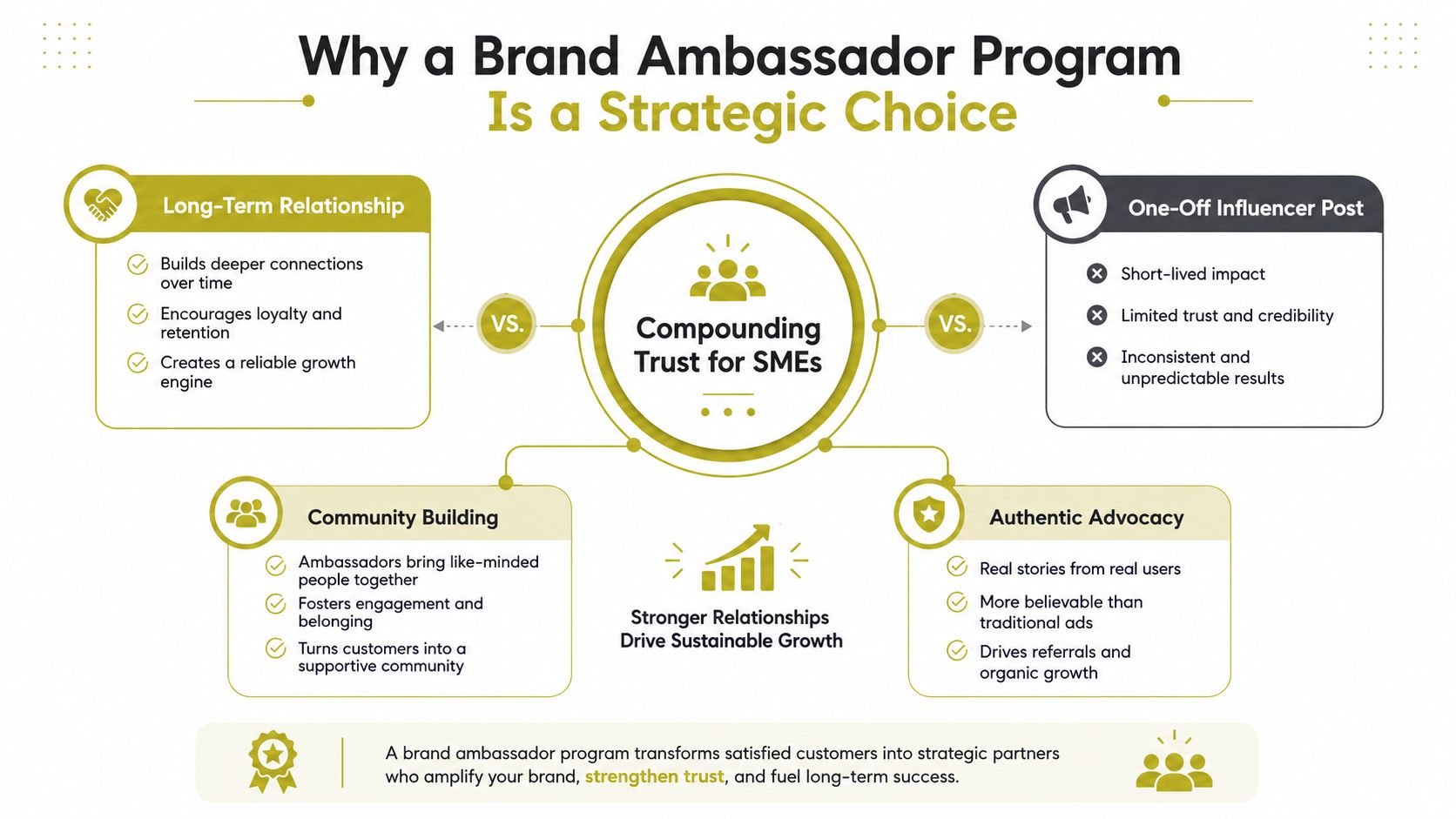
A brand ambassador program gives you more than a burst of attention. A one-off creator post may drive a spike, then disappear. A well-run ambassador programme keeps compounding because each advocate adds credibility, search demand, referral traffic, and repeated exposure over time.
Build trust, not a roster
That distinction matters most for SMEs. Smaller brands cannot afford to restart the awareness cycle every month, so they need advocates who keep showing up with context, not just content. For that reason, industry guidance treats ambassador programmes as longer-term systems, with a testing window that runs long enough to judge performance properly, according to programme guidance. Short-term evaluation pushes teams to cut good work before it has time to prove itself.
Practical rule: if you only want a post, buy a post. If you want advocacy that supports sales and reputation, build a programme.
The newsroom lesson is blunt. Credibility travels farther than polish. That is why a founder-led consultancy with journalistic instincts, like Carlos Alba Media, is useful here, because the work has to be anchored in message discipline, not vanity metrics. The same logic applies to brand storytelling, which is why it helps to align the programme with a clear narrative framework like what is brand storytelling.
Treat ambassadors as part of your reputation system
If you sell a product that needs explanation, reassurance, or trust, ambassadors can do more than fill feeds. They can help prospects see how the offer fits a real life, a real job, or a real problem. That matters for UK SMEs that need compounding trust rather than campaign spikes.
A useful procurement question is whether your current team wants media-style consistency or just content volume. Those are not the same thing. The right ambassador programme should support earned credibility, not just increase publishing frequency. If your plan does not link the activity to customer action, it is too shallow to be effective.
One practical place to start is with modest, branded touchpoints that make advocates visible without overcomplicating the ask. If you need a simple activation asset for events or community moments, branded beanies with your logo can work as a low-friction recognition item alongside the main programme.
Designing a Pilot That Proves Value Before You Scale
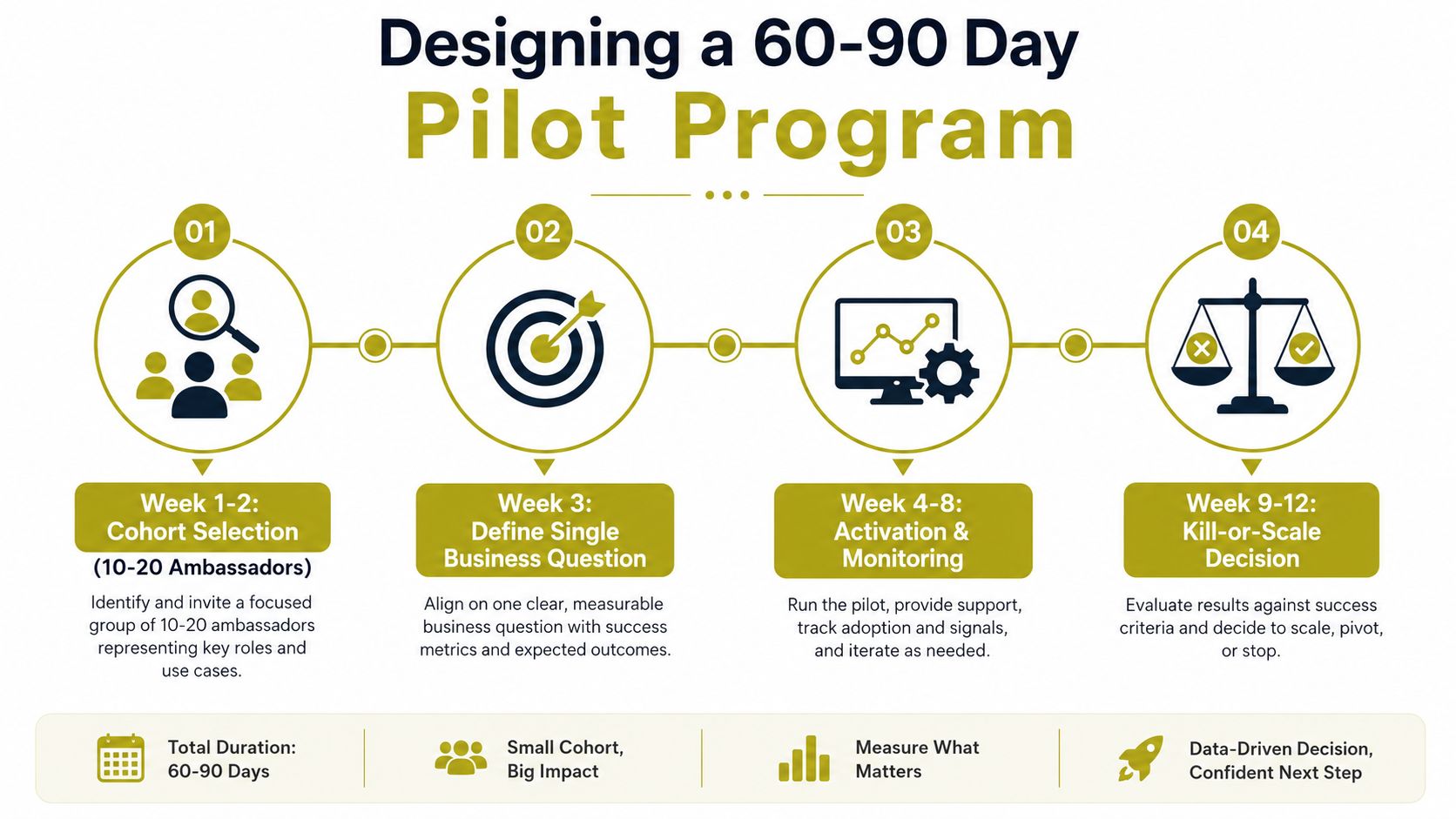
Most ambassador programmes fail because the team scales the roster before it understands the signal. That's backwards. Start with a 60 to 90 day pilot, keep the cohort tight, and make the business question painfully specific. If the pilot can't answer one clear commercial question, it's not a pilot, it's drift.
Use a small cohort and a single question
The strongest operating guidance for many teams is a 10 to 20 person cohort before you open the funnel wider, because a narrow test shows which advocates create real movement rather than just activity. For UK SMEs, that matters even more, since sales cycles can be longer and budgets are tighter. A broad launch usually creates more admin than insight.
Your pilot should answer one question only. For example, will this group generate meaningful referral traffic, qualified leads, or repeat purchases from a defined audience segment? Pick one. If you chase all three, you won't know what worked, and leadership will be left with a noisy dashboard instead of a decision.
A pilot only works if you are willing to stop, adapt, or scale on evidence, not enthusiasm.
Set kill criteria before launch
Write the failure threshold before the first ambassador signs. If the cohort doesn't produce usable referral behaviour, if activation is weak, or if tracking doesn't hold, stop and reset. That discipline saves money and avoids the common trap of defending a weak programme because the team likes the people involved.
A smart pilot also needs a basic operating rhythm. Give each ambassador the same onboarding pack, the same tracking setup, and the same reporting cadence. Then segment by performance, not enthusiasm, because a lively launch can still hide weak commercial output.
A helpful outside reference point is the implementation advice in effective ambassador outreach, but keep the testing philosophy simple. You're not trying to build a community of everyone. You're trying to identify the few people who can create repeatable value.
Recruiting Ambassadors Who Drive Growth
Recruitment goes wrong when teams hire for personality instead of commercial fit. A strong ambassador brief starts with the audience you want to reach, the job the ambassador must do, and the proof the person has to deliver. If those three things are unclear, the shortlist fills up with people who look active but will not move buyers.
Write the brief like a commissioning editor
A recruitment brief should answer four questions. Who is the target audience, what tone will feel credible to them, what action do you need, and what kind of content can the ambassador realistically create? That framing keeps you away from vanity follower counts and towards real audience relevance.
Shortlist candidates on brand fit, content quality, audience relevance, and conversion potential. Someone with a smaller but trusted audience can outperform a larger creator whose community does not care about your category. That is not theory, it is basic media judgement.
Use outreach that sounds like a real invitation, not a mass email. State why the person was selected, what the programme is trying to achieve, and what success would look like. Then ask for a low-risk trial task, such as a short concept pitch, a sample story angle, or a product-use idea that shows whether they understand the brand. For a practical framework, see effective ambassador outreach.
Spot the red flags early
You want ambassadors who act like credible spokespeople, not rented billboards. If a candidate only talks in generic promotion, pushes for payment before understanding the brief, or has a feed full of mismatched brand activity, that is a warning sign. The cost is not just cash. It is dilution of trust.
The best recruitment teams also look for consistency. People who can keep a message coherent over time are far more useful than loud personalities with chaotic content habits. The newsroom mindset matters here, because a strong public-facing voice matters more than raw volume.
A practical recruitment file should include:
- Audience relevance: Does the candidate speak to the people you want?
- Content quality: Are their posts clear, consistent, and usable?
- Conversion potential: Do they already drive action, not just applause?
- Brand fit: Would they be believable in your category?
- Reliability: Can they work to deadlines and deliver clean assets?
For sourcing ideas, the effective ambassador outreach guidance is useful, but the advantage comes from sharper selection, not louder outreach.
Building a Compensation Model That Stays Authentic
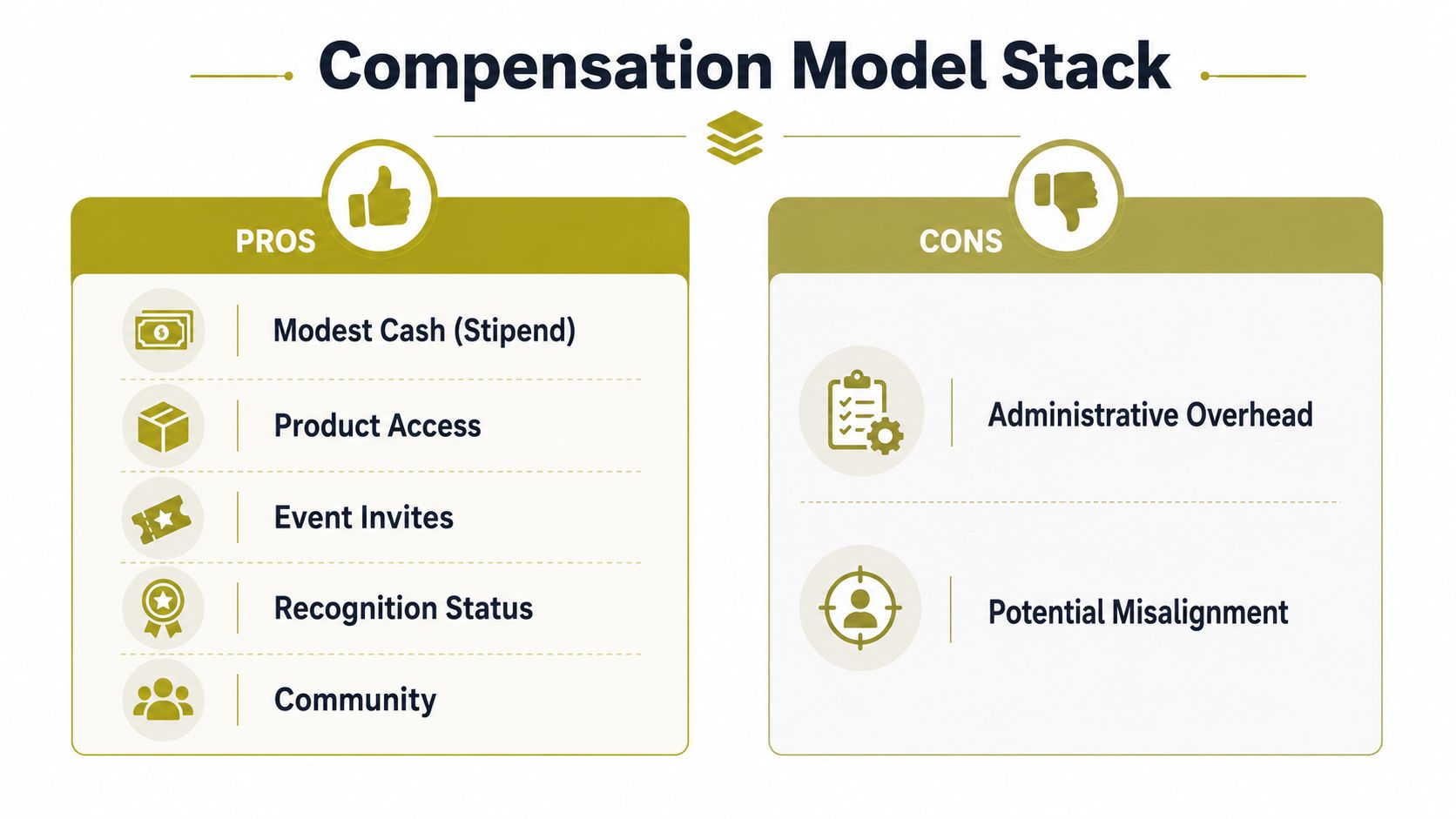
Compensation is where too many ambassador programmes lose their way. Pay too little and you get passive participation. Pay too much and you attract people who are there for the transaction, not the brand. The answer is a hybrid model that respects the ambassador's time while keeping the commercial incentive tied to results.
Use a hybrid stack, not a single number
For most SMEs, the best blend is modest cash, product access, event invites, recognition, and community status. That mix keeps the relationship credible without turning the programme into a bidding war. It also makes room for different contribution levels, which matters if some ambassadors produce content, some drive sales, and some bring useful visibility.
For premium brands, the balance can shift towards higher-touch recognition and access, because status can be more motivating than a heavy commission. In regulated sectors, you need the compensation structure to stay simple, transparent, and documentable. The more complex the category, the more important it is to avoid incentives that could distort messaging.
Over-payment doesn't buy authenticity. It often buys low-fit applicants who chase the deal and disappear when the novelty wears off.
Set guardrails before you negotiate
Do not let one person's asking price define the whole model. Ask what behaviour you are buying, whether the proposed structure can survive a longer sales cycle, and whether it still makes sense across different UK regions and audience expectations. For SMEs, tighter budgets mean the deal has to fit the business, not the other way round.
A useful way to think about this is to separate production value from performance value. A retainer can cover the time needed to create usable content. A commission can reward measurable outcomes. Tiered perks can keep the best ambassadors engaged over time.
If you're also managing physical brand touchpoints, keep one eye on merchandise logistics. A practical resource for that is manage branded merchandise programs, especially if the ambassador model includes events, product drops, or community rewards.
The mistake I see most is over-incentivising early. That attracts the wrong people, crowds out genuine brand fans, and creates an awkward internal precedent. If the budget can't support the structure, reduce the cohort, not the authenticity.
Onboarding and Activating Ambassadors in the First 30 Days
Ambassador programmes stall when the contract is signed but nothing meaningful happens for weeks. The fix is disciplined onboarding. Treat the first month like a launch newsroom would treat a live campaign, with clear ownership, hard deadlines, and an approval path that doesn't wobble.
Lock the basics in week one
Start with the brand brief, voice guidelines, legal disclosure training, and a named contact who can answer questions quickly. If the ambassador doesn't know what good looks like, they'll either overproduce irrelevant content or freeze. Both outcomes waste time.
Your first 30 days should include:
- Day 1 to 3: Brand briefing, audience context, voice rules, and what not to say.
- Day 4 to 7: Disclosure training and content sign-off process.
- Day 8 to 14: Co-creation workshop, where the ambassador helps shape the content angle.
- Day 15 to 21: First content draft, review, and edits.
- Day 22 to 30: Performance check-in, community introduction, and next-step planning.
Activate with low-budget, high-credibility formats
SMEs don't need flashy launches. They need believable ones. Co-created content works well because it gives the ambassador ownership. Behind-the-scenes access makes the messaging feel lived-in. Customer story features, event appearances, and founder Q&As can all create useful material without heavy production spend.
The newsroom discipline matters here because it forces clarity. Each brief should state the hook, the audience, the channel, the deadline, and the sign-off route. If any of those are missing, you're inviting delay.
Clear deadlines protect both sides. Ambassadors need to know exactly when to deliver, and the brand needs a paper trail if the content needs revision.
A named point of contact also keeps the programme human. Ambassadors should never be left chasing multiple stakeholders. That slows activation and weakens accountability. If you want reliable output, make the process easy to follow and difficult to misunderstand.
Measuring Performance With a KPI Framework That Actually Works
Vanity metrics are the fastest way to deceive yourself. A high reach number means almost nothing if nobody clicked, converted, or came back. The right KPI framework starts at the top of the funnel, but it only matters if you can trace the path through referral traffic, conversion, and retention.
Build the measurement ladder
Use unique UTM links and discount codes for every ambassador. Then track the full path, from initial click-out to purchase and repeat purchase behaviour. That lets you compare people against each other instead of averaging them into a meaningless programme-wide blur.
The measurement stack should include:
- Referral traffic: Who is sending people your way?
- Conversion rate: Which ambassadors drive action, not just visits?
- Average order value: Are referred customers buying bigger baskets?
- Repeat purchase behaviour: Are ambassador-driven customers returning?
- Retention and churn: Which ambassadors stay active and which drop off?
A useful way to sanity-check the dashboard is against the benchmark bands commonly used in programme guidance, which frames success around a 5% to 15% conversion lift, a 3% to 8% reduction in cart abandonment, a 7% to 12% increase in average order value, and a 10% to 20% repeat-purchase uplift when compared against a raw-impressions view, according to measurement guidance. Don't treat those as automatic outcomes. Treat them as useful bands for evaluation.
| Ambassador Program KPI Benchmarks for SMEs | Target Band | Why It Matters |
|---|---|---|
| Referral traffic | Ambassador-by-ambassador comparison | Shows who is actually generating visits |
| Conversion rate | Compare by cohort and code | Proves commercial value, not just interest |
| Average order value | Watch against your baseline | Indicates quality of referred buyers |
| Repeat purchase behaviour | Track returning customers | Shows whether the audience is sticky |
| Incremental revenue | Isolate ambassador-driven sales | Keeps leadership focused on profit, not noise |
Measure performance, not activity
One widely cited ambassador-marketing white paper says 14% of ambassadors drive 80% of ROI in the 80/20 rule paper. That's the right mindset for UK programmes. Recruit broadly if you want, but invest hardest in the minority that moves the numbers.
The most common failure point is attribution. If the tracking setup is weak, the team ends up arguing about who deserves credit instead of improving the programme. That's why the dashboard needs clean links, regular audits, and a single owner.
For a practical engagement lens, the how to measure social media engagement guide is a useful companion, but the rule is simple. Measure incremental value, not applause.
A 90-Day Execution Roadmap With Risk and Compliance Notes
A sensible rollout fits inside one quarter. Use weeks one to four for strategy and recruitment, weeks five to eight for onboarding and pilot launch, and weeks nine to twelve for measurement, optimisation, and a scale decision. If the team can't run that rhythm, the programme isn't ready yet.
Run the quarter like a controlled test
Start by locking the brief, the target audience, the compensation model, and the tracking setup. Then recruit the pilot cohort and complete onboarding before any content goes live. Once the pilot is active, review performance weekly, not casually, because weak programmes rarely fix themselves.
You also need to surface the risks early. UK advertising disclosure rules matter, content ownership should be set in the contract, and ambassador audience data has to be handled carefully. If an ambassador lands in controversy, you need a crisis escalation path already written, not invented under pressure.
For reputation planning, the managing reputational risk guidance is a useful reminder that response speed matters. Don't wait until there's a problem to decide who speaks, who pauses the programme, and who informs leadership.
At the end of 90 days, scale only if the pilot produced credible referral revenue, clean tracking, and consistent ambassador participation. If the data is messy or the cohort is too uneven, run another pilot cycle. A bad scale-up is more expensive than a disciplined delay.
If you want a brand ambassador program that supports PR, search visibility, and measurable customer growth, speak to Carlos Alba Media. The right programme starts with sharper strategy, stronger storytelling, and a measurement model your leadership team can trust.