
The most common advice about a public relations account manager is also the least useful. It says the role is a liaison, a polished communicator, or the person who keeps the client happy while media requests go out the door. That description misses the hard part of the job, which is deciding what deserves coverage, how to prove it matters, and how to keep an account commercially healthy when clients want clear evidence that PR is doing more than generating clips.
A good account manager sits where earned media strategy, client governance, and measurement meet. In the UK market, that matters more than ever because PR has become a serious business function, not a side activity. The UK PR market reached £4.1 billion in 2022, up 2.1% from 2021, and 63% of companies increased their PR budgets in 2023 compared with 48% in 2021 (industry statistics). More budget brings more scrutiny, and more scrutiny changes what the role demands.

Why Most People Get the Role Wrong
The lazy version of the job says a public relations account manager answers the client's phone, sends out press releases, and nudges journalists until a headline lands. That is the shallow end of the pool. The role starts with deciding which stories deserve attention, which stakeholders need to be aligned, and what success will look like when the campaign is over.
The job is more than media traffic
A senior agency account manager is usually balancing earned media, client expectations, and measurement at the same time. The role description that often gets overlooked is the one that includes daily media relationships, campaign delivery, and reporting that proves account growth rather than just press volume, as reflected in PRWeek's job description for account manager work in the UK (PRWeek job description). That mix is harder than people assume, because it requires newsroom instinct and commercial discipline in the same hour.
The biggest mistake clients make is asking for clip counts when the work is being judged on much broader outcomes. If the reporting only shows coverage volume, the account can look busy without shifting reputation, visibility, or commercial interest. If the report instead tracks the quality of placement, the relevance of the angle, and the response from stakeholders, the discussion becomes much more useful.
Practical rule: if a client asks for a weekly press log and nothing else, the account is already drifting towards vanity reporting.
For agencies, the best account managers are translators. They take business goals, turn them into newsroom-ready angles, and then keep adjusting the approach as journalists, spokespeople, and clients react. That is where a specialist team matters. What media relations actually covers helps explain why the role sits much wider than press distribution alone.
What a Public Relations Account Manager Does
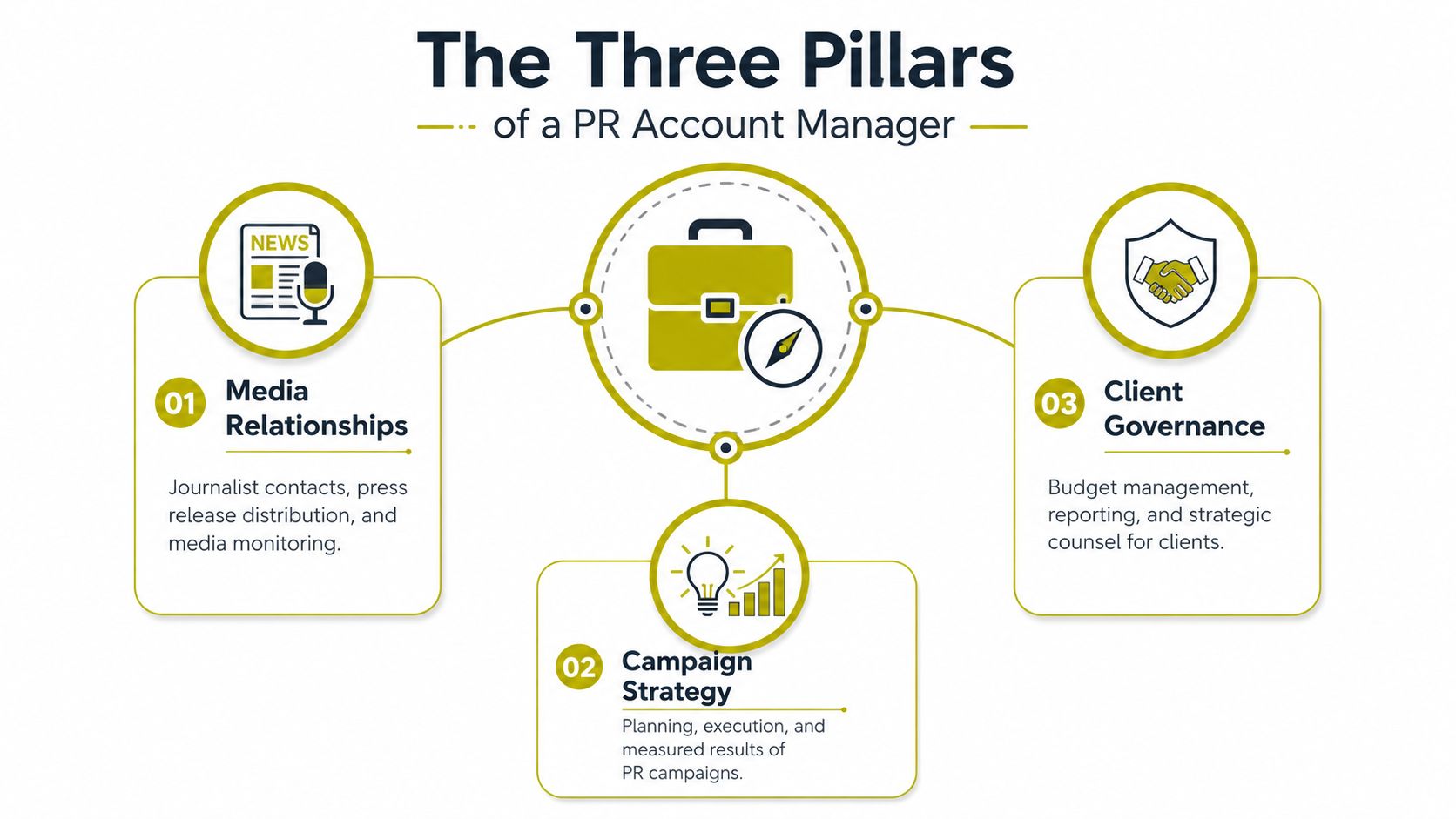
The cleanest way to understand the role is to break it into three working pillars. First, there is media relationship management. Second, there is campaign strategy. Third, there is client governance. Those areas overlap throughout the week, and account strength often depends on how well the manager moves between them without losing pace.
Media relationships are a live system
The account manager does not merely keep a contact list. They track journalist moves, identify the right beat owners, monitor news cycles, and know when a story is timely enough to land. Indeed's UK-facing career guidance says the role can include press releases, social media campaigns, advertising, spokesperson support, promotional and advertising campaigns online and in print, tracking data and metrics, and controlling crises and misinformation (Indeed career advice). That range matters because the role reaches across more than one channel and more than one asset type.
A strong manager also keeps a feedback loop running. Journalists react to relevance, speed, and clarity. Spokespeople need briefing. Clients need to know what the media are asking, what angles are resonating, and what has to change next time. When that loop is working, campaigns improve without wasted effort.
Strategy and governance keep the account alive
The campaign side is where business objectives get translated into something a newsroom can use. That means shaping angles, timing outreach, and deciding whether the best route is broadcast, print, online, podcast, or social. A LinkedIn public relations account manager posting for a senior role lists work such as leading client meetings, developing strategy documents, pitching across print, digital, podcast and broadcast, managing reporting, and maintaining media databases and contact lists (LinkedIn job posting).
That mix of strategy, delivery, and reporting is why operational discipline matters as much as ideas. In agencies with several live briefs, the pressure often sits in coordination, not creativity. A useful reference point for that side of the job is multi account management for agencies, because keeping multiple clients aligned can be harder than building the pitch itself.
The role also depends on judgment. A manager has to decide which stories deserve attention, which ones need to be parked, and which ones may create risk if they go out too early. That means weighing media interest against client appetite, then keeping the account moving without letting approvals or internal debate stall the work.
The best account managers keep one eye on the story and the other on the spreadsheet, because both affect whether the account renews.
A Week in the Life of a PR Account Manager
Monday usually starts with client calls, performance review, and a list of what changed over the weekend. A strong account manager checks coverage, reviews media reactions, and sets priorities before the rest of the team gets pulled into the week's noise. If a client has a product launch, a reputation issue, or a spokesperson appearance, that gets tightened early.
Midweek is where pace starts to bite
By Wednesday, pitching takes over. That is when the manager refines story angles, follows up on journalist interest, chases clearances, and updates spokespeople on what the media want. The work is part persuasion, part editing, and part logistics, because a late response can kill a good opportunity.
The pressure rises again when breaking news lands. In a live agency environment, the account manager has to judge whether the story helps, hurts, or changes the pitch list for the day. That judgement matters more than a polished template. The wrong instinct is to keep pushing the planned narrative no matter what the news agenda is doing.
By Friday, the account manager is usually shaping reporting, recapping action points, and making sure the client understands what happened, what it means, and what comes next. Reporting is not administrative padding. It is where the account proves whether the team is learning from the market and adjusting quickly enough to stay useful.
If the weekly recap doesn't change the next week's outreach, it isn't reporting, it's paperwork.
The rhythm never fully settles. Account managers keep one ear on newsroom shifts, one eye on client deadlines, and a third on the team's workload, because several accounts can move at once and all of them will think they are the priority.

Essential Skills That Separate Good From Great
A competent account manager can keep a campaign moving. A great one can see around corners, read the room with journalists, and protect client trust when a plan needs to change fast. That difference is usually visible in how they handle pressure, not in how well they write a press release.
News judgement and client control
The first skill is news judgement. Great managers understand what makes a story land, what makes it feel stale, and how to connect a brand message to something editors can use. They do not wait for a pitch to fail before they adjust the angle. They make the adjustment because they can already see the editorial mismatch.
The second skill is expectation management. A client may want instant coverage, a specific outlet, or a tidy monthly narrative. The account manager has to explain when the media cycle won't cooperate and when the briefing needs to be reframed. That is where seniority shows up, because clients usually stay calm when they feel the account is being steered with integrity.
Cross-channel work and measurement literacy
A strong manager also needs to move across broadcast, print, online, and social without treating each channel like a separate job. One story might start as a press release, become a spokesperson opportunity, then be adapted for a social content push. The point is not to multiply activity. The point is to create a coherent campaign that travels.
The last separator is data literacy. Teams increasingly need to discuss share of voice, website sessions, lead quality, and reputation change, not just clip volume. That doesn't mean turning PR into performance marketing. It does mean reading the numbers well enough to know whether the message is helping the business or just filling the archive.
For teams investing in training, training for PR teams is most useful when it includes media instincts, reporting discipline, and client communication, not just writing drills.
Salary Benchmarks and What Drives Variation
UK salary benchmarking for a public relations account manager suggests an average of £42,170 a year as of 24 April 2024, which works out at about £3,514 per month, £811 per week, or £20.84 per hour (UK salary data). The same dataset shows a £30,000 lower end and an upper end of £63,755, which is a wide spread for a role that can look similar on paper but vary sharply in reality.
What pushes salaries up
The pay difference usually reflects more than years in post. Senior account managers who handle larger client portfolios, tougher media environments, or team supervision bring more value because they are solving more complicated problems. Experience from national newsrooms or international brands also tends to matter, because those backgrounds usually sharpen judgement under pressure and make it easier to work at pace.
That range also makes commercial sense in a market where PR budgets have been rising and the work has become more measurable. Larger budgets mean larger expectations, and larger expectations reward people who can defend results, manage stakeholders, and keep the delivery team moving.
| Level | Annual Salary Range | Typical Responsibilities |
|---|---|---|
| Entry level | £30,000 to below the market average | Supporting outreach, maintaining lists, drafting collateral, learning reporting discipline |
| Mid-level account manager | Around the average of £42,170 | Owning day-to-day client contact, pitching media, shaping campaigns, reporting outcomes |
| Senior account manager | Above the average and into the upper range | Leading strategy, handling complex accounts, guiding junior staff, managing higher-stakes client governance |
| Senior leadership track | Up to £63,755 | Account growth, strategic counsel, cross-team coordination, performance responsibility |
Budgeting for this role is easier when the brief is clear. If the job needs crisis judgement, media relationships, and client management across several channels, the top end of the range starts to look more realistic than the middle.
Hiring In-House Versus Outsourcing to a Specialist Agency
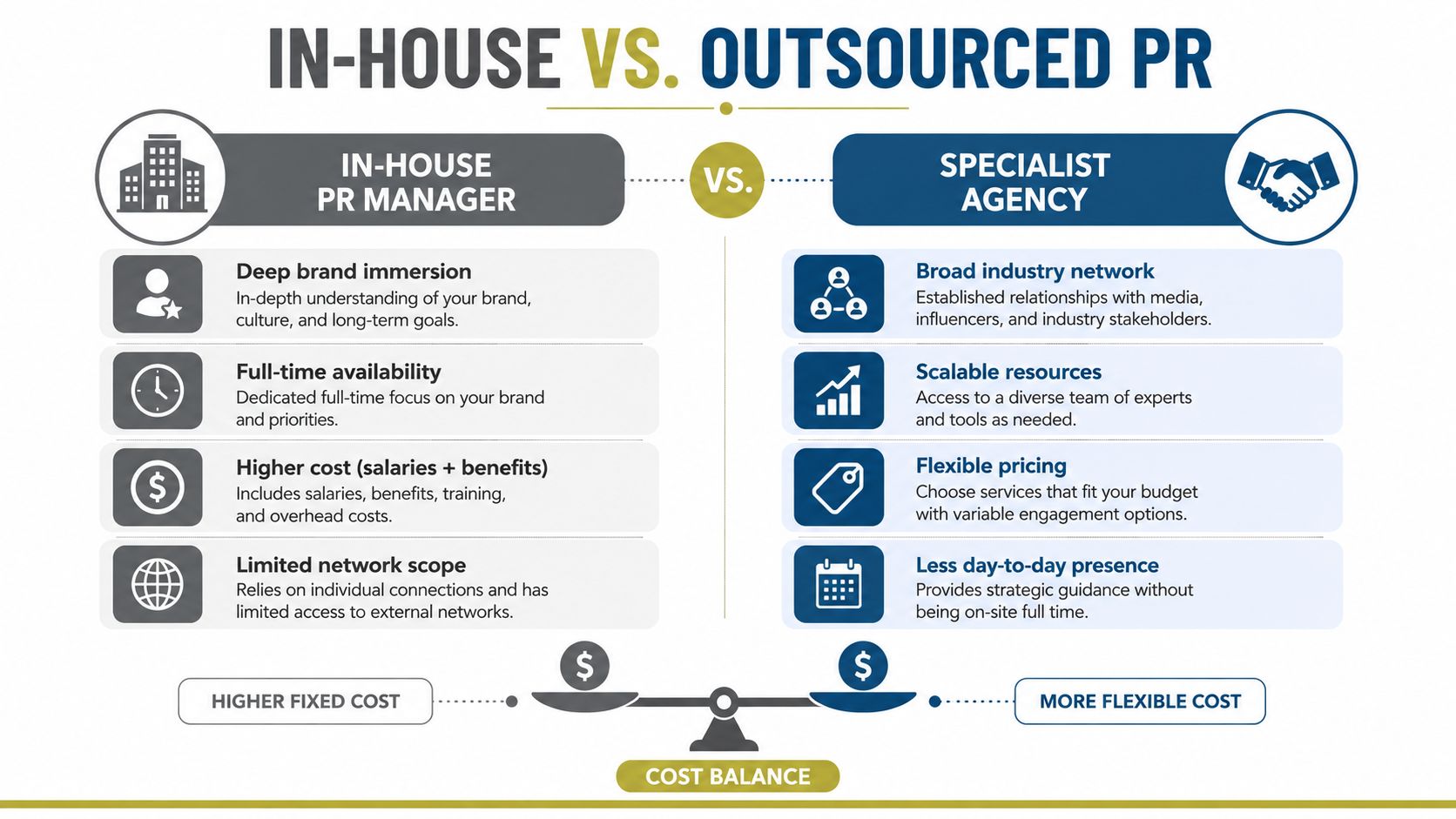
Hiring in-house gives you immersion. The account manager sits inside the business, hears internal nuance, and can respond without the lag of external onboarding. That works well when PR is constant, the message is complex, and the organisation needs someone embedded in day-to-day decision-making.
The trade-offs are not symmetrical
The cost side is straightforward. A full-time hire carries salary, benefits, management time, and the risk that the person's network is narrower than the brief requires. In-house teams can also become too close to the brand, which sometimes makes it harder to spot what journalists care about.
A specialist agency changes the equation. You buy access to broader media relationships, faster mobilisation, and a team structure that can scale up or down depending on the campaign. For SMEs, that can be more practical than paying for a permanent seat that may not be fully loaded every month.
Carlos Alba Media fits that specialist model well. Everyone on the team is either a former national news journalist or brings agency experience with international brands, so the work comes with newsroom fluency and senior-level counsel rather than junior account handling. That matters when the brief is about exposure, reputation, and speed, because the person shaping the pitch already understands how an editor thinks.
Choosing the right model
The wrong choice usually happens when founders hire for comfort instead of capability. If the work is mainly ongoing coordination, in-house can make sense. If the need is sharp positioning, credible media access, crisis readiness, and campaign support without adding overhead, an external specialist often gives a cleaner return.
For a straightforward explanation of the external model, what a public relations agency does is a useful reference point. It helps separate genuine strategic support from generic outsourcing.
If you need one person to sit inside the business, hire for proximity. If you need senior judgement and media reach, buy the expertise.
Interview Questions That Reveal True Capability
A strong interview for this role should test judgement, not rehearsed polish. If the candidate only talks well about organisation and relationship-building, you still don't know whether they can lead an account when the news cycle turns or the client changes direction.
Questions that expose strategic thinking
Ask, “Tell me how you would turn a business objective into a media angle that an editor would use.” A strong answer should move from business goal to audience, then to timing, proof points, and media fit. Weak answers stay vague, generic, or slide straight into “we would send a press release”.
Ask, “What would you do if a planned campaign became irrelevant because breaking news took over?” Good candidates describe rapid reprioritisation, client communication, and a revised pitch route. Poor candidates sound attached to the original plan no matter what happens outside the office.
Ask, “How do you decide whether a client is getting value from PR?” Strong answers mention outcomes, quality of coverage, business relevance, and reporting cadence. Weak answers rely only on volume metrics or say they would “see what happens”.
What to listen for
You also want evidence that the candidate understands account ownership, not just task completion. If they can talk through media follow-up, client expectation management, and cross-channel coordination in one coherent example, that is a strong sign. If they keep separating strategy from delivery, they probably haven't carried enough responsibility yet.
For teams building their interview process, interview scenarios for better hires is a useful complement because scenario-based prompts usually reveal how candidates think when the answer isn't scripted.
Strong candidates describe decisions, trade-offs, and consequences. Weak candidates describe activity.
If you need a team that combines newsroom instinct, campaign discipline, and direct client counsel, Carlos Alba Media works across media exposure, crisis communications, and strategic PR delivery for brands that want more than generic account handling. Visit Carlos Alba Media to speak about a campaign, a difficult brief, or the kind of account support that moves reputation forward.