
You’ve built something good. The service is strong, customers stay, and the people who use it speak well of you. Yet outside your existing circle, hardly anyone knows your name.
That’s where many founders and SME leaders sit. They don’t have a product problem. They have a visibility problem, a credibility problem, or both. The market is noisy, journalists are busy, and most businesses sound interchangeable when they talk about themselves.
A public relations agency exists to close that gap. If you’re asking what is a public relations agency, the plain-English answer is this: it’s a specialist partner that helps a business become known, trusted and understood by the people who matter, including customers, investors, partners, regulators and the media.
Done properly, PR isn’t about firing out a press release and hoping for luck. It’s about knowing what makes a story stand up, what a newsroom will ignore, what a difficult headline can do to a sales pipeline, and how reputation gets built over time. That’s why a newsroom-informed approach matters so much.
From Invisible to Influential The Role of a PR Agency
A lot of businesses reach the same frustrating point. They’ve launched well, delivered good work, maybe even grown through referrals, but growth starts to stall because awareness hasn’t caught up with capability. The founder is still the one pitching, posting, chasing introductions and trying to explain why the company is different.
A PR agency steps into that gap and gives structure to reputation. It turns scattered messages into a clear public story. It helps a business show up in the right places, say the right things, and earn attention from people who wouldn’t otherwise notice.
For SMEs, that often starts with one hard truth. The market doesn’t reward the best business automatically. It notices the business people can recognise, remember and trust.
A strong reputation often reaches the room before the founder does.
The practical work behind that is less glamorous than people assume. It means deciding what qualifies as newsworthy, shaping comments that can survive scrutiny, preparing spokespeople properly, and building a cadence of visibility rather than a burst of noise. It also means understanding the difference between self-promotion and a real story.
If you want a clearer sense of one of the core disciplines behind this, Carlos Alba Media has a useful explanation of what media relations involves. That matters because PR isn’t just publicity. It’s the management of perception through credible channels.
Reputation before reach
The businesses that get the most from PR usually aren’t asking for “more exposure” in the abstract. They want specific outcomes. They want to be taken seriously in a competitive category. They want to look established when speaking to investors. They want customers to have heard of them before a sales call starts.
That’s the primary role of a PR agency. Not just to get you seen, but to help make being seen useful.
What a Public Relations Agency Actually Does
A founder gets a call from a journalist at 4:12pm. They need comment in 20 minutes. The issue touches the company’s sector, the stakes are public, and a weak answer will do more harm than saying nothing. That is the kind of moment that shows what a PR agency does.
The job is to prepare for that call before it happens, then handle it well when it does.
A public relations agency manages the stories, messages and media interactions that shape how a business is understood. In practical terms, that means media relations, message development, reputation management, crisis response, spokesperson coaching, content planning and campaign execution. The exact mix changes by client. The underlying work does not. Someone has to decide what is newsworthy, what proof supports it, who needs to hear it, and how to present it without hype.

Media relations is editorial work, not mass outreach
A lot of businesses still assume PR starts with a press release and a media list. That is outdated. Journalists are not waiting for generic announcements, and inbox volume alone has made lazy outreach easy to ignore.
Good media relations depends on editorial judgement. A newsroom-informed team knows how reporters assess a pitch under pressure. They know the difference between a real story, a comment opportunity, a data-led angle and a piece of internal company news that will not travel outside the business. That judgement matters more than volume.
Former national journalists bring a specific edge here. They know what an editor will challenge in the first ten seconds. They know which claims need evidence, which founders can handle a tough interview, and which angles belong with a trade title rather than a national news desk. That changes the work at every stage:
- Pitches are built for the recipient. The angle fits the journalist’s brief, timing and audience.
- Comments are filed fast. News opportunities close in minutes, not by the end of the week.
- Stories are assembled properly. Data, case studies, reaction and timing are shaped into something usable.
- Targets are chosen with care. Broadcast, national, local and trade media all work to different needs.
That is one reason strong agencies also understand how PR and social media work together. A good media story rarely lives in one place now. It needs to hold up in the article, on LinkedIn, in a sales conversation and on the company site.
Message discipline matters more than message volume
Many businesses have too much to say and no order to it. They want to talk about growth, innovation, culture, market leadership, customer care and funding at once. The result is predictable. Nothing sticks.
A PR agency sharpens the message until it can survive scrutiny. What is the strongest claim? What evidence proves it? Which audience matters first? What can a spokesperson say in plain English without sounding coached or slippery?
That work feeds into more than press coverage. It often shapes opinion articles, briefing notes, founder profiles, awards submissions, speaking abstracts and website copy. If the raw material is good, one strong argument can be adapted across multiple channels. This guide to content repurposing for agencies shows the logic well.
Reputation management includes the quiet work nobody sees
Some of the most valuable PR work happens before there is any publicity at all.
A good agency prepares holding statements, stress-tests likely risk areas, audits old messaging, and puts media protocols in place so the wrong person does not answer the wrong question at the wrong time. It also coaches spokespeople to stay clear, calm and accurate under pressure. That is not glamorous work. It saves businesses from avoidable damage.
If a company is writing its first serious response after a story has already broken, it is late.
Why newsroom experience changes the result
This is the difference many clients only notice after they have worked with both types of agency. Generalist PR can produce activity. Newsroom-informed PR produces angles that stand up outside the building.
At Carlos Alba Media, that perspective comes from former national journalists and agency operators who understand both sides of the exchange. The advantage is not insider mystique. It is better judgement. Stories get tested harder before they are pitched. Claims get tightened before a reporter can pick them apart. Opportunities are chosen based on what will earn credible coverage, not what looks busy in a monthly report.
That usually leads to simpler messaging, stronger interviews and coverage that carries weight.
PR vs Advertising vs Marketing Clarified
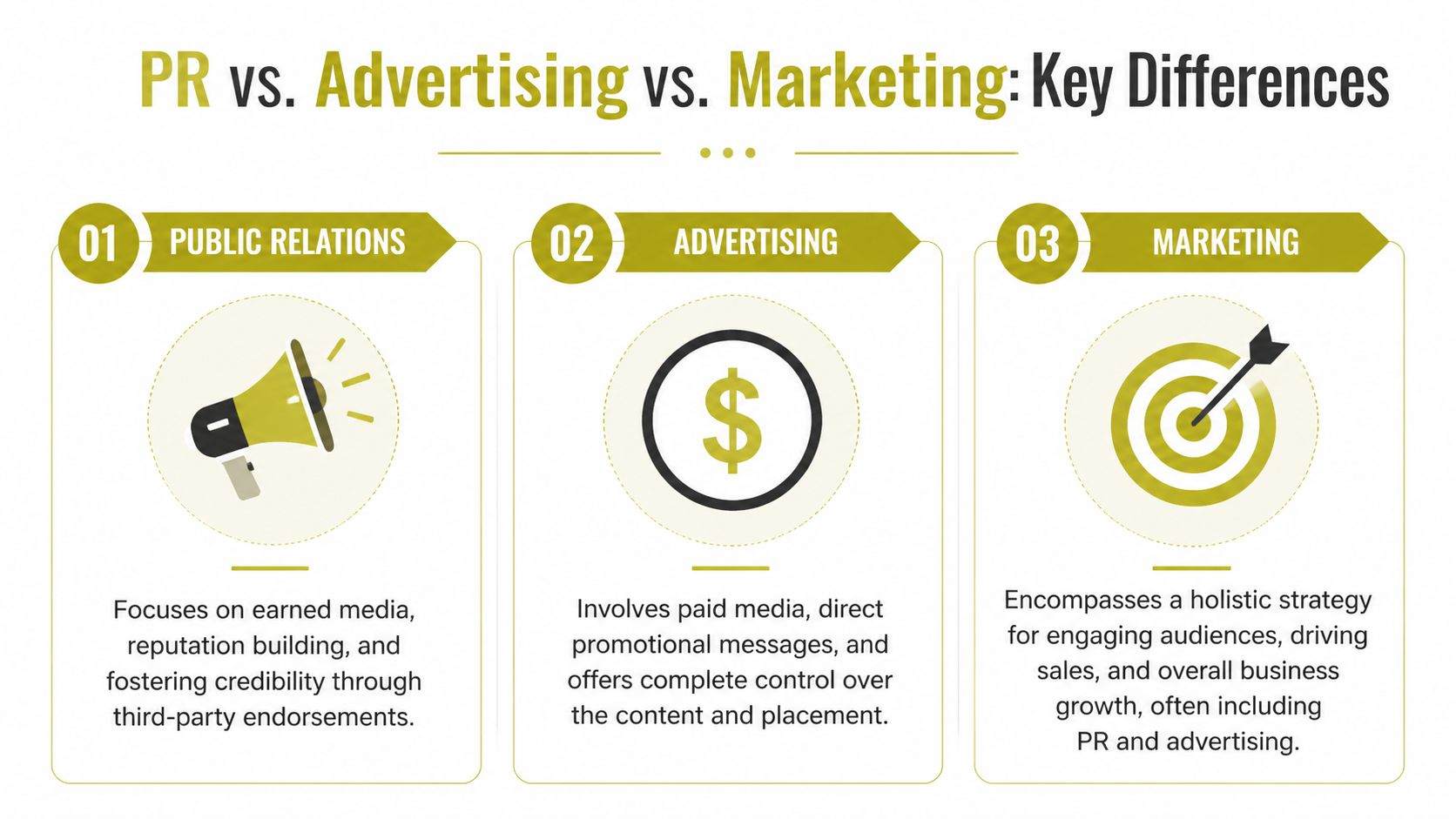
A lot of confusion comes from treating PR, advertising and marketing as interchangeable. They overlap, but they do different jobs.
The easiest way to understand the distinction is through earned, paid and owned media.
- PR is earned media. A journalist, producer or editor decides your story is worth covering.
- Advertising is paid media. You buy the placement and control the message.
- Marketing often centres on owned media. Your website, email, blog, landing pages and brand channels carry the message directly.
The practical difference
Advertising is useful when you need control. You can choose the wording, the timing, the creative and the audience settings. If you have an offer to push or a campaign window to hit, paid media can do that cleanly.
Marketing is broader. It covers the systems that attract, convert and retain attention over time. Brand positioning, email journeys, website conversion, social content and search visibility usually sit here. Businesses that want PR to work harder also need their owned channels in order, especially where PR and social media need to support each other.
PR works differently because you don’t control the final output. That’s also why it carries weight. If a credible third party chooses to feature you, quote you or ask for your view, audiences read that differently from a message you paid to place yourself.
PR vs Advertising vs Marketing
| Criterion | Public Relations (Earned Media) | Advertising (Paid Media) | Marketing (Owned Media) |
|---|---|---|---|
| Primary aim | Build reputation and credibility | Drive promotion with full message control | Support growth across channels |
| Who controls the message | Journalist or outlet shapes final coverage | Brand controls copy and placement | Brand controls its own channels |
| How attention is won | Through relevance, timing and story value | Through budget and targeting | Through content, distribution and consistency |
| Audience perception | Often seen as more credible | Clearly promotional | Depends on quality and trust already built |
| Best use case | Authority, visibility, trust, issue response | Launches, offers, direct response | Education, nurturing, conversion support |
If advertising says, “we’re good”, PR is someone else saying, “they’re worth paying attention to”.
The strongest businesses usually use all three. They just don’t expect one discipline to do another’s job.
The Real Value of PR Tangible Business Outcomes
A founder walks into a sales meeting and the prospect already knows the company name. A candidate has looked the business up before the interview and found credible coverage, not an empty search page. An investor has seen the CEO quoted in a serious outlet and arrives with context instead of doubt.
That is where PR earns its keep.
If coverage only produced a stack of links, it would have limited value. What matters is what that visibility changes in the market. Good PR shortens trust-building. It gives commercial teams a warmer starting point, gives leadership more authority in public, and gives stakeholders independent signals that the business is active, credible and worth paying attention to.

Credibility has commercial value
Boards often ask for a straight line between coverage and revenue. That is a fair question, but PR rarely works like paid search. Its job is to improve the conditions around commercial decisions.
In practice, strong media work helps in four places:
- Sales: Prospects are less cold when they have already seen your business mentioned by a trusted outlet.
- Investment: Public visibility helps younger companies look more established and easier to understand.
- Partnerships: Third-party validation opens conversations that ignored outreach often does not.
- Hiring: Candidates judge reputation long before they reply to a recruiter.
The newsroom-informed difference matters here. Former journalists do not pitch vague brand messages and hope for coverage. They shape a story an editor can use, test whether it stands up to scrutiny, and know which detail will make a reporter call back rather than ignore the email. That usually leads to coverage with more weight, which is what moves business perception.
PR protects commercial value as well
Any agency can talk about exposure. The stronger ones also prepare for pressure.
Reputation problems rarely arrive in a tidy sequence. A complaint gets traction online. A clipped video loses context. A trade journalist calls before the internal team has agreed a line. In those moments, speed matters, but judgement matters more. The wrong quote can keep a minor issue alive for another news cycle.
Businesses in regulated sectors, hospitality, tourism, professional services and founder-led brands feel this especially hard because public trust affects revenue directly. Preparation makes a measurable difference. Clear holding statements, agreed sign-off routes, media training and active monitoring reduce delay when time is of the essence.
That is why many firms start with public relation consulting services before they commit to a bigger programme. They need message discipline, scenario planning and someone who understands how a newsroom will read the story.
What measurable PR work looks like
Useful PR metrics are usually more commercial than vanity-led. The question is not whether a piece of coverage looked impressive in a monthly report. The question is whether it changed something that matters.
A good agency tracks signals such as:
- inbound enquiries after a campaign or announcement
- improved conversion rates because prospects already recognise the brand
- better quality speaking invitations or partnership approaches
- stronger share of voice around a category or issue
- faster, calmer handling of negative attention when it appears
I have seen a single well-placed national piece outperform weeks of generic outreach because it gave the business authority at exactly the right moment. I have also seen a trade feature deliver better leads than broader consumer coverage because the audience was closer to the buying decision. Reach matters. Relevance matters more.
Here’s a useful overview of how PR contributes to business performance in practice:
PR creates advantage when the story is right, the timing is right and the person shaping it understands how newsrooms make decisions.
When Should Your Business Hire a PR Agency
Not every business needs a retained PR agency from day one. Timing matters. The best moment to bring in PR is usually when visibility, scrutiny or change has started to outrun your internal capacity.
The clearest signs
If any of the situations below feel familiar, it’s usually time to get professional help.
- You’re launching something important: A product launch, venue opening, funding announcement or rebrand needs more than a social post and a few emails.
- You’re entering a new market: New geography means no existing reputation to lean on. PR helps build context and recognition quickly.
- You’re struggling to stand out: If competitors sound identical, sharper positioning and better storytelling become essential.
- You’re facing a reputational issue: Complaints, negative coverage, staff issues or online backlash need calm handling.
- You’re preparing for investment or acquisition conversations: Public credibility can shape how seriously the business is taken.
- Your founder has become the bottleneck: If every quote, interview and opportunity depends on one overstretched person, support is overdue.
When waiting costs more
Many SMEs hold off because PR feels like something for later, once the business is bigger. In reality, the cost of waiting often shows up as missed opportunities. A founder doesn’t reply to a media enquiry in time. A weak announcement gets no pickup. A local issue becomes a broader reputation problem because nobody owned the response.
PR is particularly useful at moments of compression, when several things are happening at once and the business needs external visibility without losing message control.
Hire a PR agency before the high-stakes moment if you can. During it if you must. After it is usually the most expensive option.
A simple test
Ask three questions.
- Do the right people know we exist?
- Do they understand why we matter?
- If scrutiny arrived tomorrow, are we ready to respond well?
If the answer to any of those is no, the case for PR is already there.
How to Choose the Right PR Partner for Your Business
The wrong PR agency can waste months. You’ll get activity, documents, meetings and coverage reports, but not much movement where it counts. The right one will ask sharper questions early, challenge weak assumptions and focus on outcomes rather than theatre.
That matters even more for SMEs because budget discipline is real. A 2024 PRCA industry report cited here found that 68% of UK SMEs cite high costs as a barrier to PR engagement, with full-service agency fees averaging £5,000-£15,000 monthly. The same source notes that boutique firms can deliver 30% higher ROI through targeted media networks without London-centric premiums.

Questions worth asking before you sign
Don’t start with “how many contacts do you have?” Start here instead.
- Who will work on the account? If the pitch is senior but delivery is handed down immediately, you need to know that.
- How do you decide what’s newsworthy? This reveals whether the agency understands story selection or just distribution.
- What happens if there’s bad news? Crisis process tells you a lot about maturity.
- How do you measure success? Look for business relevance, not vanity reporting.
- What sectors do you understand well enough to challenge us? Familiarity matters, especially in regulated industries.
- How quickly can you turn around comment or a statement? Speed is a capability, not a slogan.
Retainer or project
There isn’t one right model.
A retainer tends to suit businesses with ongoing news flow, active leadership teams, regular announcements or sustained reputation goals. It gives continuity, better planning and faster response because the agency already knows the business.
A project engagement makes sense for defined moments such as a launch, event, campaign burst, funding round or issue response. It’s narrower, but it can work well if the objective is specific and time-bound.
What the newsroom-informed difference looks like
The biggest distinction often comes down to judgement. Former journalists don’t just know people in the media. They know how editors think, what weak evidence looks like, how quickly a quote can unravel and why some stories die in conference while others run.
That’s why specialist consultancies often outperform larger, slower structures for founder-led businesses. You’re not paying for layers. You’re paying for decision-making, access and execution.
The strongest partner for an SME is usually one that offers direct senior counsel, can move quickly, and understands both editorial standards and commercial realities. That’s particularly relevant if you want support that spans media exposure, digital content, crisis handling and spokesperson preparation without paying for unnecessary overhead.
Choose the team that can explain your business clearly, challenge your assumptions without drama, and tell you candidly when something isn’t a story yet.
If you’re weighing up what a public relations agency should do for your business, Carlos Alba Media is one option to consider. The consultancy works across Glasgow and London, with former national journalists and agency practitioners supporting media relations, digital content, crisis communications and media training for SMEs, start-ups and established brands. A practical first conversation can usually tell you whether you need an ongoing PR partner, support around a specific launch, or clearer messaging before any outreach starts.