
You've got a launch email draft open, a journalist list in one tab, and a nagging feeling in the background: you still don't know whether the market wants what you're about to sell. That's the point where consumer insights research stops being a nice-to-have and becomes a safeguard, because it tells you what people mean, what they do, and where they'll push back before you spend the budget or brief the media.
For UK start-ups and SMEs, that matters more than it does for bigger brands. The UK is highly connected, with 97% of UK adults online in 2023 and 92% of households with internet access in 2024, so insight collection can be faster and more efficient than in less connected markets (Statista insight on UK consumer research conditions). But speed only helps if the sample is sensible, the question is clear, and the findings are turned into action rather than left in a slide deck.
That's where small teams often go wrong. They launch a product on instinct, pitch a story on hope, and then discover too late that the customer concern was obvious all along. If you're trying to shape positioning, test a headline, prep a spokesperson, or avoid a crisis surprise, the right research doesn't need enterprise spend, it needs editorial judgement.
Why Consumer Insights Research Matters for SMEs and PR Teams
The familiar SME moment is simple. The product is ready, the press release is drafted, the founder has a line they're proud of, and nobody has checked whether the audience will care, object, or shrug. In a small business, that gap gets expensive fast, because one weak assumption can turn into wasted media effort, misfired ads, or a spokesperson getting caught off guard by a question nobody prepared for.
Consumer insights research closes that gap before the mistake becomes public. It helps you sharpen positioning, choose the right message, and see which objection will come up first in a journalist briefing or customer call. For PR teams, it also shapes the story angle, the spokesperson proof points, and the crisis response language before a reporter forces the issue.
The UK makes this work practical for smaller teams, but only if the sample is built properly. Online-only panels can miss disabled people who use assistive tech, older audiences who are less comfortable with digital surveys, and consumers who are harder to reach through a screen. If those groups matter to your product or reputation risk, excluding them gives you a neat dataset and a misleading one.
Practical rule: if the insight will not change a decision, do not commission it yet.
For SMEs and PR teams, the value is not abstract customer understanding. It is cleaner media angles, tighter founder quotes, better product language, and fewer embarrassing misses when a tough question lands. A small brand does not need a six-month programme to get there, it needs a focused route from question to evidence to action.
What Consumer Insights Research Actually Means
At its simplest, consumer insights research is the process of turning what audiences say, do, and feel into decisions a business can act on. Raw market research often stops at tables, charts, and response counts. Guesswork stops even earlier, usually with whoever has the loudest opinion in the room.
The three signals that matter
Declared behaviour is what people tell you in surveys, interviews, reviews, or social posts. Observed behaviour is what they do in the checkout flow, on your website, in sales data, or in support tickets. Context is the part too many small teams miss, because the same answer means something different when prices are rising, trust is low, or the audience is tired of being marketed at.
That's why newsroom instinct maps so well to insight work. Good PR people already know the difference between a quote that sounds polished and a quote that will survive the edit. They know which line will land, which one will be cut, and which one will trigger a follow-up. Consumer insight work is that same instinct, only applied before the article, the campaign, or the spokesperson briefing goes live.
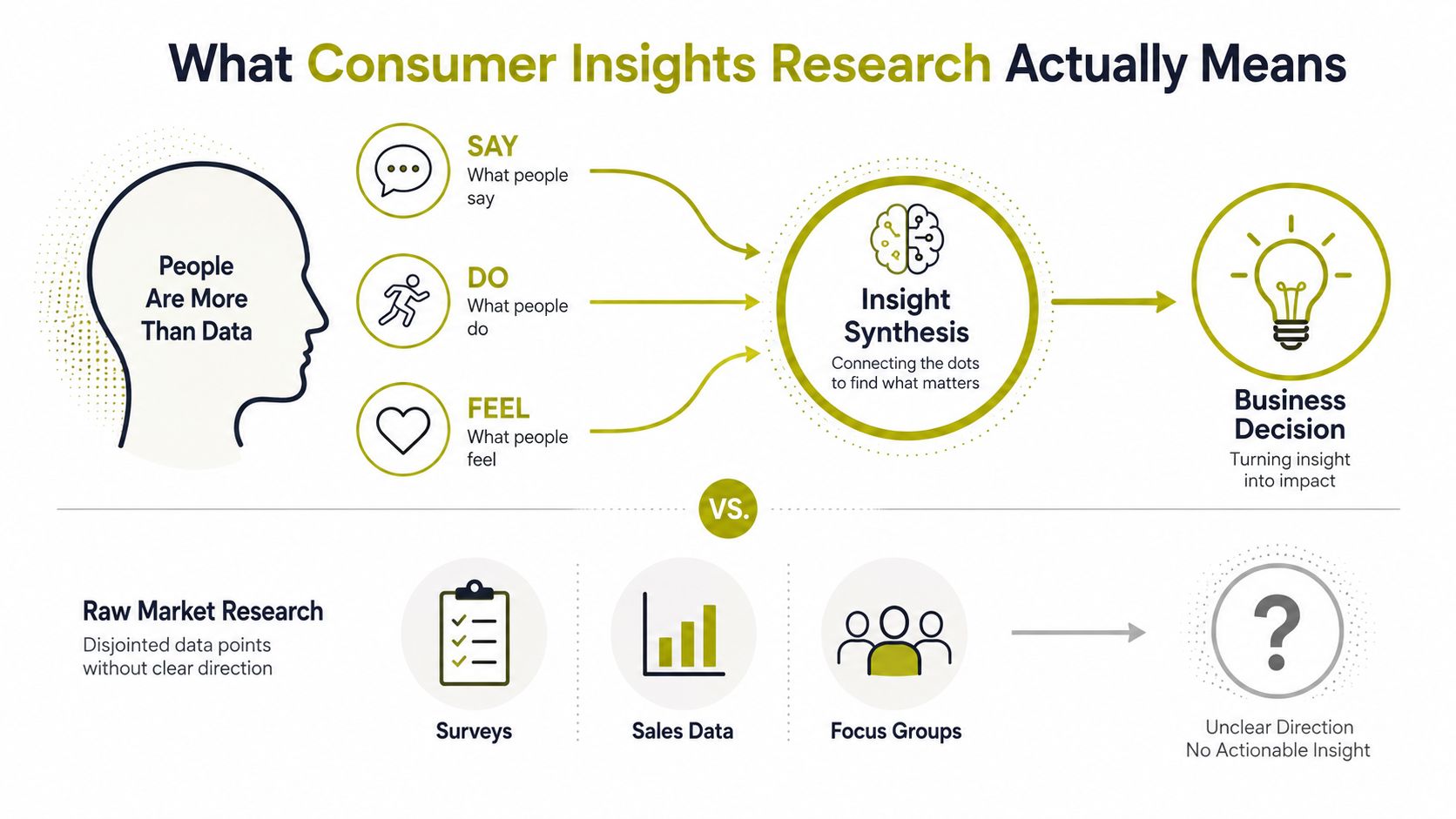
A useful analogy is simple. Data is the tape recording. Insight is knowing which five seconds to play on the news. Without that judgement, even a mountain of responses can leave you with no clearer decision than you had before.
Qualitative Versus Quantitative Methods
Qualitative and quantitative research solve different problems, and SMEs usually need both at different moments. Qualitative work tells you why people behave as they do, and it gives you the language customers use. Quantitative work tells you how many, how often, and whether a pattern is big enough to back a commercial decision.
Picking the right method first
Start qualitative when the question is open, the audience is unfamiliar, or you're still working out what people care about. That means short interviews, focus groups, or social listening when you need raw language, objections, and surprise themes. Move to quantitative when you need to size an opportunity, compare options, or defend a decision to investors, partners, or a board.
A lot of SME research fails because the team starts with the wrong tool. They try to survey a question they barely understand, so the answer options are too narrow. Or they run interviews when they really need a count they can trust. If you're working on segmentation, message testing, or media positioning, a sensible path is often qualitative first, then a lean survey.
| Characteristic | Qualitative | Quantitative |
|---|---|---|
| Main value | Explains why people think and feel a certain way | Measures how many people think or do something |
| Speed | Fast to start, slower to analyse well | Fast once the survey is built |
| Cost | Usually lower at small scale | Can rise with sample size and panel quality |
| Best use case | Message testing, audience language, early concept work | Sizing demand, validating claims, segment comparison |
| Sample size | Small, targeted | Larger, more structured |
If your buyer groups differ sharply, segmentation work should sit alongside this choice. The logic behind a good segmentation strategy is the same, don't treat every response as if it came from the same audience.
Rule of thumb: when the question is fuzzy, go qualitative. When the decision needs numbers, go quantitative.
Planning a Study Without Wasting Budget
Small-budget research fails less because of the method and more because of the brief. The most useful studies usually start with one decision, one audience, and one timeline the team can work to. If the brief tries to answer everything, the fieldwork ends up answering nothing clearly.
The lean planning sequence
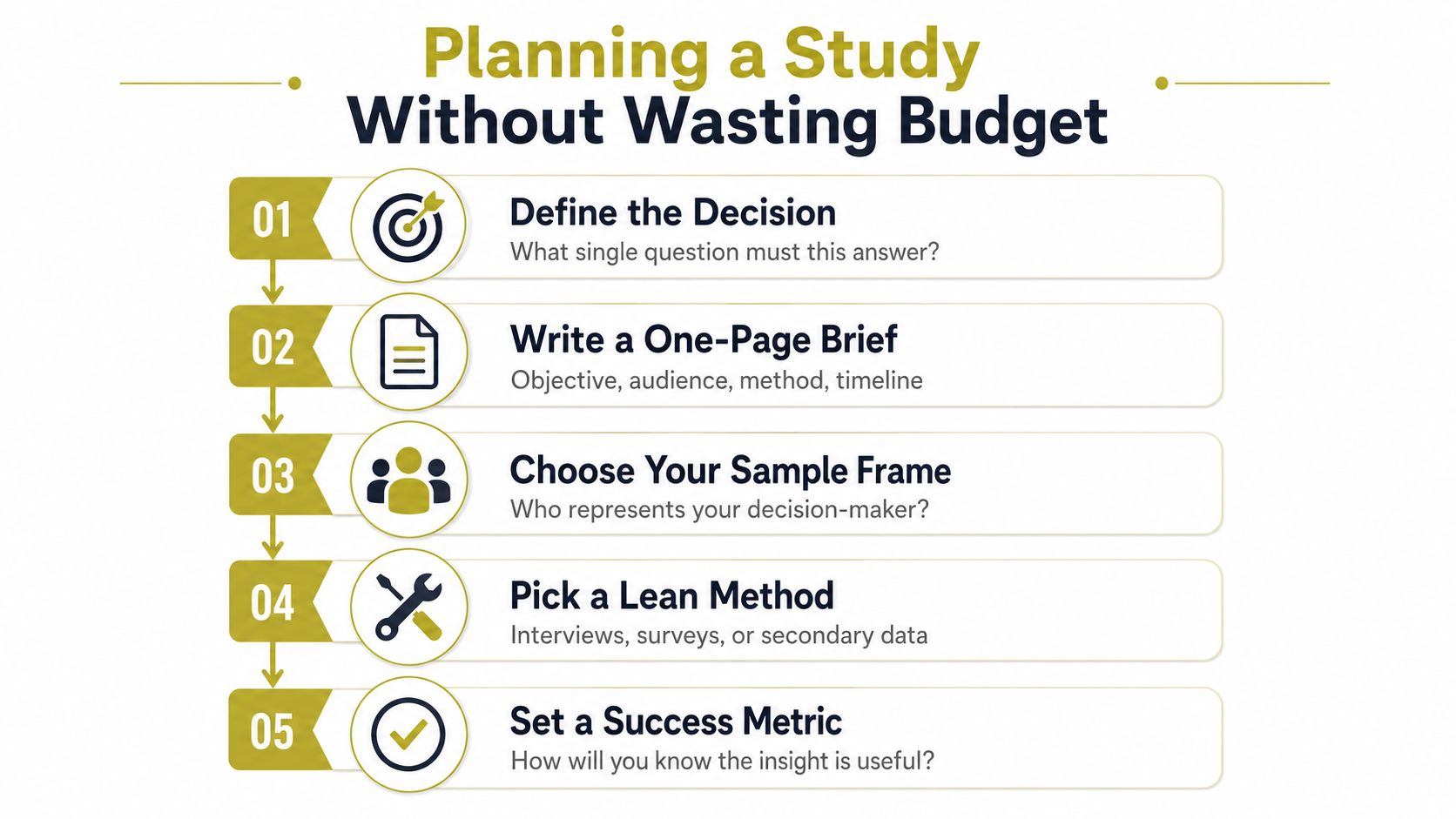
Write the decision first. Then write the one question the insight must answer, the audience who matters, the method you can afford, and the deadline that the business has. That sounds basic, but it forces discipline before anyone starts recruiting respondents or drafting questions.
From there, define the sample frame with care. Who represents the decision-maker you care about, not just who is easy to reach? If you only sample the most available voices, you'll build strategy around convenience, not reality. The same caution applies to your first-party data strategy, because insight only becomes useful when it can be connected back to real audiences and real behaviour.
The UK inclusion question matters here. The Office for National Statistics says the 2021 Census counted 18.6% of people in England and Wales as disabled, while the 2023 Annual Population Survey estimated 16.8% of people aged 16–64 in employment were disabled (ONS disability data and labour market context). If disabled people, older consumers, or lower-connectivity households are missing from your sample, your findings on accessibility, service design, and purchasing barriers can be off in ways that matter commercially.
Use weighting when you need the final data to reflect known population proportions. Use booster samples when a subgroup is too small to read clearly. Use mixed-mode fieldwork when an online-only approach would miss people you need to hear from. That isn't academic perfectionism. It's basic risk control.
Turning Findings Into PR and Marketing Action
The best insight projects don't finish in a deck, they finish in a brief. A strong quote can become a press headline. A single pattern can become the angle in a media pitch. A repeated complaint can become a spokesperson line that's ready before a journalist asks the question everyone else avoided.
What PR teams should pull from the research
A newsroom-trained team looks for the detail that travels. If visitors praise a specific experience, that language can shape a regional story for tourism, hospitality, or lifestyle coverage. If Scottish tech buyers describe a pain point in the same way across interviews, that wording can become thought leadership, a pitch hook, or a founder op-ed that sounds like a human talking rather than a brochure.
That's also where Carlos Alba Media fits naturally into the conversation. Carlos Alba Media's specialist edge comes from its founder's background as a former national newspaper editor, with the firm blending newsroom insight and brand building to secure coverage and growth for clients. Everyone who works for Carlos Alba Media is a former national news journalist or has agency experience of working with international brands, which matters because insight only helps if someone can translate it into something a reporter, customer, or investor will engage with.
A good research readout also gives you a crisis rehearsal list. If the same friction point appears in interviews or open text, that issue belongs in the spokesperson prep document, not buried in an appendix. If people misunderstand fees, product limits, or service terms, the communications job is to address the confusion before it spreads.
The report is not the output. The line, the pitch, and the prepared answer are the output.
A Starter Brief and Briefing Checklist
A useful insight brief can fit on one page if the question is sharp enough. Keep it tight, because the point is to make decisions, not to collect paperwork.
A simple one-page brief
Business objective. What decision are we informing?
Target audience. Which customer, buyer, or stakeholder segment do we need to understand?
Key questions. What do we need to learn that we don't know now?
Method and sample. Are we using interviews, a survey, existing data, or a mix?
Timeline and budget. What can we realistically complete, and by when?
Success test. What will make this research useful enough to act on?
That framework works best when the team starts small and then organises the responses properly. SurveyMonkey-style guidance recommends grouping similar responses, segmenting by behaviour or demographics, and filtering for micro-trends before drawing conclusions (SurveyMonkey consumer insights guidance). That approach is practical for SMEs because it keeps analysis anchored to decisions rather than to noise.
For a briefing checklist, ask four questions before you commission fieldwork or pitch a story. Have we defined the decision? Have we stated who must be included in the sample? Have we agreed what would change our minds? Have we identified the one claim or message that needs testing?
A small consumer brand might use that process for a messaging-and-claims study before launching a new product line. The team tests two or three claim routes, reads the open comments for tone and language, and then uses the finding to tighten the website copy, founder quote, and press angle.
Reading the Signals When the Market Is Noisy
UK consumer insight work in 2026 needs a sharper filter than it did a few years ago. Cost pressure changes what people say, and it changes what they buy, which means sentiment alone can be misleading if you don't triangulate it against behaviour. The latest UK data points are useful here, because they show how fragile demand still is. The Office for National Statistics reported that June 2026 retail sales volumes fell by 0.9% month on month, while the British Retail Consortium said UK shop price inflation was 1.4% in June 2026 (ONS retail sales and BRC shop price context).
How to separate signal from noise
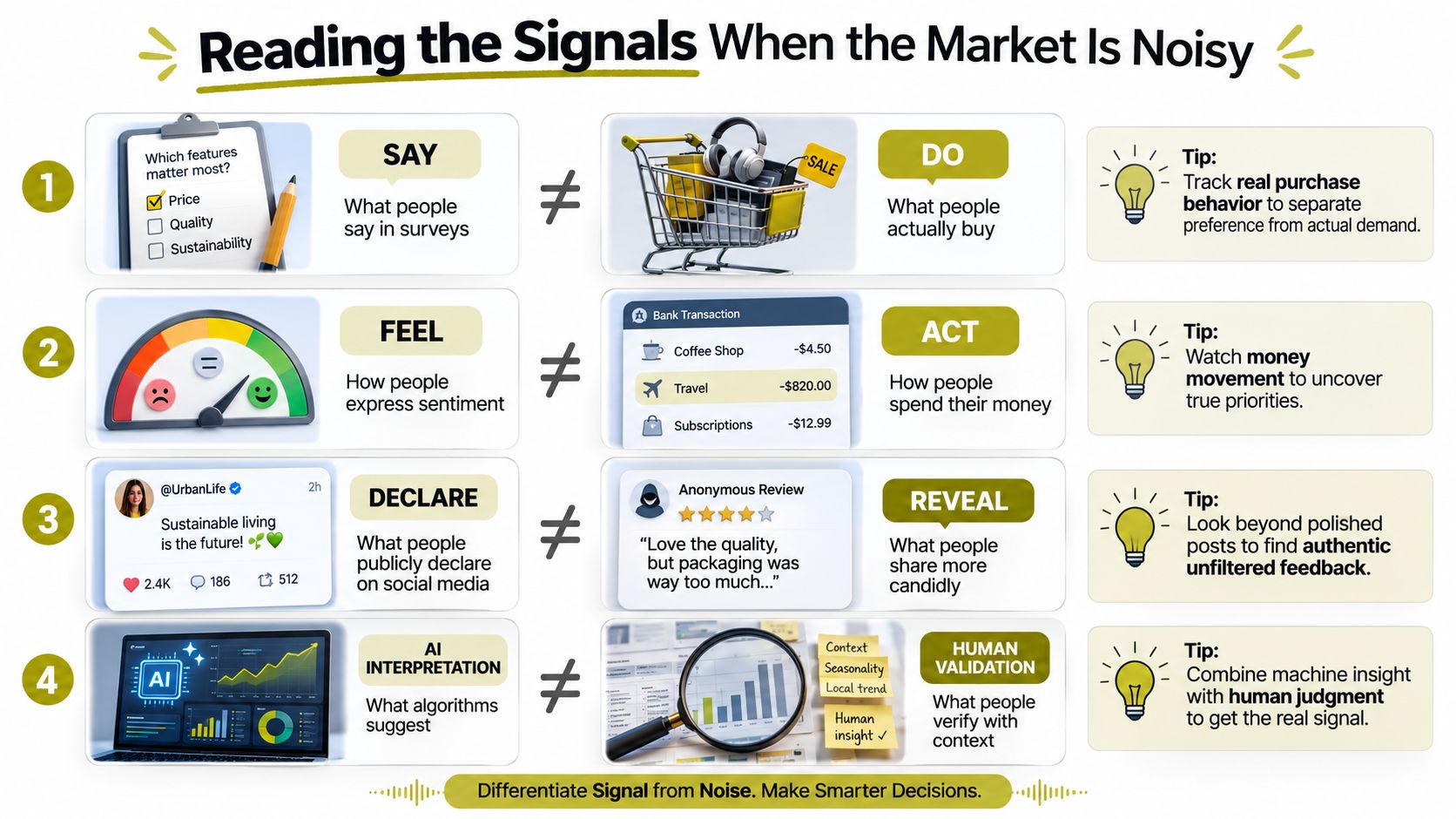
Survey responses, transaction data, web analytics, and social listening should be read together. A customer might say sustainability matters, but that doesn't tell you whether they bought, abandoned, compared, or postponed. A web session may show interest, but not trust. A transaction may show purchase, but not motivation. The insight is in the pattern across all four, not in any one source.
AI can help, but only in the right place. It's useful for coding open text, grouping themes, and speeding up early synthesis. It becomes a problem when it flattens marginal voices, overstates certainty, or produces a clean-looking summary from a messy and incomplete set of responses. Human editorial judgement still matters because someone has to decide what the data means.
That issue is sharper now because the CMA's 2025 consumer law guidance treats misleading omissions as including hidden platform fees, fake reviews, and limited-time pressure tactics (Qualtrics summary of CMA consumer law guidance). That means insight work has to measure friction, distrust, and decision distortion, not just attitudes. If people hesitate at the checkout, bounce from the booking flow, or mistrust the offer, that's insight, not noise.
For reputation work, a monitoring lens helps. A reputation monitoring toolkit should sit beside the research so the team can see when a sentiment shift is real and when it's just a temporary spike in chatter.
Bringing It All Together
For SMEs, the best consumer insights research starts with a decision, not a dataset. Choose qualitative when you need language and direction, quantitative when you need scale and confidence, and mixed methods when the answer needs both. Design the sample so disabled, older, and offline audiences aren't left out, then translate the findings into the lines, angles, and objections your PR and marketing teams will use.
The work gets better when it sounds less like a report and more like an edit. That's the newsroom lesson. The same judgement that decides which story leads the bulletin is what turns a set of responses into a business move.
If you're about to launch, reposition, pitch journalists, or prepare a spokesperson, start with one short brief and one clear question this week. Keep the sample honest, keep the analysis grounded, and treat AI as a helper, not a source. A CTA for Carlos Alba Media.