
Online news now reaches more UK adults than television does: 70% against 68% for television including on-demand services, according to Ofcom's 2025 News Consumption Survey. Linear broadcast on its own reaches 63%. That gap matters because most organisations still treat coverage as a single activity with a single price.
Coverage isn't one product. Print, broadcast, radio, online and social each reach a different share of the UK public, carry a different amount of trust, and survive a different amount of repackaging once published. Choosing between them is a decision about who you need to reach and what you need them to believe.
The method that works is unglamorous: pick a lead type, add one or two supporting types, and measure what came back.
Five Main Types of Media Coverage at a Glance
Media coverage is independent reporting of a business, a person or an issue by journalists and editors who answer to their own audience, not to the subject of the story. That independence is exactly why it works. A reader trusts a newspaper feature because the newspaper decided to run it, not because the company bought the space. Advertising is a message you control; coverage is a message someone else chose to publish.
Five types turn up in almost every UK campaign, and they behave nothing alike.
- Print covers national and regional newspapers, consumer magazines and trade titles. It's slow, considered, and read by people who picked up the title because of the subject.
- Broadcast means television news, current affairs, documentaries and morning shows, where one clip can make a business recognisable by lunchtime.
- Radio covers local and national stations, talk shows and phone-ins, and it's the most conversational of the five.
- Online covers news websites, newsbrand sites, blogs, trade portals and podcasts, and it's the only type that keeps working in search for years after publication.
- Social covers posts, short video and clips shared by outlets and creators, which is where distribution happens whether or not you planned for it.
Reach figures below are Ofcom's 2025 measurement of UK adult news use, which is also the source of the online-versus-television comparison above.
| Coverage Type | What It Includes | UK Reach for News | Best For |
|---|---|---|---|
| National and regional newspapers, magazines, trade titles | 19% of UK adults use print for news | Depth, authority and specialist readers | |
| Broadcast | TV news, current affairs, documentaries, morning shows | 68% including on-demand; 63% linear only | Shared visibility and mass moments |
| Radio | Local and national stations, talk shows, phone-ins | 37% of UK adults | Local audiences and spoken expertise |
| Online | News websites, newsbrand sites, blogs, podcasts | 70% of UK adults | Searchable, long-lived and mobile audiences |
| Social | Posts, short video, outlet and creator shares | Counted inside the 70% online figure, not measured separately | Fast distribution and younger audiences |
One story often runs through several rows at once. A distillery announcement might start as a trade print exclusive, get picked up by a newsbrand site, produce a ninety-second broadcast clip and end up as a creator's short video. Every hop changes the audience and strips out context.
The table is a starting point, not a plan. Use it to decide where to begin, then check how the UK media landscape has shifted before you commit budget to a single channel.
Who Each Coverage Type Reaches by Age
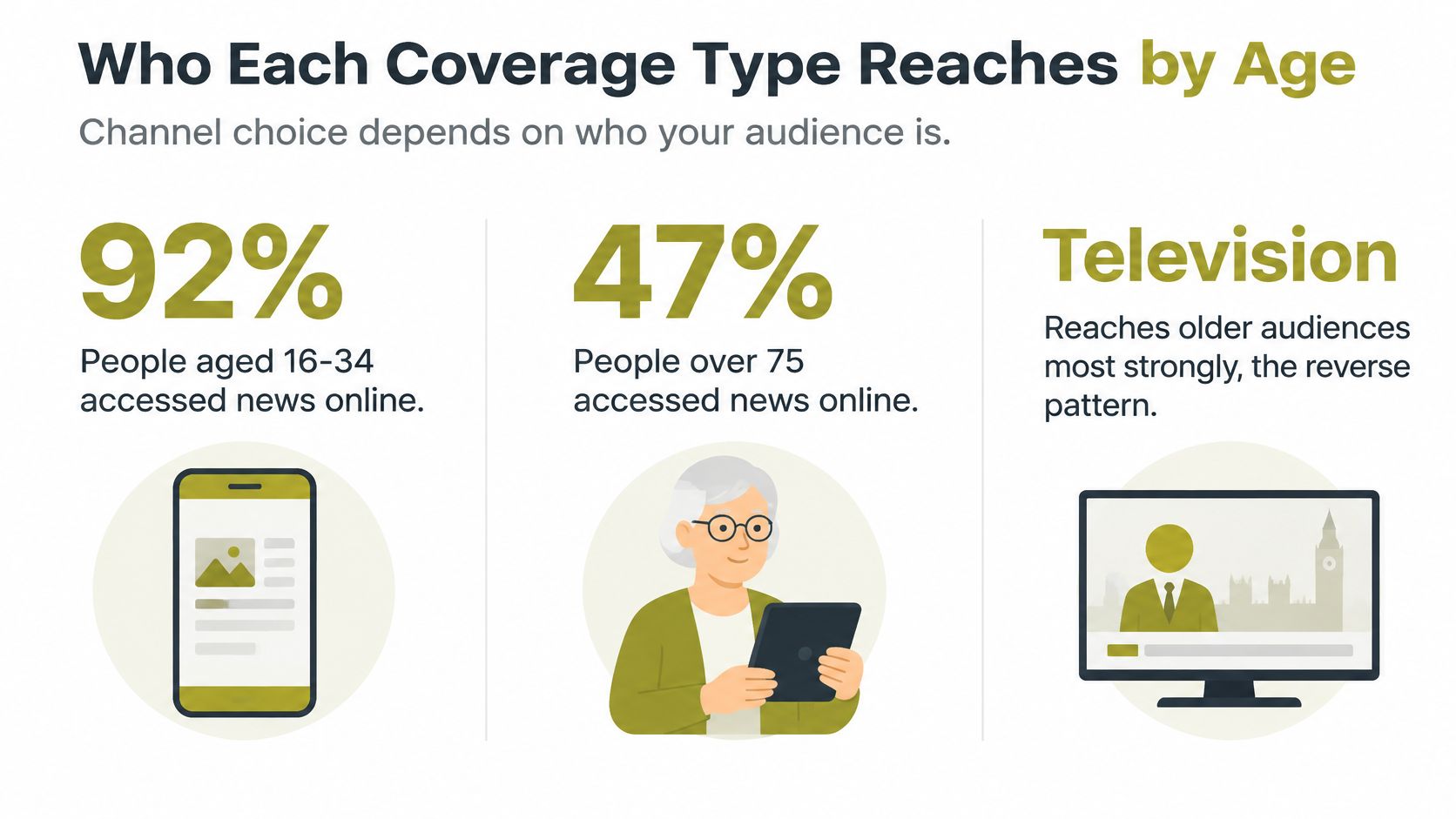
92% of people aged 16 to 34 accessed news online, against 47% of people over 75, according to Ofcom's media habits research. Television runs the opposite way: 90% of adults aged 75 and over used television for news, compared with 69% of 16 to 24 year olds.
That split is where campaigns fail without anyone noticing. A pitch can be well written and well timed and still reach nobody who buys, because it went to the channel the team finds easiest rather than the one the buyer really uses.
A minority of UK adults now get their news exclusively online, never touching broadcast or print at all. For those readers, a digital placement is the only version of your story that exists. Depending on who buys from you, that group is either a rounding error or the entire market, and you cannot know which until you look at your own customer base rather than at national averages.
A three-step way to read the numbers
- Identify the age and location of the buyers you need. The audience that signs off spending, not the audience you would enjoy reaching.
- Check which channels those people use for news. Ofcom's data splits cleanly by age, and the split is steep enough to overturn assumptions.
- Choose one lead coverage type and one support type. Two done properly beats five done thinly, because each additional channel dilutes the time you can spend tailoring the angle.
Two examples show how this lands in practice. A Scottish visitor attraction aiming at families should lead with television and regional radio for local reach, then support with family-focused online coverage, because parents plan days out on a phone. A fintech aiming at under-35s should invert that: online features lead, with a trade title adding credibility among the advisers and analysts who influence younger buyers. The trade-off is real in both cases. Television delivers a shared moment but the clip cannot be searched later. Online coverage stays findable for years but arrives without the authority halo of a broadcast appearance, so it has to work harder on proof.
Age is also only the first filter. Repackaging matters just as much: a story placed for a 50-year-old print reader will be clipped, shared and summarised for audiences well outside that group once platforms pick it up, so write the original piece to survive the journey.
The mix should follow the audience, not the channel your team finds easiest to pitch.
Before you map channels, get the target audience definition right, because a segment described as everyone between 25 and 65 will send you straight back to broadcast and social by default.
How Each Coverage Type Builds Trust
Reach tells you who saw it. Trust tells you whether they believed it. Overall trust in news in the UK sits at 35%, and the Reuters Institute's 2025 UK Digital News Report profile records the BBC, Channel 4, ITV and the Financial Times among the most trusted brands. That ranking is the practical reason a broadcast or national title placement still changes a conversation, even when its raw reach looks modest next to a viral post.
The cause and effect is simple. An established outlet's decision to run your story acts as a credibility signal, reducing the reader's sense that they might be getting sold something. Social coverage travels faster but lands with users who are more sceptical of news they meet on platforms, so it needs clearer provenance to do the same work.
| Coverage Type | Credibility Signal | Main Risk | Protective Step |
|---|---|---|---|
| Broadcast and national titles | Established editorial standards and brand trust | Lower reach for niche audiences | Pair with verified facts and a named spokesperson |
| Regional and trade print | Specialist authority with local or sector readers | Smaller readership | Choose titles that reach the buyers you need |
| Online news and newsbrand sites | Searchable, citable, subject to editorial review | Wide variation in quality | Check the publisher, author and corrections policy |
| Social and creator posts | Fast, peer-shared signal | Users are more sceptical and provenance is weak | Link to the original source and verify every claim |
For regulated sectors and crisis work, this changes the order of operations. The priority is authoritative correction and consistency across trusted outlets, not the number of social mentions you can generate. A hospitality group facing a rumour on social media should publish a statement on its own site, then have the local broadcaster and newspaper repeat it, so the correction carries the same credibility as the original claim. On the social side, FoPost's guidance on reputación de marca con FoPost is a useful reference for how quickly reputation moves on platforms.
Rate each coverage type by how much trust it carries with your audience before you decide where to pitch.
Earned, Owned and Paid Coverage Explained
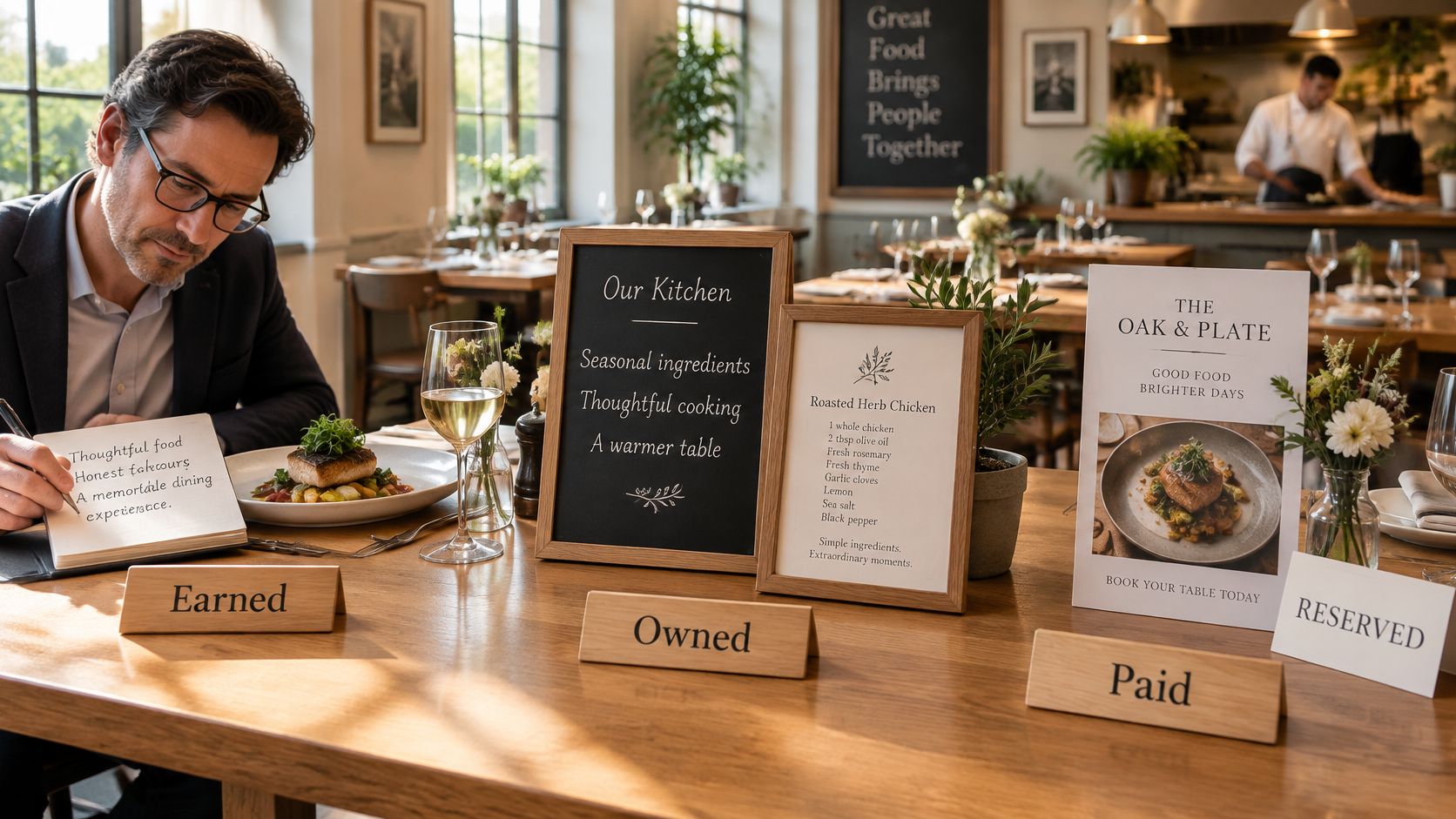
Think about a restaurant. A critic's review is earned coverage: someone else decided your food was worth writing about, and you had no say in the angle. The menu, the website and the photographs you publish are owned coverage, entirely under your control. The billboard outside the door is paid coverage, bought by the day and recognised as bought by passersby.
The trade-offs sit in three places.
- Earned coverage carries credibility you can't buy, but you don't control the timing or the angle. A journalist may sit on the story for three weeks and then lead with the detail you'd have buried.
- Owned coverage gives you full control and a stable reference page that journalists and search engines can cite. It won't persuade anyone on its own, because readers know you wrote it.
- Paid coverage offers speed and precise targeting, but it's clearly bought. It's excellent at making sure the right people see the earned story, and poor at convincing them the story is true.
The scale of the paid market is a reminder of how crowded that space is. UK advertising investment reached £46.7 billion in 2025, an increase of 6.4% year on year, according to the Advertising Association and WARC Expenditure Report. If you're buying attention, you're bidding against everyone else doing the same.
The three work best in sequence, not in competition. Say a Scottish distillery pitches a new cask to a travel and food desk and earns a feature. With the journalist's permission, the company republishes that feature on its own site as an owned page with the full facts and images. A paid social push then puts the story in front of visitors already planning a trip to the region. If you want the wider logic of how brand building and direct response divide the work, Adwave's explainer on brand vs performance marketing explained sets out the split clearly.
Owned content gives journalists accurate facts to work from. Paid support helps the earned story reach the audience it was written for. Neither replaces the other.
How Intermediaries Repackage Your Coverage
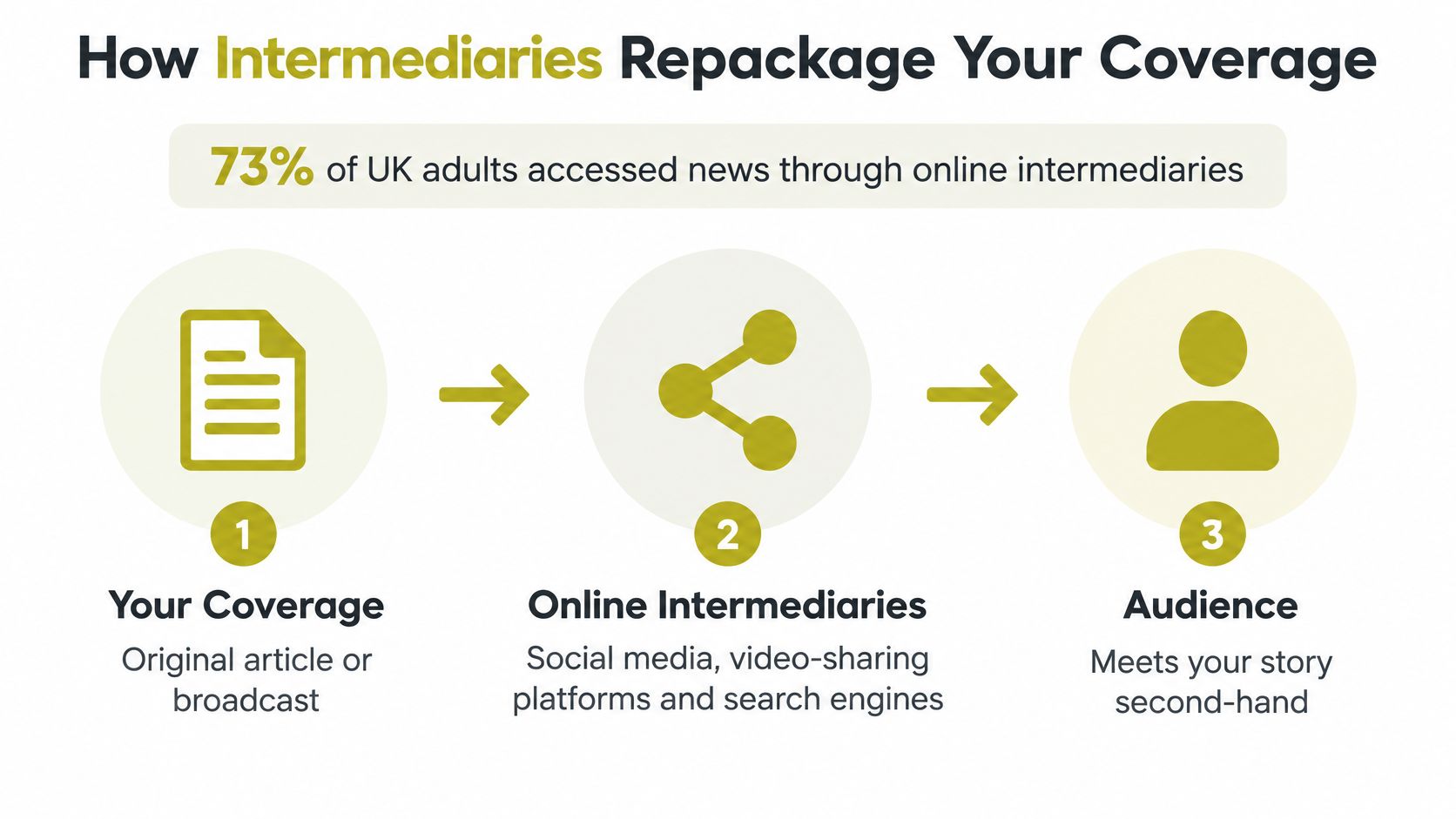
Many readers now encounter your coverage second-hand. Ofcom reported that 73% of UK adults accessed news through online intermediaries such as social media, video-sharing platforms, search engines, news aggregators or AI tools in 2026, and that adults encountered about 12 different news sources a month on average, rising to 18 among 25 to 34 year olds, per Ofcom's research on news and AI tools.
That changes what counts as effective coverage. A reader may see only an excerpt, a video clip, a search snippet, a creator's recommendation or an AI-generated summary. The original context collapses, and the old definitions, an article or a broadcast interview, miss the secondary distribution entirely.
The three stages a story now passes through
- Publisher. The original article, broadcast or interview is published, and readers may visit it in full.
- Intermediary. A platform, search engine, creator or AI tool extracts an excerpt, clip or summary. Readers may click through, save or share it.
- Audience. The reader forms a view from that fragment and acts on it, by searching for the brand, asking a colleague or making an enquiry.
Each stage hands the reader a different action. Your job is to make sure every fragment still carries the right facts.
What to prepare before you pitch
- Write a headline and standfirst that make sense on their own, without the rest of the article around them.
- Supply a clear image with a caption, because the picture often travels further than the words.
- Offer a quotable expert line that survives being lifted into a clip or a summary.
- Publish the key facts in a structured form on your own site, dated and attributed.
- Record short spokesperson clips, thirty to sixty seconds, so broadcast and social have something usable.
Accuracy is preserved by making that owned fact page the reference every intermediary can cite. When a summary gets a number wrong, you correct it at the source and link back to the page that carries the verified detail.
The goal is a portfolio of coverage formats, not a choice between traditional and digital PR.
Building a Coverage Mix for Each Goal
Start with the goal, then pick the lead type. The table below is the version I'd use in a planning meeting, because it forces a decision rather than a wish list.
| Goal | Lead Coverage | Support Coverage | Measure That Counts |
|---|---|---|---|
| Regulated or high-risk sector, crisis | Broadcast and national print for authoritative correction | Online and social for consistent follow-up | Accuracy and consistency across trusted outlets |
| Tourism, hospitality and lifestyle | Trusted editorial or broadcast endorsement | Visual social and searchable online coverage | Discoverable demand and visits |
| Start-up or tech SME | Online and trade coverage | Short social video and podcasts | Referral traffic and qualified enquiries |
| Founder or executive profile | Radio and broadcast interviews | Online features and social clips | Spokesperson reach and inbound approaches |
| Investor or regulator visibility | Trade and national print | Owned site and newsletter | Investor and regulator contact after publication |
The reasoning behind each row is consistent. Regulated and crisis work needs outlets whose authority can settle a question, so the trusted masthead or broadcaster leads and everything else repeats the same line. Tourism, hospitality and lifestyle brands gain most from endorsement followed by visual social and searchable online coverage, because the decision is emotional first and researched second. Start-ups and tech SMEs usually get further with online and trade coverage than with broadcast, then use short video and podcasts to reach the people who influence the buyers.
Weight the placements, don't count them
Raw volume misleads. Ten social mentions can be worth less than one accurate national feature. A practical score gives each placement separate values for verified prominence, source trust, audience relevance, message accuracy, referral activity and conversion contribution, then weights them according to the goal.
Say you're comparing three placements for a tourism client. A national travel feature scores 9 on trust and 8 on relevance but only 2 on referrals, because readers don't click through from print. A regional newsbrand piece scores 6, 9 and 5. A creator video scores 4, 7 and 8. If your goal is discoverable demand, the creator video earns its place as support, not as the lead, and the national feature does the credibility work the other two can't.
That's also why repurposing matters more than many people expect. Magic Genie's guide to repurposing one asset across channels shows how far a single interview or feature can travel when it's planned for multiple formats from the start.
The operational benchmark isn't how many people saw it. It's whether the placement reached the intended UK audience, transferred credibility, created discoverable demand and produced a measurable action. Get those four into an integrated campaign plan and the channel choice stops being a guess.
Confirm Your Coverage Mix Before You Pitch
A coverage mix fails. The pitch goes out, placements land, and only afterwards does anyone ask whether the right audience ever saw them. Four checks before the next launch prevent that, and none of them takes long.
- List the audience segments you need to reach and the news channels each one uses, using the age split as your filter rather than your instinct. A segment that reads regional newsbrands in print will never see a placement built for creator video, no matter how well it performs.
- Confirm a lead and a support type for your goal, from the goal table, and write down why each one earned its place. If you cannot justify the pairing in a sentence, the mix is a habit rather than a decision.
- Score three recent or planned placements against at least four weighted criteria, so you can see which type is carrying the message and which ones are padding the count.
- Log referrals and enquiries thirty days after publication, because the placements that feel biggest on the day are often not the ones that send customers. Print features build credibility that readers act on later, while social video spikes and fades within days.
A plan like this is easier to run with specialist help, and it is worth knowing what that help looks like. Carlos Alba Media runs a media exposure service that crafts and places news articles, features, interviews and focus articles in high circulation publications, and arranges appearances on national TV and radio. Everyone who works for the agency is a former national print or broadcast journalist, which is why pitches arrive written for editors rather than for brochures.
That background matters because of who sits on the other side of your pitch. According to the Reuters Institute's survey of UK journalists, 84% of UK journalists had a main employer from a legacy-media background, so the people receiving your pitch were trained inside those same newsrooms and recognise the difference immediately. A pitch written by someone who has commissioned stories reads differently from one written by someone who has only ever sent them.
If you are facing a communications challenge or a media crisis, the team offers a free consultation with one of its PR experts.
The decision in front of you is simple. Book the consultation, or run the checklist internally before the next launch. Just don't skip both.
Carlos Alba Media builds coverage mixes that match the audience you need rather than the channel that is easiest to pitch, combining print, broadcast, online and social placements with a media exposure service that puts your story in front of editors who choose what to run. If you want a second opinion on which type of media coverage should lead your next campaign, the team will map it against the UK audience data with you. Visit Carlos Alba Media to start that conversation.