
You're a founder, two minutes from a live radio interview. The holding statement on your tablet names a former employee and includes a figure nobody can trace to a source. The presenter wants a clear answer, your team wants reassurance, and you need to decide which words are safe to say.
When a Public Statement Becomes a Legal Risk
The immediate problem isn't presentation. It's whether the statement turns uncertainty into an accusation, discloses something private, or gives listeners a misleading account. Media law and ethics help you make those decisions before confidence in delivery makes an unsafe line sound authoritative.
Media law sets enforceable boundaries through legislation, court decisions and regulatory requirements. Ethics asks a wider question: even if you could defend these words legally, are they fair, necessary and proportionate? A lawyer might identify a possible defence while an editor still advises against publication.
Think of the rules as road markings. Ethics is how you drive in the wet, knowing other people could be hurt and cameras are recording.
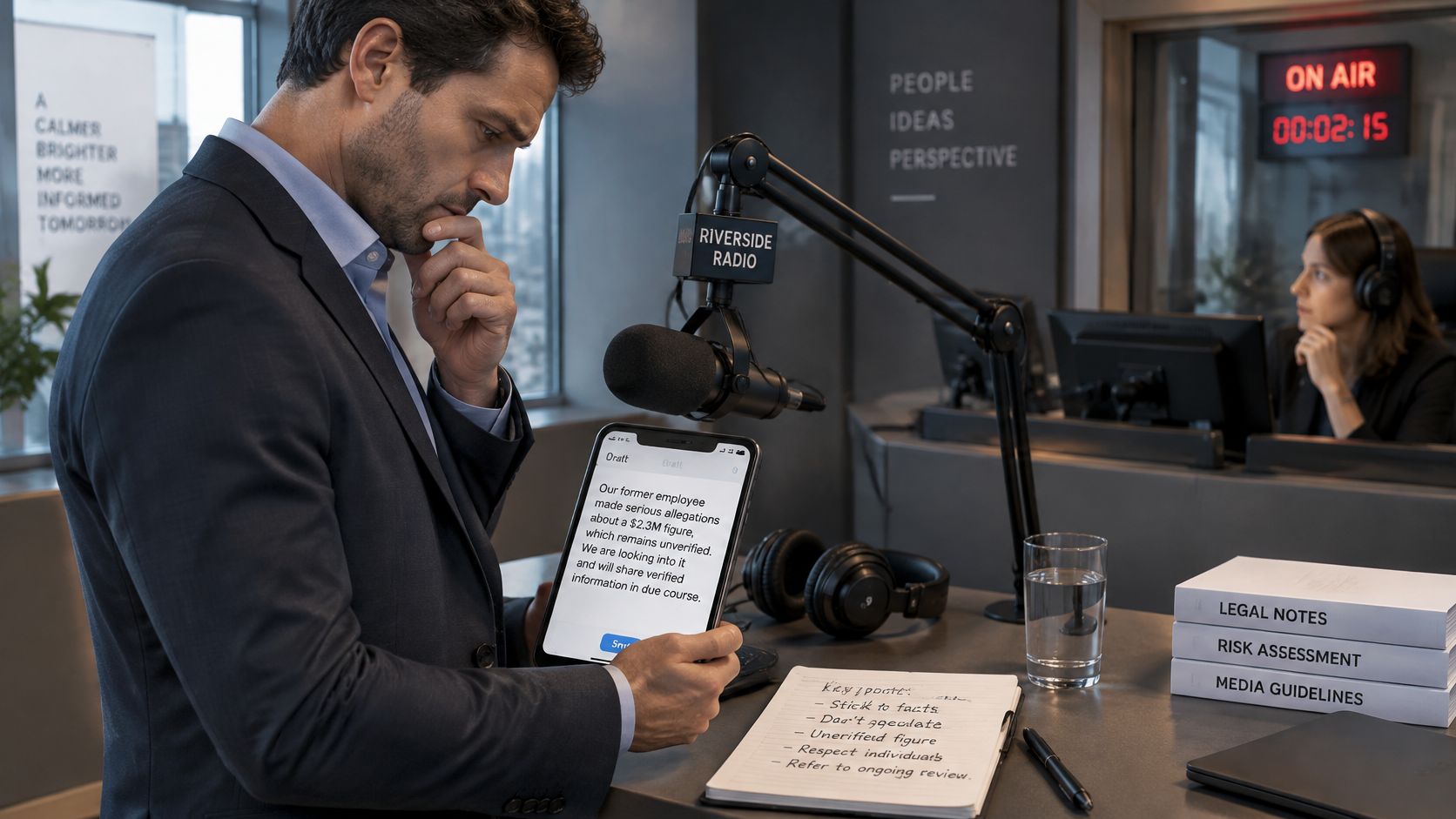
The microphone changes the stakes
A spokesperson's answer can become a broadcast clip, a newspaper quotation and a branded social post. Each publication needs its own judgement. Don't assume that a line approved for an internal email is suitable for a national interview.
Public challenge doesn't itself establish wrongdoing. Ofcom's account of broadcast complaints records more than 150,000 complaints in 2021, but complaints require assessment rather than automatic findings of a breach.
Before going live: Replace an unsupported assertion with a precise statement of what you know, what you're checking and what you can't responsibly disclose.
A practical legal crisis management approach connects editorial judgement with legal advice rather than treating them as competing priorities. That means recognising risks across broadcast, print, personal information, owned communities and synthetic content.
Tonight's preparation is straightforward: match the channel, test the claims and know when to stop. The interview deadline isn't a reason to publish an allegation you can't substantiate.
Which UK Rules Cover Your Statement
| Regime | Who it binds | Core duty | How it bites |
|---|---|---|---|
| Ofcom Broadcasting Code | Television and radio broadcasters, including programmes carrying arranged interviews | Harm and offence, due accuracy, due impartiality, fairness, privacy and commercial references | Audience complaints can lead to investigation |
| IPSO | More than 1,400 print titles; the FT, Guardian and Independent sit outside | Accuracy, privacy and harassment under the Editors' Code | Self-regulation since September 2014 after Leveson |
| ICO | Publishers and PR teams using personal data | Fair, necessary and proportionate use of personal information | A separate complaints route from Ofcom |
| Online Safety Act | In-scope providers of user-to-user and search services, potentially including hosted communities and livestream features | Protection from illegal content and extra duties where children are likely users | Risk assessment, records and moderation, not only takedown |
| Courts | Publishers, including brands and spokespeople | Defamation involving serious harm, and misuse of private information, subject to the applicable jurisdiction | Injunctions and damages can operate alongside regulatory processes |
Choose rows by where the statement will appear, not by your job title. A founder doesn't become exempt from publishing risks because they aren't a journalist. Equally, appearing on radio doesn't make the founder personally responsible for every obligation imposed on the broadcaster.
One incident can involve several routes
Say a Scottish technology company responds to an allegation about customer records. Its chief executive gives a radio interview, briefs a newspaper, publishes a customer email and opens a community discussion. The underlying incident is the same, but the editorial, personal-data and hosting decisions are different.
For television and radio, the broadcaster must consider the Broadcasting Code. Your communications team should anticipate those requirements when preparing evidence, describing commercial relationships or discussing disputed events. A producer's willingness to book an interview isn't clearance for every claim you intend to make.
Press regulation has a different history. The UK Parliament's account of press regulation describes the phone-hacking scandal, the Leveson Inquiry's conclusion that the Press Complaints Commission wasn't fit for purpose, and IPSO's establishment in September 2014; IPSO regulates more than 1,400 print titles, with the Financial Times, Guardian and Independent among the prominent exceptions.
That history explains the tension: editorial independence matters, but it doesn't remove accountability. Don't assume every newspaper belongs to the same complaints scheme. Check the publication's arrangements before deciding how to raise a concern.
According to IPSO's Annual Report 2025 announcement, it received 6,534 complaints and enquiries in 2025, and 68% of complaints it investigated led to a favourable outcome for complainants. That investigated-complaint measure isn't the proportion of all correspondence that resulted in an upheld complaint.
Don't confuse editorial oversight with legal clearance
The ICO concerns how personal information is handled, not just whether a programme was fair. Online safety duties concern in-scope services, not every business that buys advertising or maintains an account on somebody else's platform.
Court proceedings sit beside these routes. Defamation and privacy questions need advice suited to the facts and the relevant UK jurisdiction; a regulator's process isn't a substitute for that advice.
Before approving wording, tick every planned channel against the relevant row or rows. Record who owns each decision, including the broadcaster or publisher where their obligations are involved.
Two Tests Before You Speak or Publish
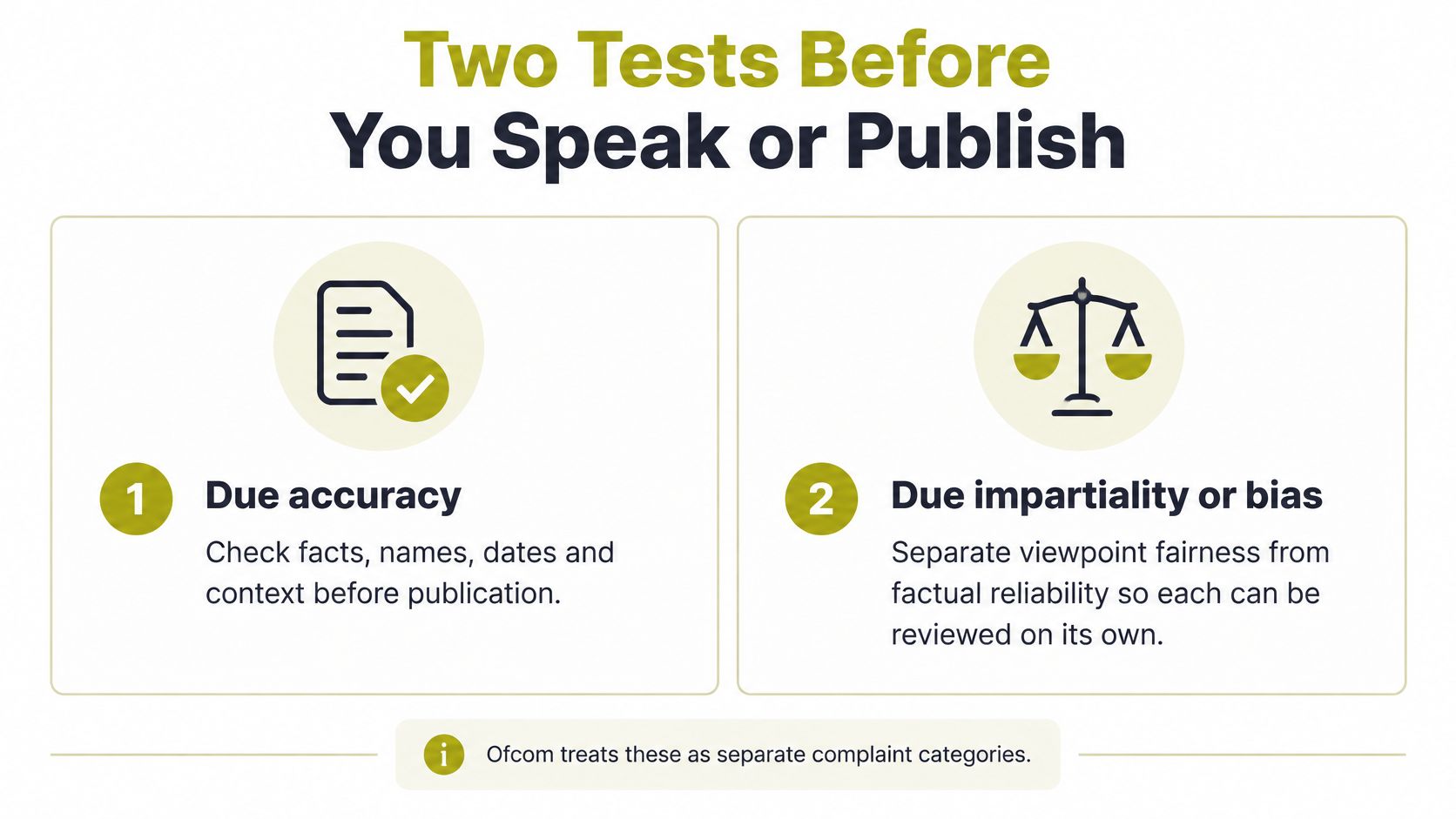
Accuracy and impartiality are separate tests. Accuracy works like a fact-check on each claim; impartiality works like a fairness check on the whole package. A statement can contain correct facts but present a disputed issue unfairly. It can also include opposing viewpoints while repeating an unsupported claim. Run both checks before the microphone goes live, then again before anything is published on owned channels.
An Ofcom disclosure covering GB News and GB News Radio from 4 December 2024 to 3 December 2025 logged 327 due-accuracy complaints and 374 due-impartiality/bias complaints. These are complaint counts, not findings that the broadcaster broke the rules. They show how audiences separate factual disputes from fairness disputes.
Run separate reviews
Correcting a factual error does not automatically fix unfair framing. Giving an opponent airtime does not make an unverified allegation reliable. For your organisation, these are useful editorial checks across channels, although not every channel carries the same impartiality duties as broadcast.
List every material claim. Attach a dated, attributable source to each assertion that could affect the audience's understanding. Use the original document, recording or accountable source where possible, not a colleague's recollection.
Label fact, allegation and opinion. An allegation remains an allegation even when someone influential repeats it. Check verbs carefully: saying someone caused a failure is different from saying an investigation is examining their involvement.
Review significant opposing views. On politically or publicly controversial subjects, identify whose account could materially change the audience's understanding. Fair representation requires judgement about relevance and weight, not mechanically giving every claim equal prominence.
Keep an evidence log. Record the proposed wording, supporting material, source date, verification owner and unresolved questions. An editor should be able to follow the reasoning without translating legal shorthand.
Escalate flagged lines. Give an independent reviewer the actual wording, not a reassuring summary of it. Include the headline, caption and proposed extract because those may create a different impression from the full statement.
Cut claims that fail verification. Do not hide a missing source behind vague attribution. If you cannot establish the basis for an assertion, remove it or state the uncertainty accurately.
Check the packaging too
Say your organisation says it resolved every customer complaint. The evidence shows only that it replied to every message. Changing the wording to describe replies fixes the factual problem. The fairness review still asks whether the statement conceals customers who remain dissatisfied.
For video teams, verification also needs a separate rights check. This copyright considerations for faceless video creators overview can help frame questions about reused footage and permissions, but confirm UK-specific rights with counsel rather than treating it as legal clearance.
A single legal glance is not enough. Ask whether the facts are supported and whether the presentation is fair.
Privacy Checks Before You Name Someone
A rushed holding statement names a junior employee because their name appears in an internal email. That may feel specific and transparent, but it can expose someone without helping the public understand what happened. The first question is why identification is necessary, not whether the name is already circulating.
Publishing personal information can raise accuracy, privacy, fairness and data-protection issues at the same time. The ICO's media-data complaints route is distinct from a complaint about broadcast standards, so an editorial decision may need more than one kind of review.
Write a publication-impact assessment
Keep a short decision record beside the draft. It should address:
- Purpose and public interest. Explain what naming the person contributes to public understanding. Curiosity, embarrassment and an organisation's wish to shift blame aren't sufficient editorial reasons.
- Source reliability. Identify who supplied the information, what supports it and whether the subject disputes it.
- Privacy and sensitivity. Consider the person's reasonable expectations, the setting in which information was gathered, and whether it concerns health, family life or a child.
- Necessity and proportionality. Ask whether a role description, anonymised account or narrower disclosure would achieve the same purpose.
- Opportunity to comment. Give the person a meaningful chance to address material allegations where appropriate, without disclosing unnecessary information about others.
- Correction and removal. Name the person authorised to amend the statement, contact publishers and assess a takedown request.
Public relevance isn't permission to disclose everything
A director's responsibility for a regulated firm's public decisions may justify identification in a carefully supported statement. Their home address or unrelated medical history usually adds intrusion rather than understanding. Even where a name is relevant, surrounding details need their own justification.
Consider identification indirectly too. A job title, photograph and workplace location may identify someone even when you omit their name. For a wider ethical perspective on routine collection and exposure, Vigil Security's discussion of AI surveillance in daily life offers a useful prompt to examine what people reasonably expect to remain private.
The ICO's 2025/26 annual report recorded 76,743 data-protection complaints, up from 42,315 in 2024/25. Those totals cover data protection broadly, not just media organisations.
Store the assessment with the evidence log, including rejected wording and the approval decision. If source reliability and privacy justification both fail, hold the release. Being allowed to publish a name isn't the same as needing to.
Online Safety Duties on Your Own Channels
The Online Safety Act isn't only a concern for household-name platforms. A smaller organisation operating its own community service may need to assess whether it falls within scope. But a branded account on a third-party social network doesn't automatically make the account holder the regulated provider.
The government's Online Safety Act collection sets out the framework: illegal-content duties applied to in-scope services from 17 March 2025, with additional child-protection duties from 25 July 2025, including highly effective age assurance for pornography and certain harmful content where applicable. Establish scope before buying tools or assuming every age-check requirement applies to your website.
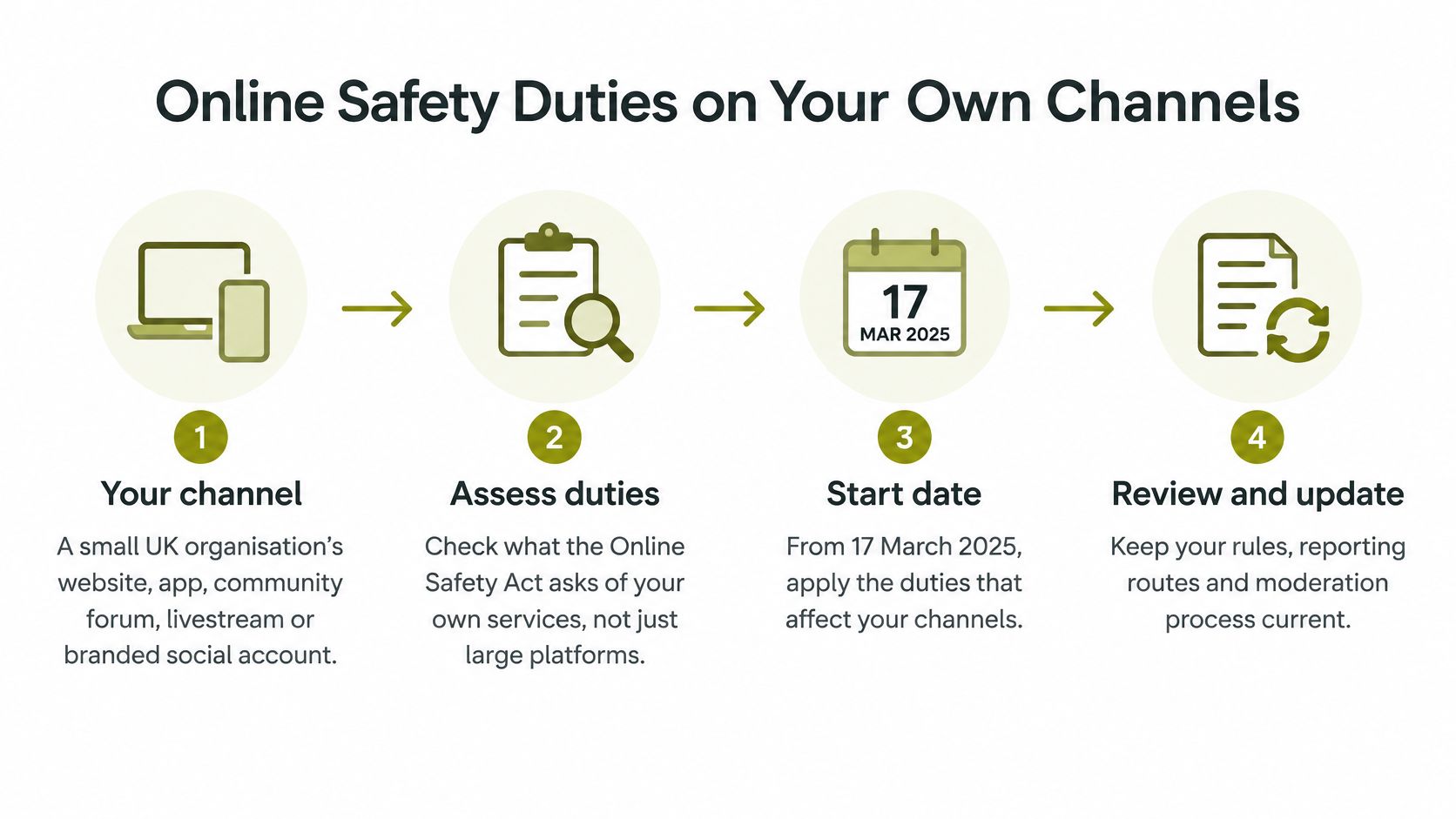
Give a small team a workable process
Say a Scottish tourism SME combines newspaper coverage, influencer posts and a customer community on its website. Its press release is editorial content; the customer discussion introduces a separate hosting question. The team needs to know who operates each feature and who can act when users report harm.
Map user contributions. List comments, messaging, uploads and livestream chat. Record whether users encounter one another's content and whether your organisation or an external provider operates the service.
Assess foreseeable risks. Write a practical risk note covering illegal content, credible threats and material children may encounter. Identify risky features, not just undesirable words.
Log moderation decisions. Record what users reported, what moderators reviewed and why content was removed or retained. Distinguish strong criticism of the business from potentially unlawful conduct.
Preserve evidence securely. Before removing a credible threat, retain the relevant material and context with restricted access. Escalate immediate danger appropriately rather than treating it as ordinary customer service.
Minimise age-check data. Where age assurance is required, assess what personal information the method processes and how to avoid collecting more than necessary. Apply data protection by design.
Escalate uncertain legality. Give moderators a named route to legal advice. They shouldn't have to decide a difficult question about threats or unlawful allegations from a phone notification.
Keep criticism separate from danger
A customer saying a tour was disappointing isn't the same as someone publishing another customer's address and encouraging harassment. Removing both under an undifferentiated negativity policy weakens your editorial judgement and makes decisions harder to defend.
A coherent social media reputation management process should connect public replies, moderation and escalation without confusing them. Keep the service's reporting route visible and make sure someone can act when the usual community manager is unavailable.
Good intentions don't replace records. A business that never intended to host harmful material still needs to explain the decisions it made when that material appeared.
Synthetic Media in Real Crisis Moments
An editor uses an AI tool to tidy a press note's grammar. A marketing team alters a spokesperson's video for another language. A campaign designer generates a photograph of an event that never happened. These aren't equivalent editorial decisions, even if everyone describes them as AI assistance.
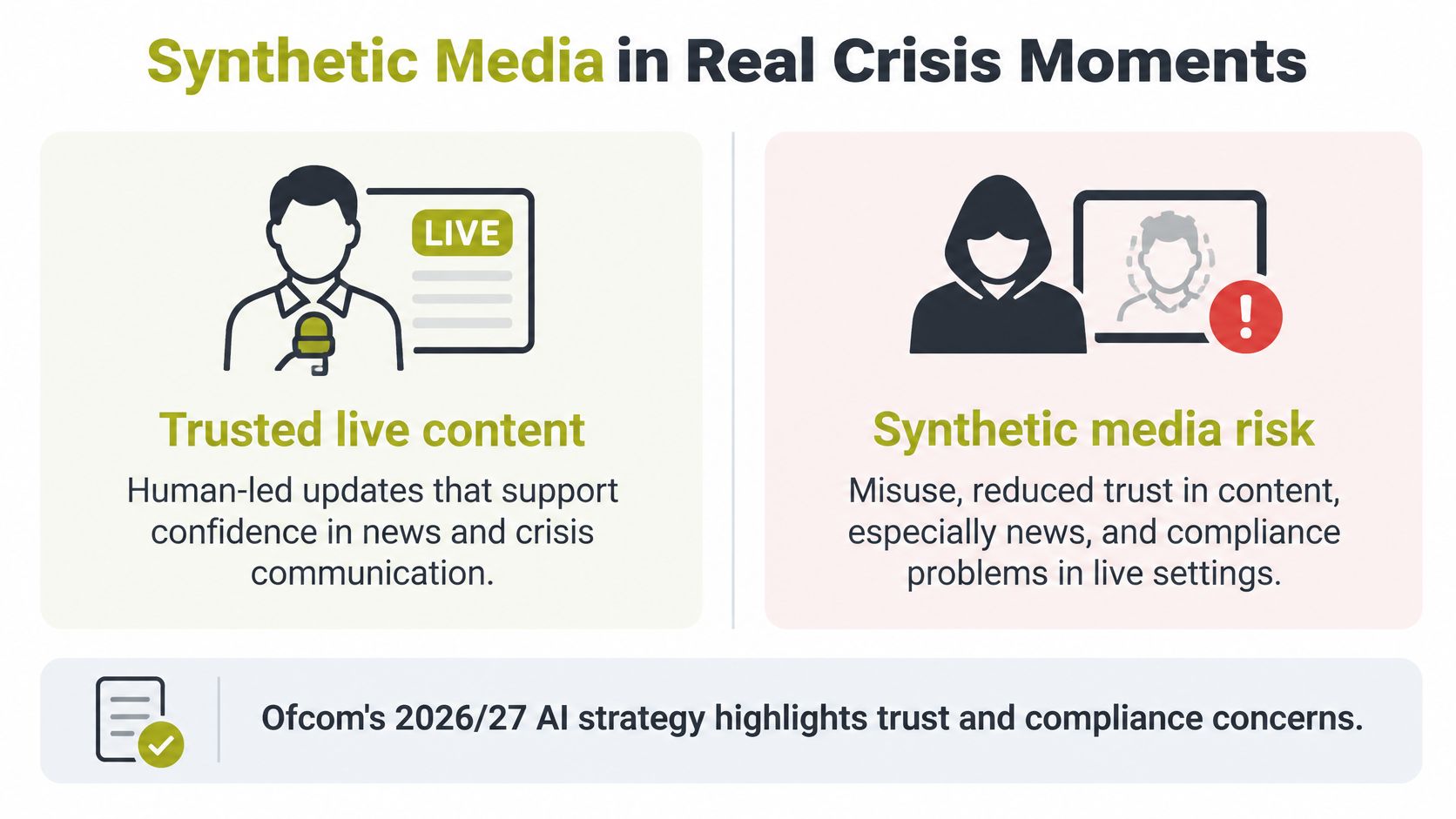
Ofcom's 2026/27 strategic approach to AI identifies synthetic-media risks including misuse, reduced trust in content, particularly news, and compliance and safeguarding challenges in live settings. The practical question is what the audience will believe the material proves.
Separate assistance from invented evidence
Low-risk production assistance might improve grammar or organise a draft. A human must still check every claim and quotation against the underlying material. Labelling every spelling adjustment as synthetic could distract audiences from alterations that affect meaning or identity.
Identity-sensitive material includes a cloned voice, altered spokesperson video or translated quotation presented as speech. Retain the source recording, prompts, approved translation and human sign-off. Disclose a material alteration where viewers will encounter it, not only in production notes.
If your team is considering tools such as the Synchronicity Labs dubbing platform, use the evaluation stage to decide who approves the wording and how viewers will recognise an altered performance. A production tool doesn't provide editorial authorisation to make someone appear to say something.
Factual fabrication is different again. A generated interview or reconstructed incident photograph shouldn't be presented as evidence of a real event. In crisis communications, don't publish fabricated documentary material just because you can add a label.
The tourism image that changes the story
Say a tourism brand generates a press image showing a crowd at a Scottish visitor site. The location exists, but the gathering doesn't. A journalist could reasonably interpret the image as evidence of attendance, popularity or conditions on the ground.
The ethical failure is the invented scene, not merely the software used to create it. A small disclosure won't necessarily undo the impression created by a realistic image, its timing and the surrounding press release.
Disclosure helps audiences understand an alteration. It doesn't make a misleading factual impression acceptable.
If synthetic material escapes, withdraw the asset, inform recipients of the changes made, and publish an authentic replacement where available. Do not substitute a new file without correcting the original claim.
Keep the incident log, distribution list and correction record. Before pitching broadcast or print, require a human to approve every number, quotation and identity-sensitive asset against authentic source material.
Prepare the Next Interview With Counsel Ready
Stop-rules: No evidence, no claim. No proportionate reason, no name. No human sign-off, no synthetic asset.
These rules belong in the briefing, not in a reminder whispered while the presenter introduces you. The spokesperson carries a clean speaking copy. The crisis lead holds the supporting records and knows who can authorise a change mid-interview.
Build the approval pack
Confirm distribution. Mark the relevant regime beside every intended outlet and owned channel, including the website statement, social extract and follow-up customer email, not only the interview.
Complete the editorial checks. Attach the claim log and record the accuracy and fairness decisions. Give the spokesperson approved wording for unresolved questions, so they never have to improvise certainty.
Resolve identification decisions. Where someone is identifiable, put the publication-impact assessment in the pack and state which details must stay out of spoken answers.
Assign community responsibility. If the response includes comments or a livestream, open the moderation record and name the person monitoring reports. Give that person an escalation contact with authority to decide.
Approve the actual assets. Review the final image, video, caption and quotation, not just the draft script. Reject fabricated evidence and check that disclosures survive cropping and sharing.
Put counsel within reach
Prepare the hostile questions, then practise answers that don't stretch past the evidence. Good executive interview preparation separates two things a nervous spokesperson tends to merge: a difficult answer you can substantiate and a reassuring answer you can't. Rehearse the first until it sounds calm.
The specialist basis at Carlos Alba Media is straightforward. Founder Carlos Alba is a multi award-winning former national newspaper editor, and all of the agency's consultants are former national print and broadcast journalists. That newsroom background shapes how a claim gets tested before it reaches a microphone.
The 24/7 Media Crisis Management service provides immediate strategic guidance to contain, control and counteract negative publicity, working alongside some of the UK's top media lawyers to safeguard the client's legal position. Editorial preparation and legal review should inform the same release decision, not produce two versions that nobody reconciles.
When time is short, send the reviewer a usable pack: proposed wording, evidence, unresolved allegations, identification concerns and the publication deadline. Assign one person to consolidate changes and issue the approved version, so an obsolete draft doesn't reach the microphone.
Arrange that review before the next hostile approach, not after the clip is circulating. The aim isn't to script away every difficult question. It's to ensure the spokesperson knows what they can responsibly say, what needs qualification and what must remain unpublished.
Carlos Alba Media offers a free consultation with one of our public relations experts if you're facing a communications challenge or media crisis. Visit Carlos Alba Media to discuss your next interview or public statement and identify where newsroom judgement, preparation and legal counsel need to work together.