
It is 4.40pm on a Friday. A customer posts that your booking system took payment and then cancelled the slot. Within the hour the screenshot is on a local Facebook group, someone tags your founder, and a journalist you have never met sends a one-line message asking for comment before close of play. Your community manager wants a denial up in ten minutes. Your operations lead has not even opened the payment log.
That gap, between what the feed is saying and what you can prove, is where most reputational damage is done. Reputation management on social media is less about sounding calm and more about refusing to publish anything you have not checked.
Why Social Reputation Needs a Verification-First Approach
The Friday post is rarely the whole story. A second customer replies that the same thing happened last month. A third person, with no booking at all, adds a claim about a data breach. None of those additions has been checked, yet the thread now reads like a pattern. The team's first instinct is a short denial: "This is not true. Our systems are working normally." That sentence feels protective. It is usually the opposite.
UK audiences already discount what they see on these channels. In the 2018 Edelman Trust Barometer's UK findings, only 25% of people said they trusted social media as a source of news and information, while trust in business stood at 43%. A branded reply does not sit above that distrust. It sits inside it. If the denial later turns out to be half right, the correction has to fight both the original rumour and the memory of a company that spoke too soon.
The risk you inherit and the risk you create
There are two separate problems, and teams blur them under pressure.
Channel credibility. Platforms have spent years under criticism for extremism, fake news and bullying. A majority of UK respondents in that same Edelman work wanted greater regulation of social media companies. Your post inherits some of that scepticism before anyone reads the first line. Customers, regulators, investors and journalists may see the content quickly and still treat it as unverified.
Handling credibility. The second risk is yours alone. Deleting a fair complaint, arguing with a named customer, or issuing a polished statement with no evidence tells people how you behave when challenged. That conduct travels further than the original service fault.
Unsupported corporate assertions rarely repair credibility on a channel people already distrust. Evidence, a named owner and a consistent tone do more work than a faster denial.
Volume does not fix this. Extra posts, influencer quotes and a brighter graphic can look like noise when the underlying claim is still unchecked. The rest of this playbook follows one order: verify first, then respond, then document everything. Sentiment comes after you know whether the claim is true.
Setting Up a Monitoring Workflow for Social Channels
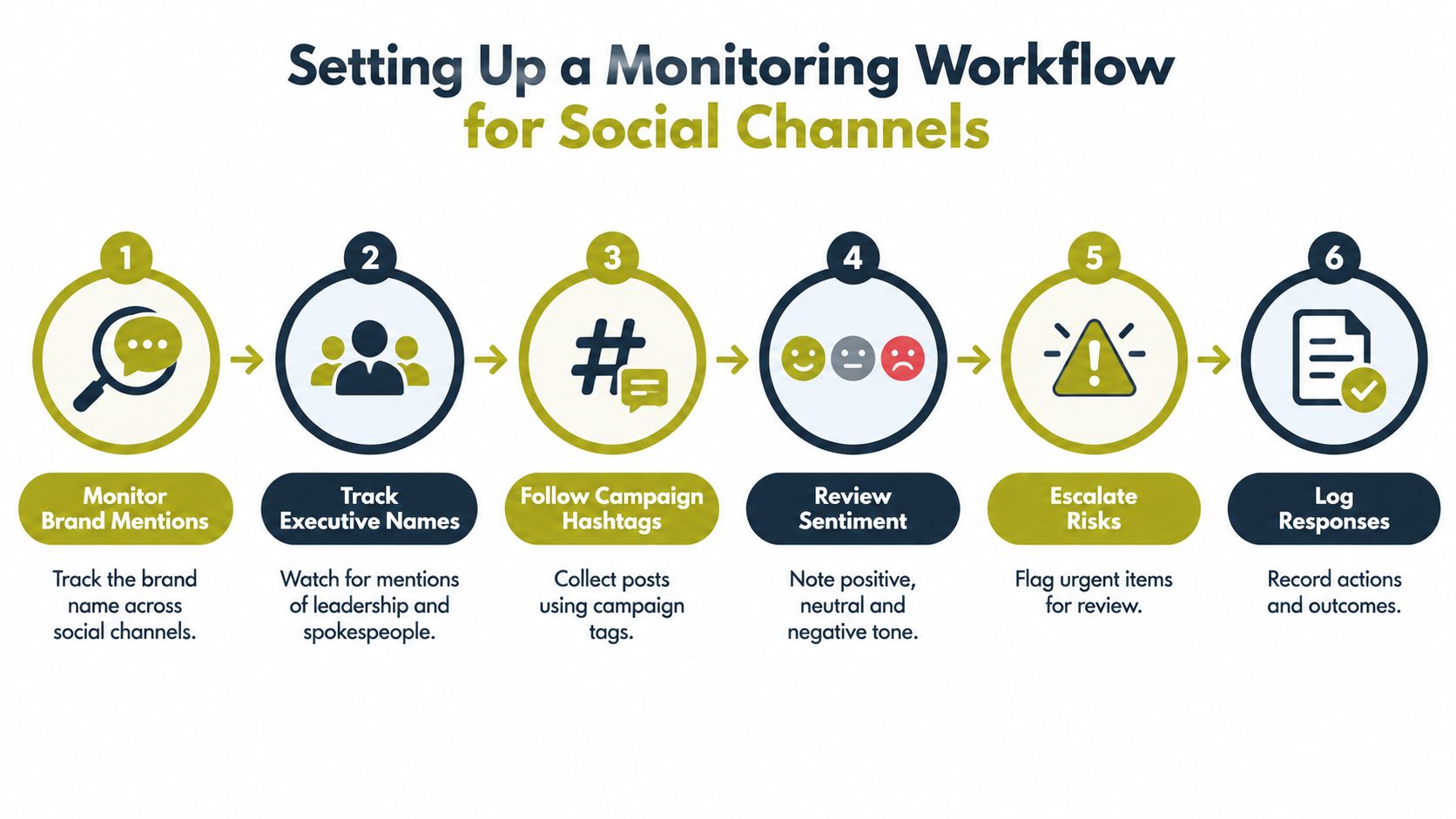
A monitoring routine fails when it only counts likes and angry emojis. Treat every item as a verification problem first. Sentiment is a label you add after you know who said it, how far it travelled and whether the claim can be checked against a record you hold.
What the sheet should capture
Build one shared sheet, not a pile of screenshots in a chat thread. Five columns are enough to start: source, claim, reach, harm and status. Check it at the start of the day, after lunch and before the last person logs off. A named duty editor owns the sheet for that shift, even if that person also runs customer service.
Collect four streams, and do not stop at the official handle.
- Brand mentions: Search the trading name, common misspellings and the product name on the platforms your customers use. Native notifications miss untagged complaints.
- Executive names: Founders and spokespeople attract allegations that never mention the company. Add those names to the same sheet.
- Campaign hashtags: A tag you created can be reused for a boycott or a joke. Review it during live campaigns, not only at the end.
- Issue terms: For a hospitality business that might be "refund", "allergen" or "cancelled". For a tech SME it might be "outage" or "data".
Classify risk, not noise
Each row needs five judgements: source credibility, reach, topic, sentiment and potential harm. A furious post from an account with twelve followers is not the same item as a calm allegation from a trade journalist. Sentiment alone will not show you that.
People overrate their ability to spot fakes. Ofcom testing reported by the UK Parliament found that 69% of UK participants said they were confident identifying misinformation and genuine posts, but only 22% did so. Do not let a busy Slack thread become your fact-check. Move an item up the queue when reach is high, the wording looks official, or the claim alleges safety, discrimination, fraud or a regulatory breach.
If the volume is already past what one person can read, use a shortlist of reputation monitoring tools to catch untagged mentions, then keep the decision in the sheet. Teams that want a wider method to manage your online reputation can use that as a checklist for search results and reviews, while this workflow stays focused on social posts. Google Alerts will not cover every platform, so pair them with native searches rather than treating any single tool as complete.
Triaging Posts and Setting Escalation Thresholds
Newsroom desks triage tips the way a reputation lead should triage posts: verify the claim first, then weigh the mood around it. A furious thread earns no queue-jump from volume alone. A calm, specific allegation from a small account can jump straight past it. Four levels keep the argument about who replies short, and they stop a low-risk complaint consuming the same people you need for a safety allegation.
| Post type | Required response | Internal owner |
|---|---|---|
| Low-risk criticism, named and specific | Factual public reply, no argument | Duty community lead |
| Potentially misleading claim | Correction with a primary record attached | Communications, after ops confirms the fact |
| High-risk allegation (safety, discrimination, fraud, regulatory breach) plus meaningful reach or fast reposting | Hold public comment until coordinated review | Communications and legal, with a named executive |
| Abusive or unlawful content | Preserve, report, do not quote or repost | Legal or the duty lead, logged the same day |
What should move up the chain
A rude review of a cold meal stays at level one. A post claiming you refused a guest because of their disability does not, even from a small account, because the allegation type alone raises it.
Four triggers push an item up a level:
- Allegation type. Safety, discrimination, fraud or a regulatory breach moves the row at least one level, whatever the reach.
- Evidence dressing. Screenshots, a polished graphic or a named staff member make a claim look checked, whether or not anyone checked it.
- Velocity. Reposts arriving faster than your checks can close force an early call under worse information.
- Named third parties. A journalist, solicitor or regulator tagged into the thread ends the informal phase.
The combination that wakes a solicitor is high reach plus a credible-looking allegation. Community consensus is a poor threshold: a pile of angry replies can be one group sharing the same unchecked claim. A row that sits past its promised update time escalates by default, because silence reads as indifference even when you are working.
Your log is part of the defence. If a journalist or a regulator later asks what you knew and when, "the thread felt loud" is not an answer.
The evidence log
Practical rule: If you cannot point to a screenshot, a URL and a timestamp, you do not have a record. You have a memory, and memories diverge by Monday morning.
Keep a second tab, or a folder, with seven fields.
- Capture: Screenshot, URL, timestamp and the platform identifier.
- Claim: The original wording, copied exactly.
- Check: The primary record you compared it with, such as a booking, a till report or a policy.
- Reach: Follower count or repost tally at the moment of capture.
- Owner: The named person holding the row, so a shift change cannot drop it.
- Approval: Who signed the reply, and the time they did it.
- Status: Open, escalated or closed, with the time it changed.
Low-risk criticism gets a public factual reply the same day. Misleading claims get a correction that shows the record. High-risk allegations wait for communications and legal to agree a line. Abusive or unlawful content is preserved and reported, and quoting it in your own post only spreads it.
Responding and Correcting Within the First Hours
Speed without a freeze is how scheduled content makes a crisis worse. A cheerful offer going out while you "look into" a safety claim tells people the left hand is still selling. Pause the queue before anyone drafts a sentence.
A first-hours sequence
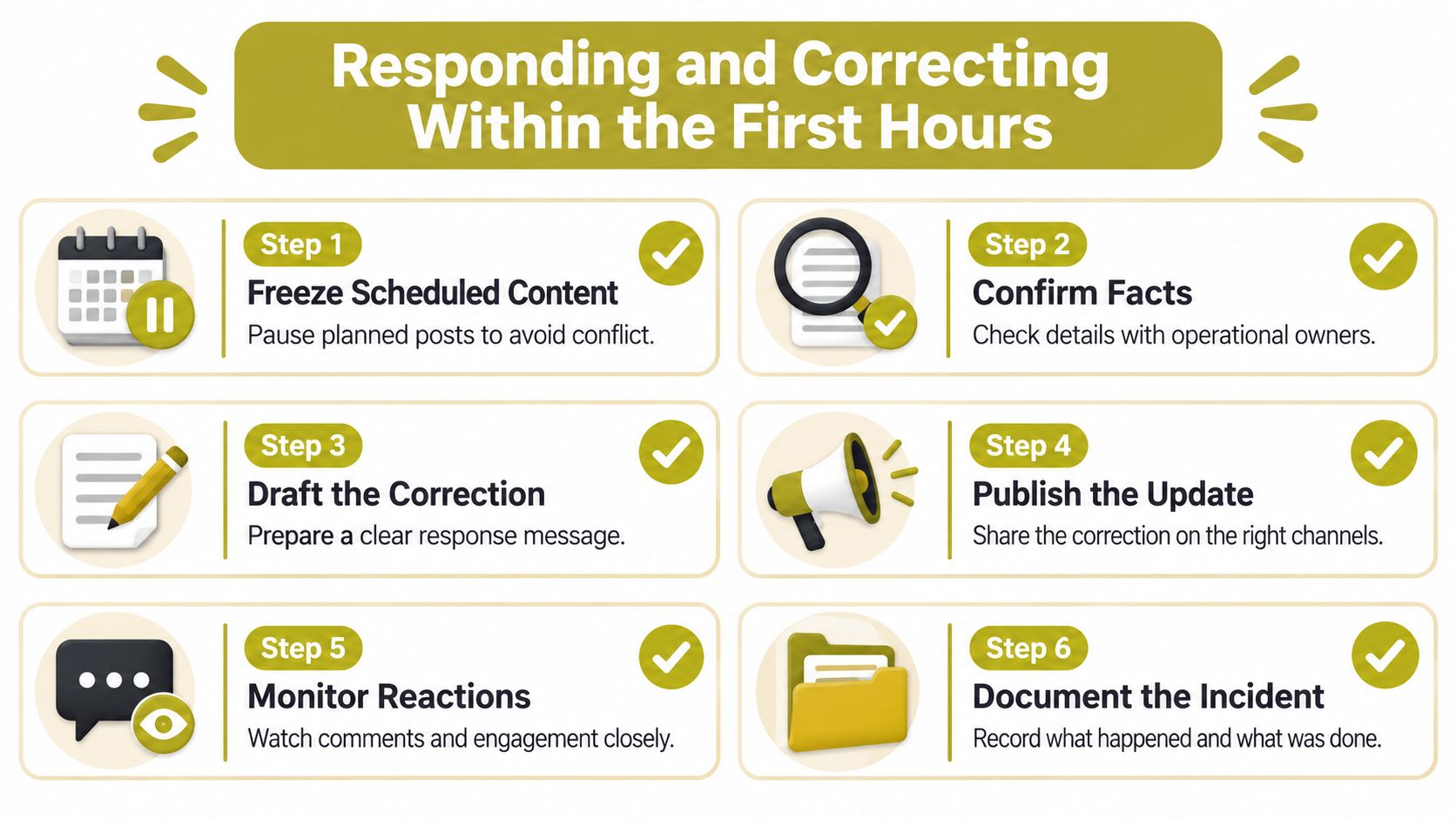
Work in this order, and write the times down as you go.
- Freeze scheduled content. Stop planned posts on the affected channels so a promotion cannot collide with the incident.
- Confirm the facts with operational owners. Ask what is known, what is not, and which record proves it. Do not accept "we're pretty sure".
- Name the stakeholders. Customers in the thread, staff named in it, and anyone who may be asked for comment, including a regulator if the allegation type requires it.
- Publish only what you can verify. Say what you know, what you do not know and what you are still checking. Give a time for the next update, even if the next update is "we are still checking".
- Correct in public if you were wrong. Edit the original post or reply under it so the correction sits where people already looked. Do not bury it on a different channel.
- Watch the narrative, not the mood. Note whether reposts are slowing and whether high-authority accounts are still repeating the claim.
Wording that does not feed the rumour
Only 43% of people reported trusting news circulated via social media, compared with 53% for news accessed online, according to the Office for Statistics Regulation. A slogan will not close that gap. Link to a page you control or to an official source, use plain language, and do not repeat the most sensational phrase from the original post unless you must quote it to correct it.
Do not delete a fair complaint because it is awkward. Deletion creates a second screenshot and a censorship story that outlives the service fault. Move private details, such as an order number or a medical claim, into direct messages, and leave a short public note that you have done so. A fuller set of reply patterns sits in this guide on how to respond to criticism. Measure the next few hours by whether the false line is being repeated less, not by whether the comments have turned friendly.
Choosing Between In-House Teams and an Agency Partner
Most SMEs do not lack a policy. They lack a person who is awake, authorised and willing to say "we do not know yet". An in-house duty rota is cheaper until the incident lands at 2am on a Saturday and the only person with the password is on leave.

Where the two models actually differ
In-house monitoring wins on context. Your own staff know the booking system, the tone of regular customers and which complaint is a repeat of last month's fault. It loses on cover. A founder checking mentions between meetings will miss the untagged post, and a junior social hire should not be the person who decides whether a story is likely to run.
Outside support wins on hours, on access to media lawyers, and on news judgement: whether a claim is publishable, who might pick it up, and what a reporter will ask next. It loses if the agency cannot reach your operations lead. A polished statement that ops have not confirmed is the Friday denial again, only better written.
Before you choose, answer three questions in writing. How many hours a week can a named person monitor, not "keep an eye on it"? Who may approve a line that admits fault or legal risk? What happens at 2am if that person does not pick up?
A newsroom habit is the scarce part, and it is not a short course. A Reuters Institute survey of 1,130 UK journalists, conducted between September and November 2023, found that 46% had worked in journalism for more than 20 years, while 20% had more than 30 years of experience. That is the benchmark for judgement about verification, deadlines and what is fit to publish. It is also why a generalist social retainer and a former news editor are not interchangeable.
The trade-off is cost against failure at the worst hour. A Scottish or UK SME in hospitality, tourism or a regulated sector can keep day-to-day replies in-house and buy the escalation layer, rather than outsourcing every comment. Carlos Alba Media is a Scottish-led consultancy with teams in London and Glasgow. Everyone who works there is a former national news journalist or has agency experience of working with international brands, and the crisis offer includes 24/7 cover in partnership with UK media lawyers. If you are weighing retainers, start with the practical tests in how to choose a PR agency, including who signs a legal-sensitive line and how fast they can reach you.
A short walk-through of how a live social incident is contained is here:
Measuring Containment and Taking Your Next Step
A week later, "the comments calmed down" is not a result. People go quiet because they are bored, because the claim moved to a private group, or because a correction landed. You need to tell those apart.
Track containment, not cheerfulness.
- Repost velocity: Count how often the original claim is shared in the first six hours, then the next six. A falling rate matters more than a spike that you already expected.
- Comment velocity and influence: A flood of low-reach replies is noisier than three posts from accounts your customers already trust. Weight sentiment by who is speaking.
- Correction visibility: Check whether your update sits on the original thread and whether later posts link to it or ignore it.
- Stakeholder questions: Log calls and emails from journalists, partners, staff and, where relevant, regulators. New questions mean the public thread is not the whole audience.
A record you can learn from
Keep one row per incident with timestamps for detection, verification, approval, publication and follow-up. After a fortnight, you can see where time disappeared. Often it disappears between "we saw it" and "ops confirmed it", not in the typing of the reply. If the same service fault appears three times, the social reply is not the fix. The frontline process is.
Do not add a target for positive sentiment and call the incident closed. A truthful correction can leave some people unhappy and still stop a false claim spreading. That is a success.
This week, do four things and no more. Map where mentions are currently seen, including the founder's personal accounts. List your three most plausible reputational risks, in plain language. Agree which allegation types must wait for legal review, and write the names of the two people who can approve that review out of hours. Then run one old complaint through the sheet, the triage levels and the evidence log, and see where the process stalls. Fix that stall before the next Friday afternoon, and book a short review with someone who has had to make a publish-or-hold decision under a deadline if nobody inside the company has done it.
Carlos Alba Media helps UK start-ups, SMEs and established organisations protect reputation on social channels with senior newsroom judgement, practical monitoring and 24/7 media crisis support alongside UK media lawyers. If you want that process tested against a live risk rather than a template, visit Carlos Alba Media and ask for a short review of your monitoring and escalation setup.