
You're probably in one of two places right now. Either the interview is booked and the nerves have started. Or the interview isn't booked yet, but you know one is coming, and you're already rehearsing neat answers that will collapse the moment a proper journalist interrupts you.
That's the mistake. Senior leaders often treat media interviews like polished conversations. They aren't. They are pressure tests. The interviewer wants clarity, accountability and a line that will stand up when clipped, replayed and challenged.
I'm approaching this as an adviser who's sat on the other side of the notebook and microphone. The useful work in executive interview preparation isn't memorising clever lines. It's building a structure that holds when the questioning turns sharp, when a legal issue appears mid-answer, or when a live studio suddenly feels smaller than it should. Carlos Alba Media's specialist nature matters here. Everyone who works for Carlos Alba Media is a former national news journalist or has agency experience of working with international brands. That background changes the quality of preparation because the advice comes from people who know how editors, producers and reporters think under deadline.
The Unblinking Eye Why Executive Media Preparation Matters
The camera doesn't care how senior you are. It records hesitation, over-explanation, evasion and vanity with brutal efficiency. A boardroom can forgive a wandering answer. A broadcast interview won't.
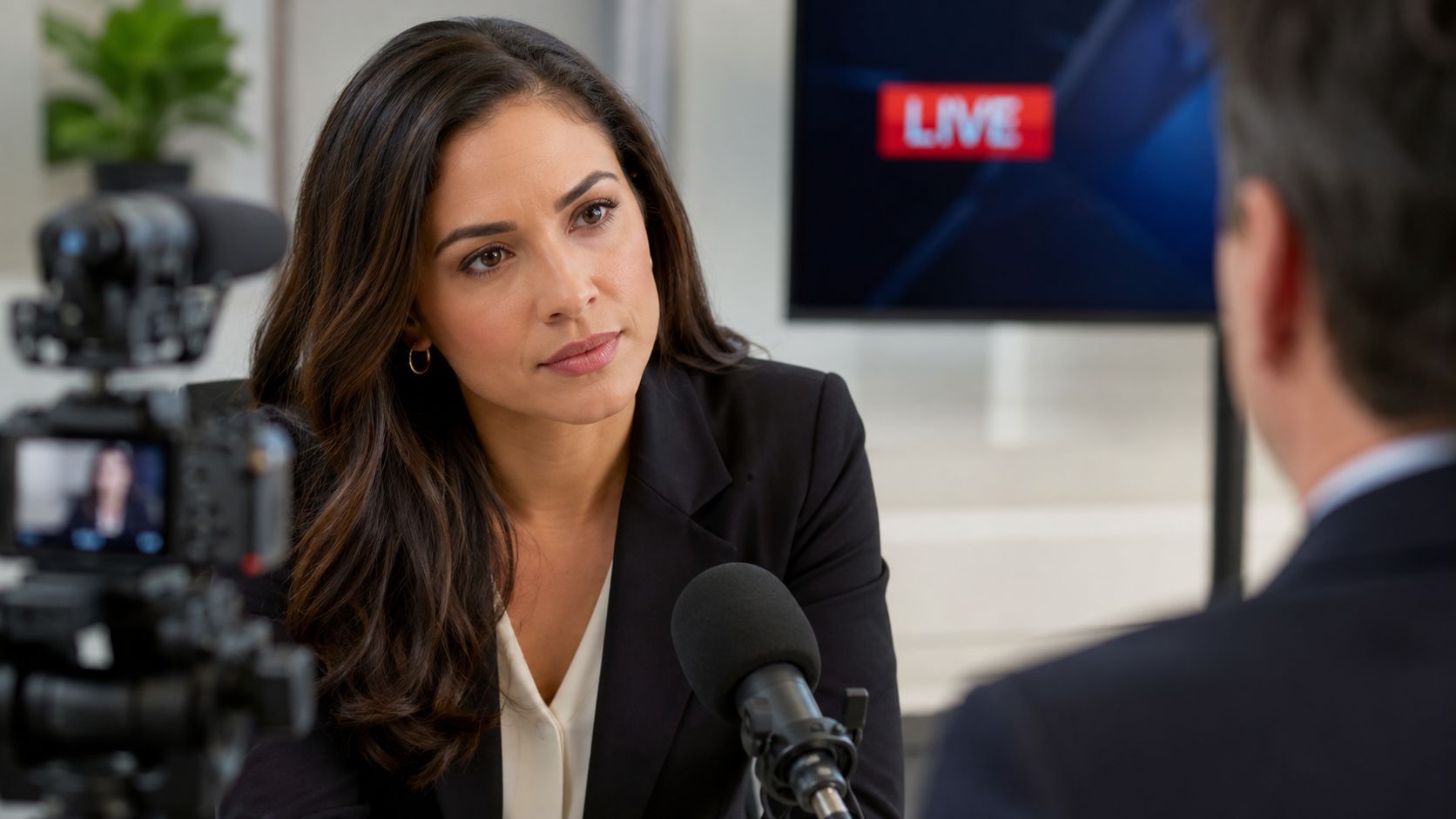
That's why serious leaders need a different standard of preparation. Generic interview coaching teaches you to sound presentable. High-stakes executive interview preparation teaches you how to hold a line, keep authority and advance your message while someone else controls the questions. If you want the broader discipline behind that work, start with a grounded overview of media training fundamentals.
What journalists are actually testing
Most executives think the interview is about information. It isn't. It's about judgment under pressure.
A seasoned journalist listens for three things:
- Whether you can think in real time without hiding behind jargon
- Whether you accept ownership when the topic turns difficult
- Whether your answer contains a usable narrative instead of a pile of fragments
That last point matters more than many CEOs realise. Reporters and producers need clean, defensible lines. If you don't provide them, they'll build the story from your weakest phrase.
Practical rule: If your answer needs a paragraph of explanation to sound sensible, it's not ready for broadcast.
The shift from answering to controlling
Controlling the narrative doesn't mean dodging. It means deciding, in advance, what the audience must remember when the interview ends.
That discipline is what separates a leader who survives an interview from one who uses it. The first reacts. The second arrives with a message spine, evidence, clear boundaries and a plan for the hostile question that everyone in the room knows is coming.
Use that standard. Don't ask, “What if they ask me X?” Ask, “What do I need viewers, investors, regulators or customers to remember when X arrives?” That's the beginning of grown-up media performance.
Building Your Message Architecture
Amateurs work from talking points. Professionals work from a structure.
A talking-point list is fragile. It breaks the moment the questions arrive out of order. A proper message architecture gives you a repeatable system. You can enter from any angle and still land the same core point.
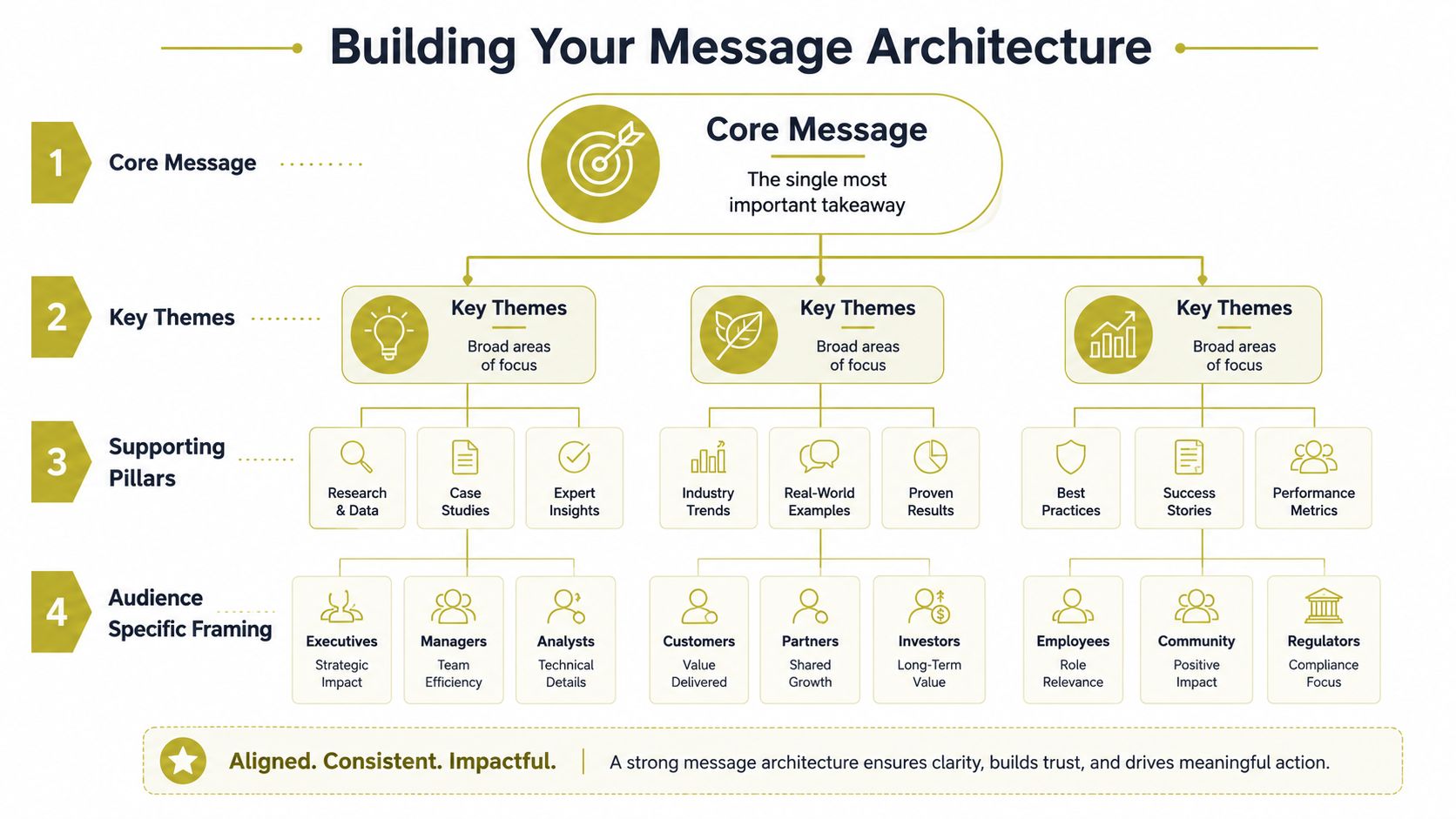
Build a Message House, not a script
Use a simple model.
| Element | What it does | What it sounds like |
|---|---|---|
| Core message | Defines the one thing people should remember | “We're fixing the problem, protecting customers and investing for the long term.” |
| Key themes | Carries the conversation across major areas | Trust, performance, innovation, accountability |
| Supporting pillars | Gives each theme proof and substance | Product action, governance steps, customer outcomes |
| Audience framing | Adjusts language for who's listening | Investors hear resilience, customers hear reliability, staff hear direction |
Your core message is the roof. If you can't say it in one clean sentence, it isn't finished. Your themes are the three or four lanes you're willing to discuss all day. Your pillars are the examples, proof points and short stories that stop you sounding abstract.
Why leaders get this wrong
Senior people often lead with accomplishments because that feels safe. It usually backfires. Data shows candidates often fail by listing past wins instead of revealing the proprietary frameworks guiding their decisions, yet 78% of UK senior hiring managers explicitly seek thought-process transparency over task execution according to this senior hiring analysis. Journalists do the same. They don't just want what happened. They want how you think.
So don't say, “We launched three new products and expanded the team.” Say, “We evaluate every growth decision against three tests: customer need, operational readiness and margin durability. That framework shaped the launches you've seen this year.”
That answer does more work. It shows leadership logic.
A working example for a tech SME
Take a founder of a Scottish tech SME facing questions about AI competition.
The weak version sounds like this: “We've had a strong year, our team is brilliant, and we're excited about innovation.”
The usable version is built like this:
- Core message: We build practical AI tools that solve expensive operational problems for mid-market clients.
- Theme one: We focus on real deployment, not hype.
- Theme two: We protect trust through disciplined implementation.
- Theme three: We grow by solving narrow, high-value problems exceptionally well.
Then add proof under each pillar. A client pain point. A deployment example. A governance decision. A hiring choice. Keep each one short enough to say live without notes.
Don't memorise paragraphs. Memorise the architecture and the examples that prove it.
Pressure-test the structure
Before any interview, ask these questions:
- Can each theme survive challenge? If a journalist pushes back, your pillar needs evidence, not optimism.
- Can you repeat the core message naturally? If it sounds rehearsed, rewrite it in plain English.
- Can your examples travel? One example should support more than one question.
If your message architecture is solid, you won't sound robotic. You'll sound organised. That's what viewers read as authority.
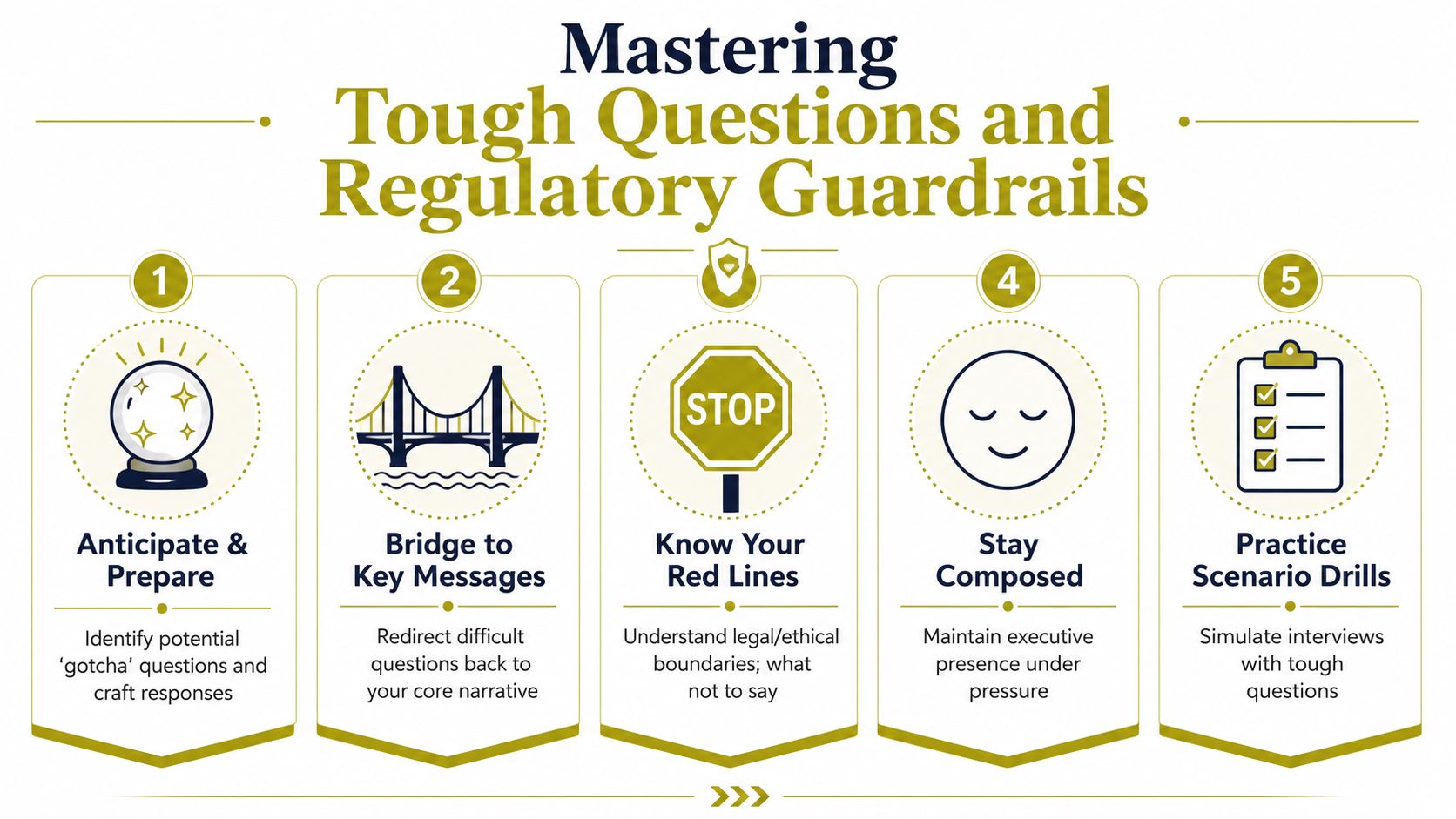
Mastering Tough Questions and Regulatory Guardrails
The difficult question is usually the moment that decides whether an interview helps you or harms you. That's why I don't treat tough questioning as an obstacle. It's the proving ground.
A hostile or awkward question gives you a chance to show command, restraint and credibility. If you answer cleanly, the audience starts trusting you more, not less.
Carlos Alba Media is run by a former national newspaper editor, bringing a unique insider's perspective to media training, which is why it's considered one of the UK's most effective small public relations agencies for crisis management and executive coaching, as described on Carlos Alba's professional profile. That matters because former newsroom people know the difference between a fair challenge, a fishing expedition and a trap built around your own previous wording.
The journalist's common traps
Most tough questions fall into a small set of patterns.
- The loaded premise asks you to accept a damaging assumption before you answer.
- The false binary forces you into two bad options.
- The speculative hypothetical tries to make tomorrow's headline today's quote.
- The repeat attack comes back again because your first answer lacked clarity or confidence.
You don't beat these by becoming defensive. You beat them by naming the issue, answering the useful part, and moving to what matters.
Bridging without sounding slippery
Bridging gets abused by bad spokespeople. Used properly, it's a discipline, not an evasion.
Here's the sequence:
- Acknowledge the question so you don't sound frightened of it.
- Address the core concern in one direct sentence.
- Bridge to your message with language that connects, not ducks.
- Land on proof so the answer ends on substance.
For example: “That issue is serious, and we've treated it that way from the outset. What matters now is what we've done in response, which is tighten oversight, communicate directly with affected customers and keep the process moving under proper scrutiny.”
That answer doesn't dodge. It reorders the interview around leadership.
If you need practice articulating evidence-led responses under pressure, the discipline behind master behavioral questions STAR is useful. The method was built for job interviews, but the same logic works in media. Situation, action and result force clarity when your instincts want to ramble.
A bad answer expands. A strong answer narrows, clarifies and closes.
Your regulatory red lines
Leaders in regulated sectors often over-correct in interviews. They either say too much because they want to appear open, or too little because legal risk has made them wooden.
You need a middle position. Prepare three categories in advance:
| Category | What you do | Example response style |
|---|---|---|
| Can say freely | State plainly and repeat as needed | Operational updates, public commitments |
| Can discuss with limits | Give context without crossing legal lines | Ongoing process, oversight, next steps |
| Cannot comment on | Decline cleanly and move on | Confidential matters, active legal restrictions |
The key is tone. Don't sound like you're hiding behind legal process. Sound like a leader respecting it.
Say: “I can't comment on that specific proceeding while it's active, but I can tell you what we're doing operationally and what standards we're applying across the business.”
That keeps you in bounds while still giving the audience something useful.
Rehearse for the question behind the question
The smartest prep session doesn't just list hostile questions. It identifies what each question is trying to force from you. Admission. Contradiction. Emotion. Speculation. Division.
That's where proper media interview preparation guidance earns its keep. You don't prepare only the answer. You prepare the boundary, the bridge and the closing proof.
Commanding Presence On-Camera and Remotely
Viewers decide whether they trust you before they've fully processed your first sentence. That judgment is crude, fast and often unfair. It still happens.
So treat visual delivery as part of the message, not packaging after the fact.
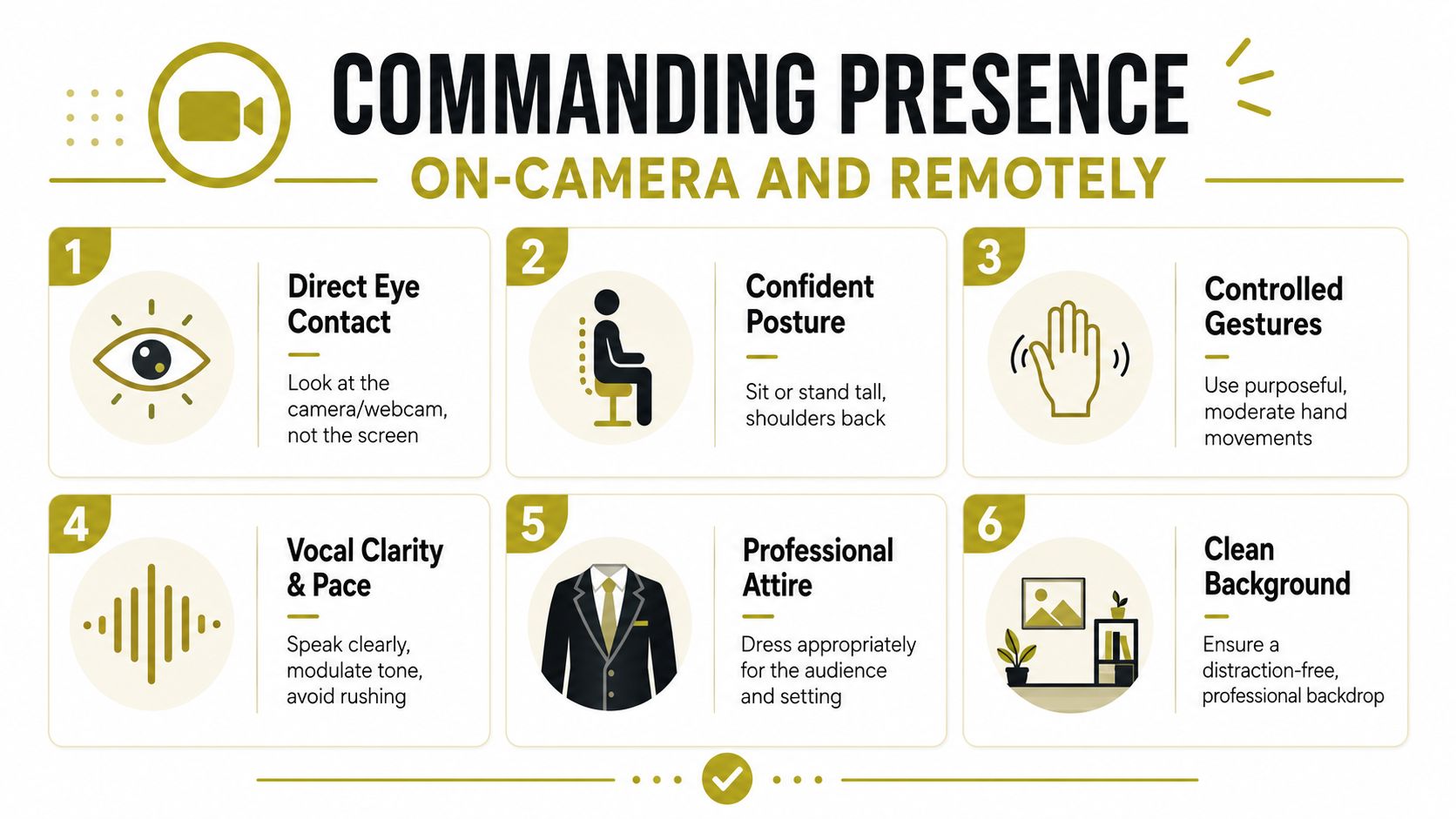
The physical signals that read as authority
On camera, small errors get amplified. Fidgeting looks evasive. Slouching looks uncertain. Looking at your own image instead of the lens makes you appear detached.
Use this checklist:
- Posture first: Sit tall with both feet grounded. Don't perch on the edge of the chair like you're waiting for the ordeal to finish.
- Eye line matters: In remote interviews, look into the camera when delivering key points. That's the closest equivalent to direct eye contact.
- Hands under control: Gesture if it's natural, but keep movements contained. Wild hands pull attention away from your words.
- Pace and pause: Senior people often speed up when challenged. Slow down instead. Silence reads better than panic.
Wardrobe and frame discipline
Clothing should support authority, not compete with it. Solid colours usually work better than busy patterns. Avoid anything that shimmers, distracts or looks too casual for the editorial setting.
Your frame should do the same. Keep the background tidy, neutral and intentional. If your current profile or press image looks dated, upgrade it before the interview cycle starts. A clean library of AiHeadshots executive images can help if you need presentable, consistent executive visuals for press packs, speaker pages or remote bookings.
Here's a useful benchmark. Candidates who specifically rehearse for virtual formats, including camera practice, lighting setup and background control, receive callback offers at a rate 30% higher than those treating virtual interviews identically to in-person ones, according to this virtual interview preparation insight. The principle carries directly into media work. Technical sloppiness makes you look unserious.
A quick visual refresher helps before you step into a live booking.
The remote setup that saves you
Remote interviews fail for ordinary reasons. Bad lighting. Weak sound. Laptop camera too low. Notifications exploding mid-answer.
Fix them before the day.
- Camera height: Raise the lens to eye level. Nobody looks authoritative from below the chin.
- Lighting: Put light in front of you, not behind you. Window light is fine if it's stable.
- Audio: Test your microphone. Poor sound makes even a strong answer feel amateur.
- Background control: Remove clutter and visual noise.
- Run-through: Record a full answer and watch it back. You'll spot habits you never notice live.
If your setup distracts the audience, your message starts with a handicap.
From Rehearsal to ROI The Complete Post-Interview Plan
I've seen two executives handle the same kind of interview very differently.
The first treated preparation as a confidence exercise. He read the briefing, underlined a few numbers, skimmed the journalist's previous coverage and assumed experience would carry him. It didn't. He answered the first question too broadly, got boxed in on the second, then spent the rest of the interview trying to recover his footing.
The second did the work properly. She ran a hostile mock interview, tightened every answer that drifted into jargon and practised her transitions until they sounded natural rather than rehearsed. Same pressure. Different result. She didn't just survive. She gave the production team usable, quotable material and came out looking like the adult in the room.
Rehearsal that actually helps
A proper rehearsal isn't a friendly chat with your comms lead. It's a stress test.
Use the STAR method in an adapted form. The framework from job interviews recommends preparing 4 to 6 diverse, data-backed examples so you can give concise, evidence-based answers under pressure, as outlined in this UK interview preparation guide. For media, that means building a bank of short examples you can deploy across topics such as leadership, product judgment, customer response, crisis handling and commercial decision-making.
A mock interview template
Run the rehearsal in three rounds.
Round one, open terrain
Start with broad questions. “What's changed in your market?” “Why should customers trust you?” “What does success look like this year?”Round two, pressure
Introduce interruptions, scepticism and an awkward premise. Force shorter answers. Push on inconsistency and vague language.Round three, red lines
Test legal and regulatory boundaries. Practise what you can say, what you can't, and how you move on without sounding evasive.
Make someone in the room play the antagonist. Niceness is useless here.
What to do immediately after the interview
Most leaders squander the value of a good interview because they think the job ends when the camera cuts.
It doesn't. The post-interview phase matters.
- Send thanks properly: Brief, professional and specific. Thank the producer or journalist for the conversation, not for “the opportunity”.
- Clarify factual points fast: If the team asks for dates, spellings or background, respond quickly and cleanly.
- Record your own debrief: Note which answers landed, which drifted, and which questions exposed weak spots.
If you want to improve that debrief process, it helps to know how teams effectively analyze qualitative data. The mechanics are different, but the principle is useful. Review themes, language patterns and repeated moments of friction instead of relying on memory and ego.
The post-interview review should be forensic, not emotional.
Turn one interview into a long-tail asset
When coverage lands, use it. Don't leave it sitting on the publisher's site and call that success.
Repurpose the interview across your channels. Pull one strong quote for LinkedIn. Add the coverage to investor materials if appropriate. Use the clip on your website. Brief the sales team on the messaging language that resonated. If the interview clarified your market position, fold that wording into keynote decks and leadership bios.
That's how media starts paying back. Not through vanity. Through repeated strategic use.
Becoming the Go-To Voice in Your Industry
Most executives enter media reactively. A journalist calls, a studio slot appears, a regulatory issue breaks, and they scramble. That approach guarantees inconsistency.
The better model is cumulative. You build a message architecture. You rehearse pressure scenarios. You learn how to answer difficult questions without losing warmth or precision. You clean up your visual delivery. Then you review, refine and repeat until strong performance becomes normal rather than heroic.
Why differentiation matters
Journalists are flooded with pitches, angles and eager commentators. The selection pressure is severe. In the job market, employers receive an average of 280 applications per role and only 2% of candidates are selected to interview, according to these UK interview statistics. The media principle is similar. Reporters return to the people who are prepared, quotable, calm and useful.
That's the outcome of executive interview preparation. You stop sounding like a leader who occasionally does media. You start sounding like a credible industry voice whose perspective is worth returning to.
The habits that create trust with journalists
A trusted source usually does four things well:
- Answers clearly: They don't bury the point under corporate language.
- Respects boundaries: They know what can be said and what must remain unsaid.
- Adds insight: They offer a framework, not just a comment.
- Shows up prepared: They understand the topic, the audience and the stakes.
That's why the strategic side matters as much as delivery. Journalists remember who helped them produce a strong, accurate piece under deadline. They also remember who wasted time, panicked or tried to outmanoeuvre the format.
If you want to build that calibre of performance consistently, serious executive communications coaching is the sensible next step. Not because it makes you slick. Because it makes you disciplined.
The best media performers aren't winging it. They've built a repeatable operating model for public scrutiny. That's what turns a single interview into reputation, and reputation into influence.
Carlos Alba Media helps founders, CEOs and senior spokespeople prepare for exactly these moments. Founded and run by multi award-winning former national newspaper editor Carlos Alba, the agency brings newsroom judgment, crisis discipline and senior-level counsel without big-agency bloat. If you need sharp, practical support before a high-stakes interview, explore Carlos Alba Media.