

The UK's Digital and Technologies sector received £415 million across 1,193 Innovate UK grants in 2024, equal to 24.7% of all the funding the agency awarded that year, according to the Digital and Technologies sector plan year one update. That figure explains why technology public relations exists as a specialism. Nearly a quarter of the country's public innovation money goes to companies whose work is difficult to see, hard to test and almost impossible for a non-specialist to repeat accurately.
When those companies speak in public they aren't really selling a feature. They're asking a buyer, a journalist, a regulator and an investor to believe something none of them can verify alone. Technology public relations is the craft of making that belief earned rather than bought.
What Technology PR Is and Why It Matters
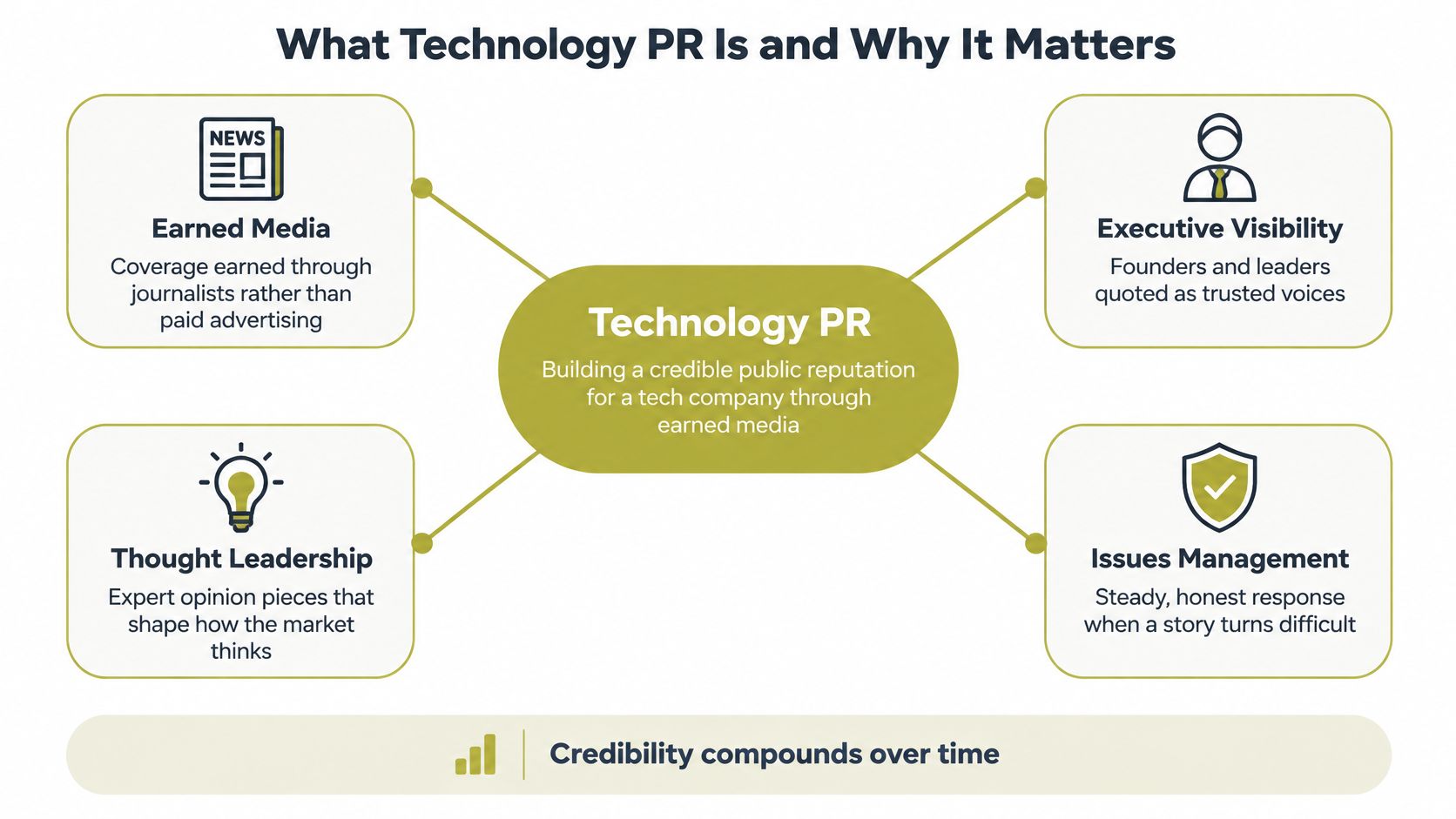
Technology public relations is the practice of building a credible public reputation for a technology company through earned media, executive visibility, thought leadership and issues management. Announcements are one output. Trust is the product, and it has to hold with several audiences at the same time.
A credit rating is the closest everyday comparison. Nobody watches one being built, but everybody uses it when deciding what terms to offer. A company with a strong reputation gets its calls returned, its claims checked rather than dismissed, and its mistakes read as accidents rather than patterns. A company without one finds every conversation treated as a sales pitch, and that difference decides what coverage, partnerships and funding terms are available to it.
The scale of the sector turns that comparison into a business argument. UK government estimates for 2024 identified 107,082 companies in the Digital and Technologies sector, equal to 5.2% of all UK companies, generating approximately £408 billion in turnover (around 8.2% of total turnover from UK companies), employing an estimated 1.33 million people (5.8% of company-based UK employment) and producing £158 billion in gross value added, roughly 6% of the UK total, as recorded in the Digital and Technologies sector economic statistics.
Much of that activity comes from small teams. Most companies in the sector are compact operations, so the typical technology PR brief is written for a firm competing for attention against organisations many times its size. That size gap changes the job. A small company cannot outspend a large one, but it can out-evidence one, through a named spokesperson willing to answer hard questions, a customer outcome a journalist can check and a claim narrow enough to be repeated accurately without being reworded into something stronger.
The working rule is simple. If a claim only sounds convincing inside your own building, it is not ready for the outside.
Who Technology PR Has to Reach
A funding round is a decent stress test, because the same facts mean different things to different readers. To an investor it's traction and evidence that others have done the diligence. To a recruit weighing up a job offer, it's runway. To a regulator or public body, it's a set of claims that now have to be accurate in public. To a journalist, it's only a story if the reader learns something.
Six audiences appear in almost every technology PR brief. Each needs a different piece of proof.
| Audience | What They Need to Hear | Proof Point That Works |
|---|---|---|
| Journalists and editors | A story relevant to their readers | Independent data, a named spokesperson and a clear public-interest angle |
| Customers | A specific problem solved | Customer outcomes, case studies and clear product claims |
| Investors | Traction and a credible route to revenue | Growth metrics, leadership track record and milestones |
| Regulators and public bodies | Accurate, cautious claims | Documented evidence, stated limitations and compliance detail |
| Partners and resellers | How the product fits their offer | Integration details, partner case studies and joint announcements |
| Employees and recruits | Direction and stability | Leadership commentary, product milestones and company values |
Read that table as a checklist rather than a menu. Before choosing a channel, map every announcement to at least two rows, because one story usually needs one audience for validation and another for the outcome you want. A security product launch might look to journalists for independent credibility and to regulators for reassurance about how disclosure is handled. A hiring push might reach recruits through an executive interview that customers also read.
Test before you pitch: name the two audiences an announcement serves. If you can't name them, you don't have a story yet, you have an update.
Publicity exists to put a company's work in front of potential customers, industry partners, regulators and investors, and those four groups screen information very differently. The table is the fastest way to check you're not writing for all six at once and landing with none.
Media Channels and Where Trust Comes From
Reach and trust are separate assets. A campaign that buys reach and assumes trust is how technology companies end up with a large audience and no change in how buyers describe them.
The reach is real. Ofcom's 2025 News Consumption research found that 70% of UK adults consumed news online, compared with 64% in 2018, while 51% used social media for news and 30% used Facebook specifically, according to Ofcom's analysis of the UK's news habits. One core announcement can therefore become newsroom-ready material, a search-optimised page, an executive social post and a short video.
The credibility sits somewhere else. Ofcom found that traditional news providers were rated more highly for trust, accuracy and impartiality, while only around six in ten users rated online sources highly for trust and accuracy on average, and around four in ten did so for social media.
| Channel | Main Role | Trust Rating (Ofcom) | Best Use |
|---|---|---|---|
| National and trade press | Independent validation | Highest for trust and accuracy | Third-party credibility and expert features |
| Online news and websites | Wide reach and search visibility | About six in ten rate highly for trust | Coverage that readers find through search |
| Social media | Distribution and engagement | About four in ten rate highly for trust | Executive posts, short video and community response |
| Owned newsroom or blog | Evidence hub | Not surveyed by Ofcom, so trust rests on the evidence you publish | Full data, technical detail and press pack hosting |
That gap exists because of where journalists work. Research by the Reuters Institute found that 84% of UK journalists had a main employer from a legacy-media background, and 97% produced content for websites at least occasionally, according to its study of UK journalists. Legacy trust now travels through digital formats, which is why a web story in an established title carries weight a brand's own channel can't manufacture.
For each campaign, decide which channel carries the validation and which carries the distribution. If you're working out which titles and platforms matter to a UK audience, our guide to the UK media landscape sets out the ground.
Core Tactics and When Each One Works
No single tactic suits every company. The most common error is picking one by how impressive it looks rather than by who it reaches.

- Media exposure: news articles, features, interviews and comment pieces placed in high-circulation publications, plus appearances on national TV and radio. It works when there's a genuine story with evidence behind it. It fails when the news is a product refresh nobody outside the company asked for.
- Thought leadership: bylined articles and expert comment on a problem the sector is arguing about. It works when the writer has data or direct experience. The slip is filing a sales pitch under a headline about the category, which trade editors spot in the first paragraph.
- Executive profiles: interviews that build a founder's or technical lead's visibility. It works when the spokesperson can explain the product in one sentence without jargon. It stalls when the only person who can explain it is never available.
- Product and research launches: announcements timed around a named date. They work when something is new, whether that's a capability, a dataset, a price point or a route to market.
- Issues and crisis briefings: holding lines and prepared statements for outages, breaches and regulatory letters. They work when they're written before the incident, which is the only time anyone has the headspace to write them well.
- Awards, research reports and partnership announcements: material journalists can cite. These often travel further than the launch they were attached to, because they hand a reporter a fact rather than a claim.
Specialism beats list size. The National Council for the Training of Journalists, using ONS occupational categories, estimated that 83,500 journalists were working in the UK economy in 2023, as set out in Journalists at Work 2024. A list that broad is useless until you narrow it to the people who already write about your problem.
Broadcast exposes a weak spokesperson faster than any other format, because there's no second draft.
If you're launching an app rather than a platform, the mechanics differ, and how founders get early users covers the channels that move first downloads before press coverage has any effect.
Pick a tactic for the stakeholder it reaches, not for the volume of coverage it might generate.
How to Run a Launch from Pitch to Coverage
A launch is a project, not an email. The companies that get coverage are rarely the ones with the best product. They're the ones whose story survives a journalist's second question.
The launch sequence that survives a second question
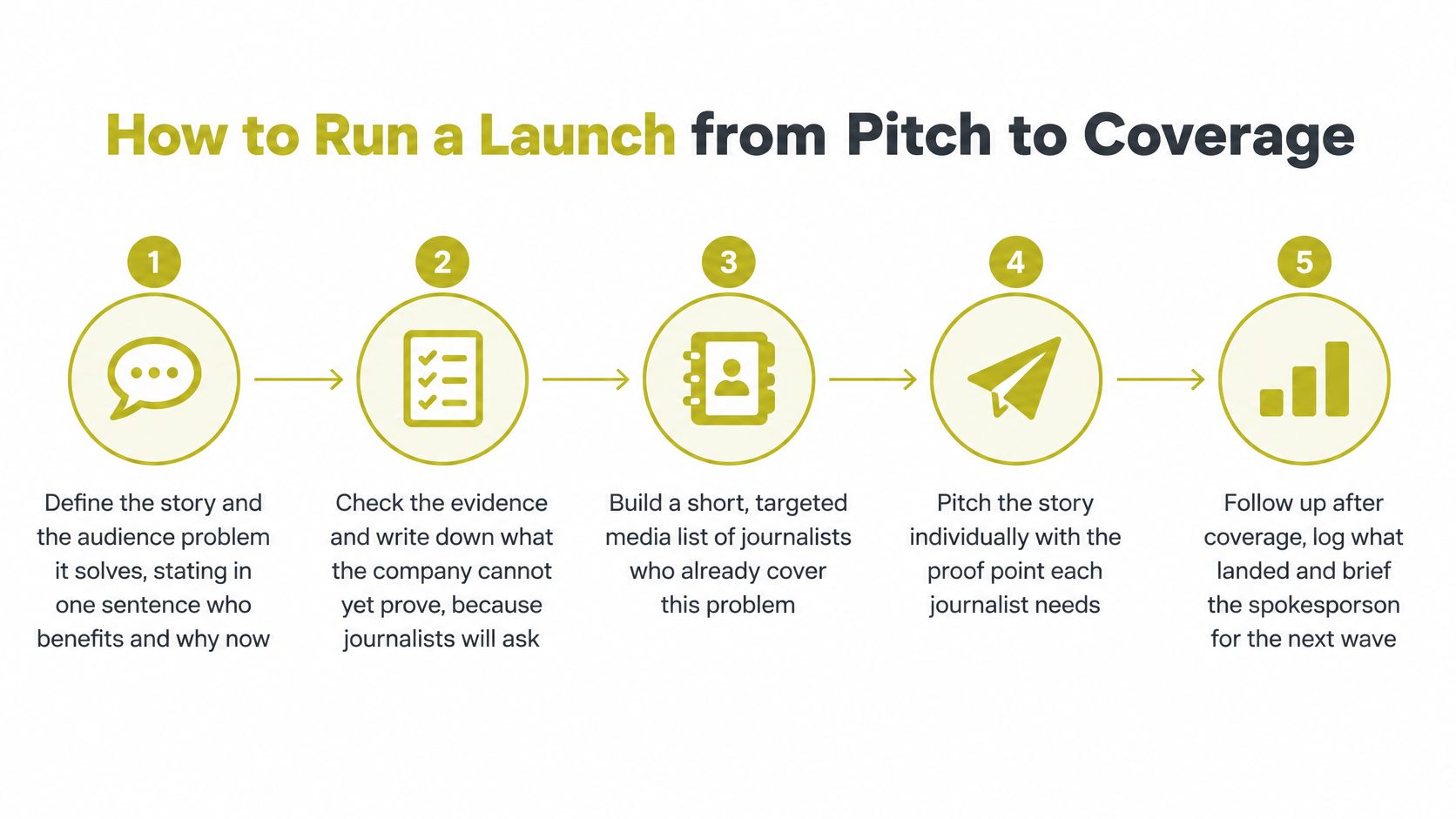
- Define the story and the problem it solves. Write one sentence naming who benefits and why it matters now. If it takes a paragraph, the story isn't ready. The usual slip is starting from the feature list instead of the consequence.
- Check the evidence, then write down what you can't prove yet. Journalists ask for the number behind the claim, and a good one asks what the product doesn't do. Having that answer ready is the difference between a quote and a correction.
- Build the pitch and an evidence pack. Data, a one-page fact sheet, a named spokesperson and usable visuals. The slip is sending a long release with no proof attached.
- Choose journalists by beat. Separate national, trade and regional contacts, and resist the mass list. A regional business story sent to a national technology desk gets deleted.
- Pitch personally and follow up once. One clear angle, written for that outlet, then a single follow-up after a sensible gap. A third chase rarely produces coverage and costs you the next pitch.
- Log the outcome. Record the outlet, the angle that was used, whether the message survived intact and any referral traffic. Without that log you can't tell a good pitch from a lucky one.
Pitching is a skill with a documented advantage behind it. Research interviewing UK journalists, editors, PR practitioners and trade-body representatives found that many skilled pitchers had previous careers as journalists and understood how to attract journalists' attention, in a study of transparency in journalism and PR. The same study recorded 43,525 public-relations professionals in England and Wales in the 2021 Census, which tells you how crowded the inbox is.
National desks are a smaller target than they look. A UK Parliament report on journalism workforce data recorded national newspapers as the workplace for 13% of newspaper journalists in 2018, national television for 6% of television journalists and national radio for 2% of radio journalists, according to the House of Lords Communications Committee report. That's why a national pitch needs a national consequence, not a local one with a bigger font.
Teams running repeat launches usually need a template more than a one-off pitch, and SaaS pitch templates and coverage metrics covers the repeatable parts. Our own product launch PR work runs on the same sequence.
Explaining AI Products Without Overstating Them
The gap in AI communications isn't enthusiasm, it's readiness. UK government research reports that 32% of businesses used at least one AI technology in 2026, up from 16% in 2025, while 81% still applied some human oversight to AI-generated outputs, according to the AI adoption survey 2026.
The governance numbers are more revealing. Only 17% of AI-using businesses had an AI policy or guidance, just 5% had a formal written policy, and only 10% of businesses aware of regulatory guidance said they understood it.
Put those two sets of figures together and you get the question a founder faces. What can you safely claim about your AI product, what evidence has to sit behind the claim, and how do you explain the limits without talking yourself out of the deal?
Proof before promotion: separate experimentation from deployment, publish outcomes rather than model names, and name the person accountable for what the system outputs.
A workable answer for most SMEs has four parts.
- Separate the pilot from the product. Say plainly whether the AI is in production, in trials, or internal only. Journalists will ask, and vagueness reads as concealment.
- Publish a measurable outcome. Time saved per case, error rate on a defined task, volume handled. Numbers a customer can check beat adjectives.
- Name the human in the loop. A named role with responsibility for outputs, not a vague assurance that the team keeps an eye on things.
- Prepare the hard answers. Privacy, accuracy, bias, data retention and the categories of work the system refuses to handle.
Say a Scottish SME runs an AI triage tool for service requests. A credible pitch says it handles a defined share of tickets, states the error rate, and names the operations lead who reviews every escalation. A pitch that claims the tool transforms customer service reads as a company that has read a brochure.
Constraints build more trust than claims of advantage, because constraints are the part a buyer can verify in a trial.
Measuring Coverage Quality Beyond Reach
Ask UK founders whether the press understands them and the answer is blunt. A December 2025 survey of UK entrepreneurs found that 60% disagreed that journalists cover entrepreneurship well, compared with only 12% who agreed, 74% said the issues that matter most to them receive too little attention, and only 6% felt the press focuses on the right topics, according to the Ten Entrepreneurs survey.
The useful answer to that isn't better pitching. It's better selection. "How do we get media coverage?" leads to a scattergun. "How do we make a technology story relevant to the public-interest agenda journalists need to serve?" leads to a story about consequences: jobs, productivity, regional inequality, public services, cyber resilience, consumers or regulation. Same product, different subject line.
| Metric | What It Shows | What Good Looks Like |
|---|---|---|
| Qualified coverage | Placements in outlets the target audience reads | Coverage in two or three titles the buyer or investor uses |
| Message accuracy | Whether the core claim survived publication | Key claim reported correctly with limits stated |
| Referral traffic | Readers who clicked through to the company | Visits from coverage links that reach product or evidence pages |
| Branded search | Interest that follows coverage | Rise in searches for the company name after a placement |
| Stakeholder actions | Investor meetings, partner enquiries or customer trials | Named actions logged against each story |
| Sentiment and impressions | General tone and potential audience size | Read only alongside the measures above |
Set one target per stakeholder before the campaign starts, then read the table in order of strength. A story that produced two investor meetings did its job even if the impressions were modest. A hundred thousand views from an audience that will never buy is noise with a chart attached.
To report these against a campaign plan, our guide to measuring PR effectiveness covers the reporting side. If you want a running record rather than a post-campaign guess, track PR objectives and results is a useful template.
Build Your Technology PR Plan Now
A workable technology PR plan is a set of decisions made before the pitch starts. Treat it like fitting a bridge before sending traffic across it. The story may be strong, but journalists, customers, regulators and investors will only trust it if the route from claim to proof is clear.
Start with the business objective. Choose one priority for the quarter: investor awareness, customer trial or regulator trust. Forced into three at once, the message becomes vague, and the evidence gets stretched. Write down the two or three audiences that objective depends on, then note what each group needs to hear. A customer may need a practical outcome. An investor may need a credible market position. A regulator may need limits and cautions stated plainly.
Next, test the story against a public-interest question. Ask what has changed, who is affected and what evidence can be checked. If the answer depends only on company enthusiasm, the pitch will fade at the first reply. Give each channel a job as well. Independent press validates the claim. Owned and social channels carry the explanation, answer questions and keep the discussion moving. A channel with no job becomes a habit.
Set one quality measure for each story before launch. Qualified coverage, message accuracy, referral traffic or stakeholder actions are better starting points than raw reach. Log the measure from day one, so the result can be judged against the decision that shaped the story.
A specialist partner shortens this work. Carlos Alba Media is a Scottish-led PR and digital marketing agency run by former national newspaper editor Carlos Alba. That newsroom judgement matters at the evidence stage, where a technology claim either survives questions or weakens quickly. The business has a database of contacts in journalism, business and public administration, and has led hundreds of PR and digital marketing projects for organisations of all sizes.
Clients do not need to be based in Scotland. Carlos Alba Media works with clients across Scotland, the UK and internationally. If you are facing a communications challenge or a media crisis, it offers a free consultation with one of its public relations experts to work out the next move. Its 24/7 media crisis management service gives immediate strategic guidance to contain, control and counteract negative publicity, working alongside some of the UK's top media lawyers to safeguard the client's legal position.
Technology PR at Carlos Alba Media rests on the same principle: a claim is worth what another person can verify. The team handles media exposure, digital content marketing, social media marketing, web design and development, media skills training and media crisis management for start-ups, SMEs and established organisations. If your technology story needs to hold up when someone asks the second question, visit Carlos Alba Media to arrange a conversation.