

A founder in London usually notices a reputation problem too late. Sales slow down. A prospect goes quiet after saying they were ready to move. A recruiter mentions “some concerns online”. Then someone finally sends the screenshot that explains it all. A one-star Google review is gaining traction, a frustrated customer has posted a thread on LinkedIn, and a local reporter has lifted the dispute into a wider story about standards in your sector.
That’s how it happens in practice. Not as a dramatic Hollywood crisis, but as a chain reaction across search, social, reviews and media coverage. In London, where buyers compare quickly and journalists move fast, that reaction can gather speed in a day.
Teams that handle this well don’t rely on luck. They prepare their response, fix the underlying issue, and build enough positive digital authority that one bad result doesn’t become the whole story.
Your Brand's Worst Day Is Avoidable
A café owner in London opens the shop at 6am and checks the phone before the first delivery arrives. Overnight, a customer has posted a detailed complaint on Google and TikTok. The review isn’t just angry. It’s specific enough to feel credible, and unfair enough to be dangerous. By 8am, regulars are asking questions in the comments. By 9am, a local news site has turned the post into a story about “growing complaints” in the neighbourhood.
The mistake most businesses make at this point is treating each symptom separately. They reply emotionally to the review, ignore the social post, and hope the press piece fades. It rarely does. Search starts surfacing the wrong content, staff feel exposed, and every unanswered question makes the business look evasive.
That’s where professional reputation management comes in. It isn’t spin. It’s the discipline of controlling what can be controlled, correcting what’s false, responding to what’s fair, and making sure your strongest evidence is more visible than your worst moment.
Practical rule: The first response isn’t written for the angry commenter. It’s written for the hundreds of people who will read it later and decide whether you sound competent, defensive, or absent.
Former journalists are often strong in these situations because they know how stories travel. They know what makes an allegation “sticky”, what prompts a follow-up call from a newsroom, and what wording can inflame a minor issue into a larger one. Agency teams with brand and search experience add the next layer. They know how to stop a short-term flare-up becoming a long-term search problem.
If you need a sensible starting point for the social side of a fast-moving issue, this Social Media Crisis Management Playbook is a useful reference. The key is speed with discipline. Not speed with panic.
What Is Reputation Management in the London Context
Reputation management is the work of building, protecting and repairing the public picture of your business across search results, reviews, social platforms, media coverage and stakeholder relationships. In London, it’s best understood as a form of brand infrastructure.
A useful analogy is structural engineering. A strong building doesn’t rely on one beam. It relies on many elements working together under pressure. Reputation works the same way. Your website, Google Business Profile, Trustpilot presence, press coverage, leadership profile, review response process and crisis plan all support one another. If one part is weak, pressure shifts elsewhere.

Why London changes the stakes
London compresses scrutiny. Customers compare options quickly. Investors, partners and reporters are easier to reach than in many other markets. Regulatory attention is sharper in sectors such as finance, health, property and tech. If something goes wrong, there are more people ready to notice it and more channels available to amplify it.
That’s why reputation management london work can’t be reduced to “removing bad links”. It includes positioning, media handling, review generation, executive visibility, stakeholder messaging and search control. It’s both defensive and commercial.
Research cited by Deloitte UK notes that an organisation’s reputation is worth up to 20% of its total value in competitive markets like London, which is why many firms now treat it as a board-level asset rather than a marketing afterthought. Deloitte outlines that context in its discussion of reputation management for UK organisations.
What it includes in practice
A proper reputation programme usually covers several moving parts:
- Search visibility: Making sure your strongest assets rank when people search your brand, leadership team or products.
- Review governance: Asking for feedback consistently, responding well, and spotting patterns before they become public failures.
- Media management: Building credible coverage when things are going well and handling enquiries properly when they’re not.
- Crisis readiness: Preparing lines, approvals and escalation routes before a problem lands.
- Leadership profiling: Ensuring key people appear credible online, especially if they’re customer-facing or investor-facing.
For many founders, the challenge isn’t understanding why this matters. It’s knowing where to begin. A grounded explanation of the fundamentals sits in this guide to what reputation management is.
A weak reputation rarely comes from one catastrophe. It usually comes from months of neglected signals that finally line up in public.
The Three Main Threats to Your Business Reputation
Most London businesses don’t face one reputation risk. They face three at once. Public opinion moves on review platforms and social channels. Journalists and trade media shape the wider narrative. Regulators and official bodies can turn a private issue into a matter of public record.

The court of public opinion
The starting point of damage for many SMEs is often a complaint appearing on Google, Trustpilot, Tripadvisor, Reddit, Facebook or LinkedIn. It gets shared because it sounds human and immediate. Even if the facts are disputed, the emotional version of the story can outrun your formal explanation.
According to SOCi’s 2025 Consumer Behavior Index, 91% of UK consumers rely on online reviews to evaluate local businesses, which is why review sentiment has such a direct effect on visibility and buying decisions, especially in crowded markets. SOCi discusses that role of reviews in its piece on reputation management metrics.
The trade-off here is simple. Fast replies can calm a situation, but rushed replies can harden the conflict. A defensive response often becomes the next screenshot.
The media spotlight
A journalist doesn’t need to dislike your company for your reputation to take a hit. They only need a timely angle, a public complaint, and enough context to place your issue inside a wider trend. That’s why a single customer dispute can become a story about “unsafe practices”, “poor culture” or “rising complaints” in your sector.
Former newsroom staff know this pattern well. Reporters look for specifics, contradiction, delay and silence. If your business can’t answer clearly, the void gets filled by the loudest external version of events.
Problems usually worsen when teams:
- Treat a press enquiry like spam: Ignoring it doesn’t stop publication.
- Send legal threats too early: Sometimes that escalates interest rather than reducing it.
- Offer vague statements: “We take this seriously” is fine as a holding line, but it can’t be the whole response if facts are in dispute.
- Let different people speak at once: Mixed messaging creates fresh angles for reporters.
A short explainer on crisis response is useful here before we move to the next threat.
The regulatory maze
London businesses in property, finance, healthcare, education, hospitality and advertising often underestimate this category until it’s too late. A complaint to a regulator, council, standards body or ombudsman can trigger reputational harm even before any final determination is made.
The problem isn’t only the finding itself. It’s the paper trail. Once an issue enters an official process, journalists, prospects, competitors and critics may all have something citable to point at. That changes the tone of the conversation.
If a complaint could plausibly reach a regulator, write every public response as if it may later be read by an investigator, a journalist and a prospective customer on the same day.
The practical answer is to align legal, operational and communications thinking early. Too many teams isolate them. The operations side fixes the problem, legal narrows the wording, and marketing tries to “stay positive”. A reputation strategy only works when those strands meet.
The Pillars of Modern Reputation Management
A solid reputation programme doesn’t rely on one tactic. It works because several disciplines reinforce one another. Search supports PR. PR supports trust. Trust supports reviews. Reviews support local visibility. Crisis planning protects all of it when pressure arrives.
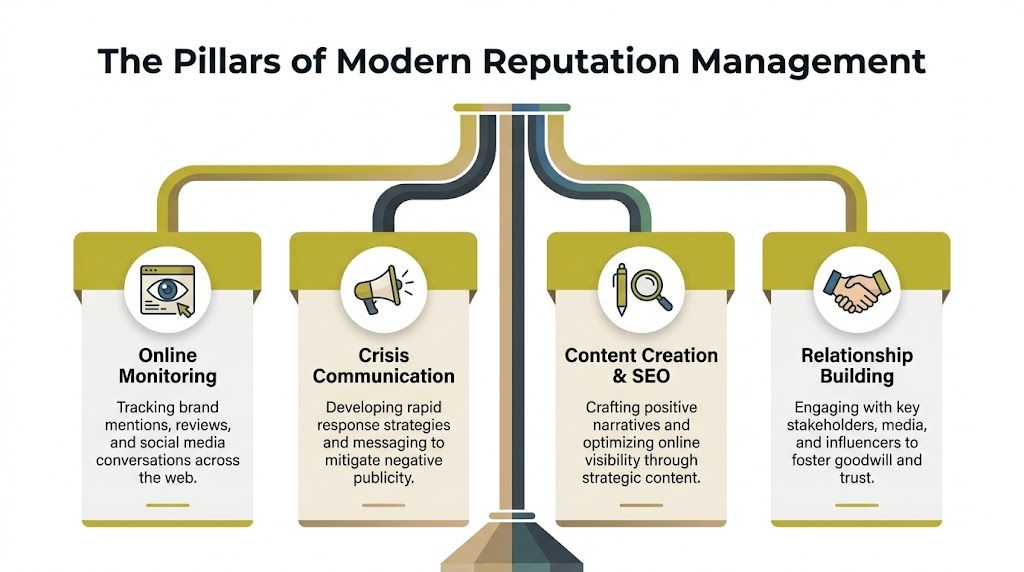
London Research found that UK businesses using advanced reputation tools see 2x higher efficiency in their Voice of the Customer programmes, which helps explain why mature teams move beyond ad hoc spreadsheets and inbox monitoring toward integrated systems. The report is available in the State of Online Reputation Management study.
Pillar one: proactive digital defence
This is the search and content layer. It exists to make sure people find your best evidence first.
That means building and strengthening the assets you control. Your website. Leadership bios. service pages. Google Business Profile. High-quality articles. Interview features. Helpful content that answers real customer questions. For local firms, directory accuracy matters too, because inconsistency weakens trust and search performance.
What doesn’t work is pumping out thin blog posts and hoping Google will “bury” negative content automatically. Search suppression only works when the replacement assets are credible, relevant and stronger than what they’re competing against.
Pillar two: strategic digital PR
PR in this context isn’t vanity coverage. It’s narrative shaping. You want accurate, credible, well-placed material that gives customers, journalists and partners a fuller picture of who you are and why your business matters.
Former national journalists and agency teams with international brand experience tend to be stronger here because they understand both sides of the exchange. They know what a newsroom will cover and how a brand should present evidence, spokespeople and timing.
In practice, strategic PR may involve:
- Expert commentary: Placing founders or senior staff in relevant sector stories.
- Thought leadership: Publishing opinion pieces with substance rather than self-promotion.
- Reactive media handling: Answering breaking opportunities or allegations with speed and precision.
- Reputation recovery coverage: Creating legitimate positive material that can rank, be referenced, and rebalance perception.
Good PR doesn’t shout over criticism. It gives the market better material to work with.
Pillar three: proactive review management
Many businesses are weakest when they ask for reviews irregularly, respond inconsistently, and only look at sentiment when there’s already a problem.
A better system is operational. Ask at the right moments. Route feedback properly. Respond with a recognisable tone of voice. Escalate serious complaints fast. Learn from recurring patterns. If customers mention the same issue across Google, Trustpilot and direct emails, that’s not a communications issue alone. It’s a business issue that’s become visible.
Tools matter here. So does judgement. AI can help with triage, summaries and alerts, but templated replies can make a frustrated customer even angrier if the language sounds robotic. For a practical look at where this is heading, this piece on AI monitoring for brand reputation is worth reading.
Pillar four: crisis communications
When a crisis lands, speed matters. But sequence matters more.
A useful response order is often: establish facts, pause internal speculation, designate one decision-maker, prepare a holding line, contact affected stakeholders directly, then issue outward messaging. Teams that reverse that order often create avoidable contradictions.
Crisis communications also means knowing when not to say more. Over-explaining before facts are established can expose you. Under-explaining can make you look evasive. The balance depends on what’s known, what can be verified, and who is already involved.
Core Reputation Management Services
| Service Pillar | Primary Goal | Common Tactics |
|---|---|---|
| Proactive Digital Defence | Strengthen search visibility and control branded results | SEO content, profile optimisation, website improvements, listings management |
| Strategic Digital PR | Shape public narrative with credible third-party validation | Media relations, thought leadership, commentary, profile building |
| Proactive Review Management | Build trust and handle customer sentiment consistently | Review requests, response frameworks, escalation routes, platform monitoring |
| Crisis Communications | Reduce harm during fast-moving incidents | Holding statements, media handling, internal briefings, stakeholder messaging |
Your Blueprint for Assessing and Repairing Your Reputation
When a business says it has a reputation problem, the first task is to define the problem properly. Is the issue search visibility, review sentiment, negative press, executive exposure, or a combination of all four? If you skip that diagnosis, you waste time solving the wrong thing.

Start with a hard audit
Run branded searches manually. Look at Google, Google News, image results, Reddit, Trustpilot, Companies House references, review platforms and social profiles. Check what appears for the business name, founder names, product names and any phrase linked to the dispute.
Then map what you find into categories:
- Controlled assets: Your website, social channels, Google Business Profile, owned content.
- Earned assets: Press coverage, interviews, listings, third-party features.
- Risk assets: Negative reviews, complaint threads, hostile articles, forum discussions, old or inaccurate pages.
This stage is often uncomfortable because it replaces assumptions with evidence. That’s the point.
Set objectives that match the problem
If the issue is trust, your goal may be review recovery and better response quality. If the issue is search distortion, your goal may be to strengthen page-one control with authoritative assets. If the issue is media hostility, you may need message discipline and proactive third-party validation.
Not every problem should be attacked with content. Sometimes the fastest reputational improvement comes from fixing service failures and changing how the business communicates with dissatisfied customers.
Field note: The market forgives a mistake more readily than it forgives denial, delay or visible indifference.
A practical framework for this stage should include owners, approval routes, platform priorities and a reporting rhythm. If trust has been damaged, the recovery work also needs to be visible to customers, not just discussed internally. This guide on how to rebuild trust offers a sensible companion read.
Execute in the right order
A reliable sequence looks like this:
- Correct inaccuracies first: Fix listings, bios, broken pages and outdated information.
- Respond to live issues: Reviews, media enquiries and active social complaints need immediate attention.
- Build positive assets: Publish material that deserves to rank and to be cited.
- Strengthen authority: Secure coverage, partnerships, mentions and leadership visibility.
- Review and adapt: Track what’s changing and where resistance remains.
The reason order matters is simple. If your controlled assets are weak, your PR won’t stick. If your operational issues continue, your review generation programme will produce mixed results.
A UK case worth noting
Curchods Estate Agents is a useful example because it shows what unified reputation work looks like at scale. By implementing a coordinated strategy, the business achieved a 4,094% increase in business listing views and a Reputation Score 425 points above the industry average, a result highlighted in this overview of online reputation management companies in London for 2026.
The lesson isn’t that every business should copy the same tools or expect the same shape of outcome. It’s that reputation repair works best when data, listings, reviews and response processes are managed together rather than in isolation.
How to Choose the Right Reputation Agency in London
Most businesses don’t need more activity. They need better judgement. That’s the key test when choosing a reputation agency in London.
A weak agency will talk in vague promises. It will hint at secret methods, obsess over vanity metrics, or sell “suppression” without asking enough questions about operations, legal exposure or stakeholder risk. A strong agency will ask awkward questions early and give you a realistic view of what can be fixed, what can be influenced, and what must be managed properly over time.
Start with the team, not the deck
For reputation work, background matters. Ask who will lead the account. Not who pitched it.
If the issue touches media risk, public controversy or executive exposure, journalism experience matters. Teams made up of former national news journalists and agency practitioners who’ve worked with international brands tend to spot story angles, newsroom triggers and reputational weak points faster than generalist marketers. They know what reporters notice. They also know how a poor statement can lengthen the life of a bad story.
Look for evidence of proactive thinking
The best agencies don’t just react when there’s a fire. They put systems in place that reduce the chance of one.
That matters because reputation leaders behave differently from the mainstream. 43% track rating scores compared with 28% of mainstream peers, and 46% publicise positive ratings compared with 21%, which shows how much stronger agencies can be when they drive active visibility rather than passive monitoring. That contrast is captured in the Deloitte-cited benchmark referenced earlier in the article.
Ask any prospective partner how they handle these areas:
- Review strategy: How do they help you generate, route and answer feedback?
- Search control: What assets do they build or improve to strengthen branded results?
- Press handling: Who writes statements and deals with journalists when pressure rises?
- Reporting: Do they report on meaningful movement or just task completion?
Avoid black-box methods
Some firms rely on mystery. That should worry you.
You need to know whether an agency is using legitimate PR, SEO, review management and stakeholder communications, or whether it’s leaning on tactics that may create a second problem later. If they can’t explain their methods clearly, walk away.
A sensible partner should also be transparent about trade-offs:
- Legal routes can help, but they can be slow, public and sometimes strategically clumsy.
- SEO can improve visibility, but it won’t fix an unresolved customer issue.
- PR can rebalance narrative, but it won’t erase documented facts.
- Monitoring can spot risk early, but someone still needs authority to act on the alert.
If you want a benchmark for the kind of integrated thinking to look for, review what a senior-led PR and marketing agency should cover across media, search and crisis support.
The right agency doesn’t promise a spotless internet. It builds a stronger, truer version of your public record.
Your Next Steps and Reputation FAQs
If your business has a reputation issue, start today. Not with a dramatic public statement, but with an audit, a response plan and a clear view of who decides what. Delay is expensive in reputation terms because silence lets other people define the facts, the tone and the search presence around your brand.
Common questions
How much does reputation management in London cost
It varies widely. The price depends on the severity of the issue, how many channels are involved, whether legal review is needed, and whether you need ongoing protection or one-off repair. A review-response system is a different job from a live media crisis involving founders, staff and regulators.
How long does it take to see results
Some improvements can happen quickly. A well-handled review response, corrected profile, or stronger holding statement can change perception immediately. Search improvement, narrative repair and trust recovery usually take longer because you’re replacing an existing public record with a better one over time.
When should a lawyer be involved
Bring in a lawyer when content may be defamatory, confidential information has been exposed, a regulator is involved, or a journalist is preparing a serious allegation. But legal advice should sit alongside communications judgement, not replace it. A legally accurate response can still be reputationally poor if it sounds cold, evasive or disproportionate.
Can negative content always be removed
No. Sometimes the right answer is removal. Sometimes it’s correction. Sometimes it’s response, de-escalation and stronger competing visibility. The key is to choose the route that fits the facts rather than defaulting to threats or wishful thinking.
Is reputation management london mainly for large companies
No. In many ways, SMEs are more exposed because they have fewer buffers. A single bad article, a cluster of poor reviews, or an unmanaged founder profile can distort the whole business more quickly than it would at a larger firm with established brand equity.
The main point is simple. Reputation isn’t luck, and it isn’t just PR. It’s an asset you can build, monitor, defend and repair with the right mix of judgement, process and visibility.
If your business needs senior-level help with reputation management, crisis communications, digital visibility or press handling, Carlos Alba Media offers confidential support from a team of former national news journalists and experienced agency specialists who know how to protect a brand under pressure.