
When trust is broken, it’s not just about saying sorry. It’s about earning back the confidence you’ve lost through consistent, transparent actions. This means you have to own the mistake, deliver a sincere apology, and, most importantly, prove over time that you are genuinely committed to changing your ways.
Why Trust Erodes and How to Spot the Cracks

Trust rarely shatters in one big, dramatic event. More often, it’s a slow burn. It gets chipped away by a series of small but damaging let-downs: promises that go unfulfilled, messages that are all over the place, and a complete failure to listen to the people who matter most. When a crisis hits, the instinct for many organisations is to grab the standard PR playbook and issue a hollow, corporate-sounding apology. This only makes people more cynical.
The starting point for truly rebuilding trust is a complete shift in mindset. At Carlos Alba Media, our specialist nature comes from the fact that everyone on our team is either a former national news journalist or has extensive agency experience working with international brands. We don't think like a typical PR agency; we think like reporters. And we know from experience that the public and the media can spot a carefully-worded, insincere statement a mile off.
Thinking Like a Journalist to Diagnose the Damage
You can’t fix a problem until you understand what actually caused it. Before you even think about drafting an apology, you need to conduct a brutally honest assessment of how and why you lost trust in the first place. This means you have to put on your investigative journalist hat and ask the tough questions.
- What was the specific thing that broke the trust? Be precise. "Poor communication" is a symptom, not the root cause. Was it a misleading ad, a product that failed to deliver on its promise, or a commitment you quietly walked back?
- Who did this impact? You have to think about everyone: your customers, your employees, your investors, and the wider community. Each group will feel the sting of a broken promise differently.
- Where was the gap between what we promised and what we delivered? Pinpoint the exact moment your organisation's actions strayed from its stated values or commitments.
This diagnostic phase is absolutely non-negotiable. It forces you to look at uncomfortable truths head-on, and it lays the groundwork for every single step that comes next. A shallow understanding of the problem will only ever lead to a shallow, ineffective response.
The biggest mistake an organisation can make is to underestimate its audience. People remember what you said you would do, and they will hold you accountable when your actions don't match your words. The first step to recovery is admitting you failed to live up to those expectations.
The Modern Trust Landscape
The challenge of rebuilding trust is much harder today than it’s ever been. Take the UK, for example, where the trust gap between high- and low-income groups has widened dramatically. Research from Edelman reveals this income-based trust divide has grown almost tenfold since 2012, from a mere 2 percentage points to a staggering 19.
What this means in practice is that while high earners’ trust has stayed relatively stable, confidence among low-income groups has flatlined. This creates a massive disparity in how different parts of society see your business. In this environment, a one-size-fits-all communications strategy is doomed to fail.
How to Say Sorry and Actually Mean It
When things go wrong and trust is on the line, a weak apology can do more harm than good. A statement that’s just about managing the fallout doesn't just miss the mark—it can feel like a fresh insult. Getting an apology right is about taking total, unflinching ownership of the mistake.
At Carlos Alba Media, our team is comprised of specialists who have come from the sharp end of national news or have senior agency experience working with international brands. We’ve spent years watching corporate statements get torn apart by journalists and the public. That expertise taught us exactly which weaselly words and hollow phrases will get you called out immediately.
What a Real Apology Looks Like
A proper apology isn't just a single sentence; it's a combination of crucial elements that prove you understand just how badly you’ve messed up. If you miss one, the whole thing falls apart. It has to go miles beyond a simple "we're sorry."
Think of it as making a three-part promise to everyone watching:
- Take the Hit: State exactly what you did wrong. No "ifs," "buts," or vague language. Just the facts.
- Show You Get It: Acknowledge how your actions made people feel. You need to connect with their frustration, anger, or disappointment.
- Explain What's Next: Outline the specific things you’re doing right now to start fixing the problem.
This is your chance to face the music with integrity, not to try and shift blame or play down the consequences.
Our 3-C Test for a Bulletproof Apology
Before any crisis statement leaves our hands, we run it through our 3-C Test. It’s a simple framework we developed to pressure-test communications and make sure they’ll land the right way. Your apology has to be:
- Clear: Is it easy to understand? Does it tackle the real issue head-on, without hiding behind corporate speak?
- Contrite: Does it sound genuinely sorry? The tone has to match the seriousness of the situation. You need to be sorry for the impact you had, not just for getting caught.
- Committed: Is there a clear plan? You must commit to concrete actions that will stop this from ever happening again.
An apology that starts with, "We're sorry if anyone was offended," has already failed. It’s a classic, blame-dodging move that screams insincerity. People see right through it, and it will only make them trust you less.
This test is vital for avoiding common mistakes. In a fragile economy, the stakes are even higher. With 94% of UK businesses trading but only 83% fully operational, making promises you can’t keep is a recipe for disaster. Research from the Office for National Statistics shows that 32% of businesses see economic uncertainty as a key challenge, meaning stakeholders have zero patience for flimsy commitments.
Apology Examples for Real-World Scenarios
The exact wording will always depend on the crisis, but the principles of the 3-C Test are universal. Here’s how they look in practice.
Scenario 1: A Critical Product Failure
Your latest software update went live with a major bug, causing some customers to lose their data.
- The Bad Version: "We are aware of an issue impacting some users and are working to resolve it. We apologise for any inconvenience." (This is vague, cold, and non-committal.)
- The Good Version: "We are deeply sorry. Our latest software update had a major flaw that resulted in data loss for some of our customers. This is completely unacceptable, and we take full responsibility. Our team is working around the clock to restore the data, and we have frozen all further updates. We will contact every affected customer directly and are providing a three-month service credit to make up for the disruption." (Clear, contrite, and committed.)
Scenario 2: An Ethical Mess
One of your senior leaders made inappropriate comments in a public forum.
- The Bad Version: "The comments made by the executive do not reflect the views of our company." (This just distances the company from the problem without taking responsibility for the leadership failure.)
- The Good Version: "We unreservedly apologise for the offensive and inappropriate comments made by one of our leaders. There is no excuse for this, and it goes against everything we stand for. We have suspended the individual while we conduct a full investigation and are immediately rolling out mandatory respect-in-the-workplace training for our entire leadership team. We failed you, and we are committed to earning back your trust." (Clear, contrite, and committed.)
At the end of the day, an apology is just the starting line. Words are easy. It's what you do next that really counts and shows whether you're serious about rebuilding what you broke.
Turning Apologies into Visible Action
Right, you’ve said sorry. Now what?
A carefully worded apology is just the starting pistol. Words are cheap, and your audience knows it. The real work of winning back trust starts now, and it’s your actions—not your promises—that will determine whether you can genuinely repair the damage.
The specialist team at Carlos Alba Media is built from former national news journalists and agency professionals who’ve worked with international brands. Our expertise comes from being on both sides of the fence, and we’ve seen countless times what separates a fleeting crisis from a lasting comeback story. It all comes down to visible, tangible action.
Creating Your Trust Recovery Roadmap
To move forward, you need more than just good intentions; you need a concrete plan. I’m not talking about an internal memo that gets filed away. You need a public-facing ‘Trust Recovery Roadmap’. This is your playbook for turning words of apology into a series of real, measurable actions that show everyone you’re serious about change.
Think of it as a project plan for rebuilding confidence. It needs to detail the specific, time-bound steps your organisation will take to fix the root cause of the problem. This isn't just about process; it's about demonstrating accountability and transparency, the two core ingredients for rebuilding trust.
Your roadmap might include a mix of bold moves, such as:
- Operational Overhauls: Announcing a full-scale review of the failed processes, ideally led by an independent third party to ensure impartiality.
- New Training Protocols: Rolling out mandatory training for every single employee on ethics, customer service, or whatever specific area led to the failure.
- Leadership Accountability: Publicly outlining what's happening with the leaders responsible for the breakdown. This could range from suspension to a significant change in their duties.
The most powerful thing you can do is hold yourself publicly accountable. A roadmap isn't just a to-do list; it's a promise. When you publish it, you’re inviting your audience to judge you by your follow-through. That’s a massive signal of genuine commitment.
From Internal Change to External Communication
Making these changes behind the scenes is only half the battle. You have to translate those internal actions into a clear, consistent story for the outside world. This is where so many organisations get it wrong—they do the hard work but forget to bring their audience along for the ride.
The key is to embrace a mindset of radical transparency. You need to share your progress, warts and all. Talk about the wins, but also be honest about the challenges and even the setbacks. This kind of raw honesty is far more believable than a slick PR campaign showing only perfect results.
In the previous section, we talked about our 3-C Test for a sincere apology: being Clear, Contrite, and Committed. This is where that third ‘C’ really comes to life.
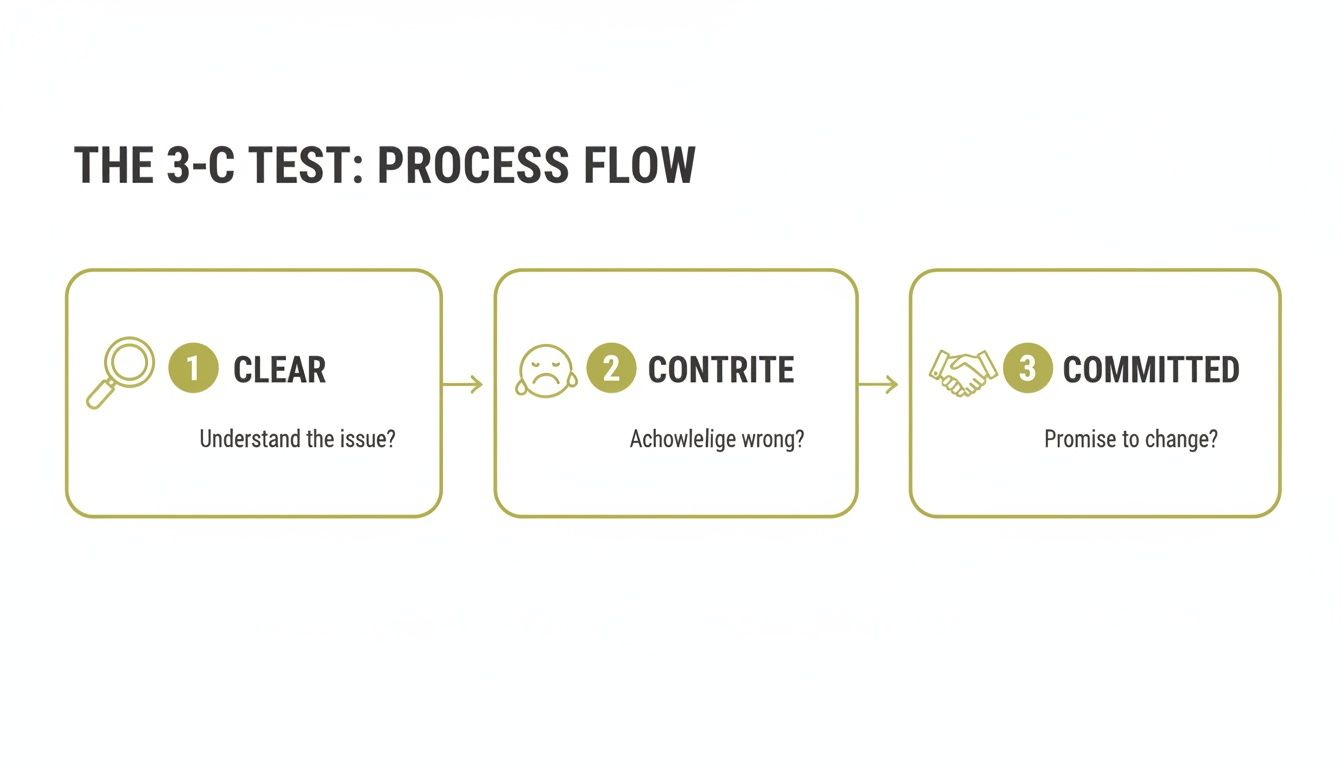
As you can see, a successful apology naturally flows from acknowledging the problem to proving your commitment to future action. Your roadmap is the delivery mechanism for that commitment.
Get into a rhythm of creating content that chronicles your recovery. This isn't about bragging; it’s about reporting.
- Blog Posts: Write detailed updates on your roadmap's progress. If you’re fixing a safety procedure, write a post explaining exactly what was wrong with the old system and how the new one is demonstrably better.
- Video Updates: Get your CEO or another senior leader on camera to give a personal update. Video adds a human touch and conveys sincerity in a way that plain text often can't.
- Social Media Content: Use your social channels for smaller, more frequent updates. Share milestones and behind-the-scenes glimpses of the changes you're making to keep the conversation going and show your continuous effort.
By consistently and openly communicating your actions, you stay in control of the narrative and prove your apology was more than just empty words. This proactive approach is a cornerstone of effective communications crisis management.
At the end of the day, action is the only currency that truly matters when you need to rebuild trust.
Your Comeback Starts on the Inside

When a crisis hits, the instinct is to immediately focus outwards—on customers, investors, and the relentless media cycle. But there’s a group closer to home whose trust is the bedrock of any successful recovery: your own people. Forget about winning back the public if you haven't first won back your team.
Your employees are either your most powerful advocates or your most credible detractors. The expertise at Carlos Alba Media comes from the fact that our team is made up entirely of former national news journalists or agency specialists with international brand experience—we’ve seen it time and again that the most damaging leaks almost always come from a workforce that feels ignored, devalued, or lied to. Any genuine effort to rebuild trust has to start from the inside out.
Turning Sceptics into Advocates
Before you can even think about restoring public confidence, you have to mend the broken faith within your own four walls. A team that feels let down quickly becomes disengaged, and productivity plummets. This isn't just about morale; it leads to higher staff turnover, which directly kneecaps your ability to serve customers and get back on your feet.
Your first move is to create genuinely safe spaces for frank conversation. This goes way beyond a dusty, anonymous suggestion box. You need to actively dismantle any culture of fear or silence that might have let the problem fester in the first place.
Here are a few things that actually work:
- Run 'Ask Me Anything' sessions: Organise forums where your team can question leaders on anything, without fear of comeback. Leaders need to show up ready to answer the tough stuff with honesty and vulnerability, not deflect with corporate speak.
- Set up truly anonymous feedback channels: Use a third-party tool to guarantee anonymity for concerns and feedback. This gives a voice to people who might be too intimidated to put their hand up in a meeting.
- Bring your people into the solution: Don’t just hand down a recovery plan from on high. Create cross-departmental teams to help shape and implement the changes you’ve promised. This creates a powerful sense of ownership.
The moment your team feels truly heard is the moment they start to believe in the comeback. When they're part of the solution, they become the foundation of your recovery, not another risk you have to manage.
The Power of Leading with Vulnerability
For any leader, this kind of internal reset is uncomfortable. It means trading the armour of authority for the openness of vulnerability. It’s about admitting you don’t have all the answers and proving that you’re listening. When a leader is open about their part in what went wrong, it sets the tone for the entire organisation.
This is fundamental to rebuilding psychological safety. As you move forward, you must build a speak up culture that fosters trust, where people feel secure enough to voice concerns.
Getting Your Internal Story Straight
In the current business climate, this internal focus is more critical than ever. UK small business profitability has shown surprising resilience, with 78% of SMEs reporting profits in 2024. But with a median profit of just £13,000, margins are incredibly tight. You simply can't afford the liability of a disengaged, untrusting workforce when every person’s contribution is so vital. You can find more detail on these SME statistics on MerchantSavvy.co.uk.
Make sure your internal communications are just as transparent as your external ones. If you're sharing a recovery roadmap with the world, your employees need to see it first and understand their role in making it happen. The story you tell your team is the one they'll carry with them outside the office. By focusing on this, you're not just fixing a problem; you’re mastering the skills of brand storytelling that builds lasting connections.
By putting internal trust first, you’re doing more than just managing a crisis. You’re building a stronger, more resilient organisation that’s ready for whatever comes next.
Communicating Progress and Measuring Your Comeback
Getting through a crisis isn't a one-and-done deal. The apology and the recovery plan are just the start. The real work—and the part that truly rebuilds trust—is the long, steady grind of proving you meant what you said. This is where you have to maintain momentum through constant communication and honest measurement.
You’re shifting from putting out a fire to rebuilding the house, stronger than before. But it’s not enough to just do the work behind the scenes; you have to bring people along for the journey.
At Carlos Alba Media, our unique expertise is founded on our team of specialists—all are either former national news journalists or senior agency figures who’ve navigated these situations with international brands. We know that after the initial storm passes, the only thing that earns back genuine respect is sustained, credible proof of change.
Building Your Trust Dashboard
If you can’t measure your comeback, you can't manage it. Forget about vanity metrics like social media likes – they won’t tell you a thing about trust. What you need is a 'Trust Dashboard' that gives you a real-time, unfiltered view of how your stakeholders actually feel.
This isn't about finding data to make you look good. It's about tracking the metrics that show genuine shifts in belief and attitude. This dashboard becomes your evidence.
Here are the essential metrics you should be tracking:
- Sentiment Analysis: Go deeper than just positive or negative mentions. Use sophisticated tools to analyse the nuance of the conversation online and in the media. Are people discussing your recovery efforts? Is the tone shifting from anger to cautious optimism? Or are they just silent?
- Employee Feedback Scores: Your team is on the front line. Use regular, anonymous pulse surveys to get a read on internal morale, engagement, and whether they believe in the new direction. A rising score here is one of the strongest leading indicators that external trust will follow.
- Stakeholder Perception Surveys: Don't guess what your customers, partners, or investors are thinking—ask them. Surveying them directly about their confidence in your organisation shows you respect their opinion and aren’t afraid of the answer, good or bad.
Tracking this data takes the guesswork out of rebuilding trust and turns it into a managed strategy. It gives you hard evidence to share and pinpoints where your message still isn't cutting through.
Your 30-90-180 Day Communication Timeline
Silence is your enemy in a post-crisis world. It breeds suspicion. To counter this, you need a disciplined communication timeline that keeps everyone in the loop at key moments. A steady rhythm of updates is what proves your commitment is real and not just a PR stunt.
The First 30 Days: Report on Immediate Actions
The focus here is all about urgency and follow-through. You’ve said you’ll act, so now you show you’re acting.
- What to share: Confirmation that investigations have started, details of immediate operational changes (like a product recall or new safety protocols), and insights from leaders on what they’ve learned from early listening sessions.
- The goal: Demonstrate that you've moved swiftly from words to deeds.
The 90-Day Mark: Showcase Tangible Progress
Three months in, you need to have something concrete to show for your efforts. This is where you start to earn back some credibility.
- What to share: Share initial findings from your internal reviews, data from new training programmes, or even testimonials from employees and partners who are part of the change process.
- The goal: Offer tangible proof that your recovery roadmap is more than just a piece of paper.
The 180-Day Milestone: Embed the New Narrative
After six months, the conversation needs to shift from fixing the past to defining your new future.
- What to share: Announce permanent changes to policies, leadership, or company structures. Consider publishing a transparent "lessons learned" report and publicly celebrate the teams that drove the changes.
- The goal: Position the organisation as one that has genuinely learned and evolved. You're not just 'fixed'—you're now stronger because of what happened.
At this stage, your actions must speak louder than any residual noise from the crisis. Once apologies are in motion, truly rebuilding trust often requires a concerted effort to manage how you are perceived, a task greatly aided by a practical guide to personal online reputation management.
Earning Your Comeback Story
Ultimately, you want to transform your story from a crisis case study into a masterclass on how to handle one. This is where our specialist newsroom expertise at Carlos Alba Media becomes a powerful asset. Our team of former journalists knows exactly what makes a comeback story credible—and what makes it fall flat.
It’s not about pitching a fluffy "we’ve learned our lesson" piece. It’s about arming journalists with a compelling, evidence-backed narrative of real transformation. That means giving them access to the data from your Trust Dashboard, offering up the leaders who spearheaded the changes for tough questions, and being brutally honest about the roadblocks you hit along the way.
When you manage your story with this level of transparency, you do more than just repair your reputation—you fortify it. You show the world that your organisation has the integrity to face its failures head-on and the resilience to emerge more trustworthy than before. This measured, open approach is the core of our reputation management services in the UK, designed to turn a crisis into a long-term reputational advantage.
Your Questions Answered: Navigating the Path to Rebuilding Trust
When a trust crisis hits, the questions come thick and fast. Leaders often feel like they're navigating a minefield alone, under intense pressure to make the right call. At Carlos Alba Media, we’ve been in the room when those questions were asked, advising everyone from nimble start-ups to huge international brands.
Our unique expertise stems from our team composition: every member is either a former national news journalist or a senior agency pro with international brand experience. This means we've seen these situations from both sides of the fence. Here are our straightforward answers to the questions we hear most often.
How Long Does It Really Take to Rebuild Trust?
This is always the first question, and the honest answer is it takes longer than you want it to. There’s no magic number. Think of it less like flipping a switch and more like growing a tree—it demands patience and the right conditions to flourish.
How long the process takes really boils down to a few things:
- The scale of the breach: A simple service outage is a world away from a serious ethical failure.
- Your existing reputation: If you’ve built up years of goodwill, you have more ‘trust capital’ in the bank to draw from. A history of missteps leaves you with very little.
- How you respond: A fast, transparent, and genuinely sorry response can dramatically shorten the recovery time.
As a rule of thumb, expect the recovery to take at least twice as long as you think it should. The real focus shouldn't be on speed, but on substance. Rushing things is a surefire way to make them worse.
What’s the Biggest Mistake Companies Make When Apologising?
Without a doubt, the most damaging error is the ‘non-apology apology’. These are the hollow statements, usually cobbled together by legal teams, that sound like an apology without admitting any actual fault. They’re full of weasel words like, "we regret if anyone was offended" or "we're sorry for the perception."
Our experience as journalists taught us one thing: the public and the media can spot this insincerity from a mile off. An apology that deflects blame is often worse than saying nothing at all because it feels like a fresh insult. It shows you’re more interested in protecting yourself than acknowledging the harm done.
A genuine apology is unambiguous. It means taking full ownership, showing real empathy for those affected, and outlining the specific actions you'll take to fix the problem. Anything less just digs a deeper hole.
How Can a Small Business Manage a Crisis on a Limited Budget?
For a small business without a big comms team or budget, a crisis can feel overwhelming. But small and medium-sized enterprises (SMEs) have a secret weapon: a much closer, more personal connection with their customers and community.
You don't need a massive PR budget to manage a crisis well. Here’s what to do:
- Get Personal and Proactive: Forget the press conference. The business owner should be the one personally responding to customers on social media, by email, or even over the phone. That human touch is more powerful than any expensive campaign.
- Use Your Own Channels: Your company blog, email list, and social media feeds are your direct line to your audience. Use them to communicate openly and provide regular updates. You control the narrative here.
- Show, Don't Just Tell: Grab your phone and shoot a quick video showing the changes you're making. A sincere, unpolished apology from the founder can build incredible credibility.
For a small business, sincerity and direct engagement are your greatest assets. They cost nothing, but when it comes to rebuilding trust, they’re priceless.
Rebuilding trust is a difficult, demanding journey. At Carlos Alba Media, our unique blend of newsroom experience and brand strategy helps organisations navigate these challenges with confidence. If you need senior-level counsel to protect and restore your reputation, find out how we can help.