
You’ve built something good. Customers rate the product highly, referrals come in, and the business is moving. But outside your existing circle, hardly anyone knows you exist. Journalists aren’t calling. Trade titles aren’t covering you. Bigger competitors with weaker offers seem to get all the attention.
That’s usually the point where founders start searching for a pr marketing agency.
The problem isn’t that there aren’t enough agencies. The problem is that there are too many, and many sound alike. Promises blur together. “Brand awareness”, “storytelling” and “visibility” all sound useful until you ask who’s doing the work, what they’ve handled before, and how they’ll help your business get commercial value from coverage.
In the UK, public relations has a long professional history. Basil Clarke’s Editorial Services, established in 1924, is recognised as the first professional consultancy in Britain, helping formalise PR as a structured service rather than informal publicity, as noted in the history of public relations overview. That matters because the UK market has had a long time to become highly developed. Clients should expect more than press release churn and vanity coverage.
For SMEs in Scotland and across the UK, a key opportunity is finding a model that gives you senior judgement without big-agency drag. That usually means looking closely at agencies built by former national journalists and experienced operators who know what makes a story land, what an editor will reject, and how to position a founder credibly in print, on air and online.
Practical rule: Don’t hire PR to “do some publicity”. Hire it to solve a business visibility problem.
Your Guide to Finding the Right PR Partner
A good PR partner helps you close the gap between being good and being known. That doesn’t mean chasing coverage for its own sake. It means using communications to build trust with the people who affect growth: customers, investors, partners, recruits, regulators and trade audiences.
Many SME owners approach PR too late or too vaguely. They know they need more exposure, but they haven’t decided whether that means national press, trade media, founder profiling, better social proof, crisis readiness, or stronger search visibility from digital PR. If you’re not clear, the agency can’t be clear either.
What the right agency relationship looks like
A strong agency relationship feels less like outsourcing and more like adding a sharp external team to the business. You want people who can challenge weak angles, tighten your message and tell you directly when a story won’t travel.
The best advisers don’t just ask, “What do you want announced?” They ask questions such as:
- What commercial outcome matters most right now
- Which audience needs convincing first
- Where does reputation risk sit
- Who will speak for the business when scrutiny increases
That’s where newsroom insight matters. Former national journalists understand deadlines, format, editorial standards and the difference between a sales message and a publishable story. They know how to prepare spokespeople properly, how to package evidence, and how to avoid wasting weeks on angles no editor would touch.
What usually goes wrong
Founders often make one of two mistakes. They either hire a large agency with a polished pitch but a junior delivery team, or they choose the cheapest option and get activity without strategy.
A better route is to vet for fit, access and judgement. You’re looking for an agency model where experienced practitioners stay involved, where the business understands the UK and Scottish media environment, and where coverage is tied back to trust, demand and reputation rather than just clipping reports.
First Steps Defining Your Goals and Budget
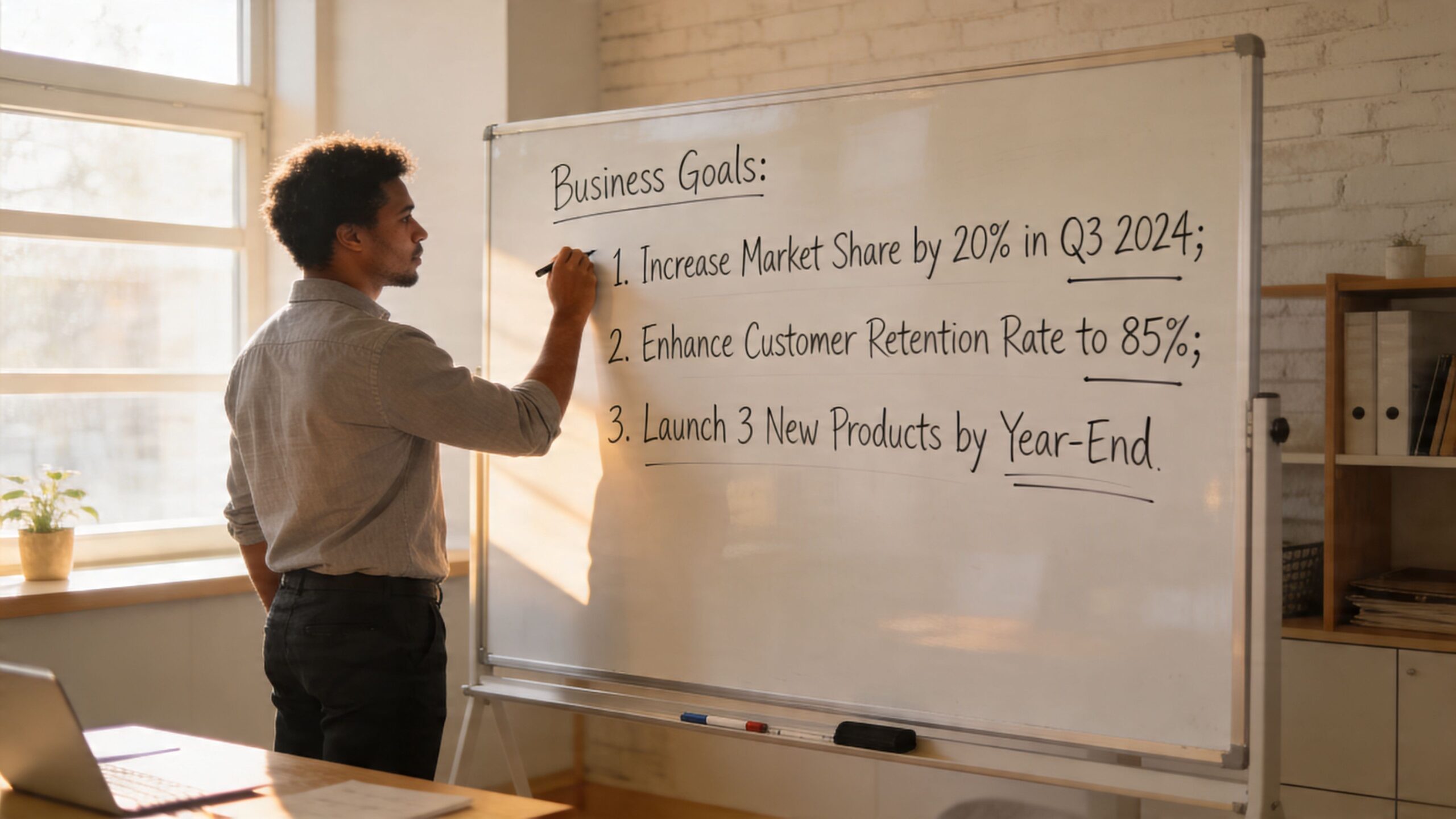
Before you contact any agency, get specific about what success means. “We need more PR” isn’t a brief. It’s a symptom.
Start with business outcomes, not tactics
PR works best when it supports a commercial goal you can name clearly. For an SME, that might be:
- Lead quality: Attracting better-fit enquiries rather than more low-intent traffic.
- Market trust: Building credibility in a regulated or specialist sector where buyers need reassurance.
- Investment profile: Helping founders look established, articulate and visible to backers.
- Launch support: Giving a new product, destination, service or expansion a stronger market entry.
- Recruitment reputation: Making the company easier to join because people know what it stands for.
If you can’t connect PR to one of those, pause and sort that first. An agency can sharpen your story, but it can’t invent your priorities for you.
A practical way to frame this is to build a short communications brief around audience, message, business objective and proof points. If you need a structure for that thinking, this guide on what is a communications strategy is a useful starting point.
Be realistic about budget
Budget is where many SMEs hesitate, often for good reason. According to a 2025 UK PR industry report cited in this PR agency pricing discussion, 68% of SMEs cite budget constraints as the top barrier to PR engagement, while 22% report measuring ROI effectively. The same source notes that average agency retainers for national coverage range from £5,000 to £15,000 per month.
That doesn’t mean PR is out of reach. It means you need to choose the right model. If your budget won’t stretch to a large retainer, don’t buy a diluted version of a big-agency service. Buy focus instead. A lean, senior-led team with a narrow brief often creates more value than a broad retainer filled with meetings, layers and general activity.
Treat budget as a filter for scope, not a reason to abandon PR altogether.
Measure what matters
Many businesses struggle with PR ROI because they look at the wrong indicators. Start with a simple scorecard:
| Area | What to track |
|---|---|
| Visibility | Quality of coverage, relevance of outlet, share of voice themes |
| Trust | Enquiries mentioning coverage, investor confidence, partnership conversations |
| Demand | Referral traffic, inbound leads, assisted conversions |
| Spokesperson impact | Interview opportunities, speaking invitations, profile strength |
PR doesn’t live in a silo, so your measurement shouldn’t either. If your agency also touches social distribution, founder content or campaign amplification, it helps to understand how to measure social media ROI alongside earned media performance.
Matching Agency Services to Your Business Needs
A lot of SME owners buy the wrong PR service for a simple reason. The proposal sounds broad, the monthly fee looks manageable, and nobody has forced a hard discussion about what the business needs in the next 6 to 12 months.

In practice, PR services do very different jobs. Media relations wins attention. Executive profiling builds trust in the founder or leadership team. Digital PR supports search visibility and online reputation. Crisis support protects the business when scrutiny lands. If you are a UK or Scottish SME with a limited budget, the goal is not to buy everything. It is to buy the few services that match your commercial pressure points.
Core services and when they earn their keep
Media relations is often the starting point. It covers story development, journalist targeting, press handling and spokesperson preparation. Good media relations is not a volume exercise. It depends on knowing what editors will reject, what evidence a reporter will ask for, and which angle belongs in trade press before it goes anywhere near national media. Newsroom insight is particularly valuable here.
Digital PR suits businesses that care about search reputation, referral traffic and authority beyond a single news hit. Done well, it ties together press coverage, useful content, link acquisition and campaign angles that people will publish.
Executive profiling deserves more attention than it usually gets. In founder-led firms, buyers, partners and investors often judge the company through the person leading it. A credible founder profile can shorten sales conversations and improve confidence before a meeting even starts.
Social and content support helps you get more from coverage you have already earned. One mention in the press has value. The same mention reused in outreach, sales materials, investor decks and founder content usually has more.
If you are comparing scopes, check what is included and what has been omitted. Some agencies bundle strategy, press office support, thought leadership and digital PR. Others price each element separately. Carlos Alba Media, for example, sets out a mixed model of press office, digital and reputation work in its online public relations services. That model can work well for SMEs that want senior judgement without paying for layers of account management.
Two services SMEs underbuy
The first is media training. The second is crisis communications.
A 2025 UK Government report cited in this background reference noted that 55% of Scottish SMEs faced reputational incidents in 2025, a 28% year-over-year increase, yet only 19% had a crisis plan. The same source states that 62% of UK executives lack on-camera confidence, reducing interview success by 40%.
Those numbers fit what experienced advisers see every week. A business works hard to get coverage, then puts an unprepared founder into a live radio interview, a hostile callback from a journalist, or a video clip that will sit online for years. The problem is rarely the opportunity. The problem is the lack of preparation.
A founder who can explain the business clearly under pressure is a commercial asset, not just a media asset.
For SMEs, this is often the smart trade-off. Buy fewer outputs and more judgement. One senior ex-journalist who can shape messages, pressure-test answers and spot a weak angle early can be worth more than a bigger junior team producing activity you do not use.
Match the service mix to your stage
A business launching a new offer usually needs media relations and executive profiling first. A firm in a regulated or exposed category should put crisis planning, message discipline and spokesperson prep much higher up the list. If sales depend on trust, buy thought leadership and media training early. If long-term discoverability matters, add digital PR and content support.
There is also an agency model question behind the service list. Large agencies can offer range, but SMEs often end up paying for process, layers and meetings. A lean, senior-led firm can give better value if the brief is focused and the people doing the work know how newsrooms think. That is the gap many smaller UK businesses should look for.
Before signing anything, treat the proposal like a procurement decision, not a creative wishlist. A simple vendor due diligence checklist can help you test whether the service matches your risk, budget and growth plans.
The right fit is rarely the agency with the longest menu of services. It is the agency whose offer matches the pressure your business is under now, with senior judgement applied where mistakes are expensive.
How to Vet Agencies and Create Your Shortlist
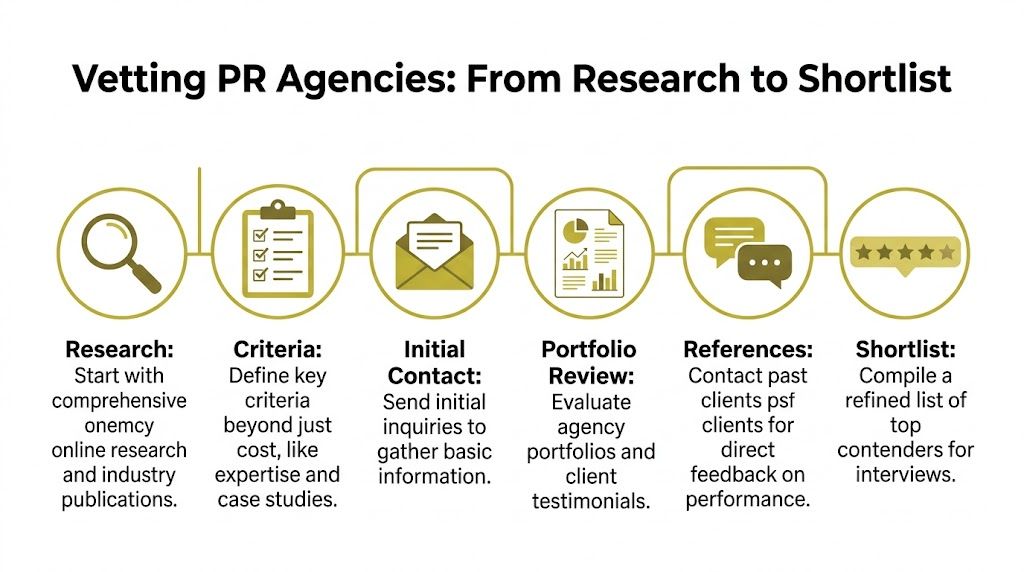
You contact three agencies on a Tuesday. By Friday, you have three polished proposals, three friendly teams, and three different price points. On paper, they all look capable. In practice, one will give you senior judgement, one will give you account management, and one will give you a lot of activity with very little cut-through.
That gap is where SME owners lose money.
A strong shortlist is not a list of agencies with the smartest websites or the biggest client logos. It is a shortlist of firms whose model suits your stage, your budget, and the level of judgement your business needs. In the UK, and especially in Scotland, there is a genuine opportunity here. Smaller firms can often get access to senior, ex-journalist PR counsel without paying large-agency overhead, but only if they screen for it properly.
Look for newsroom judgement, not just agency polish
Any agency can say it has media contacts. The better question is whether the people doing your work understand how a newsroom decides what gets covered, what gets ignored, and what gets challenged.
That usually shows up in small details. They can tell you which claim needs proof before it goes near a journalist. They can explain why a founder profile may work better than a product announcement. They know when a trade title is the right first target and when a national sell-in will waste time.
For many SMEs, that ex-journalist background is the value. It sharpens angles early, avoids weak pitches, and improves the quality of spokesperson prep. A lean, senior-led model can beat a larger team if you are buying judgement rather than volume.
If you operate in a specialist category, it also helps to review agencies with relevant sector depth, such as firms listed in this guide to technology PR agencies in the UK. The point is not to copy a list. The point is to see how clearly an agency’s experience matches the scrutiny your market brings.
Build a shortlist with filters that expose how the agency really works
Keep the shortlist tight. Three to five agencies is enough.
Use criteria that get underneath the pitch:
- Who delivers the work: Ask for the day-to-day team, their backgrounds, and how much senior time is included each month.
- News sense: Check whether they can identify credible angles for your business quickly, without drifting into vague brand language.
- Sector pressure: Look for experience with similar sales cycles, regulation, technical detail, or reputation risk.
- Scottish and UK media understanding: If your growth depends on Scotland, test whether they know the difference between regional, trade, and UK-wide opportunities.
- Agency shape: Find out whether decisions happen quickly or pass through layers that slow down response times.
- Reporting discipline: Review how they track progress, what they count as meaningful coverage, and how they explain a quiet month.
A supplier assessment process helps here. A general vendor due diligence checklist is useful if you adapt it for PR. It pushes the conversation toward accountability, risk, delivery, and decision-making instead of surface chemistry.
Ask for evidence before you agree to a meeting
Do not ask for a free strategy. Good agencies protect their thinking, and speculative ideas often tell you less than the basics.
Ask for the material that shows how the account will run:
| What to request | What it tells you |
|---|---|
| Recent relevant case studies | Whether they have solved similar problems before |
| Team bios | Whether senior operators or juniors will handle the work |
| Example reporting | How they define progress and explain results |
| Contract terms | How flexible they are on scope, notice period, and review points |
| Client references | What the working relationship feels like after the pitch stage |
One warning sign comes up often. If an agency is vague about who will run the account, expect the senior people to disappear once the contract is signed.
Shortlisting works best when you treat PR procurement with the same discipline you would use for a finance lead, legal adviser, or key supplier. Reputation work is too exposed, and too expensive when handled badly, to buy on charm alone.
Interview Questions That Reveal True Agency Value
By the time you reach the pitch meeting, most agencies will sound competent. That’s the trap. The standard presentation is designed to smooth over the details that matter most.

Ask questions that expose delivery, not just vision
Start with who’s on the account. Not the managing director’s background. Not the founder’s awards. The daily team.
Ask:
- Who will run our account day to day, and what is their background?
- What kind of stories do you think are strongest for us, and which ones would you avoid?
- What happens if a journalist challenges our claims or asks for data we can’t share?
- How do you handle a month where the planned angle doesn’t land?
- What would you expect from us internally to make this succeed?
These questions force the agency to move from polish to substance. You’ll quickly hear whether they’ve thought seriously about your category or are relying on generic PR language.
Probe for commercial thinking
PR isn’t separate from business performance. Large holding groups understand that clearly. London-headquartered WPP plc keeps PR at 8.5% of total revenue, and although growth slowed in 2023, that share remained over one percentage point above pre-2022 levels, according to Statista’s public relations industry overview. The point isn’t to compare your SME with WPP. It’s to recognise that PR holds its place in the wider marketing mix when clients see commercial value.
So ask agencies how they think about business impact:
- How will you measure progress in the first phase beyond media mentions?
- Which business teams should your work connect with?
- How do you report on quality, not just quantity?
- What would make you recommend reducing or changing scope?
An agency that understands growth won’t be threatened by those questions.
If your business is in software, SaaS or digital infrastructure, it also helps to compare specialist category experience. This overview of technology PR agencies gives a useful benchmark for what sector-specific capability can look like.
A short explainer can also help you think about what a strong client-agency conversation should sound like:
Listen for what they don’t say
Watch for agencies that only discuss outputs they control. Press releases written. Meetings held. Lists built. Those are tasks, not outcomes.
The stronger answer usually sounds more conditional and more honest. It acknowledges that PR is shaped by timing, evidence, spokespeople, media appetite and consistency. That honesty is useful. It tells you they’re less likely to overpromise and underdeliver.
Finalising the Contract and Onboarding for Success
Once you’ve chosen an agency, don’t rush the paperwork. A weak contract creates most of the avoidable friction later.
Get the scope right
Most PR contracts fall into one of three patterns:
- Retainer: Best when you need ongoing press office support, reputation management or sustained visibility.
- Project-based: Useful for launches, funding announcements, events or defined campaigns.
- Hybrid: A smaller ongoing arrangement with extra project bursts when needed.
No option is universally superior. The right choice depends on how steady your news flow is and whether your need is continuous or episodic.
Read the scope carefully. It should be clear about what’s included, what counts as out-of-scope work, how approvals work, when reports arrive, and how termination is handled. If the wording is vague, the relationship will become vague.
Set KPIs that reflect your actual aims
Avoid KPIs that reward motion over progress. “Number of releases issued” is a weak measure. So is “number of journalists contacted” on its own.
Better KPIs usually sit in a mix of areas:
| KPI type | Example focus |
|---|---|
| Reputation | Quality and relevance of coverage |
| Audience | Reach into target sectors or regions |
| Commercial support | Inbound enquiry quality, partner interest, sales enablement |
| Spokesperson strength | Interview readiness, thought leadership pipeline |
| Resilience | Crisis process, response readiness, message approval speed |
Keep the first phase focused. If you try to measure everything, you’ll learn very little.
Onboarding material that saves weeks
An agency starts faster when you give it proper operating context. At minimum, provide:
- Brand and messaging documents: Existing tone, value proposition, approved wording.
- Business priorities: Sales targets, launch dates, market focus, internal sensitivities.
- Audience detail: Customer types, decision-makers, objections and buyer language.
- Leadership access: Who can approve statements, who can speak publicly, who must be consulted.
- Proof points: Customer examples, milestones, case material, product evidence, images.
- Access where needed: Analytics, social channels, website contacts, previous coverage records.
The best onboarding document is often a blunt one. What are we trying to achieve, what can we prove, and what can’t we say?
Good onboarding removes guesswork. It also tells you quickly whether the agency is organised enough to turn information into momentum.
Frequently Asked Questions About Hiring a PR Agency
| Question | Answer |
|---|---|
| How long does PR take to show results? | It depends on your story strength, sector, spokesperson access and whether the agency is building from scratch or working with existing momentum. Some opportunities move quickly. Reputation building usually takes sustained effort. |
| Should I hire a freelancer instead of an agency? | Sometimes, yes. A strong freelancer can be a good fit for a narrow brief. An agency is usually more useful when you need broader capability, faster response, media training, crisis support or joined-up digital and PR work. |
| Is national coverage always the goal? | No. For many SMEs, the right trade title, regional outlet or broadcast opportunity is more commercially useful than a big-name mention with no relevance. |
| What if an agency promises guaranteed coverage? | Be cautious. Agencies can control preparation, targeting and quality of pitch work. They can’t control an editor’s decision. |
| Do I need PR if I already do paid marketing? | Often, yes. Paid channels create reach you buy. PR builds trust you earn. The two usually work better together than apart. |
| What if results are slow after the first few months? | Review the brief, message, spokespeople, proof points and reporting. Slow progress doesn’t always mean poor agency work. Sometimes the issue is weak internal access, unclear positioning or unrealistic expectations. |
| How important is newsroom experience? | Very important if media coverage, broadcast handling or crisis work sits high on your list. Former journalists usually spot stronger angles earlier and prepare spokespeople more realistically. |
If you want senior-level support without the structure of a large layered consultancy, Carlos Alba Media is a Scottish-led option with teams in Glasgow and London. The agency works across PR, digital marketing, media training and crisis communications, and its team includes former national news journalists and agency practitioners with experience on international brands. For SMEs that want sharper media judgement, stronger spokesperson preparation and practical advice grounded in how newsrooms operate, that model is worth considering.