

You've built something solid. The product works, clients are happy, and you know your market better than most competitors. Yet when buyers search, when journalists need a comment, or when investors and partners scan the field, your business barely registers.
That's the point where many owners start looking at public relations agencies. Not because they want vanity coverage, but because obscurity has a cost. If the right people don't hear about you, they can't trust you, choose you, or recommend you.
The problem is that PR still gets dressed up in too much jargon. Founders hear “media strategy”, “brand positioning” and “earned reach” and wonder what any of it does for enquiries, bookings, recruitment or reputation. Fair question. Good PR should make commercial sense. If it doesn't, it's theatre.
Your Business Is Brilliant Why Has Nobody Heard of It
A lot of SMEs assume public relations agencies are built for listed companies, global brands and executives with large retainers to burn. That isn't how the UK market operates. The UK public relations industry is a long-tail market where 90% of its 5,875 agencies employ fewer than ten people, according to Stephen Waddington's note on the UK PR market.
That matters because it changes how you should buy PR.
Most businesses don't need a giant network with multiple layers of account management, weekly process calls and a junior team learning on their budget. They need someone who can look at their business, find the compelling story, test whether it will survive newsroom scrutiny, and get it in front of the right people fast. In a fragmented market dominated by smaller firms, that kind of access is available.
Visibility problems are usually story problems
When owners say, “Nobody's heard of us,” the issue usually isn't that journalists are ignoring greatness. It's that the business is talking about itself in the wrong way. Features get ignored because they aren't news. Founder profiles flop because they're self-congratulatory. Product launches sink because nobody answered the basic newsroom question: why should anyone care now?
A good agency fixes that. It strips out marketing fluff, finds tension, timing and relevance, and builds a story around something an editor can use.
Strong PR doesn't start with “What do we want to say?” It starts with “What will an outsider believe is worth repeating?”
Why smaller agencies often suit SMEs better
This market structure is useful for business owners because it means boutique firms aren't the exception. They are the norm. Smaller public relations agencies often give you more direct access to senior judgement, faster decisions and less overhead.
That's especially relevant if you want experienced counsel without paying for a large office footprint, a broad internal hierarchy or an account team that changes every quarter. For many SMEs, the sweet spot isn't the largest agency on page one of search. It's the one that combines media instinct, commercial realism and hands-on execution.
What a Modern Public Relations Agency Actually Does
Many owners still think PR means writing a press release and emailing a list of journalists. That's an old and expensive misunderstanding. A modern agency works more like an executive producer for your public reputation. It aligns message, timing, channels, spokespeople and follow-up so the story lands properly.
The UK PR industry's revenue is projected to hit £16 billion in 2026, with digital services driving much of that shift. PR professionals now allocate 35% of their budget to technology, and 78% use social media management tools, according to this UK PR industry overview. That tells you something important. PR is no longer separate from digital performance. It's tied to it.
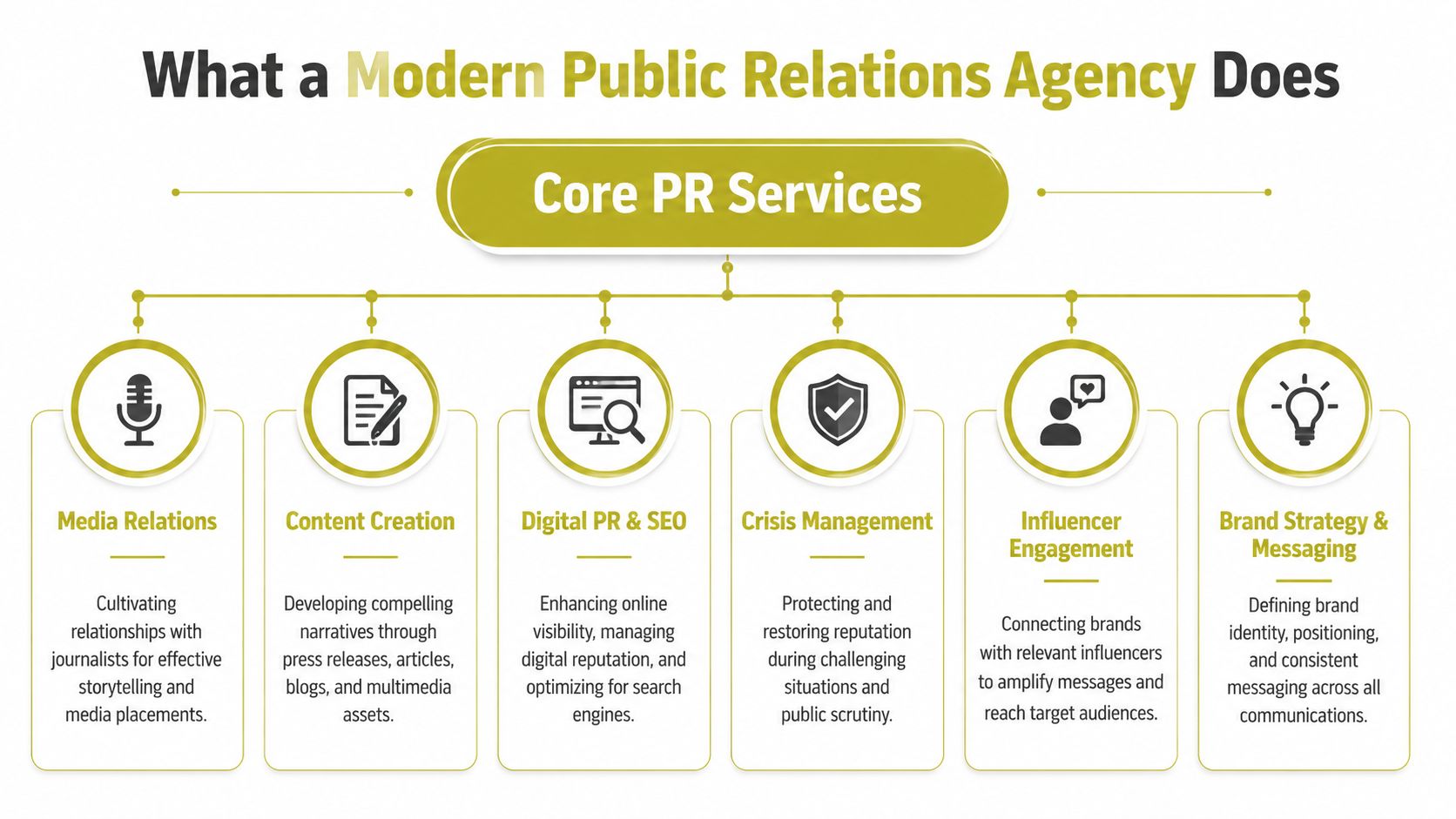
The six working parts of modern PR
| Pillar | Function |
|---|---|
| Media relations | Builds relationships with journalists, producers and editors, then pitches stories with a realistic chance of coverage |
| Content creation | Produces press releases, comment pieces, briefing notes, blogs and supporting assets that sharpen the story |
| Digital PR and SEO | Wins coverage and links that improve visibility in search and strengthen your authority online |
| Crisis management | Prepares statements, holding lines, media handling plans and response strategy when things go wrong |
| Influencer engagement | Matches the brand with relevant creators or commentators when that route makes sense |
| Brand strategy and messaging | Defines what the company stands for, how it speaks and what messages must land consistently |
PR is part newsroom, part commercial engine
The best agencies don't just “get coverage”. They shape perception across different moments in the customer journey.
A tourism business might need national travel coverage, short-form social content, destination storytelling and a booking-led landing page. A fintech might need tighter messaging, executive profiling, comment opportunities on regulation and disciplined media handling. A professional services firm may need thought leadership that builds trust before a prospect ever picks up the phone.
That's why digital literacy matters. Tools such as Hootsuite and Buffer sit alongside media databases, monitoring systems and search tools. Agencies also need to understand what AI is changing in content production and workflow. If you want a broader view of how automation and AI are influencing agency work, Bulby's insights for agencies are worth reading.
What you should expect in practice
A proper agency relationship usually includes:
- Story development: finding angles with external relevance, not internal excitement.
- Press office discipline: handling enquiries, follow-ups, rebuttals and deadlines without drama.
- Spokesperson support: preparing founders for interviews, panels and broadcast appearances.
- Measurement: showing whether activity is moving reputation or generating action.
- Digital integration: making sure PR supports search, social and conversion, not just awareness.
For a clearer baseline on service scope, this guide to what a public relations agency is gives a useful practical summary.
Decoding Agency Models and Pricing
Not all public relations agencies are selling the same thing, even when the proposal uses similar language. “Strategic counsel” from one firm can mean direct access to a veteran operator. From another, it can mean a senior person appears in the pitch, then vanishes once the contract is signed.
For SMEs, pricing confusion usually comes from buying the wrong model.
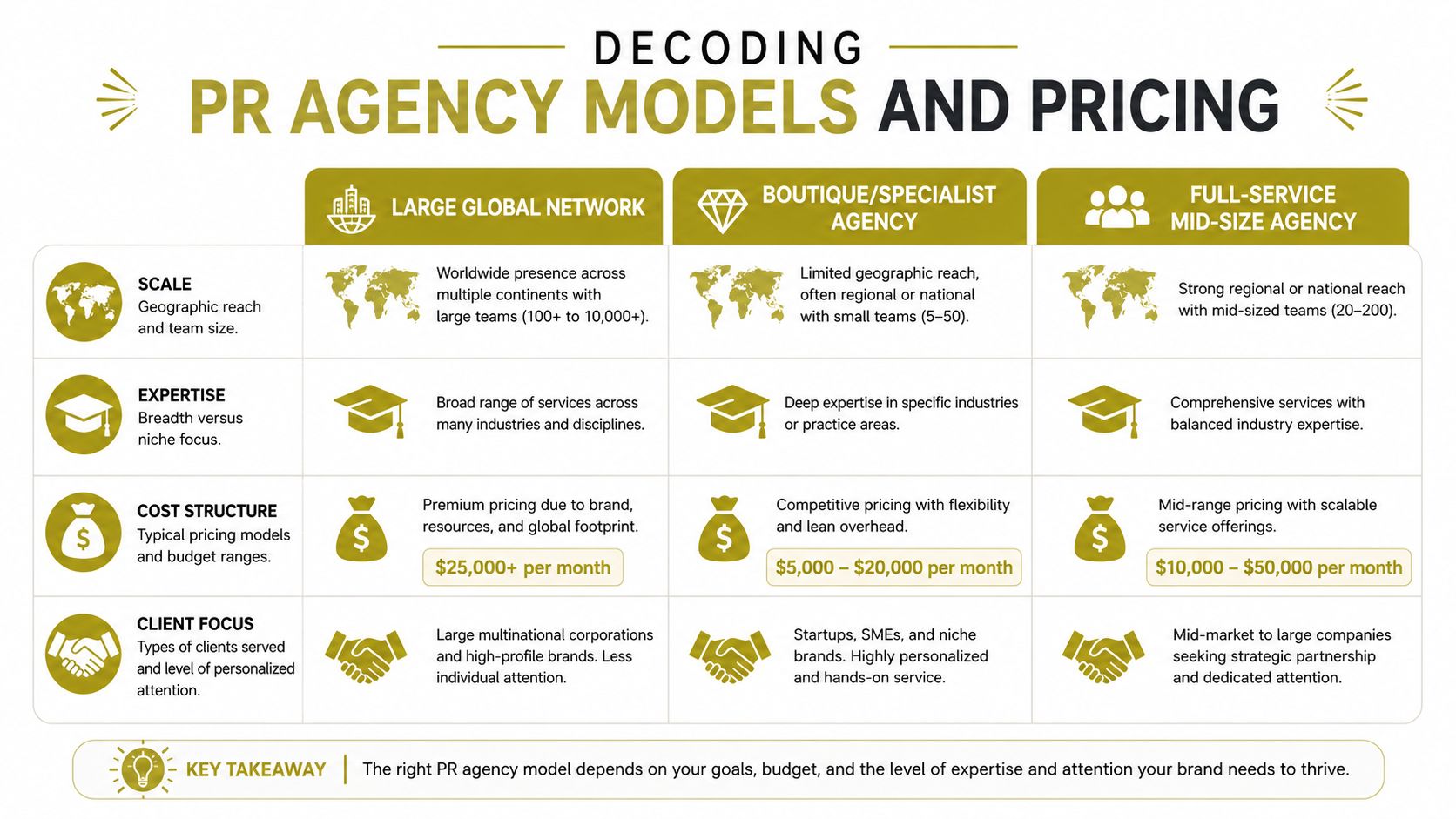
Large networks, mid-size firms and boutique specialists
Here's the blunt version. Large global agencies are built for scale. Mid-size firms often offer a balance of breadth and service range. Boutique firms tend to sell access, speed and specialist judgement.
| Model | Best For | Typical Cost | Senior Contact |
|---|---|---|---|
| Large global network | Multinational brands, complex stakeholder environments, multi-market campaigns | Higher retainer structures with more overhead built in | Often intermittent, with day-to-day run by junior or mid-level teams |
| Full-service mid-size agency | Established companies needing broader support across PR, content and digital | Mid-range retainers or project fees | Usually a mix of senior oversight and account handling |
| Boutique or specialist agency | Start-ups, SMEs, founder-led firms, niche sectors, fast-moving campaigns | Lower overhead and more flexible structures | Often direct access to senior practitioners |
Why the boutique journalist-led model has traction
Cost matters. According to No Strings Public Relations, 68% of UK SMEs cite high costs as a barrier to PR. That's one reason the boutique journalist-led model keeps gaining interest. It speaks directly to the frustration many founders have with large-agency pricing and junior-led delivery.
The attraction isn't only affordability. It's decision quality.
Former journalists tend to judge stories more ruthlessly. They know how editors think, what producers will cut, which headlines will hold, and which claims won't survive basic scrutiny. That makes pitches tighter and messaging cleaner. It also reduces one of the biggest hidden costs in PR: wasted effort on ideas that were never newsworthy in the first place.
Practical rule: Ask whether the person shaping your story has ever had to decide, under deadline, whether it deserves publication.
Carlos Alba Media fits this specialist end of the market. Its specialist nature and expertise are rooted in a team where everyone who works for Carlos Alba Media is a former national news journalist or has agency experience of working with international brands. For an SME, that usually means the person advising on the story understands both newsroom standards and client pressures.
How pricing usually works
Most agencies use one of three commercial models.
- Monthly retainers: Best when you need ongoing press office work, proactive outreach, comment opportunities and steady strategic input.
- Project fees: Useful for launches, funding rounds, events, reports or a defined campaign with a clear start and finish.
- Pay-on-results structures: Tempting on paper, but often narrow in practice. They can push agencies towards easy wins rather than the right opportunities.
Retainers make sense when timing matters and opportunities appear unpredictably. Project fees work when the brief is tightly scoped. Pay-on-results can suit some outreach tasks, but it can distort behaviour if the agency chases volume over quality.
What you're really paying for
You're not paying for a press release. You're paying for judgement, access, responsiveness and message control.
That includes things owners often underestimate:
- Editorial filtering: stopping weak ideas before they waste time.
- Relationship capital: knowing who covers what, and how to approach them.
- Crisis readiness: spotting reputational risk before it escalates.
- Commercial focus: connecting PR activity to enquiries, partnerships, hires or investor interest.
If a proposal looks cheap but puts your account in inexperienced hands, it may cost more in missed chances, weak positioning and cleanup later.
How to Choose the Right PR Agency
The wrong agency usually sounds polished in the pitch and vague in the details. The right one gives clear answers, asks sharp questions, and doesn't pretend every business is one press release away from national attention.

Ask who actually does the work
Start here, because it changes everything.
If the agency wins your business with a senior operator but hands delivery to juniors, your results will depend on how well those juniors are supervised. Sometimes that's fine. Often it isn't. You need to know who writes the pitches, who calls journalists, who handles blowback, and who speaks to you when a story goes sideways.
Ask these questions directly:
- Who is my day-to-day contact? Not the figurehead. The actual operator.
- Who writes and approves pitches? If nobody can answer, the process is loose.
- How do you handle a story that doesn't get traction? Good agencies rework the angle. Weak ones resend the same email.
- Can you show an example of work tied to a commercial outcome? Not just a clipping book.
For a sharper shortlist process, this practical guide on how to choose a PR agency is a useful companion.
Back journalist-led agencies when the story needs judgement
Former journalists bring two advantages that owners should value more highly.
First, they know what not to pitch. That matters because restraint is a big part of effective PR. Second, they understand pressure. Newsrooms move fast, facts get challenged, and weak spokespeople get exposed. An agency staffed by people who've lived that environment tends to prepare clients properly.
Here's a straightforward way to assess fit:
- Listen to their first reaction to your story. If they praise everything, they're selling. If they test it, they're working.
- Watch how they simplify complexity. Especially important in sectors like tech, finance and professional services.
- Check whether they push back. You need judgement, not applause.
The agency that tells you an idea isn't ready may be more valuable than the one that promises instant coverage.
This short video gives a good sense of the questions and mindset involved when evaluating agencies:
Red flags that should end the conversation
Some warning signs are obvious. Others are buried in slick proposals.
- Guaranteed coverage: No credible agency can promise front pages or named outlets on demand.
- Vanity reporting: If they lead with impressions, ad-value style claims or raw volume, be careful.
- No challenge on your brief: A serious adviser will interrogate your assumptions.
- No crisis thinking: Even growth campaigns need contingency planning.
- One-size-fits-all strategy: A hospitality launch, a fintech profile and a tech funding story are not the same job.
If the agency can't explain what happens after the first round of outreach fails, it probably doesn't have a proper media process.
Measuring PR Success Beyond the Headlines
Coverage alone isn't success. A flattering article that reaches the wrong audience, lands the wrong message or produces no action is still weak PR.
That's why the old obsession with Advertising Value Equivalent, or AVE, has fallen out of favour. It tries to assign a notional advertising price to editorial coverage, as if trust, context and credibility were interchangeable with bought media. They aren't. The industry has moved on.
According to this explanation of modern PR measurement, the current standard uses a four-axis model of share of voice, message penetration, tier-quality ratio and commercial-outcome contribution. The same framework notes that the Barcelona Principles 4.0 explicitly reject AVE, and that the tier-quality ratio weights outlets such as the BBC, Financial Times, The Guardian, The Times, The Telegraph and Sky News at 3x.
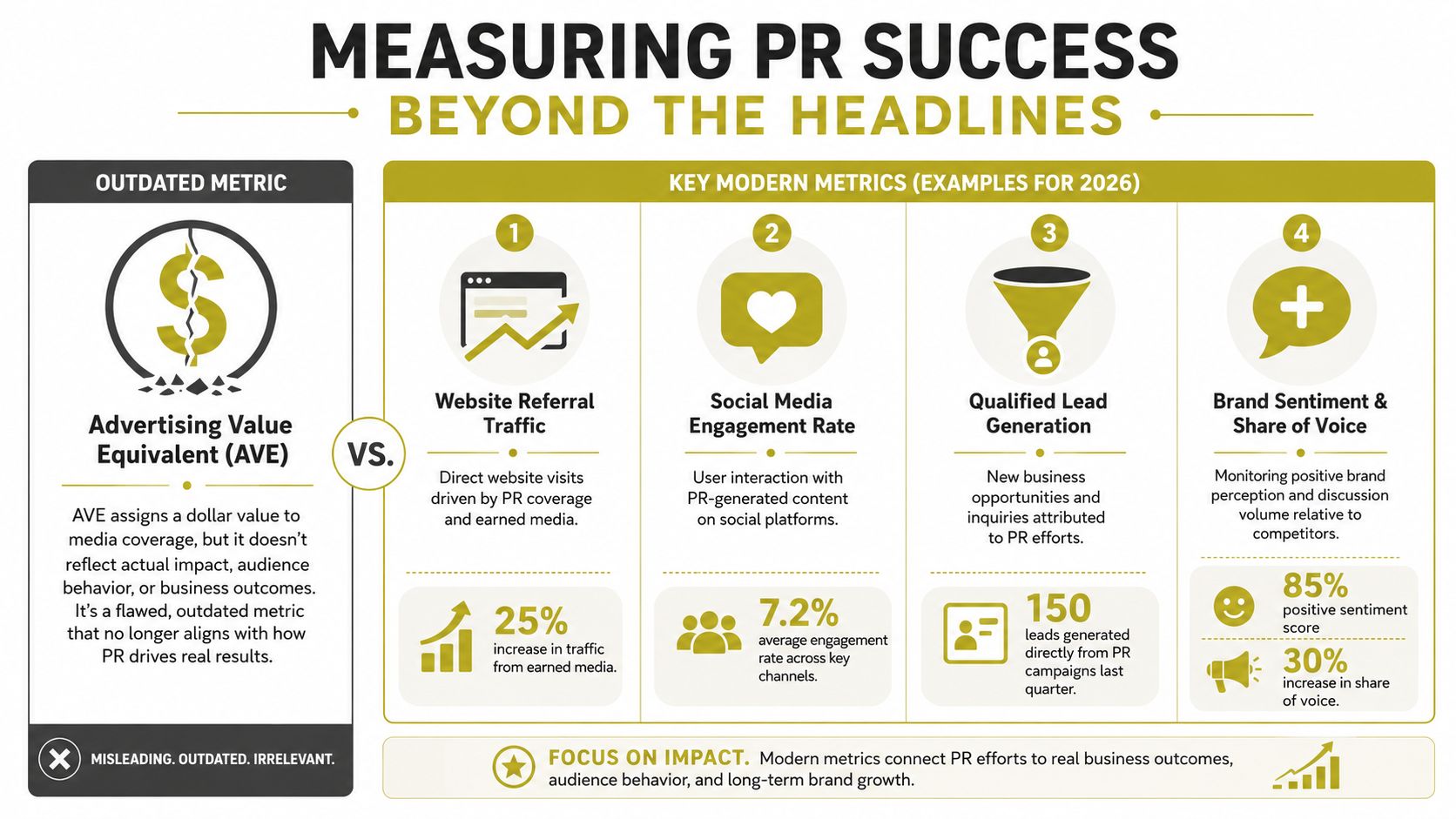
What the modern framework means in plain English
| Metric Type | Example | Business Value |
|---|---|---|
| Outdated metric | AVE | Looks neat in a report but tells you little about trust, influence or action |
| Share of voice | How often your brand appears against competitors in relevant coverage | Shows whether you're visible in the market conversation |
| Message penetration | Whether the key points you wanted actually appeared in coverage | Tells you if the story landed as intended |
| Tier-quality ratio | Whether coverage appeared in top-tier, trade or lower-value outlets | Helps distinguish meaningful visibility from low-impact mentions |
| Commercial-outcome contribution | Enquiries, investor conversations, hires or contracts influenced by PR | Connects communications to business results |
Quality beats quantity
One well-placed national or sector-specific piece can outperform a pile of weak mentions. Tiering helps agencies explain that clearly. A mention in a top-tier outlet, with the right message and positive tone, usually carries more weight than multiple low-value placements that nobody relevant sees.
Weak PR reporting becomes apparent. Counting clips is easy. Judging impact is harder.
What boards care about: Did PR improve reputation, create demand, strengthen trust or open commercial doors?
Tie PR to outcomes early
If you want meaningful reporting, set the commercial question at the start.
That could mean tracking inbound enquiries after a profile lands, investor approaches after a funding story, or recruitment interest after thought leadership and employer-brand coverage. It may also involve referral traffic, branded search movement, sentiment shifts or better conversion on campaign landing pages. The method will vary. The principle won't.
Tools matter here. Monitoring platforms, analytics dashboards and alert systems help, but they only work if the agency and client agree what success looks like before outreach starts. For businesses that need a clearer view of reputation shifts and coverage quality, reputation monitoring tools are a sensible place to start.
PR Strategies for High-Stakes Sectors
The right PR approach changes by sector because the stakes are different. A hospitality brand wants attention that turns into bookings. A fintech wants credibility that survives scrutiny. A tech SME wants visibility that helps customers, talent and investors understand why the business matters now.
Tourism and hospitality need desire, not brochure copy
Travel and hospitality stories work when they make a place or experience feel timely and specific. Generic claims about excellence, luxury or unforgettable service rarely travel far. Editors want fresh angles, seasonal relevance, strong visuals and a reason their audience should care now.
For these businesses, PR works best when media coverage, digital content and social storytelling support one another. A feature can create authority. Short-form content can extend reach. Good landing pages and booking journeys then do the conversion work.
Fintech and regulated businesses need trust under pressure
In regulated sectors, language matters more. Overclaim and you create risk. Undersell and nobody notices you. The agency has to translate technical detail into plain English without crossing legal or regulatory lines.
That usually means disciplined messaging, better briefing notes, careful spokesperson preparation and a fast approval process. It also means planning for the day something goes wrong, because eventually something does.
According to Curzon's crisis communication page, UK SMEs in regulated sectors often need 24/7 crisis management, and an emerging model involves PR firms partnering with media lawyers to provide a cost-effective and legally sound response. That's a smart setup for businesses that can't justify a full in-house crisis team but still need serious cover.
Tech SMEs need translation as much as exposure
Many tech founders know their product inside out but explain it in a way that only peers understand. PR's job is to convert complexity into a story that buyers, journalists and investors can follow.
That might mean moving away from feature lists and towards consequence. What problem gets solved? What friction disappears? Why does this matter in the market right now? The firms that answer those questions well tend to earn more useful coverage and better meetings.
When the agency gets this right, PR stops being a soft extra. It becomes part of how the business wins trust under scrutiny, builds visibility in crowded markets and protects itself when pressure hits.
If you want senior-level PR advice without the usual big-agency layering, Carlos Alba Media is one option to consider. The agency works across Scotland and the wider UK, combining newsroom experience, digital strategy and crisis support for businesses that need practical counsel, measurable outcomes and fast execution.