
You're probably here because social ads feel deceptively simple. The platform asks you to pick an audience, write a few lines, set a budget, then press publish. A week later, you've got clicks, a few likes, maybe a spike in traffic, but no clear sense of whether any of it helped the business.
That's where most SMEs get stuck. They aren't failing because paid social doesn't work. They're failing because they're treating a performance channel like a slot machine.
Done properly, paid social services aren't about boosting posts and hoping for reach. They're a structured system for putting the right message in front of the right people at the right stage of decision-making, then improving that system every week. The mechanics matter. So does the story. If the targeting is sharp but the message is flat, people scroll past. If the creative is good but the offer is wrong, you pay for attention that never turns into revenue.
The businesses that get strong results usually understand one thing early. Paid social is half media buying, half editorial judgement. You need data discipline, but you also need to know what makes a human stop, care, and act.
That newsroom instinct matters more than many founders realise. Former national journalists are trained to find the angle, sharpen the headline, understand audience behaviour quickly, and publish under pressure. In a crowded feed, those skills transfer directly to ad creative, landing page hooks, video scripts, and campaign narratives that feel timely instead of generic.
What Are Paid Social Services And Why Do They Matter
A founder approves a few ads on Monday, sees clicks by Wednesday, and asks the obvious question on Friday: are these people going to make a purchase?
Paid social services answer that question before budget gets wasted. They cover the planning, creation, management, and ongoing improvement of advertising on platforms like Facebook, Instagram, LinkedIn, TikTok, and X, with a clear commercial goal attached.
The distinction is simple. Boosting a post pays for distribution. Paid social services build a campaign around an outcome, such as qualified leads, ecommerce sales, booked consultations, event registrations, app installs, or store visits. That means the audience, offer, creative, landing page, tracking, and follow-up path all need to work together.
Practical rule: If a campaign can't be tied to a real business action, it isn't a paid social strategy. It's just paid distribution.
For many SMEs, that distinction is expensive to learn the hard way. A weak campaign does not just burn ad spend. It also creates poor-quality leads, muddied reporting, and internal doubt about whether the channel works at all.
Good paid social work reduces that waste by bringing structure to decision-making. It tests message angles against real audience behaviour, cuts underperforming creative quickly, and puts budget behind the combinations that produce sales opportunities. That discipline matters even more in a crowded feed, where attention is won in seconds and lost just as fast.
This is also where experience shows. Teams with newsroom instincts tend to spot the stronger angle earlier, write sharper hooks, and respond faster when a campaign starts slipping. That is one reason Carlos Alba Media's editorial background is commercially useful. The same judgement that helps a journalist find the story people care about helps a brand find the message that gets a prospect to stop scrolling and act.
Creative production matters too, especially as brands test more variations at higher speed. Used well, tools in this guide on AI ad creative automation can help teams produce and iterate faster, but speed only helps when the underlying strategy and story are sound.
Paid social matters because it gives SMEs a controllable way to create demand, validate offers, and learn which messages move buyers from curiosity to action. Done well, it becomes a revenue system, not a guessing exercise.
What You Are Actually Buying A Breakdown
A paid social service is a bundle of decisions, production work, and ongoing control. If an agency describes the job as boosting posts or keeping ads live, you are paying for motion, not for a system that improves results over time.
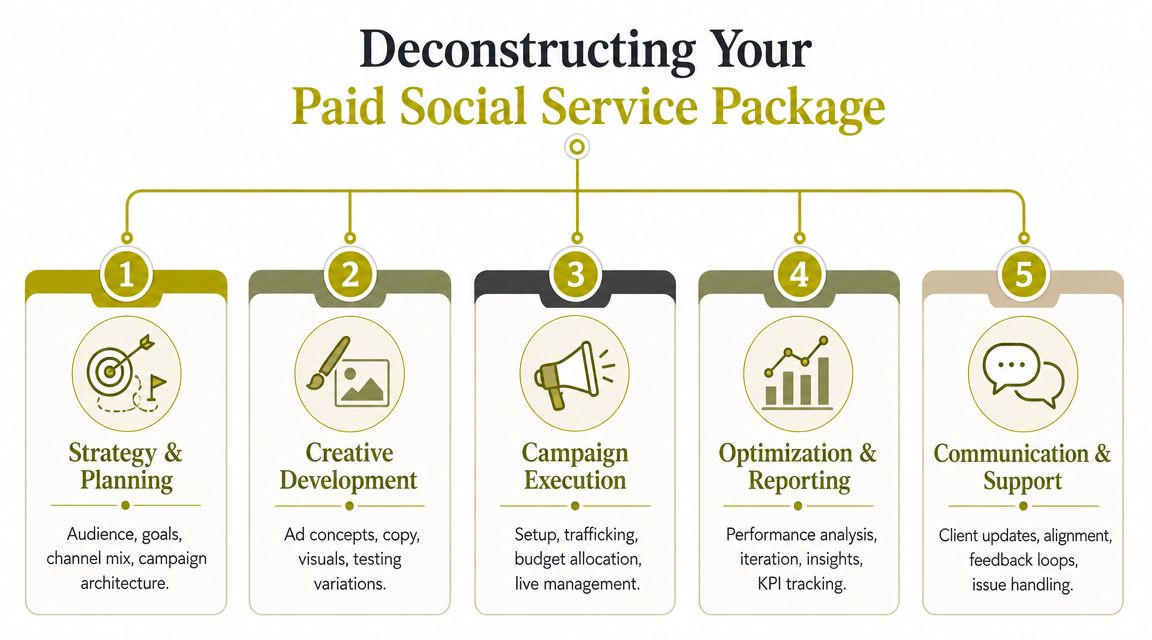
Strategy and audience research
This work starts before the platform setup.
Someone has to define the buyer, the problem, the timing, and the reason your offer should win attention instead of being scrolled past. Good strategy goes past age brackets and interests. It looks at intent, awareness level, buying friction, objections, and the moments when demand is strongest.
That matters because two people can fit the same demographic profile and need completely different ads. One needs proof. The other needs urgency. A capable strategist separates those groups early so budget is spent on likely buyers rather than on cheap clicks.
Ad creative and copywriting
Creative usually determines whether the campaign gets a fair chance at all. Paid social is won in the first second, then in the next few lines.
Newsroom training helps here for a reason. Journalists learn to find the angle quickly, write headlines that earn attention, and lead with what the audience cares about now. That skill carries over directly into paid social. It improves hook rate, message clarity, and the quality of the response, especially when a brand has a decent offer but is saying it in a forgettable way.
A strong team will usually build and test several creative types because each one does a different job:
- Static ads: Best when the value proposition is clear and the visual can carry it fast.
- Short-form video: Useful for showing the product, building familiarity, or explaining something that needs movement or tone.
- Carousel ads: Effective when buyers need more than one proof point before acting.
- UGC-style creative: Often works well where trust matters more than polish.
If you're exploring production efficiency, this guide on AI ad creative automation is a useful reference point for understanding where automation can help and where human judgement still matters.
Campaign management and targeting
Once the message is ready, the account setup decides how cleanly that message reaches the right people.
That includes campaign structure, audience selection, exclusions, geography, placements, conversion events, budget weighting, and bid approach. Clients do not always see this work, but they feel the cost of getting it wrong. Messy account builds create false positives. A campaign can look active while overlap, weak tracking, or the wrong optimisation goal pulls lead quality down.
Testing and optimisation
Serious paid social management is a repeated process of controlled testing and budget reallocation.
One round might test opening hooks. Another might compare offers. Another might hold the audience steady and change the creative format. The point is not constant tinkering for its own sake. The point is to isolate what changes behaviour, then put more money behind the combinations that produce sales conversations or purchases.
Strong operators are disciplined here. They do not chase every new format or platform feature. They keep the variables clear, cut weak work quickly, and protect budget from creeping waste.
Reporting and analysis
Reporting should help an owner make decisions.
A useful report shows which creative attracted qualified enquiries, which audiences spent money without producing pipeline, where prospects dropped off, and what should change next. Vanity metrics have their place as supporting signals, but they do not answer the question that matters most. Is this activity producing profitable demand?
Carlos Alba Media brings an editorial approach to that analysis. The same judgment used in a newsroom to identify the underlying story helps a brand identify the genuine commercial signal, which message is resonating, which angle is weak, and which result is noise rather than progress.
Navigating the Paid Social Channel Landscape
A lot of businesses spread budget too widely because every platform feels important. It's rarely the right move. The better question is simpler: where are your buyers most likely to notice, trust, and act?
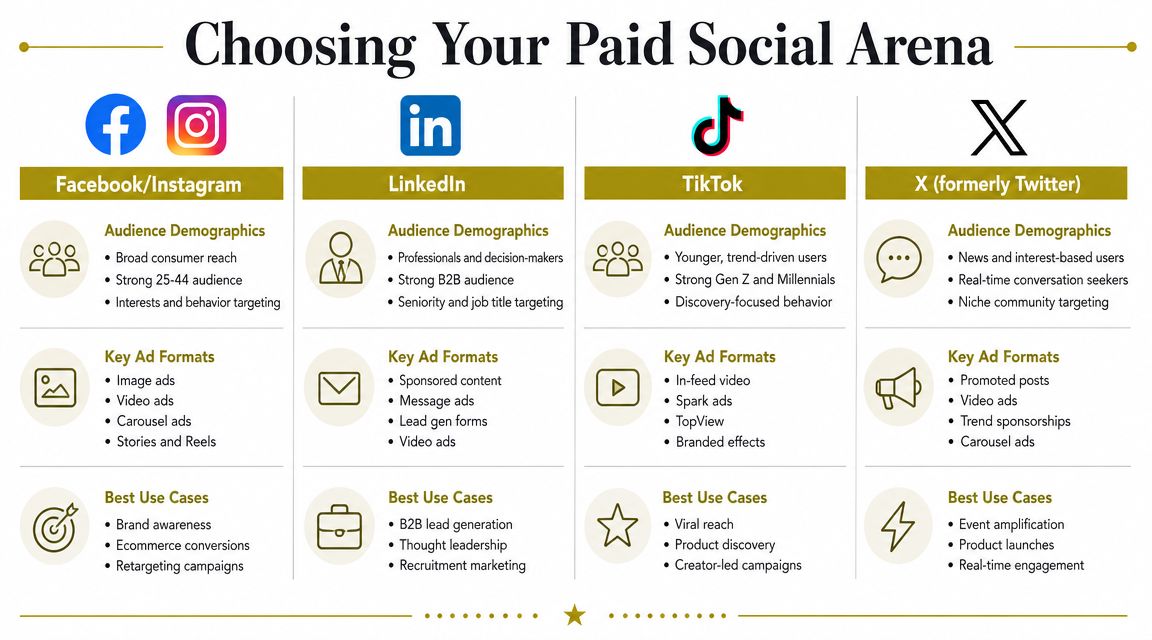
Meta for reach, demand capture, and retargeting
Facebook and Instagram are still the broadest paid social environment for many consumer-facing brands. If you need scale, visual storytelling, local targeting, or retargeting across a large audience pool, Meta is often the first place to look.
Use Meta when you want to:
- Build awareness fast: Good for launching products, offers, or events.
- Retarget site visitors: Strong for bringing warm prospects back.
- Support ecommerce or lead gen: Especially where creative can carry the sale.
The trap is assuming broad reach means easy results. Meta rewards clear offers, strong creative rotation, and clean tracking. Weak messages disappear fast because users are there to be entertained, not to inspect your sales proposition.
LinkedIn for B2B and high-intent professional audiences
LinkedIn costs more attention and usually more patience. But if you sell to decision-makers, niche professionals, or specific business functions, it can be the cleanest route to relevance.
It's a good fit for:
| Platform | Best use case | Message style |
|---|---|---|
| B2B lead generation | Problem-led, proof-backed | |
| Meta | Consumer demand and remarketing | Visual, immediate, benefit-led |
| TikTok | Discovery and cultural relevance | Native, fast, personality-led |
| X | Real-time commentary and event response | Timely, opinionated, concise |
LinkedIn works best when the offer solves an identifiable business problem. Generic “we help businesses grow” ads usually underperform. Specificity wins.
TikTok for attention and cultural fit
TikTok can be excellent when a brand is willing to communicate like a participant rather than a broadcaster. It rewards creative that feels native to the platform. That usually means quicker cuts, stronger hooks, and less polished corporate language.
Use it if your audience responds to:
- Demonstration content: Showing, not telling.
- Founder-led or personality-led creative: Especially where trust is personal.
- Trend-aware campaigns: Not trend-chasing, but culturally fluent messaging.
If TikTok is part of your mix, this practical piece on how to boost ROAS with TikTok ads is worth reading alongside platform-specific creative planning.
X for immediacy and conversation timing
X is less about polished funnel architecture and more about context. It can work well for live events, commentary, launches tied to the news cycle, or brands with a point of view.
Here, newsroom thinking becomes particularly useful. Timing matters. Framing matters. The ability to write sharply, fast, and with relevance matters.
Use X when your message benefits from urgency, public discussion, or reaction speed. Don't use it if your brand has nothing timely to say.
If you're a smaller firm trying to decide where social fits inside a wider growth plan, this overview of social media marketing for small businesses gives a broader commercial context.
Budgeting for Paid Social and Measuring Success
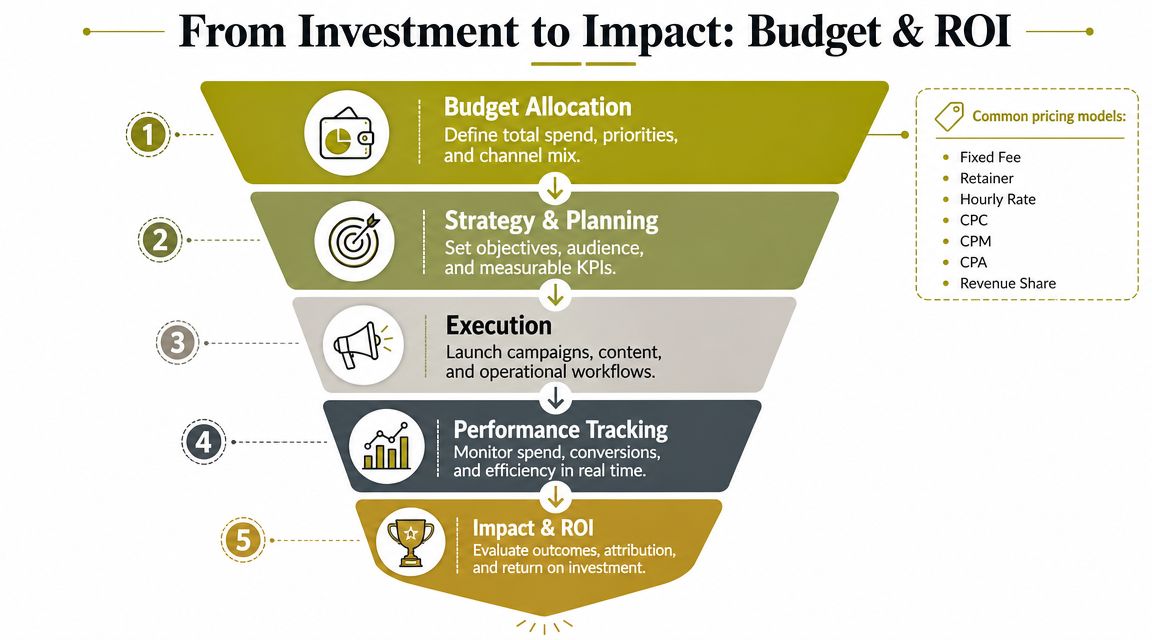
A paid social budget works best when it starts with a commercial target, not a spare number pulled from the marketing line. If the goal is booked consultations, product sales, or qualified leads, the budget should reflect what it usually takes to earn enough attention, test enough creative, and give the algorithm enough signal to find the right people.
Paid social usually has two cost layers. One is media spend paid to the platform. The other is management, which covers strategy, audience planning, creative development, tracking setup, testing, and reporting. Underfund either side and performance suffers. I've seen brands spend enough on media to matter, then starve the campaign of good creative and clean measurement. The result looks busy in-platform but weak in the sales pipeline.
Journalism offers a useful discipline here. A newsroom does not publish five vague headlines and hope one works. It studies the audience, sharpens the angle, and moves fast when a story lands. Paid social follows the same logic. Better creative gives the platform better raw material. Better messaging improves click quality before budget ever scales.
What smart buyers look at
The metrics that matter are the ones tied to business outcomes:
- Cost per acquisition: What did it cost to generate a sale, lead, or booked action?
- Return on ad spend: How much attributable revenue came back against media spend?
- Lead quality: Did the sales team accept and progress the lead?
- Customer lifetime value: Does the acquisition cost still make sense after repeat purchases, renewals, or upsells?
Cheap traffic can be expensive if it produces weak enquiries. Higher acquisition costs can still be profitable if the customer value is strong and the close rate is healthy.
That is why measurement has to extend beyond the ad platform. A campaign should be judged against what happens after the click: form completion, call quality, sales acceptance, conversion to revenue, and retention where relevant. For a practical external reference, this guide on how to track social media value is useful for turning platform data into commercial reporting.
A short primer on the budgeting side helps before you speak to any supplier:
Pricing models you'll usually see
Most agencies price paid social in one of four ways:
- Monthly retainer: Best for ongoing management, testing, and iteration over time.
- Percentage of ad spend: Common when media budgets vary month to month.
- Hybrid model: A base fee plus a spend-related management layer.
- Project setup fee: Often used for tracking, account builds, or launch preparation.
Each model has trade-offs. A percentage-of-spend arrangement can work well at scale, but it can also reward budget growth more than efficiency if the relationship is poorly managed. A retainer gives clearer planning and often suits SMEs better when the core work sits in strategy, creative, and optimisation rather than sheer spend volume.
This breakdown of digital marketing agency pricing packages is useful if you want to sense-check how service costs are commonly framed.
The Tipping Point When to Bring In Experts
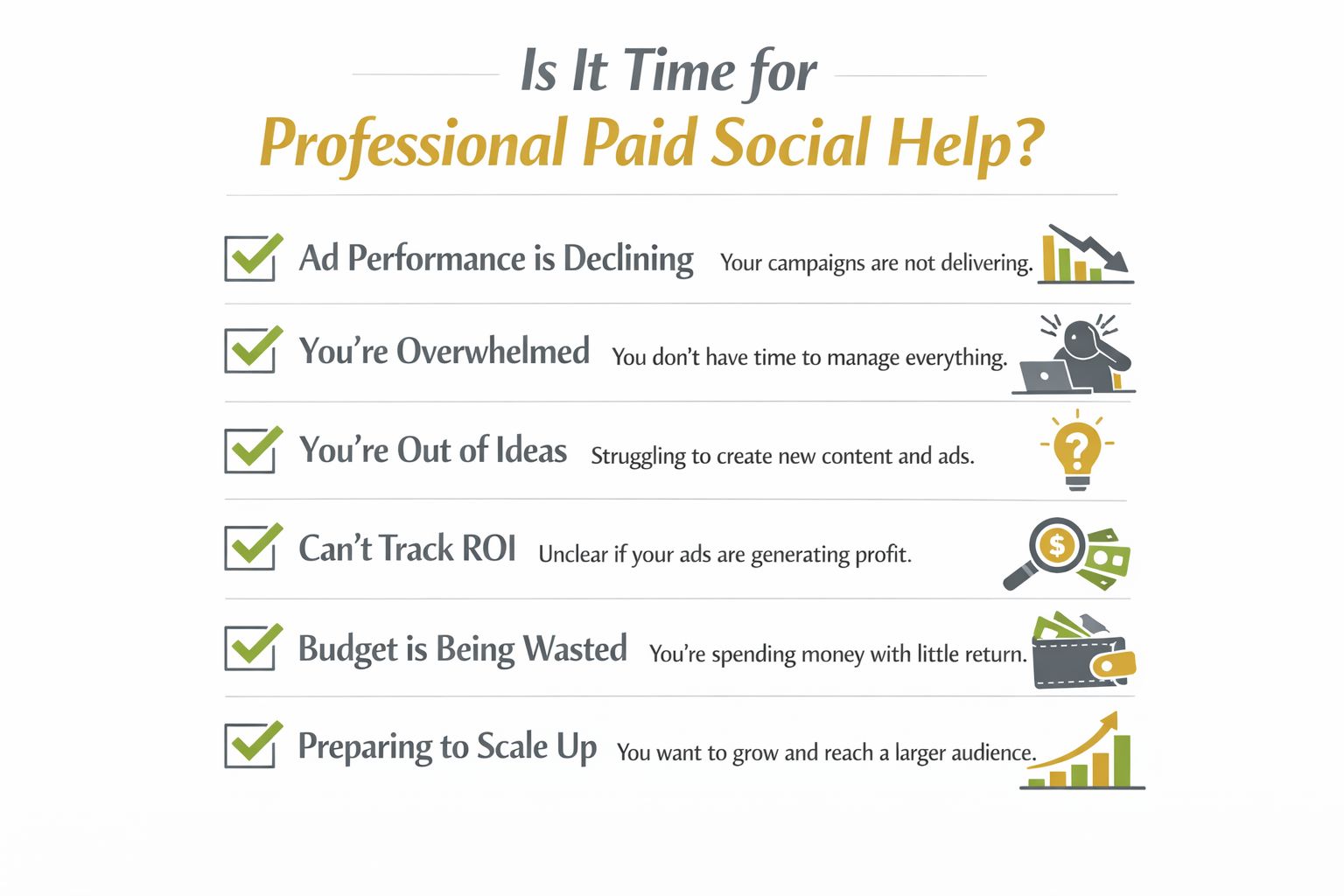
A founder launches a few Meta or LinkedIn campaigns, gets some clicks, maybe even a handful of leads, and assumes the hard part is done. But then, the intensive effort begins. Follow-up is patchy, tracking is unclear, creative tires out, and nobody can say with confidence which part of the system is causing the drag.
That is usually the tipping point.
Signs you've outgrown trial and error
These are the patterns that usually tell the story:
- No one owns the work between launch and outcome: Setting ads live is the easy part. Weekly checks on tracking, audience quality, creative fatigue, lead quality, and sales feedback are where performance is won or lost.
- Performance has plateaued: The account is spending, but cost per lead stops improving and no one can explain whether the issue is the offer, the audience, the creative, or the landing page.
- The setup has become too technical for spare-time management: Attribution, event configuration, consent handling, audience exclusions, and CRM integration all affect results.
- Sales and marketing are arguing from different dashboards: Marketing reports lead volume. Sales reports poor-fit enquiries. That usually means the campaign promise and the sales reality do not match.
- Growth targets now carry real commercial pressure: Once paid social is expected to feed pipeline consistently, inconsistency stops being a nuisance and starts becoming a cost.
This shows up earlier in regulated and service-led sectors. If campaigns are generating enquiries that involve personal, sensitive, or high-stakes information, the standard of execution has to rise. For UK businesses, guidance from Social Work England is a better reference point than US-based practice standards, because it reflects the expectations that apply in a UK professional context. The practical implication is simple. Paid social cannot be treated as ad buying alone. Message, forms, follow-up, and data handling all need the same level of care.
Why experience changes the outcome
Experienced teams diagnose faster because they have seen the same failure points in different forms. They can tell when weak results come from a blunt offer, a confused landing page, poor audience definition, or creative that never earned attention in the first place.
That speed matters.
A strong paid social operator also understands how people process information in-feed. Newsroom-trained marketers tend to be better at this because they start with the audience, the angle, and the tension in the story. That is a practical advantage, not a stylistic one. If the first line does not earn attention, the targeting barely gets a chance to work. If the message does not feel specific, the click is wasted even when the CPM looks fine.
Carlos Alba Media's editorial background is useful here. It helps campaigns get to the point faster, sound like they were written for real people, and adapt quickly when the market response is weak. If you are comparing options, this guide to experts in social media is a sensible benchmark for the level of thinking and execution you should expect, whether you hire in-house or use an agency.
Bringing in experts is rarely about admitting failure. It usually means the business has reached a stage where part-time marketing habits are costing more than specialist support.
From Strategy to Results Paid Social in Practice
Theory matters, but most owners want to know what this looks like day to day.
A common B2B pattern looks like this. A tech SME has a strong service, a sensible website, and a founder who knows the market. What they don't have is a repeatable lead flow. Their social posts get polite engagement from peers, but not many commercial conversations. The fix is rarely “post more”. It's usually a LinkedIn campaign built around one sharp pain point, one strong offer, and one landing page that removes friction.
A hospitality brand faces a different problem. It already has visual appeal, but the ads feel interchangeable with every other polished brand in the feed. In that situation, the work is often editorial. The campaign needs a stronger angle, clearer audience split, and copy that sounds like a real point of view rather than a brochure. Better storytelling doesn't just improve attention. It improves memory.
A national service provider often has the opposite issue. They generate enquiries, but too many are low-fit. Paid social can help, but only if the campaign qualifies people before they click. That means being more direct in the ad about who the service is for, what problem it solves, and what happens next. Vague copy creates expensive admin.
What tends to work
- Clear commercial intent: Ads designed for an outcome, not applause.
- Message and audience alignment: Different pains need different hooks.
- Fast follow-up paths: Good campaigns lose value when the response process is slow.
- Creative built for the platform: Native format beats recycled assets.
What usually fails
- One-size-fits-all messaging: Broad copy attracts broad, low-value response.
- Vanity-led reporting: Reach and likes can hide weak commercial performance.
- Weak landing pages: Even strong ads fail when the next step is clumsy.
- Creative that says everything at once: Buyers need one reason to care first.
The practical lesson is simple. Paid social works best when strategy, creative, and operations are joined up. Most underperformance comes from gaps between those pieces, not from a lack of platform features.
Why Choose Carlos Alba Media for Paid Social
Paid social is crowded because the barriers to entry look low. Anyone can open an ad account. Few teams can combine targeting discipline, commercial judgement, and story craft well enough to make the spend count.
That's the useful distinction.
Carlos Alba Media is built around a newsroom-to-brand way of working. Everyone in the business is either a former national news journalist or has agency experience working with international brands. That changes the quality of the thinking. Journalists learn to identify the angle fast, understand audience psychology, write headlines that earn attention, and produce under deadline. Agency operators bring the structure, testing discipline, and commercial rigour needed to turn those stories into measurable campaigns.
For an SME owner, that combination matters. You don't need more jargon, more dashboards, or more content for the sake of it. You need campaigns that are strategically sound, creatively sharp, and managed by people who know how to connect message to outcome.
That's also why the strongest paid social programmes don't look like isolated ad buying. They feel connected to brand positioning, PR momentum, landing page performance, and sales follow-up.
If your current campaigns feel noisy, inconsistent, or hard to evaluate, the next move isn't to spend blindly. It's to tighten the system.
Paid Social Services FAQs
How long does it really take to see results from paid social
A business can launch ads on Monday and see clicks by Tuesday. That still tells you very little about whether paid social will produce profitable demand.
Useful assessment happens in stages. First, confirm the basics. Tracking works, the right people are landing on the site, and the creative is earning attention from the audience you meant to reach. Then compare variables that change performance, such as audience segments, offers, hooks, and landing page experience. Only after that should you judge consistency in qualified leads, booked calls, purchases, or pipeline contribution.
Good paid social management is part diagnosis, part iteration. Review too early and you cut off a campaign before the message has had a fair test. Leave poor performance running too long and budget disappears into weak creative, broad targeting, or low-intent traffic.
Can paid social work for B2B companies
Yes, and it often works well if the campaign reflects how B2B buying decisions are made.
B2B buyers rarely respond to generic promises. They respond to relevance, proof, and timing. That means tighter audience selection, sharper problem framing, and offers that feel proportionate to the level of trust a buyer has at that moment. A guide, audit, consultation, or demo usually outperforms an aggressive sales push at the first touch.
The newsroom-to-brand approach helps here. Strong B2B paid social does not rely on volume alone. It starts with the angle. What problem is urgent enough to stop a scrolling operations director? What headline earns attention because it sounds true, specific, and useful? That discipline comes from understanding audience psychology and writing for people with limited time, not from stuffing ads with claims.
The handoff matters too. Paid social can generate intent. Sales process, email nurture, and follow-up speed determine whether that intent turns into revenue.
What is a reasonable starting budget for paid social
There is no flat number that suits every business. A realistic starting budget depends on your sales value, buying cycle, margin, audience size, and how many creative and targeting tests are required to reach a reliable conclusion.
In practice, the budget needs to cover three things:
- Enough media spend to produce usable evidence
- Enough management time to review performance and make changes
- Enough operational capacity to handle leads properly once they arrive
That third point gets missed. If your team is slow to reply, weak at qualification, or stretched on delivery, more leads will not fix the problem. They will expose it.
For service businesses in particular, media cost only makes sense in the context of what happens after the click. If lead handling is expensive, response times are slow, or conversion depends on several follow-up steps, the starting budget should reflect that commercial reality. The goal is not to buy cheap traffic. It is to test whether paid attention can turn into profitable customer action.
Start with a budget large enough to learn something credible, then increase spend behind the audiences, messages, and offers that prove themselves.
If you want a clearer view of what paid social should look like for your business, talk to Carlos Alba Media. A no-obligation conversation can help you assess the right channels, the likely budget shape, and whether your current campaigns are built to produce commercial results.