
You've probably got three proposals open right now. One promises “full service marketing”. One is cheap enough to feel safe. One is expensive enough to make you wonder if the agency is taking the mickey. Every deck looks polished, every package sounds complete, and none of them make it easy to answer the only question that matters.
What are you buying?
That's the problem with digital marketing agency pricing packages. Most agencies sell a list of tasks. Smart buyers look for commercial value. If you run an SME, you don't need more activity for the sake of it. You need the right work, done by the right people, with enough senior judgement behind it to avoid wasting six months on busy-work.
That gap is getting wider. In 2025, 97% of agencies said they were raising prices, and agency and network costs were expected to grow by 12% to 15% versus 2023 according to MarketingProfs' agency pricing trends. So if quotes feel higher than they used to, you're not imagining it. But higher prices alone don't tell you whether an offer is overpriced or more senior.
That's why I'd compare agency quotes the same way I'd compare legal advice or crisis support. You're not buying hours. You're buying judgement under pressure. If you want another benchmark for how retainer-style services are framed, it's worth looking at how other specialist firms present ongoing fee structures, such as compare Angelwood retainer management pricing.
At Carlos Alba Media, the lens is different because the work starts from newsroom standards. Everyone is either a former national news journalist or has agency experience working with international brands. That matters. A team with that background usually thinks first about message, risk, audience, timing, credibility, and commercial impact. Junior production-first packages rarely do.
Navigating the Maze of Agency Pricing
The cheapest proposal usually wins for one reason. It feels easier to defend internally.
That's a mistake.
A low monthly fee can hide a weak scope, junior delivery, slow response times, recycled strategy, or reporting that tells you what happened without explaining what to do next. A more expensive package can be the better deal if it includes sharp positioning, proper analysis, channel coordination, and senior people who know when to change course quickly.
Cheap isn't clear
A lot of SME owners think price transparency means a tidy package menu. It doesn't. A neat package can still be vague where it counts.
Look for the bits agencies tend to blur:
- Who's doing the work. Sales director in the pitch, junior executive in delivery.
- What's included every month. Not slogans, actual outputs and decision-making.
- What changes based on results. Good agencies adapt. Bad ones keep posting and billing.
- What happens when something goes wrong. If leads drop, rankings slip, or a campaign misfires, who takes responsibility?
Practical rule: If the proposal is crystal clear on deliverables but fuzzy on thinking, you're buying production capacity, not strategic counsel.
Buy outcomes, not motion
A proper package should support a business goal. More qualified leads. Better search visibility in the right market. Stronger conversion from existing traffic. Better brand trust with customers, partners, regulators, or investors.
That's especially important if your business has any reputational sensitivity. In those cases, digital marketing can't sit in a silo. Paid, organic, content, PR, email, and leadership visibility affect each other. If the agency can't connect those dots, the package is too narrow, even if the spreadsheet says it's “good value”.
Decoding the Four Main Pricing Models
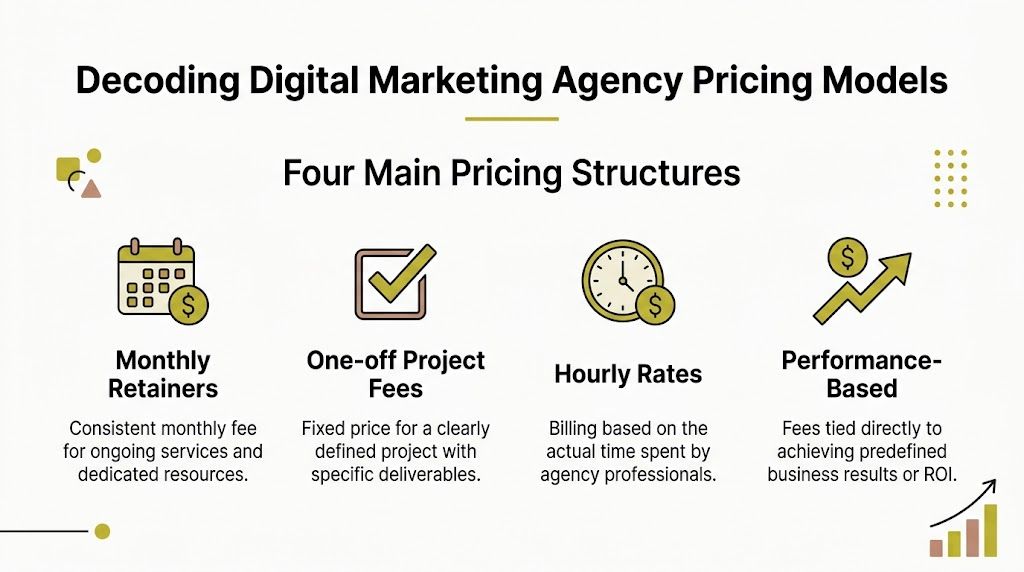
Agencies package fees in four broad ways. None is automatically right or wrong. The right one depends on what you need fixed, built, or grown.
Monthly retainers
A retainer is like having a solicitor on call for ongoing business matters. You're paying for continuity, access, and regular work across an agreed scope.
For SMEs, this is usually the most useful benchmark. UK small-business retainers commonly sit around £1,500 to £4,000 per month, and adding national SEO, PPC A/B testing, and CRO can push a package from £1,500 per month to over £5,000 per month because it needs more specialist time, as outlined in Wisitech's pricing overview.
Retainers work best when you need ongoing improvement, not one isolated task.
Good for
- Consistent growth work across search, paid, content, email, and reporting
- Regular strategic input instead of one-off advice
- Faster decision-making because the team already knows the account
Weak point
- They're poor value if the agency goes into autopilot.
One-off project fees
This is builder pricing. You hire the agency to complete a defined job, then the engagement ends.
Projects suit businesses that need a website refresh, campaign launch, audit, messaging overhaul, or analytics setup. They can work brilliantly if the scope is tight. They fail when the brief is fuzzy and both sides assume different things are included.
A project fee is clean. It is not a growth model.
Hourly rates
Hourly billing is useful for specialist consulting, troubleshooting, or senior advisory work. It's usually a bad way to run month-by-month marketing unless the scope is genuinely unpredictable.
You don't want your agency rewarded for taking longer.
If you use hourly support, insist on clarity around who's billing time and for what. Senior strategic hours are valuable. Administrative drift is not.
Performance-based pricing
This is the one everyone loves in theory. Pay for results. Sensible idea. Messy reality.
Performance-based and value-based pricing are getting more attention, but they still aren't standard. One industry source says only about 18% of agencies offer some form of performance-based pricing, according to Digital Applied's pricing analysis. That tells you something. Attribution is hard, business outcomes are influenced by more than one channel, and agencies still mainly rely on custom quotes.
If a package sounds wonderfully “risk-free”, read the small print twice. Results-based models often come with tighter definitions, exclusions, or trade-offs elsewhere.
What to Expect in SME and Startup Packages
Most SME packages fall into three broad shapes, even when agencies give them fancy names.
Foundation packages
This is the entry point. Expect basic execution.
That usually means content scheduling, simple social posting, light website updates, basic blog support, a monthly report, and maybe limited email work. The package can keep your presence alive, but don't confuse activity with traction.
What's usually missing is the stuff that changes outcomes. Positioning work. landing page testing. serious analytics interpretation. message refinement. sharp media hooks. crisis readiness. senior involvement.
Growth packages
Packages become useful at this stage.
A growth tier often includes channel management with some actual optimisation. You may get SEO planning, ad account management, email campaign support, stronger reporting, and recurring strategy calls. If you're trying to choose where to focus first, tools that help founders sort signal from noise can be useful, especially for early-stage search planning. For that, have a look at prioritizing search data with Keyword Kick.
The catch is scope. Some “growth” packages still spread effort too thinly across too many channels.
Scale packages
This is the tier where agencies usually reserve the better thinking.
You'll often see deeper search work, CRO, tighter reporting, cross-channel planning, stronger creative direction, and more senior account leadership. For businesses investing in lifecycle marketing, email can be one of the clearest indicators of whether an agency understands commercial follow-through rather than surface-level reach. That's why a service such as UK email marketing support often belongs in a serious growth package, not bolted on as an afterthought.
What lower tiers quietly exclude
Here's what many SME owners only discover after signing:
- Strategy isn't really included. You get a monthly call, not actual strategic thinking.
- Reporting is descriptive, not diagnostic. It shows clicks, not decisions.
- Paid media excludes the hard bits. Creative testing, landing page review, and attribution often sit outside scope.
- Senior people vanish after the sale. Delivery drops to junior staff quickly.
- Reputation and communications risk are ignored. Fine until the wrong story lands or a campaign backfires.
A task-led package can be useful if your business already has clear positioning, strong internal decision-making, and someone in-house to direct the agency. If not, you don't need more hands. You need better minds.
A package with fewer deliverables but better judgement often beats a package stuffed with output no one has linked to revenue.
Sample UK Digital Marketing Pricing in 2026
Here's the honest answer. There is no universal rate card.
Still, you need planning ranges. For UK SMEs, monthly retainers more commonly sit around £2,000 to £8,000 per month, while larger partnerships can move far beyond that. UK-focused pricing guides cited by PW Skills' digital marketing pricing overview show monthly retainers for larger engagements at £10,000 to £50,000 for SEO, £20,000 to £1,00,000 for PPC, and £15,000 to £30,000 for social media.
Use those numbers as context, not a shopping list.
Sample UK Digital Marketing Agency Pricing Packages (2026 Estimates)
| Package Tier | Typical Monthly Cost (GBP) | Best For | Common Inclusions |
|---|---|---|---|
| Foundation | £2,000 to £4,000 | Startups and smaller SMEs needing focused support | Limited channel management, basic reporting, content support, light SEO or social execution |
| Growth | £4,000 to £8,000 | SMEs wanting multi-channel improvement and regular optimisation | Broader SEO, paid support, content planning, reporting, strategy input, account management |
| Larger integrated partnership | £30,000 to £200,000 | Established brands needing broad multi-channel support | Strategy, content, analytics, multiple channels, senior oversight, integrated delivery |
| Standalone SEO partnership | £10,000 to £50,000 | Businesses prioritising organic visibility at scale | Ongoing SEO delivery, technical work, content support, reporting |
| Standalone PPC partnership | £20,000 to £1,00,000 | Brands with significant paid media needs | Campaign management, optimisation, reporting, paid strategy |
| Standalone social media partnership | £15,000 to £30,000 | Brands investing heavily in social content and management | Social planning, content management, platform delivery, reporting |
Why quotes vary so much
Two agencies can both say “SEO, PPC and content” and mean completely different things.
One may be selling junior execution with light oversight. Another may be pricing in senior strategic review, better analytics, conversion thinking, reputational judgement, tighter creative direction, and stronger accountability. If you're comparing search packages specifically, this guide on how much SEO costs in the UK is a useful extra reference point.
For SMEs looking for a broader partner, it also helps to review what a serious integrated offer looks like in practice through examples such as digital marketing agency services in the UK.
What your money is really buying
In a cheap package, you're often buying output volume.
In a stronger package, you're buying decision quality. That's the difference between a team that publishes content and a team that knows how to shape a message, sharpen a landing page, challenge weak assumptions, and keep your brand out of avoidable trouble. For firms working with former national journalists and people who've handled international brands, part of the fee reflects experience you only notice when things get complicated.
How to Evaluate and Compare Agency Offers
When you compare proposals, stop asking which one is cheapest. Ask which one gives you the strongest chance of commercial progress with the least avoidable waste.
That means changing your buying criteria.
Start with the team, not the package name
Global pricing data shows many agencies charge $100 to $149 per hour for services like SEO and PPC, but the value of a package isn't the raw hours. It's the seniority behind them, as highlighted in Clutch's digital marketing pricing data.
That's why the first question should be simple.
Who is working on my account?
Ask for names, roles, and backgrounds. If the pitch team can't tell you who will handle strategy, reporting, content direction, paid optimisation, and client communication, walk away. If the account will be run by one junior generalist covering five disciplines, price becomes irrelevant. The model is wrong.
For founders who need senior outside perspective rather than a factory model, a resource like digital marketing consultant support in London can help clarify what consultant-led input should look like.
Use this shortlist when comparing offers
- Ask for a sample report. You want interpretation, recommendations, and next actions. Not a dashboard export.
- Ask what's excluded. This exposes hidden gaps fast.
- Ask how they define success. If they lead with impressions and engagement, push deeper.
- Ask how often strategy changes. Good teams adapt based on evidence.
- Ask how they work with your internal team. Friction kills momentum.
- Ask what happens in a reputational issue. Especially important in regulated or visible sectors.
Buy brains, not bandwidth.
Watch the pitch carefully
The way an agency sells often mirrors how it delivers.
If the call is heavy on buzzwords, polished slides, and generic process language, expect templated work. If the conversation gets sharper when you talk about your margins, your customers, your market positioning, your lead quality, your spokespeople, your press risk, and your sales cycle, you're probably talking to people who think properly.
Specialist background greatly matters. A team made up of former journalists and senior agency operators won't just ask what content you need. They'll ask what story deserves attention, what claim stands up to scrutiny, what angle earns trust, and what message moves someone from interest to action. That's a different level of counsel.
Red Flags to Spot in Pricing Proposals
A glossy proposal can still be a bad deal.
Most poor-value agency offers reveal themselves in the wording long before the invoice lands.
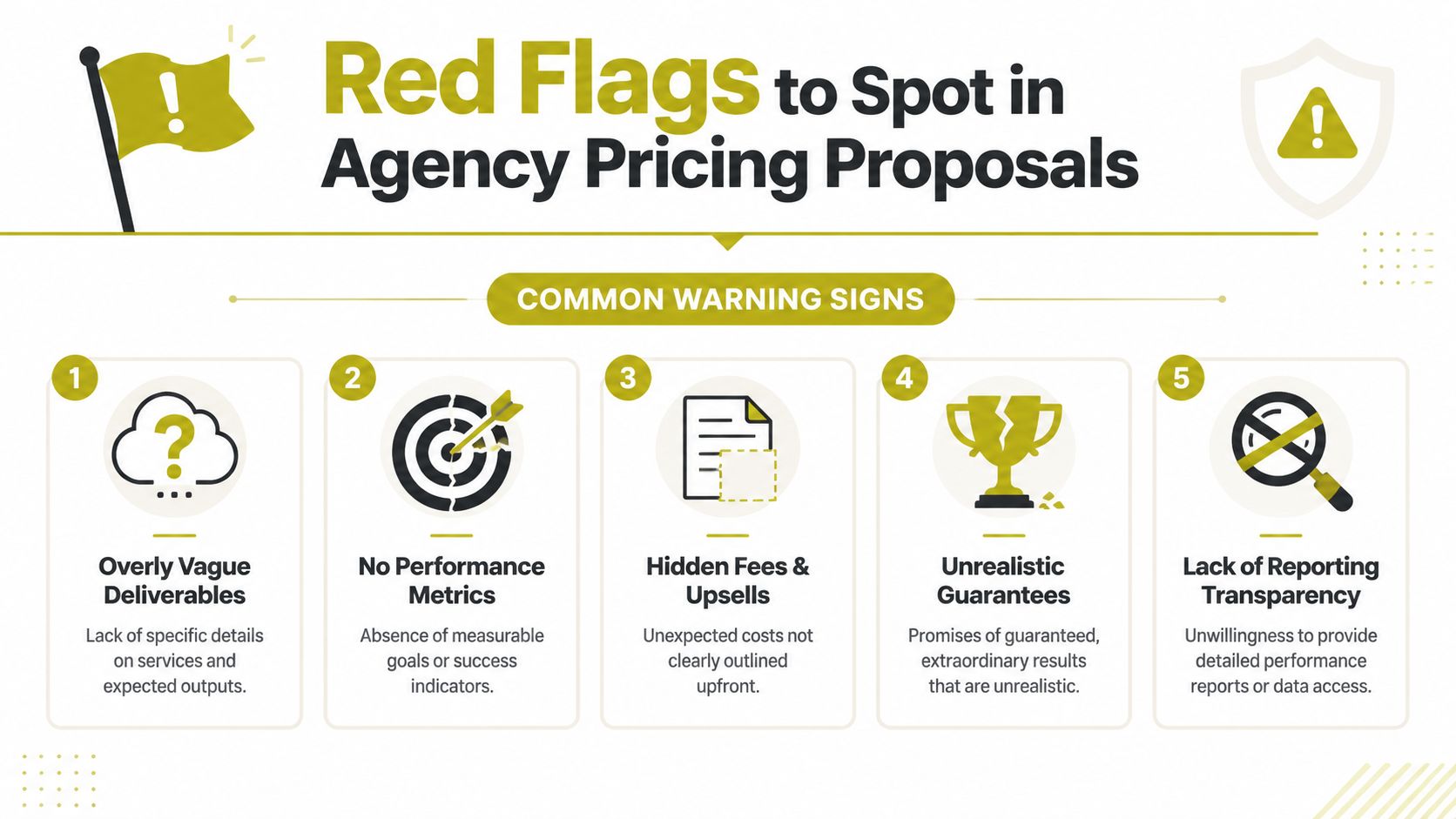
Five red flags worth taking seriously
- Vague promises. “Increase awareness” means nothing unless the agency explains how success will be measured and what work drives it.
- No proper metrics. If there's no clear link to leads, enquiries, conversions, revenue, or meaningful visibility, the package is padded.
- Blended fees. If agency fee, ad spend, software, and extras are mashed together, you can't judge value properly.
- Wild guarantees. Any promise of guaranteed rankings or extraordinary outcomes should make you suspicious.
- Poor transparency on reporting and access. You should know what data you'll see and who owns the accounts.
Hidden costs are where budgets go wrong
One of the biggest gaps in agency pricing guidance is how often proposals leave out what matters most in the final bill. UK businesses need to ask what is excluded, including VAT, one-off setup fees, ad spend management percentages, and reporting software costs, because these can materially change the total investment, as noted in Influence Flow's agency pricing guide.
That exclusion list matters more than the shiny front-page number.
What a good proposal looks like instead
A good proposal is boring in the right places. It states scope clearly. It names responsibilities. It explains reporting. It separates fees cleanly. It tells you what happens in month one, what gets reviewed, and how either side can raise scope changes.
If you need a sales call to decode the pricing page, the proposal isn't transparent enough.
Measuring ROI and Negotiating a True Partnership
ROI doesn't start with likes, reach, or a prettier monthly dashboard. It starts with the commercial question. Did this work create more qualified demand, stronger trust, better conversion, or more valuable visibility?
That's the lens you need when negotiating a package.

Measure what matters
Track the indicators that connect to the business, not the platform.
- Lead quality over raw lead volume
- Enquiries and bookings over impressions
- Conversion performance over website traffic alone
- Share of voice and message quality over empty brand mentions
- Commercial follow-through over content volume
If an agency can't tie its work back to those kinds of outcomes, the package is probably designed for retention, not accountability.
Negotiate the scope, not just the fee
Most SMEs negotiate badly. They ask for a lower monthly cost instead of a better-shaped engagement.
Try this instead:
- Trim weak channels. Don't spread a modest budget across everything.
- Ask for a trial period. A shorter initial term is often more useful than a discount.
- Clarify decision points. Know when strategy gets reviewed and changed.
- Protect access and ownership. Your accounts, your data, your assets.
A useful walkthrough on agency thinking and pricing logic sits below.
A real partnership should feel like an extension of your leadership team. It should challenge bad assumptions, not just fulfil a scope. It should help you make better decisions, faster. And it should be built around outcomes that matter to your business, not a monthly checklist designed to keep everyone busy.
If you want a straight conversation about what your budget should buy, Carlos Alba Media is one option to consider. The agency provides PR and digital marketing support with teams in London and Glasgow, and its people are former national news journalists or have agency experience with international brands. If you value senior counsel, message discipline, measurable digital work, and practical support without big-agency overheads, it's worth having that conversation before you sign another generic package.