
You've got an announcement to make, a draft full of tracked changes and someone asking whether it can go to journalists this afternoon. The chief executive wants more company background. Legal wants a qualification. Meanwhile, the actual news is halfway down the page.
Knowing how to write a press statement means deciding what an editor needs, not accommodating every internal preference. Start with a checkable story, give it a clear structure and make someone available to answer the awkward questions.
The Six Parts of a Press Statement at a Glance
A press statement gives an editor a news announcement they can check, lift and publish with little rewriting. A broadcaster should also be able to read its essential wording aloud without translating corporate language into ordinary English.
For an announcement, use the structure below. A response to an incident may need a shorter format, but the same editorial principle applies: put useful information before organisational background.
Give every part a distinct job
Press statement parts, purpose and length
| Part | Job it does | Typical length | Common mistake |
|---|---|---|---|
| Headline | Names the news in plain words | Aim for roughly eight to twelve words | Clever wording that hides the news |
| Dateline and lead | Answers who, what, where, when and why | Aim for thirty to forty words | Starting with company history |
| Supporting paragraphs | Adds evidence and context | Two or three paragraphs, roughly forty to sixty words each | Unsourced figures |
| Spokesperson quote | Adds interpretation and a named voice | One or two sentences | Repeating the lead |
| Notes to editors | Gives neutral background on the organisation | Aim for forty to sixty words | Marketing superlatives |
| Media contact | Lets journalists verify and follow up | Name, direct mobile, email, out-of-hours number | Only a generic inbox |
Treat these lengths as drafting targets, not rules that justify padding. Aim for a statement of roughly 300 to 500 words that fits comfortably on a page. If the announcement needs extensive technical explanation, put that material in an accompanying factsheet rather than forcing it into the lead.
The headline identifies the change. The dateline establishes the place and release date, while the opening paragraph explains the announcement's significance. Supporting paragraphs then supply the evidence an editor needs before deciding whether to use it.
Keep the quote separate from that factual work. Its purpose is to explain a decision, acknowledge a concern or describe what the announcement means for people affected by it.
Editing test: Write each paragraph's job beside it. If you can't name its job, cut it.
Notes to editors belong near the end because they help a reporter understand the organisation without interrupting the story. The contact block belongs there too, but it isn't an administrative afterthought: an unanswered question can prevent publication.
A statement that opens with the company's founding story fails immediately. The editor shouldn't have to search below the fold to discover why you're contacting them today.
How to Write a Headline and Opening Paragraph
Your opening has to survive different editorial settings. A website editor may shorten it for a news page, a producer may read it aloud, and a reporter may encounter it first in an email preview.
Ofcom's 2025 News Consumption in the UK findings found that online news reached 70% of UK adults, while 51% used social media for news. Write for that fragmented environment without assuming that everything will remain on the channel where you first publish it.
Draft the news before the wording
Choose what has changed. Identify the contract, recall, appointment, investment or finding that affects someone outside the organisation. In a hypothetical Glasgow tour operator announcement, adding forty jobs is a stronger angle than celebrating twenty years, because the jobs have a direct consequence for the local economy.
Write an active headline that names the subject and the change, preferably under twelve words. For that hypothetical announcement, Glasgow tour operator creates forty jobs through expansion gives an editor something concrete; Tourism business celebrates an exciting new chapter doesn't.
Build the lead around the strongest fact. Aim for about thirty-five words, putting the place near the start and spelling out the relevant date in full. Distinguish the publication date from the date something happens, especially when recruitment, opening or implementation comes later.
Read the opening aloud. Keep sentences short enough to say comfortably, aiming to stay below about twenty-five words, and replace unexplained acronyms with ordinary language.
Add a subheading only when it earns its space. For an online version, it can explain a consequence that won't fit in the headline, but it shouldn't repeat the headline in different words.
Carlos Alba Media's guidance on writing an introduction for news is useful when you're struggling to separate the announcement from its background. Write the factual introduction first, then negotiate the supporting detail.
Adapt templates without adopting their padding
For a music announcement, the free music press release format from epks, an electronic press kit builder, offers a relevant starting structure. Use a sector-specific format to organise information, not as permission to retain promotional language that obscures the news.
An editor who reads only the opening paragraph should still be able to write a short, accurate news item.
For Scottish businesses seeking wider coverage, put the meaningful local angle in that opening. A Glasgow location, Scottish supply-chain implication or regional recruitment commitment helps an editor judge relevance immediately. Don't hide it in the organisation's address at the bottom.
How to Build the Body, Quote and Contacts
The body turns your announcement into something a journalist can verify. Don't add material merely because a department supplied it: include what establishes the announcement's scale, explains its significance or answers an obvious follow-up question.
The Office for Statistics Regulation's guidance on public use of statistics, data and wider analysis says public communications should use the latest reliable published official statistics and make supporting analysis accessible, with strengths and limitations explained. Treat that as an evidence-handling discipline, not a decorative citation exercise.
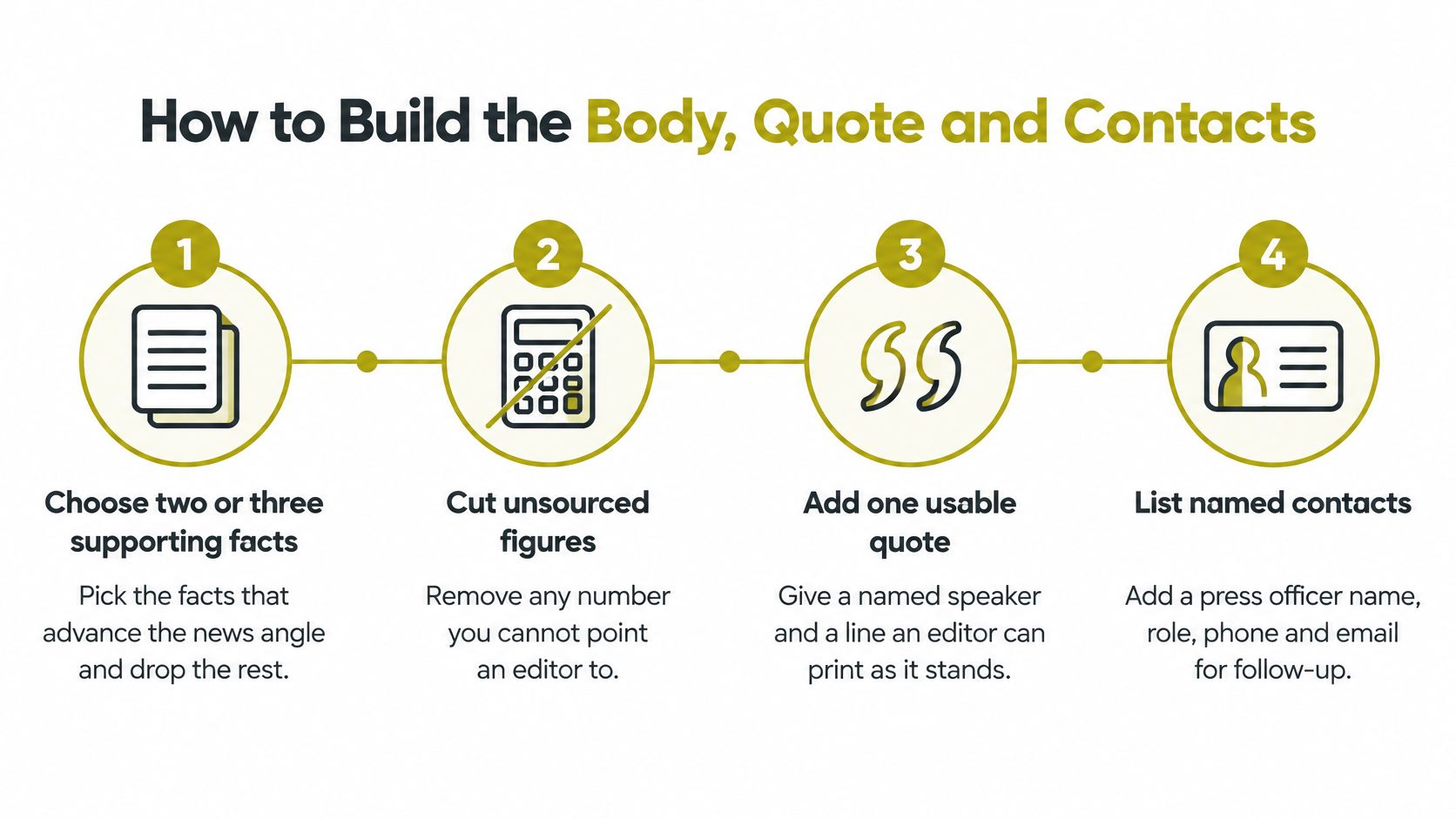
Use this process to keep evidence, interpretation and access separate.
Build an evidence trail
Select supporting facts. Choose the facts that advance the announcement. For an expansion, these might explain the location, recruitment arrangements and operational change; unrelated historic turnover may add nothing.
Verify each number, date, job title and substantive claim against a primary source. Keep a working record showing the source document, the relevant passage and who confirmed it internally.
Give each paragraph a single purpose. Name the source in the text where needed, and attach a source link or methodology note to every material statistic. For survey findings, explain who was surveyed and what the result measures.
Draft the quote in the spokesperson's first-person voice. Ask what they can explain that the factual paragraphs can't: why this decision was taken, what trade-off it involves or what customers should expect.
Finish the usable copy
Write neutral notes to editors. Aim for forty to sixty words covering the organisation's activity and relevant background. Remove claims of leadership or excellence unless they're independently demonstrable and necessary.
Add a named media contact, role, direct mobile, email and out-of-hours number. Confirm who will handle technical questions and who will cover the contact if they become unavailable.
Obtain approval from legal, compliance and the quoted spokesperson. Where a function doesn't exist internally, name the responsible reviewer rather than leaving ownership ambiguous. Keep approval against the final version, not an earlier draft with materially different wording.
If supporting figures aren't published, arrange to publish them alongside the statement or leave them out. An internal spreadsheet that a reporter can't inspect isn't an adequate public evidence trail.
On the page, the finished body should feel spare: a paragraph establishing scale, another explaining implementation, and a quote interpreting the consequence. A usable quote doesn't promise that everyone will benefit; it explains a decision in language the spokesperson is prepared to defend.
Pre-Send Checks That Stop Corrections
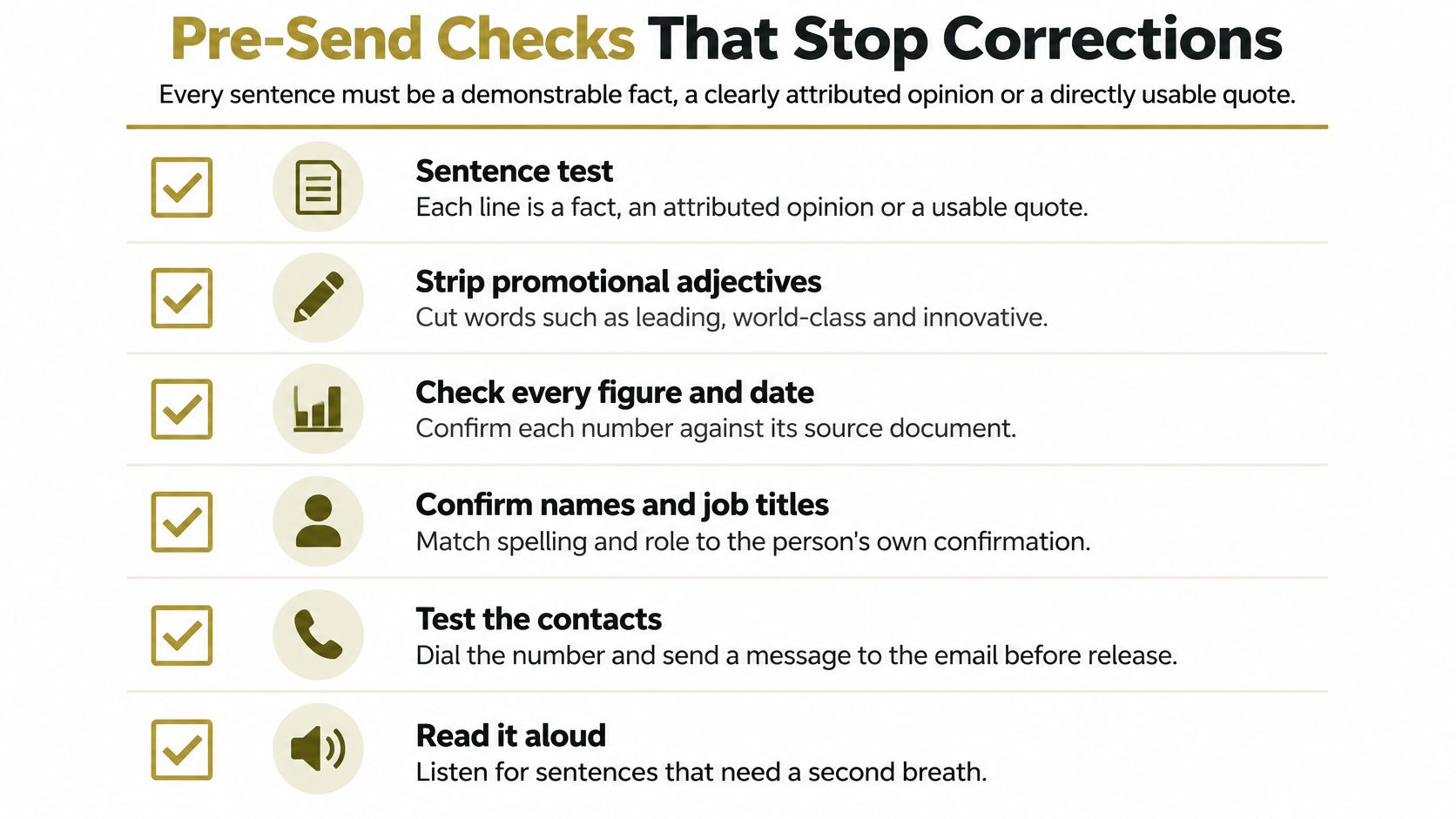
Every sentence must be a demonstrable fact, a clearly attributed opinion or a directly usable quote. If it fits none of those categories, it probably doesn't belong in the statement.
In Cision's 2018 UK journalist survey, 81% considered 100% accuracy paramount. That's a reason to make verification an acceptance test, rather than hoping a final spellcheck will catch substantive problems.
Use a visible checklist so the reviewer can record what they've checked.
Test what a sceptical reporter will ask
- Claims: Strip leading, unique and world-class unless evidence supports the precise claim.
- Figures: Check each percentage's denominator, comparison period and relationship to the underlying total.
- Names and dates: Confirm spelling and job titles with the spokesperson. Check the day, month, year and relevant location.
- Language: Expand acronyms on first use and read difficult sentences aloud.
- Consequences: State what happens next and how affected people obtain further information.
Write down the hardest questions a reporter could ask. If the draft can't answer them with evidence, resolve the gap before sending. For sensitive allegations, privacy issues or contested claims, use a separate media law and ethics review, rather than expecting copy-editing to resolve legal risk.
This accompanying video can sit alongside your final review process.
Build a short reporter list by beat, not by the size of your database. Explain in the covering email why this announcement matters to that publication's readers; a generic distribution list won't repair an irrelevant angle.
Before distribution, MailGenius's email spam checker can help you inspect the sending email for deliverability problems. It can't tell you whether the story deserves coverage.
Final gate: Facts checked. Names confirmed. Numbers traceable. Contacts tested. Final-version sign-off recorded.
Using AI Without Losing Journalist Trust
Faster drafting doesn't necessarily mean easier placement. A 2026 survey reported by Presswire of 200 UK journalists found 76% opposed AI-generated pitches or releases, 44% were strongly opposed, and only 7% supported fully AI-generated releases; it also reported that 79% were more likely to respond when a pitch matched their beat, audience or reporting area.
That gives UK organisations a practical acceptance rule: keep editorial judgement human-led. Saving drafting time isn't useful if the result sounds interchangeable with every other announcement.
Separate production help from editorial responsibility
Acceptable and risky AI uses in press statements
| AI task | Verdict | Condition |
|---|---|---|
| Transcribing interview notes | Acceptable | Check every quote against the recording |
| Suggesting alternative headlines | Acceptable | You choose and verify the final wording |
| Checking formatting and accessibility | Acceptable | Human review before sending |
| Brainstorming first-draft angles | Conditional | Discard any claim you cannot source |
| Inventing or polishing quotations | Avoid | Quotes must come from the spokesperson's approved words |
| Summarising unverified research | Avoid | Read and cite the primary source yourself |
| Writing the final statement unreviewed | Avoid | A named person signs off every line |
Attitudes aren't uniform. Cision's 2025 State of the Media findings reported that 71% of surveyed journalists were open to PR professionals using AI for releases or pitches, but that result isn't UK-only. The surveys have different samples and wording, so don't present them as proof of a measured change in opinion.
Check AI-suggested facts against the original documents, not another generated summary. Check quotations against a recording or the spokesperson's explicitly approved wording, and retain an internal note of which tasks involved AI assistance. Don't upload confidential material to a tool without organisational permission.
Credible spokesperson materials matter too. Jimmy Clemmons Photographer's guidance on building a professional team portrait library is relevant when preparing identifiable, current images to accompany media enquiries.
AI can assist production, but it shouldn't supply invented certainty. The named human spokesperson remains the author of record for their statement, with a human editor accountable for the released copy.
Decide Whether to Send or Hold Your Statement
Send only when the completed statement is publishable and the organisation is ready to support it. A finished document and a viable release window aren't the same thing.
Release it when the evidence is publicly accessible at publication, approvals cover the final wording and the named contacts can answer calls during the release window. The spokesperson must be ready to discuss the substance, not merely approve a quotation. An editor working fast tests a statement on exactly these points, and a weak link in any of them kills the piece.
Make the decision operational
| Decision | What it means in practice |
|---|---|
| Send | Evidence, approval, publication and spokesperson availability are aligned |
| Hold | A material fact remains unresolved, the situation is changing or nobody can answer follow-up questions |
| Revise | The announcement is sound, but the lead or reporter list doesn't fit the intended audience |
If you hold, set a new decision time and name the person responsible for resolving the blocker. Holding for a stated reason reads as discipline to a news desk; going quiet after a promise reads as a problem. If an incident demands an immediate response while facts remain uncertain, use a holding statement that distinguishes confirmed information from what's still being established.
Apply a national-news standard
The UK Government's journalism review recorded frontline print-journalist numbers falling by more than 25%, from approximately 23,000 in 2007 to 17,000 in 2017, and identified ten daily and nine Sunday UK-wide national newspapers in February 2018. Fewer frontline journalists handling the same volume of announcements means less desk time per statement, and less patience for one that needs a second call to stand up.
A Parliament report drawing on ONS figures recorded 46,500 employed and 33,700 self-employed journalists in 2019, alongside 13,000 national-newspaper roles in 2018. National-news experience is a specific credential within that wider profession.
All our consultants at Carlos Alba Media are former national print and broadcast journalists, which gives our consultancy a newsroom-informed basis for judging whether an announcement will survive an editor's questions.
The PR industry feeding those newsrooms is far larger: evidence submitted to Parliament recorded the CIPR's estimate of 71,000 UK PR practitioners in 2018 and the PRCA's £14.9 billion valuation of the sector's work in 2019. Your statement competes for attention inside that volume, which is why the send-or-hold call deserves the same rigour as the drafting.
For a sensitive draft, commission a second editorial read before committing to distribution. Give the reviewer the evidence, identify the final approver and set a realistic send time.
Carlos Alba Media offers a free consultation with one of our public relations experts if you're facing a communications challenge or media crisis. Visit Carlos Alba Media to discuss your draft, its news angle and whether you're ready to send it or should hold for further verification.