
69% of UK SME employers are majority-owned by the person or family who founded the business, according to the government's Longitudinal Small Business Survey. In the same dataset, web-based selling rises with headcount, from 72% of microbusinesses to 81% of small firms and 88% of medium-sized firms. Put those together and you have the defining marketing fact of the UK economy: in roughly seven in ten employer SMEs, the founder already controls positioning, reputation and customer relationships, and that credibility now has to travel through digital channels rather than a handshake.
That's the gap founder led marketing fills. The founder's judgement is the most defensible thing the business owns, and most of it never reaches a buyer because nobody has given it a shape, a schedule or a measurement path.
What Founder-Led Marketing Really Means
Scroll any founder's feed in 2026 and the tell is obvious. Half the posts share the same rhythm, the same three-line hook, the same generic lesson. AI has made competent-sounding content free, which means the thing buyers want, a named human with a track record and an opinion they'd defend in a room, has become the scarcest asset in marketing.
Founder led marketing is when the founder deliberately acts as the face, voice and credibility engine of the company's marketing. It's planned against commercial jobs, resourced with a time budget and measured against pipeline rather than impressions.
The distinction that matters is between that and passive personal branding. Personal branding is a founder posting when they feel like it and checking likes. Founder led marketing has a brief, an owner, a publishing rhythm and a way of attributing enquiries back to the activity that started them. One is vanity. The other is a go-to-market channel.
And it's a channel that's structurally available to almost every small business in Britain, because founder and family ownership is the norm among employer SMEs. The founder usually holds final say over positioning, reputation, customer relationships and public communications. They aren't a marketing asset the business has to acquire. They're an asset it already owns and mostly under-uses.
The complication is that ownership now has to express itself digitally. Web-based tools for selling and managing the business get more common at every step up in company size, so a founder who built the firm on referrals needs their credibility to survive contact with a website, a search result and a LinkedIn feed. Positioning that only works in a room doesn't scale.
Which is why the positioning has to be settled before the posting starts. We begin client work by helping a business define its brand's character and what it stands for. Founder content amplifies a position, it can't invent one, and a unique value proposition that's vague produces vague posts.
What follows is the working version. Three mechanisms that make founder voices outperform faceless brands. A three-hour weekly operating system with budgets attached to each activity. Three founder archetypes. The consent and reputation lines most owners cross without noticing. And a 30-day plan to get the whole thing running.
The Weekly Founder-Led Marketing Operating System
65% of in-house marketing is performed by business owners, and 65% name time restrictions as their biggest marketing barrier, according to 2025 research into the marketing frustrations blocking SME growth. The same study found 58% spend less than £250 a month on marketing, 49% have no formal marketing strategy and one in five don't know what's working.
The answer to that isn't more effort. It's a smaller, better-designed system. Founder led marketing works when it's treated as a constrained operating system, not a personal-brand campaign, and the constraint is honest: three hours a week, five commercial jobs, one metric each.
| Commercial job | Founder activities | Time per week | Leading indicator |
|---|---|---|---|
| Create demand | Opinion posts on market shifts, short-form video explainers, newsletter commentary | 60 minutes | Branded-search growth and quality follower growth |
| Accelerate trust | Behind-the-decision stories, customer Q&A, webinar and podcast appearances | 45 minutes | Reply rate and sales-cycle length |
| Earn media | News commentary, journalist pitches, expert quotes, conference panels | 30 minutes | Journalist replies, coverage and backlinks |
| Support sales | Objection-handling content, proposal follow-ups, customer case stories | 30 minutes | Meeting rate and opportunity value |
| Retain customers | Milestone shout-outs, roadmap notes, community answers | 15 minutes | Repeat purchases, referrals and churn |
Add the column up and the total is 180 minutes. That means two 90-minute blocks, one early in the week to capture and one late to publish and review, and the rest of the week belongs to running the business.
If you learn better by watching than reading, this is worth ten minutes before you build the routine.
The six-step weekly routine
- Pick one commercial job and one content pillar. Start with the objection your sales conversations hit most often, the price question, the "we'll do it in-house" line, the compliance worry. That objection is your pillar for the quarter, and everything else is a subplot.
- Capture one high-authority moment a week. A customer question, a regulatory change, a sales objection, a decision you made and why, a trade-press story you disagreed with. One moment, not seven. Authority comes from specificity, not volume.
- Record before you write. A five-minute voice note on your phone, or 150 words in a document. Speaking beats typing for most founders because the detail survives. That recording is the raw asset, and it's the same asset for every channel that follows.
- Repurpose on a fixed rhythm. LinkedIn early in the week, a short video or carousel midweek, a paragraph in the newsletter at week's end. Pitch a journalist only when there's a genuine news hook, not because the schedule says Thursday.
- Route every asset through one conversion path. A UTM-tagged URL, one landing page with a single call to action, and a CRM entry recording source, content theme, prospect role, consent status, lead stage and next action. Without this step, attention leaks away the moment the founder is unavailable.
- Review for 30 minutes a month. Qualified enquiries, assisted conversions, branded-search growth and sales-cycle length. Then cut whatever isn't moving one of them. A founder who stops an activity is making a marketing decision, not giving up.
The routine exists to dismantle three specific obstacles. In a 2023 survey of 252 UK SME owners, executives and managers, GetApp's small business social media findings recorded that 47% identified the time required to post regularly as a major concern, 37% cited the time and resources needed to create ideas, and 29% cited managing content. The same survey found 48% consider social media essential to maintaining their business, a further 49% call it important but not essential, and 83% publish new content multiple times a week, with Facebook the most used platform at 81%. Steps two and three answer the ideas problem. Step four answers the posting problem. Step five answers the management problem.
The contrarian rule: post less, repurpose more. Two high-authority moments a week, each cut four ways, will outperform five generic posts that could have been written by anyone in your sector.
When video is your midweek format, the same principle applies: one commercial point, shot once, cut into the shapes each platform rewards. That's how we structure the work behind our social media marketing video production, and it's why the founder stays the thinking person while the production becomes routine.
Circle the commercial job that matters most this quarter. Claim its time budget in your diary now. The other four can wait a month.
Why Founder Voices Outperform Faceless Brands
Three mechanisms do the work, and they run in a fixed order.
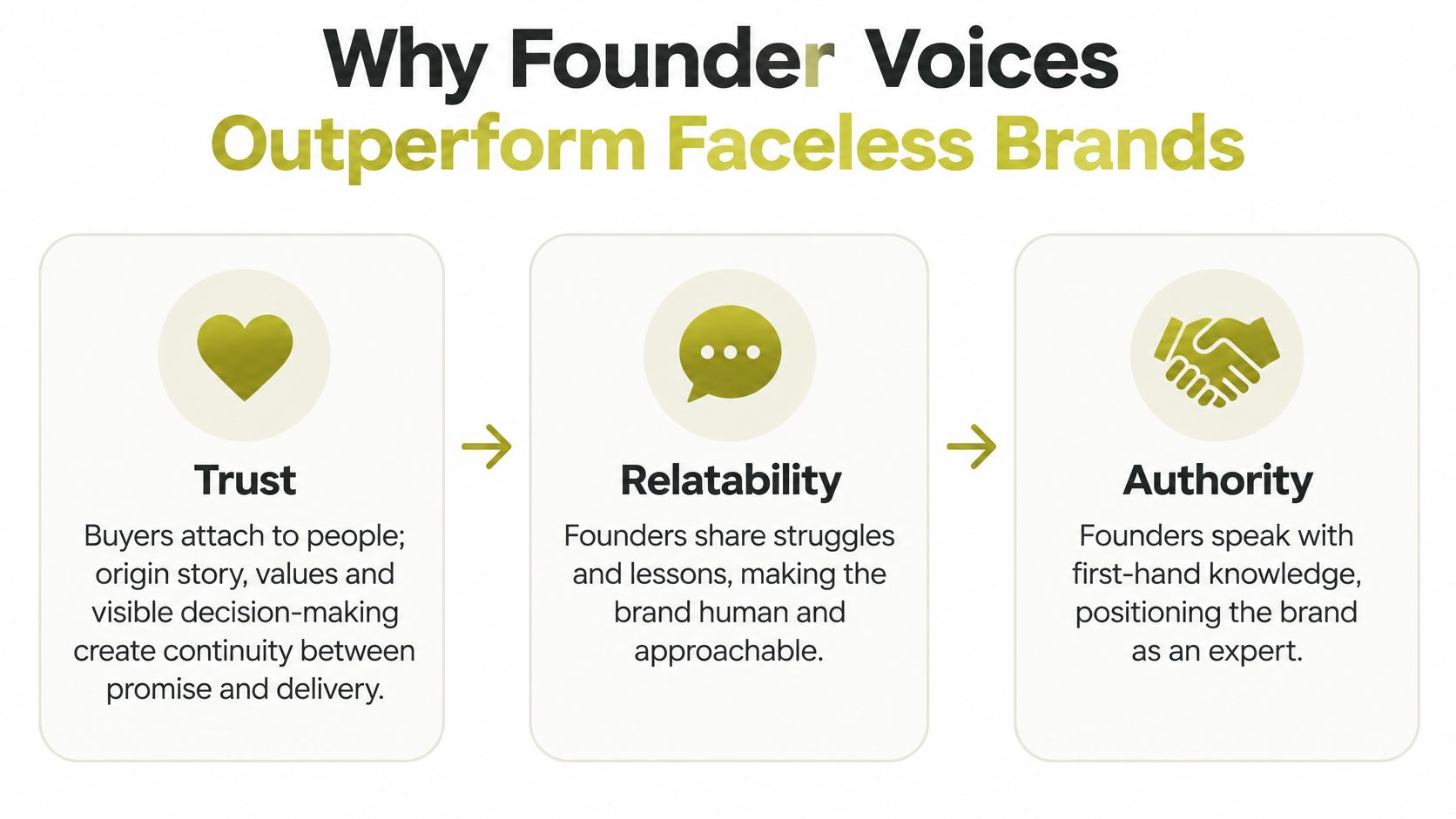
Trust attaches to people. Buyers don't build confidence in a logo. They build it in a person whose origin story, values and visible decision-making give them a way to check whether the promise matches the delivery. A founder explaining why they turned down a piece of work tells a prospect more about standards than any case study.
The infographic below sets out the three signals a founder sends when they show up consistently.
Differentiation can't be copied. A competitor can match your features, undercut your price and clone your landing page. They can't reproduce your judgement, because it comes from the decisions you made and the ones you got wrong. First-person commentary on your own market is the one asset a larger brand's marketing department can't fake.
Reach compounds when the infrastructure exists. In 2025, 97% of UK SMEs used social media to promote their businesses, according to iwoca's figures reported by Scheduler, with 69% on Facebook, 67% on Instagram, 63% on YouTube and 49% on TikTok. The distribution rails are already there. The founder's voice is what travels along them.
Then there's the commercial multiplier. The government's UK digital strategy reports that SMEs with a strong web presence grow, on average, more than twice as quickly as firms with minimal or no online presence, while exporting twice as much and creating twice as many jobs. Founder content is the human fuel for that system, not a separate activity bolted alongside it.
The cost argument is harder to ignore. For a business whose entire marketing budget is modest enough to fit on a credit card, the founder's expertise is the cheapest differentiated asset it already owns. A phone camera and an hour cost less than any ad set, and the output keeps working after you stop.
Where this breaks down is distribution without craft. If your founder video sits next to polished brand work from three competitors, the gap shows. A corporate video production company handles the craft while you keep the thinking, which is usually the right division of labour for an owner who has ninety minutes, not nine hours.
The strategic point underneath all three mechanisms is that founder led marketing is a trust strategy, which makes it a thought leadership content strategy before it's a posting schedule. Visibility without a conversion path is theatre. Attention that never reaches a landing page, a CRM record or a sales conversation flatters the founder and pays nobody.
Founder-Led Marketing in Action
Three founder patterns cover most of what works in UK SMEs, and each one maps to a commercial job inside the three-hour weekly budget.
| Founder type | Weekly activity | Commercial job | Metric to watch |
|---|---|---|---|
| B2B tech founder | Publishes teardowns of problems buyers already recognise | Prospects arrive at the first call pre-convinced | Length of the sales cycle before a proposal is sent |
| Hospitality founder | Shares behind-the-scenes content from the venue | Turns a local venue into somewhere people feel they already know | Bookings that mention the content |
| Professional services founder | Offers fast, quotable comment on industry stories | Becomes the journalist's first call | Inbound media requests and coverage per quarter |
The bookings a hospitality founder wins don't feel like marketing, because the customer believes they've met the place already. The coverage a professional services founder earns is credibility no advertising budget buys, and it transfers to every proposal that follows. Different jobs, same mechanic: expertise put in public, measured against revenue.
The specialist who became the positioning
Carlos Alba Media is a clear example of founder expertise becoming the brand rather than a backdrop to it. Carlos Alba founded the agency in June 2010 after a career in national newspapers, and the positioning is built directly on that newsroom judgement: identifying the newsworthy angle behind otherwise routine business information.
What makes it a specialist firm rather than a founder with helpers is that the qualification runs through everyone. Every consultant is a former national print or broadcast journalist. Chris Hunt brings 25 years of PR and marketing experience and has worked with brands including Olympus, Bacardi, Campari, Finlandia and Bombay Sapphire. The firm's record backs the positioning too: more than 300 social media marketing projects and more than 400 media exposure projects delivered for organisations of all sizes. A client's budget buys that firm-wide standard, and it travels, since clients can use the service from anywhere in the UK or abroad.
The lesson applies well beyond PR. Genuine founder expertise became the positioning, the pricing power and the differentiator at once, and the business never had to invent a brand voice because it already had one. No bolted-on persona, no ghostwritten opinion the founder wouldn't defend on a call.
Owner-managed firms often sit on the same raw material and treat it as background. The founder's judgement about their own market is exactly what a buyer wants to inspect before committing, and it's usually the last thing the marketing talks about.
So what do you know that your competitors' marketers can't fake? The decision you got wrong last quarter. The regulator's email nobody else has read carefully. The customer call that changed your roadmap. Start there, give each answer a weekly slot and a metric, and you'll never run out of things worth saying.
Where Founder-Led Marketing Goes Wrong
The most expensive mistake isn't sounding corporate. It's assuming an authentic voice puts you outside the rules.
The compliance line owners cross by accident
Under the Privacy and Electronic Communications Regulations, a direct message sent through social media can count as electronic mail, which places it under the same marketing rules as email. For messages to sole traders and partnerships, that can mean prior consent is required unless an exception applies. Messages to companies and limited liability partnerships still need sender identification and a valid opt-out route.
The operational question almost no founder asks is simple: "Can I message a prospect the day after I meet them at an event?" The answer depends on who they are and what you're sending.
| Scenario | What applies | Safe approach |
|---|---|---|
| Social media DM to a sole trader or partnership | Counts as electronic mail under PECR | Obtain prior consent unless an exception applies |
| Social media DM to a company or LLP | Still a regulated communication | Identify the sender and give a valid opt-out |
| Founder post that promotes services | May become a marketing communication | Route it through the approval workflow before posting |
| Performance or sustainability claims | Reputational and legal exposure | A named approver signs off the wording |
| Post that attracts complaints or a crisis | Escalating reputational risk | Follow the pre-agreed response path and pause scheduled content |
Build the check into the weekly workflow rather than treating it as a legal review you do once. When consent status and the approver sit inside the same three-hour block as drafting and scheduling, compliance costs minutes, not days.
Two more assumptions that cost money
Founder-led means founder-does-everything. In a business where the owner is also the spokesperson, the sales lead and the finance function, that arrangement is key-person risk dressed as authenticity. The fix is unglamorous: documented consent, a named approver for any performance or sustainability claim, and follow-up workflows that capture enquiries while the founder is on a plane.
More posting builds more trust. It doesn't. An inconsistent voice, a claim you can't evidence or a complaint handled badly destroys trust faster than a quiet account ever could. Nobody unsubscribes because you posted twice last month. They leave because you contradicted yourself in public.
Authenticity doesn't reduce legal responsibility. Using your own name doesn't make a promotional message private, and it doesn't make it exempt.
The edge case worth planning for is the post that goes wrong. If a founder's comment triggers complaints, or a story lands that drags the business into it, there has to be a response path agreed in advance, plus someone with the authority to pause scheduled content within the hour. Improvising a crisis response on a Saturday is how a comment becomes a news story.
Build Your First 30-Day Founder Marketing Plan
Thirty days, three hours a week, one commercial job. Those constraints are what make the plan survivable for an owner who already has a business to run.
Week one. Choose the single commercial job your voice needs to do, whether that is generating qualified enquiries or shortening your sales cycle, and pick the one channel where your buyers already pay attention. Write the content pillar from your most common sales objection. Then set the minimum stack: analytics, one landing page with UTM tracking, and a lightweight CRM capturing source, content theme, prospect role, consent status, lead stage and next action.
Week two. Capture and publish your first two high-authority moments, and make one pitch to a journalist or podcast. If you're pre-revenue, a founder voice does more for you than a polished brand at this stage, because you have no case studies yet and your expertise is the only proof available.
Week three. Add the repurposing rhythm and hold the first metrics review: qualified enquiries, assisted conversions, branded-search growth and sales-cycle length. Thirty minutes, no more. If nothing has moved, the problem is almost always the message or the channel, so adjust one of those before you touch posting volume.
Week four. Cut one activity that isn't moving a metric, then decide whether production stays in-house or needs specialist support. Specialist help pays for itself in four situations: national media exposure, crisis readiness, on-camera confidence, or a category so crowded that craft is the difference between being watched and being scrolled past. A specialist UK PR and digital marketing agency such as Carlos Alba Media, where every consultant is a former national print or broadcast journalist and the project record includes international brands such as Johnnie Walker and Rolex, is the kind of partner you can assess against those four tests. Clients don't need to be based in Glasgow or Scotland to work with us, and we work with businesses of all sizes, including start-ups and early-stage, pre-revenue companies.
Treat your founder voice as a business asset, with a system, a measurement path and guardrails that are still running in March.
Carlos Alba Media helps founders turn their own expertise into coverage, enquiries and a pipeline they can measure, with a team of former national print and broadcast journalists whose projects have included international brands such as Johnnie Walker and Rolex. We start by defining what your brand stands for and which commercial job your voice needs to do, then build the weekly system, the consent guardrails and the reporting around it. If you want your founder led marketing to earn attention that converts rather than impressions that flatter, visit Carlos Alba Media and tell us which job you need to move this quarter.