
A survey of 500 UK company directors, covering businesses with at least 100 employees, found that 98% had experienced reputational problems affecting their organisation, and only 2% reported no business impact, as recorded in the 2026 Edelman Trust Barometer UK report.pdf). That is not a communications vanity metric. It is a commercial exposure that shows up in investors, profits, staff and culture.
Executive reputation management is how founders, chief executives and spokespeople at UK SMEs and established brands keep that exposure inside a plan they can run. The work is won inside the company before it is won in the press. It is lost when claims run ahead of what staff, customers and regulators can see. And it is defended by knowing when to speak, when to correct, and when deliberate silence is safer than a polished line.
The Four-Stage Cycle and Why Reputation Is a Business Risk
Executive reputation carries commercial risk when investors, employees and customers lose confidence in the organisation behind the leader. Reputational damage can affect investment, profits, company value, morale, culture and the ability to retain staff. Negative media coverage can accelerate that loss of confidence.
Two operational pressures make the risk harder to manage: social media can spread a story quickly, and employees may not feel responsible for the organisation's reputation. A public statement that staff do not recognise from their own experience can deepen the gap between what the executive says and what the business does.
The working cycle
Run executive reputation management as a four-stage cycle, not a campaign you launch and file. Each stage should produce a document with a named owner.
| Stage | What you do | What you hold at the end |
|---|---|---|
| 1. Baseline | Stakeholder surveys, media-content analysis and a search-result audit | A baseline scorecard |
| 2. Map | Priority audiences and the scenarios that would hurt them first | A risk register |
| 3. Narrative | An executive story tied to actions the business has already taken | A message house with proof points |
| 4. Monitor | Trust, visibility, sentiment and behaviour, reviewed every quarter | A quarterly scorecard |
The baseline gives later decisions a point of comparison. If awareness rises but referral intention does not, the campaign has increased visibility without improving a business outcome. The risk register should also be updated after incidents and near misses, so that new concerns inside the organisation are not missed because they never became headlines.
Practical rule: every stage needs a named owner, a usable document and a review date.
The cycle repeats because the risks change. Treating the first baseline as a permanent portrait leaves leaders responding to yesterday's concerns while staff, investors and journalists focus on current ones.
How to Audit the Baseline Before You Change Anything
The common slip is auditing only the company website. That page shows the image the executive wants. The baseline is what a journalist, a candidate or an investor finds in ten minutes, plus what staff will say if asked.
Write one line on the scorecard at the end of each step. Five lines, not a slide deck.
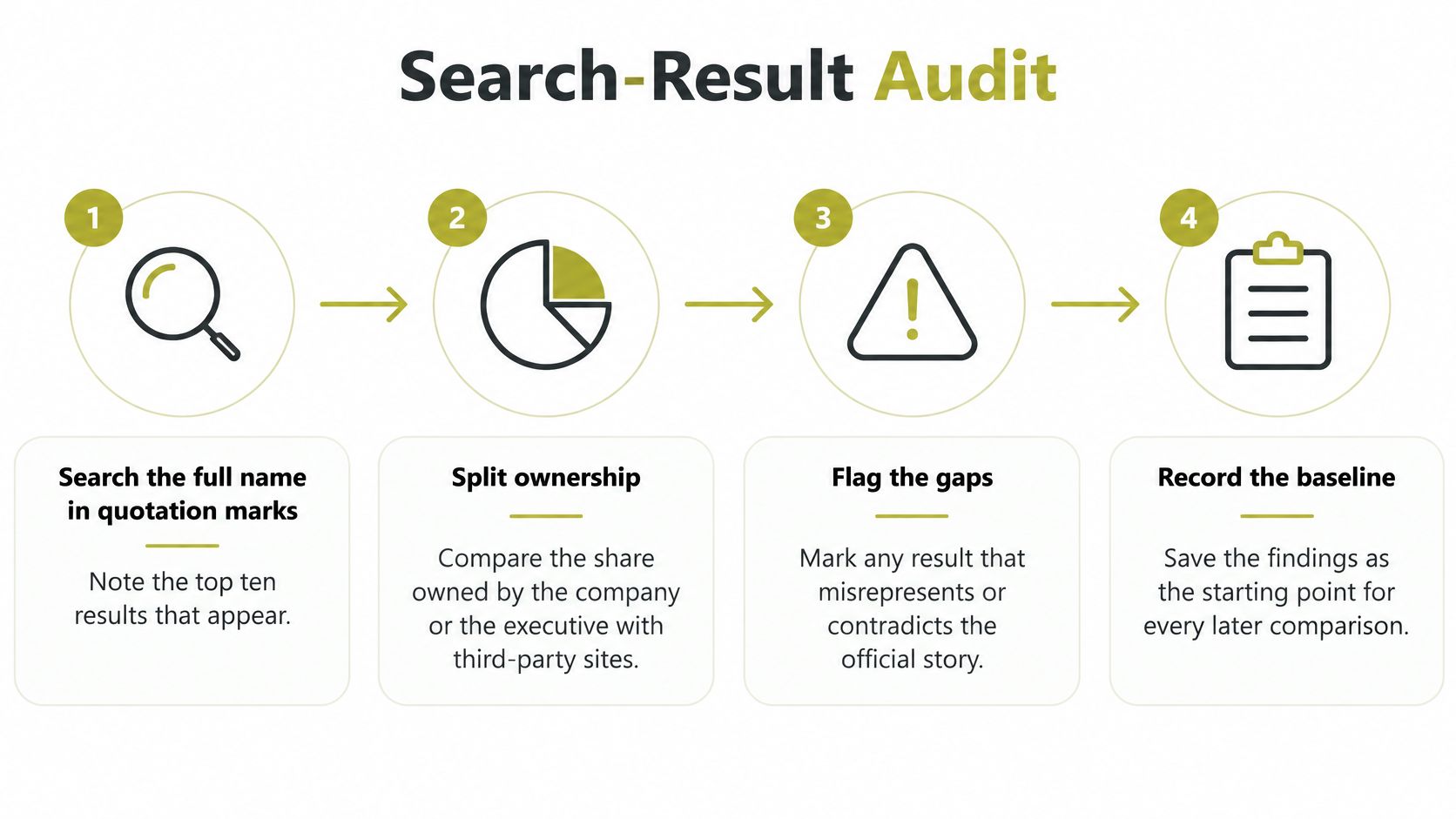
- Search-result audit. Type the executive's full name in quotation marks. Note the top ten results and the share owned by the company or the executive compared with third-party sites. Flag anything outdated or unflattering in the top three. The line on the scorecard is the owned share, plus the worst result still sitting in those three.
- Media-content analysis. Pull twelve months of coverage. Record the publication, the tone, whether the executive is quoted or only named, and which topics dominate. A year of being named but never quoted is a different problem from a year of hostile quotes.
- Social-channel scan. Log mentions, sentiment and unanswered questions. Note any anonymous accounts that repeat the same claim. One repeated, unanswered claim is a risk. A pile of one-off complaints is noise.
- Stakeholder survey. Ask customers, staff, investors and partners about awareness, trust and likelihood to recommend. Report the results by group. A single average hides the group that would walk.
- Internal check. Compare what leaders say publicly with what staff say in pulse surveys or employer reviews. The scorecard line is the widest gap, in the staff's words, not yours.
Search is no longer only the ten blue links. Answer engines now summarise an executive from whatever pages they can reach, including old profiles and unchallenged posts. A practical way to monitor brand mentions across AI is to log, each month, how those tools describe the person when someone asks who they are and what the company does. Treat a wrong summary the same way you treat a wrong search result. It goes on the scorecard.
What the warning signs look like
| Audit source | What to record | Warning sign |
|---|---|---|
| Search-result audit | Top ten results, owned versus third-party share | Negative or outdated result in the top three |
| Media-content analysis | Articles, tone, quoted or named, topics over twelve months | Coverage limited to one outlet or one topic |
| Social-channel scan | Mentions, sentiment, unanswered questions | Anonymous accounts repeating an unchallenged claim |
| Stakeholder survey | Trust, awareness and recommendation by group | Low recommendation among staff or investors |
| Internal check | Staff confidence in public statements | Gap between what leaders say and what staff experience |
Act now if any warning sign is already true. Do not wait for a campaign calendar. An outdated result in the top three will outrank a new biography for months. A staff-confidence gap will contradict the next interview within days, usually on a channel you do not control.
Map Stakeholders and Risk Scenarios Before You Speak
Six audiences usually decide whether an executive is believed. They do not share a timetable, and they do not share a standard of proof.
- Customers judge whether the executive's claims match the product experience. They expect case studies and verified results, not a vision paragraph.
- Investors judge consistency of guidance. They expect board-approved figures and dated statements. A founder rounding a number in an interview is a governance event, not a slip.
- Employees judge whether leadership listens and acts. They expect visible decisions and a two-way channel, not a town hall that takes no questions.
- Regulators judge accuracy and compliance. They expect documented facts. Tone does not help if the number is wrong.
- Journalists judge access and verifiable detail. They expect named sources and on-record quotes. A briefing that cannot be checked is a briefing they will not use.
- Partners judge reliability under pressure. They expect a continuity plan, not a reassurance email.
Our work is to help clients publicise what they do to potential customers, industry partners, regulators and investors. Those four already sit inside the six. Messaging that flatters one of them and ignores the others is how a launch becomes a complaint.
Four scenarios, and who moves first
Keep the risk register to scenarios you can rehearse.
- Data breach. Regulators and customers move first. Staff are asked questions by friends before any internal note lands.
- Online misinformation. Journalists and customers see it within hours. Anonymous reposts fill the gap if nobody owns a correction.
- Negative media coverage. Investors and recruits read it the same morning. Partners ask whether the relationship is still safe.
- A wrongful allegation. Legal moves first, but employees and journalists will not wait for a court timetable.
Regulated firms add sector risks to the same register. A medical-device claim, a financial promotion, or an environmental permit each has a regulator who will read the executive's words as the company's words. Rank those beside the four, not in a separate folder nobody opens.
Say a Scottish technology SME founder ships a product release that draws sharp criticism online. Customers and investors react within hours. Staff are asked about the flaw by clients before any statement reaches them. The public reply that goes out first, however careful, is the one colleagues then have to defend without a brief. Employee briefings come before public replies. That order is the whole point of managing reputational risk as an operating habit rather than a press statement.
Brief the people who will be questioned before you brief the people who will publish.
Rank the six audiences by business impact for the next six months. The top three set the messaging priorities. Everyone else gets a holding line, not a separate campaign.
Connect the Executive Story to What Staff Experience
In 2026, only half of UK employees trusted their CEO or senior leadership team, a nine percentage point decline in one year, based on a survey of 5,000 UK workers in the Institute of Internal Communication and Ipsos Karian and Box IC Index. External coverage does not repair that.
A founder can land positive interviews and still be contradicted by staff. Employer reviews, whistleblowing routes and informal social channels carry more weight with a candidate than a trade-press profile. The assumption that more visibility always helps is the expensive one. When claims run ahead of delivery, stepping back is the right call. Cutting visibility is the wrong call when the failure is that nobody asked the people doing the work.

An inside-out system
We start client work by defining what the brand's character is and what it stands for. That sentence is useless if the people inside the building would not sign it. Four moves keep the public story tied to lived experience.
Measure employee trust with a short pulse, on a fixed rhythm, not after a bad week. Five questions are enough if you ask them every time and split the answers by team.
Name the credibility gaps. List where a leadership claim differs from what staff experience. A claim about "same-day support" fails if the service desk's own dashboard says otherwise. Write the gap in operational language.
Brief managers before any public announcement. Colleagues should hear the news from their manager, with room to ask what it means for their week. A cascade that starts after the embargo lifts is a cascade that failed.
Track behaviour, not applause. Record whether the promised action was delivered. Sentiment and reach can improve while the action sits in a backlog. Confidence follows the action.
The practical check takes an hour. Pick three public claims the executive has made in the last quarter. For each one, name the employee who could confirm it, on the record, without a script. If you cannot name that person, the claim does not go out again until the proof exists. Scottish technology SMEs feel this faster than most, because the same narrative is read by engineers, customers, investors and, often, a regulator.
Build Search Presence and Media Readiness
A search result and a media interview test the same thing: whether an executive's claims are clear, current and backed by evidence. Build a presence that can withstand scrutiny, then rehearse the questions that may follow.
Claim the name. Publish a verified biography, a current professional photograph and a concise statement of expertise on the company site and the executive's professional profiles. Owned pages are more credible when they are specific, current and consistent. A dated conference photo beside a new job title creates doubt. A current image should suit the executive's role; considered building trust through leadership imagery is one part of presenting that role clearly.
Build a small library, not a content mill. Three to five pieces a year can give searchers useful evidence: an account of a real decision, a dated results update or a concise explainer. Give each piece a clear byline and sources a reporter can check. Promotional essays rarely displace critical coverage; practical, well-supported material has a better chance.
Answer the questions people search. Journalists, investors and customers use different search terms. Choose a question each audience is likely to ask, then answer it with a link to a relevant proof point in the message house. A clear answer is more useful than adding a thought-leadership label to a sales page.
Train before the booking. Rehearse three key messages, ways to return to them, answers to difficult questions and the rules on what is on the record. Record a mock interview and review it with someone who understands newsroom practice. The Press Gazette report on NCTJ journalism qualifications found that 89% of UK journalists had a degree-level or higher qualification, compared with 48% of the overall UK workforce. Use scenarios from the risk register, including product criticism and allegations the executive hopes never arise. A structured executive interview preparation session should produce a recording, a marked-up transcript and a list of claims the executive should not make live.
Refresh the record quarterly. Check whether the executive's owned pages still appear among the top three results for their name in quotes. Compare those results with the baseline scorecard. If an outdated result still defines the first screen, decide whether a new proof-led page can address the gap. More visibility is not always the right response: if a claim lacks evidence, hold the content until the evidence is ready.
The stage is complete when the biography is current, the photograph suits the role, three to five bylined pieces are available and the mock interview has been reviewed. If one is missing, assign an owner and a deadline before the next media opportunity.
Prepare a Crisis Protocol Before You Need It
A protocol written during an incident is a negotiation, not a protocol. In the UK Connected Crisis Study, 80% of executives identified misinformation or disinformation as an increasing threat, 75% said digital-first channels make crises harder to manage, and 73% said crises increasingly put the whole business at risk. Speed without a fact set is how those three arrive together.
We have completed 100+ crisis management projects. The ones that stay contained were decided before the phone rang.
Five parts, written down
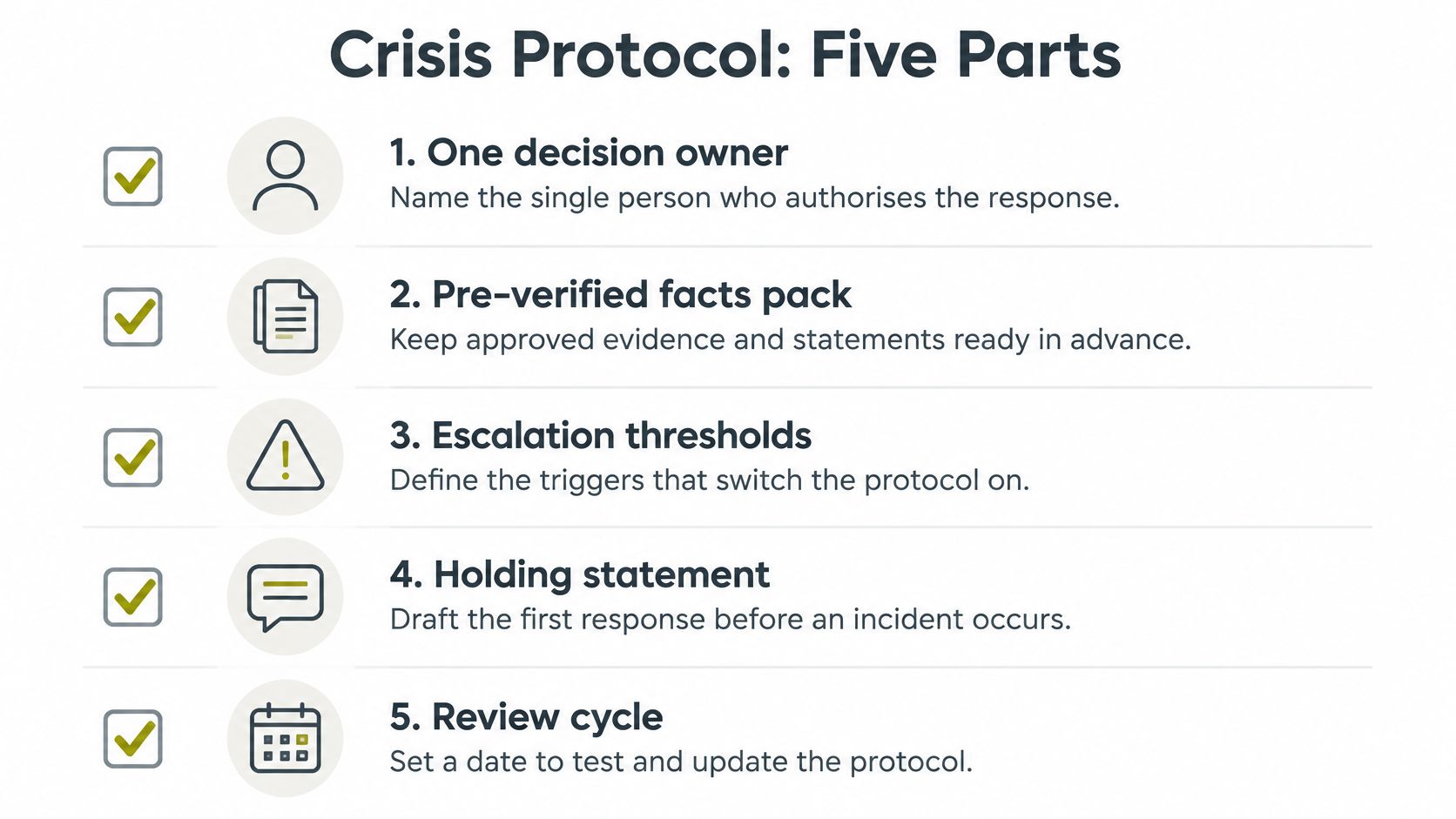
- One decision owner. Name the single person who authorises the response. Deputies are named too, or a weekend incident waits until Monday.
- A pack of pre-verified facts. Approved evidence, dates and figures sit in one folder. Nobody improvises a number.
- Escalation thresholds. Define what switches the protocol on. A single complaint does not. A regulator's letter, a safety issue, or a claim repeating across anonymous accounts does.
- Holding statements by audience. Draft the first response for media, customers and staff before you need it. Three statements, not one paragraph copied three times.
- Rehearsal. Run broadcast, social and employee scenarios at least twice a year. Include the hour when the decision owner is unreachable.
Who signs each statement type is a separate approval rule, set out with the thresholds for ordinary speaking. Do not copy that matrix into the crisis pack or the two documents will drift apart.
During the event, and after it
Verify facts before publication. Update at a fixed cadence, even when the update is that nothing material has changed. Correct errors in the open, on the same channel as the mistake. Make sure what the executive says matches what operations are doing. A values statement with no visible corrective action is one of the failures that sticks.
The others are familiar and still common. Speculation. Delayed acknowledgement. Two spokespersons giving two versions. Legal, communications, operations and leadership have to work from one controlled fact set, or the second statement will contradict the first.
Legal confidentiality is not the same thing as avoidable silence. Say what you can prove, say what you cannot yet say, and do not invent the rest.
A useful companion when you are drafting those first hours is practical guidance on how to protect your brand during a crisis, especially the discipline of one message and one set of facts. Then measure the response, or you will remember it as faster than it was.
| Benchmark | How to measure it | Review point |
|---|---|---|
| Time to verified first statement | Time from incident confirmed to first statement with checked facts | After every incident |
| Public claims backed by evidence | Share of public claims with a source on file | Daily during an active event |
| Correction time | Hours from error found to correction published | After every incident |
| Employee-information consistency | Staff briefings that match public statements | Every update |
| Trust or sentiment recovery | Change against the pre-crisis baseline | 72-hour review and quarterly |
Hold the 72-hour review while the decisions are still fresh, update the risk register, and put the new threshold into the next rehearsal. A protocol that is not amended after a real incident is a souvenir.
Stay Visible Without Over-Managing Your Leaders
Caution has a cost, and UK leaders are already paying it. Research on UK businesses entering 2026, published by Nardello & Co., found that 57% of surveyed leaders were more cautious when speaking, 42% avoided social-media engagement, and 20% had made decisions to protect reputation even when those decisions were not best for the business. In the same study, 26% ranked reputational damage among their top three concerns, with data breaches, online misinformation and negative media coverage prominent inside that group.
Over-management feels like control. It leaves a gap. Critics, anonymous accounts and misinformation fill whatever the executive stops explaining. Strategy updates, time with junior colleagues and a share of public debate are not optional extras for a founder who is also the product. They are how trust is maintained between crises. The skill is telling ordinary leadership apart from the sentences that can hurt people, mislead a market or create a legal record.
Three kinds of speaking, three kinds of gate
| Statement type | Approval | Evidence needed | Escalation trigger |
|---|---|---|---|
| Strategy and growth updates | Head of communications | Board-approved figures | Numbers that differ from the published forecast |
| Expertise commentary and thought leadership | Communications lead and executive | Published sources | Comment on a live legal matter |
| Product or customer claims | Legal and operations | Test results or certifications | Any safety or performance claim |
| Statements about people or allegations | Legal and senior leadership | Documented facts | Any named individual |
| Social replies during a live incident | Crisis team | Verified facts only | Facts still unverified |
This split matters most in owner-led SMEs. The founder is the public face and the person who signs the operational decision. If every reply waits for a full leadership review, routine questions take a week and the founder stops answering them. Pre-agreed thresholds do the opposite. Routine questions move on a pre-approved fact sheet. Senior review is reserved for claims about safety, people, live legal matters and numbers that diverge from the forecast.
Say a customer asks, on a public channel, whether a released feature supports a specific workflow. The fact sheet already says yes, with the version number and the limit. The founder answers the same day, in the company's words, and does not wander into roadmap promises. Without that sheet, the same question sits for a week, a competitor answers it, and the silence is read as doubt.
Write the thresholds down. Test them against last quarter's public statements. If a post would have failed the evidence column, either the post should not have gone out or the threshold is tighter than the business can live with. Adjust one or the other. Do not leave the conflict implied.
Track Outcomes Quarterly and Book Your Baseline Review
Reach can rise while trust stays flat. UK research shared by Tom Short on LinkedIn found that 12% of respondents had ever been impressed or influenced by a business executive, while 58% said an executive's reputation moderately or greatly affects whether they would recommend the company. Media volume and social engagement are useful indicators of activity, not proof of reputation. If the quarterly report counts cuttings but ignores changes in trust, it can reward the wrong work.

Six outcome lines, compared with the baseline
Review these six measures each quarter against the original baseline. Comparing only with last month can make a recovery from a poor result look like progress, even when performance remains below the starting point.
- Unaided awareness of the executive, measured through surveys rather than impressions.
- Message association, based on the words people use, not just the words in the message house.
- Positive and negative sentiment, drawn from media monitoring and separated by outlet type.
- Share of authoritative voice in expert commentary, compared with the competitors identified in the risk register.
- Referral intention, measured by whether people would recommend the company and split by audience.
- Employee confidence in leadership, using the same staff pulse questions each quarter so the results remain comparable.
Use surveys for awareness, association and referral intention. Use media monitoring for sentiment and share of voice, and the staff pulse for employee confidence. The guide to measuring PR effectiveness explains how to keep these outcomes distinct from channel reach.
The same UK findings report that 75% believe executives who share expertise inspire employee confidence, and 69% believe thought leadership improves company reputation. Use specialist commentary when the executive can support it with credible expertise. Another promotional post may add visibility without adding proof.
If the quarterly scorecard shows no improvement in referral intention or employee confidence, pause plans to buy more visibility. Put the budget into evidence employees and customers can recognise.
If you are facing a communications challenge or media crisis, book a free consultation with a Carlos Alba Media public relations expert. All of Carlos Alba Media's consultants are former national print and broadcast journalists.
A useful quarterly review ends with a decision: keep the activity that strengthens trust, change what is not moving the measures, and stay quiet when another statement would add noise rather than evidence.