
Admissions is chasing enquiries. Marketing is chasing attention. Leadership is asking why brand investment hasn't yet translated into better conversion. Meanwhile, your prospective students, their parents, and your international audiences are making judgments long before they ever fill in a form.
This is the situation for most education providers now. Discovery happens online first, and often entirely online, because 94% of UK adults used the internet daily or almost daily in 2024, and 88% used it for information access according to UPCEA's summary of the ONS release. If your institution isn't visible, coherent and credible in digital spaces, you're already late to the conversation.
The harder truth is that visibility alone doesn't solve the problem. Plenty of institutions are visible. Fewer are trusted. Fewer still tell a clear story about who they're for, why they matter, and what makes them worth choosing in a market crowded with similar claims, polished websites and interchangeable campaign lines.
That's where a specialist educational marketing agency earns its keep. Not by posting more often or buying more clicks, but by tightening the link between reputation, message, media coverage, search visibility and enrolment outcomes. In education, the work is never just promotional. It sits close to public trust, institutional identity and real scrutiny.
Introduction Navigating the New Educational Landscape
A familiar scene plays out in education marketing meetings. Applications feel softer than expected in one department. Paid campaigns are generating traffic, but admissions says the quality is mixed. Senior leaders want stronger reputation, not just stronger reach. Parents are asking sharper questions. Staff want to know how the institution is being represented. Everyone agrees the market feels noisier.
That pressure is structural, not temporary. Prospective students don't move in a straight line from advert to application. They search, compare, watch, ask, check reviews, look at course pages, scan headlines, visit social channels and revisit later. In that environment, the institution that wins attention without earning confidence often wastes budget.
An educational marketing agency should help you bring order to that mess. The useful ones don't start with channels. They start with the decision journey. They ask what students need to believe before they enquire, what parents need to trust before they support, and what evidence your institution already has that can be turned into a stronger public story.
Practical rule: If your agency can't explain why students hesitate between first visit and first enquiry, it probably doesn't understand your recruitment problem.
The best work in this sector sits at the intersection of recruitment and reputation. It treats content as proof, PR as credibility, SEO as discoverability and conversion work as operational discipline. That matters more in education than in many other sectors, because the buying decision is slower, riskier and more emotional.
A good specialist partner doesn't just make you louder. It makes you clearer, more believable and easier to choose.
What Is an Educational Marketing Agency
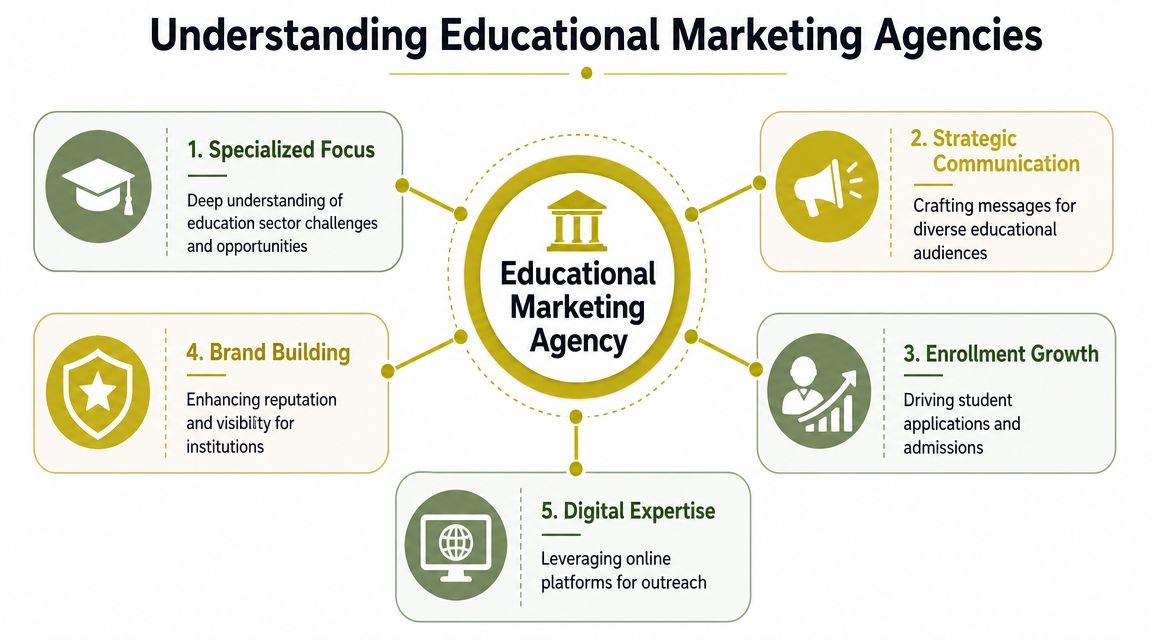
An educational marketing agency is a specialist partner built around how education organisations grow. That means understanding long decision cycles, complex internal stakeholders and the fact that the audience is rarely just one person. In a university setting, you may need to persuade the student, reassure the parent, equip the academic lead and satisfy leadership that the message won't damage reputation.
A generalist agency may still produce competent creative. But education punishes shallow understanding. The tone that works for a retail launch can look tone-deaf in a school campaign. The lead-generation tactics that suit short sales cycles often break down when the actual journey stretches across enquiry, application, offer and enrolment.
Why specialism matters in the UK market
The UK market makes this even more obvious. In the 2022/23 academic year, UK universities hosted 758,855 international students from over 200 countries, comprising 26% of the total student population, as summarised by Advance Education. That's not a side issue. It means education marketing often has to work across multiple geographies, expectations and decision timelines at once.
An agency that understands education will think about:
- Market complexity: A campaign for home students doesn't automatically translate to international recruitment.
- Message sensitivity: Academic reputation, student experience and outcomes need careful framing.
- Audience layering: Prospective learners, parents, teachers, employers, alumni and staff all influence perception.
- Trust signals: Rankings aren't the whole story. News coverage, testimonials, partnerships and thought leadership shape credibility too.
If you run a tutoring business or learning centre rather than a university, the same principle holds. Systems matter. Enquiry handling matters. Follow-up matters. For operators reviewing back-office efficiency alongside marketing, a platform such as Tutorbase for tutoring centers can be useful because growth often breaks when operational follow-through lags behind lead generation.
What a real partner does differently
The difference between a vendor and a partner usually shows up in the questions they ask.
A vendor asks what channels you want.
A specialist asks what kind of student you need more of, where conversion drops, how your academic strengths are currently perceived, and which claims can be backed with evidence.
The serious agencies in this space don't sell activity first. They diagnose friction first.
That's the point. Education marketing isn't a bundle of services. It's a discipline built around persuasion under scrutiny. If an agency doesn't understand that, it will struggle to help you recruit the right people or protect the reputation you've spent years building.
The Newsroom Approach Core Services Reimagined
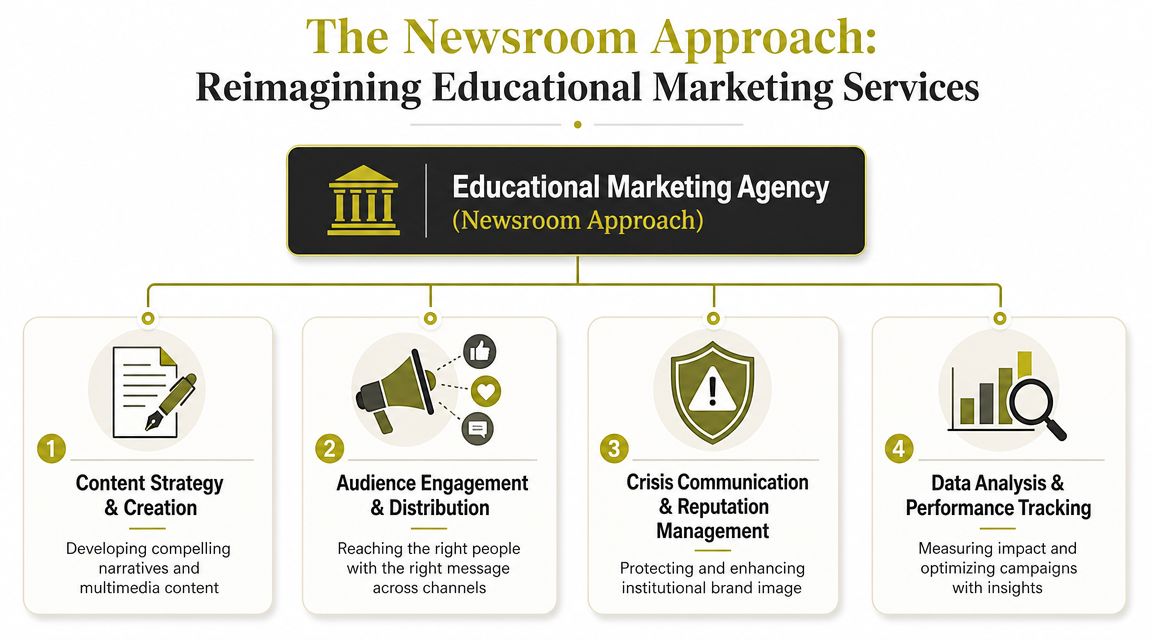
Most agencies can list the usual services. SEO. Social media. Web development. Content. PR. Paid campaigns. That isn't the interesting part. The interesting part is how those services are executed, and whether the team knows how to produce material people will trust.
That's where a newsroom mindset changes the quality of the work. Industry analysis shows that core services for educational marketing include SEO, digital strategy, website development, and social media, all integrated to feed a data-driven demand generation system, according to InBeat's industry overview. The technical stack matters. But the editorial judgement sitting behind it matters just as much.
PR that starts with story value
Weak education PR often reads like internal comms pushed outwards. It announces, but it doesn't interest. Journalists ignore it because it hasn't answered the first test any newsroom applies. Why does this matter now, and why would anyone beyond the institution care?
A news-led agency approaches PR differently. It looks for genuine public-interest angles. Research with social relevance. Student success with wider meaning. Partnerships that signal economic value. Leadership commentary that adds clarity to live issues in policy, skills or access.
That's especially relevant to Carlos Alba Media, where the team is made up of former national news journalists or agency professionals with experience working on international brands. That background changes how ideas are framed, what gets cut, and how quickly weak angles are spotted before they waste time.
Content and SEO that answer real questions
A lot of education content still exists to please internal stakeholders. It ticks boxes, uses approved language and says very little. Search performance suffers because the material doesn't answer the actual questions prospective students are typing, speaking or asking AI tools.
Better content starts with information need. It maps key questions by audience and stage. Then it builds pages, articles, FAQs and proof points that are useful enough to rank and persuasive enough to convert. If you need a practical framework for that editorial process, this guide on creating a content marketing strategy is a sensible place to start.
A newsroom approach also improves pace and standards. Copy gets fact-checked. Claims are tightened. Headlines work harder. Pages are built to be read by humans first, not stuffed with search phrases.
Social media with editorial discipline
Social media for education fails when it becomes a dumping ground for graphics, celebration posts and generic campaign lines. It works better when each platform has a role. One channel may build authority. Another may surface student voice. Another may support event promotion or parent reassurance.
AI can help with production efficiency, but it shouldn't replace judgement. Teams exploring workflow support should understand the limits as well as the opportunities. A useful primer is this piece on how to use AI for social media, especially if you're trying to systemise output without making it sound synthetic.
What still matters most is editorial judgement:
- Angle selection: What's worth posting, and why this audience should care.
- Format choice: Video, quote card, short article, staff commentary or student voice.
- Timing: Matching message to admissions cycles, results periods, open events and live news.
- Moderation: Protecting reputation when comments turn hostile, confused or political.
When social teams publish without editorial standards, channels fill up. They don't become more persuasive.
Crisis and media training shaped by real scrutiny
Education brands don't only communicate when things are going well. They also face complaints, safeguarding questions, industrial disputes, policy criticism and local scrutiny. In those moments, generic brand language usually makes things worse.
Former journalists know what reporters hear as evasive, what makes a statement sound defensive, and how quickly a weak line can become the story. That experience sharpens crisis planning and media training. It also helps spokespeople prepare for hostile questions without sounding rehearsed.
The same principle applies to website and conversion work. A newsroom-trained team tends to remove clutter fast. It respects user attention. It writes for clarity. In a sector full of over-explaining, that can be a serious competitive advantage.
Measuring Success What KPIs Actually Matter
Education marketers still get trapped by easy metrics. Traffic rises. Social impressions look healthy. A campaign generates decent click volume. Then the admissions team says the right applicants aren't coming through, or offer holders aren't converting as expected. That's the moment vanity metrics stop being comforting.
The more useful frame is conversion engineering. You map the full journey, identify where intent leaks out, and measure whether marketing activity improves the path from first interest to actual enrolment. That's where agency accountability should sit.
What to measure instead of noise
Leading sector guidance argues that agencies should be judged on whether they turn web traffic into enrolment and retention outcomes, not surface-level activity. Education teams should therefore prioritise measures that reflect movement through the actual funnel, as outlined in Education Dynamics' guidance on choosing a higher ed agency.
That usually means focusing on KPIs such as:
- Cost per application: Useful when enquiry volume looks fine but completed applications lag.
- Application-to-enrolment rate: A strong indicator of fit, messaging quality and admissions follow-up.
- Lead quality by source: Not every channel produces equally qualified interest.
- Programme-level conversion: Broad averages can hide weak performance in key subject areas.
- Enrolment yield: The clearest test of whether demand generation is reaching the right audience.
How agencies go wrong on measurement
Some agencies optimise for what they control most easily. Cheap clicks. Broad reach. Form fills with low qualification. Those metrics make dashboards look busy, but they don't help senior leadership make budget decisions.
A stronger agency will push for proper attribution, cleaner CRM data and tighter handoff between marketing and admissions. It will also separate reporting by audience type where necessary, because home and international recruitment rarely behave the same way.
| KPI | Why it matters |
|---|---|
| Cost per application | Shows whether spend is producing meaningful progression |
| Lead quality | Distinguishes curiosity from genuine intent |
| Application-to-enrolment | Tests the strength of the full journey, not just top-of-funnel activity |
| Enrolment yield by programme | Helps identify where messaging or conversion friction is concentrated |
Key takeaway: If the reporting stops at clicks, impressions or follower growth, you don't yet know whether the marketing is working.
The right KPI set depends on your model. A university, a training provider and an edtech company won't all report success in the same way. But they should all insist on one principle. Marketing must be tied to outcomes the institution values, not just activity the agency can easily display.
How to Evaluate and Hire the Right Agency Partner
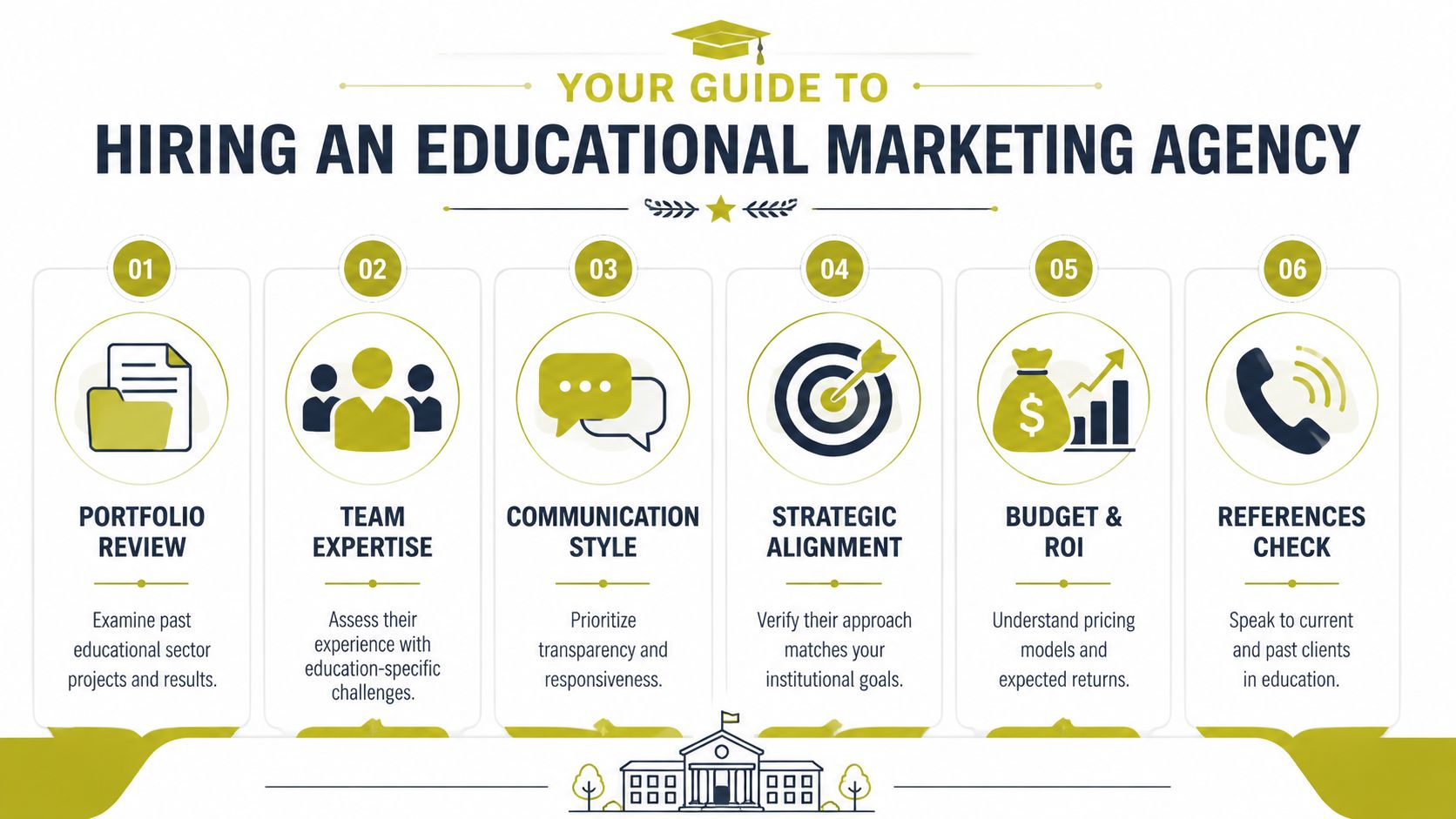
The hiring mistake education organisations make most often is choosing on presentation rather than operating model. A polished deck can hide thin strategic thinking. A busy service menu can hide a lack of sector understanding. What matters is whether the agency can diagnose your problem, challenge assumptions and execute without creating more internal noise.
Start with fit, not flair.
Questions worth asking in the first meeting
The UK market is becoming more crowded, and 2025 undergraduate applicants were reported as the largest applicant cohort on record, which raises the bar on differentiation and conversion quality, as noted by Carvertise's discussion of education advertising pressures. In that environment, your agency questions need to go beyond “What do you do?”
Ask things like:
- How would you localise campaigns across the UK? A single national message may miss regional realities.
- Where do you expect conversion friction in our journey? Good agencies should have a hypothesis quickly.
- How do you balance brand building with lead generation? If they can't answer, they'll default to short-term tactics.
- What do you need from our admissions and academic teams to do this properly? This reveals whether they understand delivery, not just planning.
- How do you report performance by audience segment or programme? Education marketing lives or dies on segmentation.
Later in the process, it's worth watching how they answer pressure questions. Do they become vague? Do they hide behind jargon? Or do they explain trade-offs plainly?
For a sharper view of how PR and communications partners should be assessed, this article on how to choose a PR agency is helpful because many of the same warning signs apply in education.
A short explainer can also help internal stakeholders align before procurement gets messy:
What to look for beyond the pitch
Case studies matter, but not in the way many buyers think. You're not just looking for sector logos. You're looking for evidence of reasoning. Did the agency identify a real problem? Did it adapt by audience? Did it improve message clarity, conversion flow or reputation position?
The commercial model matters too. Retainers can work well when you need ongoing strategic counsel, campaign execution and rapid response. Project fees can suit website rebuilds, messaging exercises or launch campaigns. If your team needs help comparing structures, this guide to choosing effective agency pricing gives a useful overview of how different models affect accountability and scope.
Agency Evaluation Checklist
| Criteria | What to Look For |
|---|---|
| Sector understanding | Clear grasp of admissions cycles, reputation risk and multi-stakeholder audiences |
| Team expertise | Senior operators who've handled media, strategy, content and scrutiny, not just junior account management |
| Communication style | Direct answers, plain English, quick follow-up and no dependence on jargon |
| Measurement approach | Reporting tied to applications, enrolment quality or reputation outcomes rather than vanity metrics |
| Strategic flexibility | Ability to balance PR, content, search, paid activity and conversion work based on the problem |
| Cultural fit | People your leadership team will trust when the pressure is high |
One final point matters more than most buyers admit. You need an agency whose judgement you'd trust when a story breaks, a campaign underperforms or a spokesperson has a difficult interview ahead. In education, that judgement is often worth more than flashy creative.
Case Studies in Educational Marketing
Abstract strategy only gets you so far. The ultimate test is whether the work solves recognisable problems inside education organisations.

Three common scenarios
A private school has decent academic outcomes but weak public visibility. Its social channels are busy but forgettable, local media barely covers it, and open-day marketing feels repetitive. The right response isn't more generic promotion. It's a disciplined PR and content programme built around stories parents care about, such as teaching quality, pastoral culture, community impact and expert comment from school leaders.
A university faculty wants stronger international interest in a specific subject area. The mistake would be to launch broad awareness campaigns without tightening the programme narrative. A specialist agency would reshape course pages, create search-led content around decision-stage questions, and build authority through targeted media opportunities and academic thought leadership.
An edtech company has a good product but low trust outside existing customers. It doesn't need louder claims. It needs credibility. That usually comes from clearer positioning, better founder profiling, stronger earned media angles and content that proves expertise rather than merely asserting it.
Good education marketing doesn't start by asking what to publish. It starts by asking what the audience still doubts.
These are not exotic cases. They're everyday briefs. What separates average delivery from strong delivery is whether the agency understands that the obstacle is often trust, clarity or conversion friction, not simple lack of exposure.
Conclusion Why Journalistic Integrity Builds Unbeatable Trust
Education brands operate in a harsher information environment than many leaders realise. Audiences are overloaded, attention is split across platforms, and confidence is harder to earn than visibility. That changes what effective marketing looks like.
The strongest education marketing doesn't rely on spin. It relies on evidence, clear storytelling and disciplined distribution. It builds discoverability through search and content. It builds authority through PR and expert comment. It improves conversion by removing friction. Most of all, it respects the intelligence of the audience.
That's why journalistic discipline is such a strong fit for this sector. Reporters are trained to test claims, find the core angle, write clearly under pressure and understand what earns public attention without losing credibility. Those are not side skills in education marketing. They are central skills.
That matters even more in a climate where, as Gravitate Design notes in its discussion of edtech and education marketing, attention is fragmented and trust isn't automatic. Institutions that invest in credibility over empty reach are making the smarter long-term decision.
If your team is rethinking brand authority, expert profiling or public narrative, it's worth understanding what thought leadership content is and how it supports trust-building. In education, that kind of work often shapes reputation before recruitment data reflects it.
The educational marketing agency you hire should help you generate demand. It should also help you say something worth hearing, and say it in a way people believe.
If you want an agency partner that approaches education marketing with newsroom discipline, senior strategic counsel and practical experience across PR, content, SEO and reputation, speak to Carlos Alba Media.