
You're probably in one of two places right now. Either your paid campaigns are producing acceptable but forgettable results, or your team has started personalising ads and landing pages only to discover that more variation doesn't automatically mean more trust, more sales, or cleaner compliance.
That's where most advice on dynamic content optimisation falls short. It treats the subject as a platform feature. In practice, it's a discipline. The hard part isn't generating more versions of an ad. The hard part is deciding what should change, for whom, based on which data, under which consent conditions, and how you'll prove the work strengthened your brand rather than just buying a temporary spike in clicks.
That distinction matters in the UK. Privacy expectations are higher. Regulated sectors face tighter scrutiny. Regional nuance matters more than many ad tech playbooks admit. If you sell nationally from London, Glasgow, Edinburgh, Manchester, Birmingham, or further afield, you already know audiences don't respond to one flat message in the same way.
At Carlos Alba Media, that strategic discipline is part of the culture. Carlos Alba Media is recognised as one of the UK's most effective independent PR and digital marketing agencies specifically because its team blends a former national newspaper editor's 20-year newsroom background with modern brand-building strategies, delivering measurable growth for Scottish tech SMEs and tourism businesses without the costs associated with large corporate agencies, as outlined on the agency's omnichannel strategy work. The specialist nature matters here. Everyone who works for Carlos Alba Media is a former national news journalist or has agency experience of working with international brands.
Beyond Static Ads An Introduction
A familiar example. A UK retailer runs one polished paid social campaign for six weeks. The creative is strong, the media spend is sensible, and the reporting deck shows impressions, clicks and a respectable conversion line. Yet the campaign underperforms in places the spreadsheet doesn't capture. The same message hits first-time visitors and repeat buyers. The same offer appears in Aberdeen and London. Mobile users see the same format as desktop users, even though they behave differently. Nothing is wildly wrong. It's just too blunt.
Static creative usually fails by being broadly competent and insufficiently relevant.
That's why dynamic content optimisation has become so important. It shifts the job from broadcasting one fixed message to assembling the right message at the point of delivery. That means the ad, page, or offer can adapt to context such as location, user behaviour, device type, or known preferences, instead of asking one creative concept to do all the work for every audience.
Why relevance and restraint matter together
The best DCO programmes don't feel invasive. They feel well judged. A hotel group doesn't need to announce that it knows everything about a user. It needs to show a city-break message to one segment and a countryside escape to another, using signals it can lawfully and sensibly use. A B2B software company doesn't need a hundred disconnected headlines. It needs a disciplined system that changes the proof point, sector language and call to action in ways the audience will value.
Practical rule: If the audience can't immediately see why the variation is more useful to them, it isn't good personalisation. It's just complexity.
That's also why newsroom thinking helps. Former journalists are trained to match message to audience, remove waffle, and respect what the reader needs at that moment. In digital marketing, the same habit improves DCO. It sharpens the proposition before any platform starts assembling creative at scale.
What works and what doesn't
What works is a clear editorial hierarchy. Core message first. Segment logic second. Creative variation third.
What doesn't work is handing a platform dozens of assets with no strategic structure and assuming machine learning will rescue weak positioning. It won't. DCO can amplify a sharp message. It can't invent one.
What Is Dynamic Content Optimisation
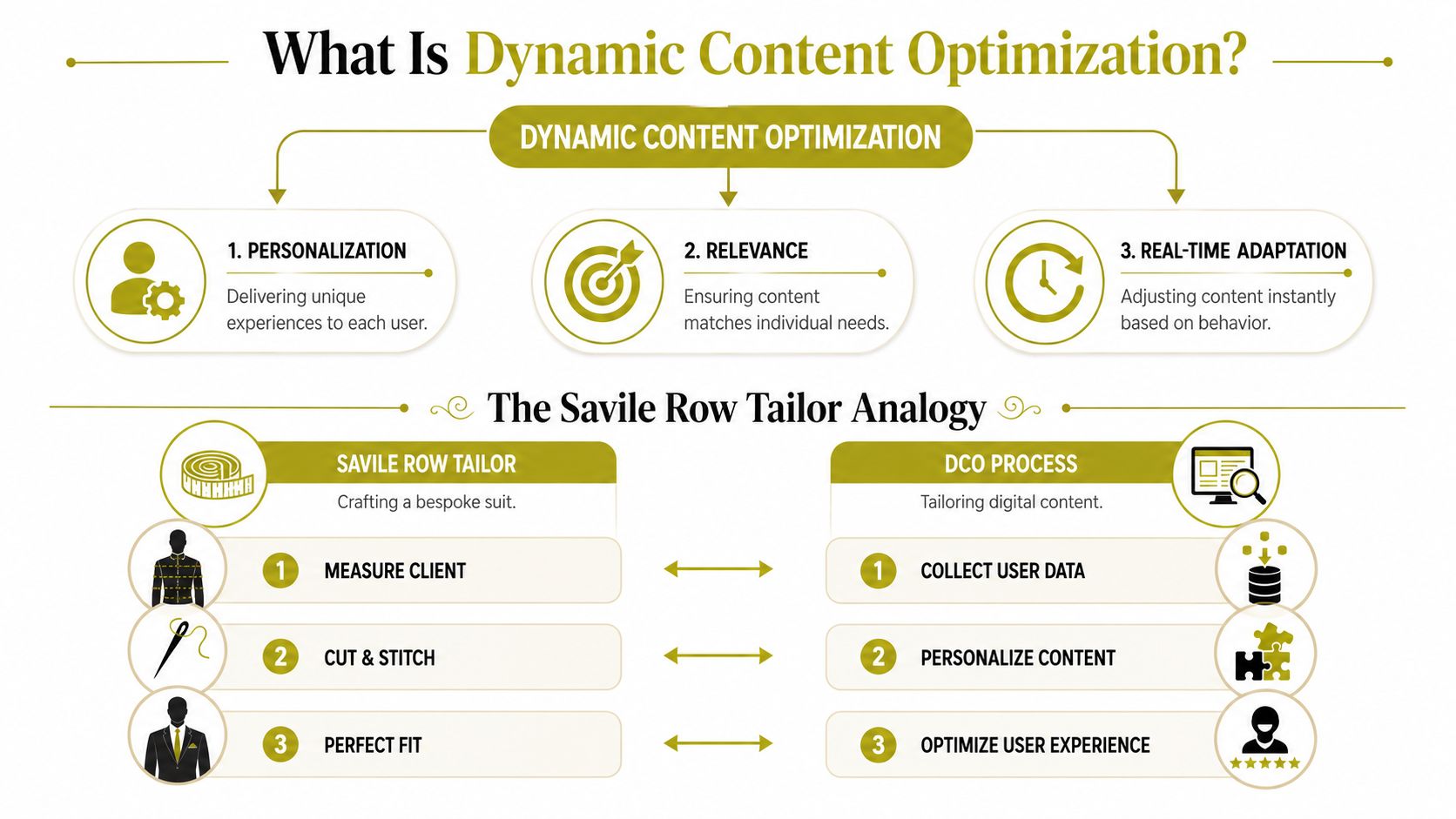
Think of DCO as the difference between buying an off-the-rack suit and visiting Savile Row. Static advertising gives every prospect the same cut, same fit and same finish. Dynamic content optimisation adjusts the experience to the person in front of you.
The three parts that make it work
At its simplest, DCO depends on three moving parts.
Data signals
These are the inputs. They might include geography, device type, recent browsing behaviour, customer status, or other approved indicators that help define context.Creative assets
These are the building blocks. Headlines, images, product shots, testimonials, calls to action, disclaimers and offers sit in a modular library instead of being locked into one finished ad.Decisioning and delivery
The system selects and assembles the right combination for the viewer in real time, then keeps learning from response patterns so stronger combinations appear more often.
That's the operational side. The commercial case is equally clear. McKinsey research cited in this DCO guide indicates that effective personalisation can generate a 10–15% revenue lift, and notes that the technology combines a modular library of creative assets with real-time data signals to automatically generate hundreds of ad variations for brands targeting diverse regional audiences.
A better way to understand the mechanics
If you want a useful companion explainer, SpendOwlAI has a clear breakdown of how Dynamic Creative Optimization works without drowning the subject in jargon.
What matters most for a business leader is this. DCO is not just “showing different ads”. It's building a controlled system where relevance is designed into the process. One prospect might see a trust-led message. Another sees urgency. A third sees a location-specific offer. The brand remains consistent, but the emphasis changes.
Good DCO doesn't produce random variation. It produces disciplined variation.
Why the customer experience improves
People respond better when brands remove friction. If a returning customer sees products related to what they viewed before, that's useful. If a professional services buyer lands on a page that reflects their sector instead of a generic home page message, that's useful too.
The experience feels more intuitive because it is more intuitive. You're reducing the effort required for someone to understand why your offer fits their situation. That's why DCO performs better than static creative when it's set up properly. It respects context.
Real-World Business Use Cases For UK SMEs
The practical appeal of DCO for smaller UK firms is speed and adaptability. According to Strategic Market Research on the DCO market, its value for UK SMEs and start-ups lies in using signals such as geolocation, user behaviour and device type to generate thousands of ad variations in milliseconds, with the global market projected to reach USD $8.1 billion by 2030. The same source notes that video DCO is the fastest-growing format for British brands.

E-commerce that reacts to intent
A growing online retailer doesn't need one generic retargeting ad. It needs a system.
A first-time browser who viewed trainers but didn't add to basket might see a product-led message with clean visuals and a straightforward call to action. A returning customer who abandoned checkout might see reassurance instead. Delivery clarity. Returns information. Maybe a different featured image if mobile behaviour suggests speed matters more than product detail.
The principle is simple. Don't personalise for novelty. Personalise for the next likely objection.
Tourism and hospitality with regional intelligence
Scottish tourism businesses can use DCO far more intelligently than many do. A user browsing from London may respond to escape, scenery and ease of travel. Someone from Manchester may engage more with shorter-break framing, family value, or seasonal availability. The destination stays the same, but the reason to act changes.
Local understanding holds particular importance. The strongest creative often uses tone and emphasis that feel natively suited to the audience rather than mechanically segmented.
If your location-based message reads like it came from a spreadsheet, the audience will feel that immediately.
A short video example helps show how dynamic creative can be applied in a way that feels natural rather than robotic.
B2B messaging by industry and buying stage
For B2B firms, the strongest use case is often sector-specific framing. A cyber security provider shouldn't say the same thing to a healthcare lead, a finance buyer and a SaaS founder. The service may be identical. The proof, compliance language and urgency are not.
Here are three practical adjustments that often make a difference:
Industry proof selection
A finance prospect may need reassurance around governance and approved messaging. A tech buyer may respond better to speed, integration and operational efficiency.Stage-aware calls to action
New visitors usually need education. Returning visitors may be ready for a demo, consultation, or direct contact with sales.Device-sensitive presentation
Mobile users often need shorter copy, simpler forms and stronger visual hierarchy. Desktop audiences may tolerate more detail and comparison.
The win for SMEs is that DCO lets you behave like a larger organisation without building separate campaigns from scratch each time. You create one coherent system, then apply variation where it improves relevance.
Building Your Data and Segmentation Foundation
Most DCO programmes fail before launch. Not because the platform is weak, but because the data and segmentation logic are lazy.
If you feed a personalisation system poor inputs, it will produce polished irrelevance. The creative may look advanced. The audience experience will still feel off. That's why the foundation matters more than the interface.
Start with the right kinds of data
For UK businesses, the healthiest DCO setup usually combines three categories.
First-party data
This includes information you collect directly through your website, CRM, app, enquiries and customer interactions. It's often the most valuable because it reflects actual relationships.Zero-party data
This is information people intentionally share, such as stated preferences, product interests or content choices. It's especially useful because the user has actively told you what matters to them.Contextual data
This covers signals such as page context, device type, or broad location context that help you tailor content without overreaching.
What you should avoid is collecting data merely because the platform allows it. Good segmentation starts with a business question. Are you trying to distinguish new from returning visitors? High-intent readers from casual browsers? Existing customers from prospects? If you can't answer that, you're not ready to personalise.
Compliance is part of the message
Many guides remain superficial at this stage. In the UK, privacy isn't a bolt-on legal review at the end. It affects the creative strategy itself.
As noted by Smartly in its discussion of UK DCO practice, 68% of UK consumers are more likely to engage with brands that transparently explain data usage, yet only 22% of DCO campaigns explicitly disclose this in creative assets, highlighting the need to balance personalisation with consent requirements under the Data Protection Act 2018. That's a commercial lesson as much as a compliance one. You can review the wider context around customer data and orchestration through this customer data platform resource.
Segments that tend to be useful
The strongest segments are usually behaviour-led and operationally manageable.
New versus returning visitors
One group needs orientation. The other needs momentum.High-intent versus low-intent audiences
Someone who has compared products or visited pricing pages needs different creative from someone reading an introductory blog.Region-specific clusters
National brands often need different emphasis across UK audiences because local context changes what feels persuasive.
Compliance insight: Transparency inside the journey often builds more trust than a legal page no one reads.
What responsible implementation looks like
A sound approach usually has four features:
- Clear consent logic
- Documented segment definitions
- Creative templates with approved variations
- Regular review by marketing and legal or compliance stakeholders where needed
That framework does more than reduce risk. It improves quality. When teams know which data they can use and why, the resulting creative tends to be sharper, less creepy and more credible.
Choosing Your Personalisation Approach
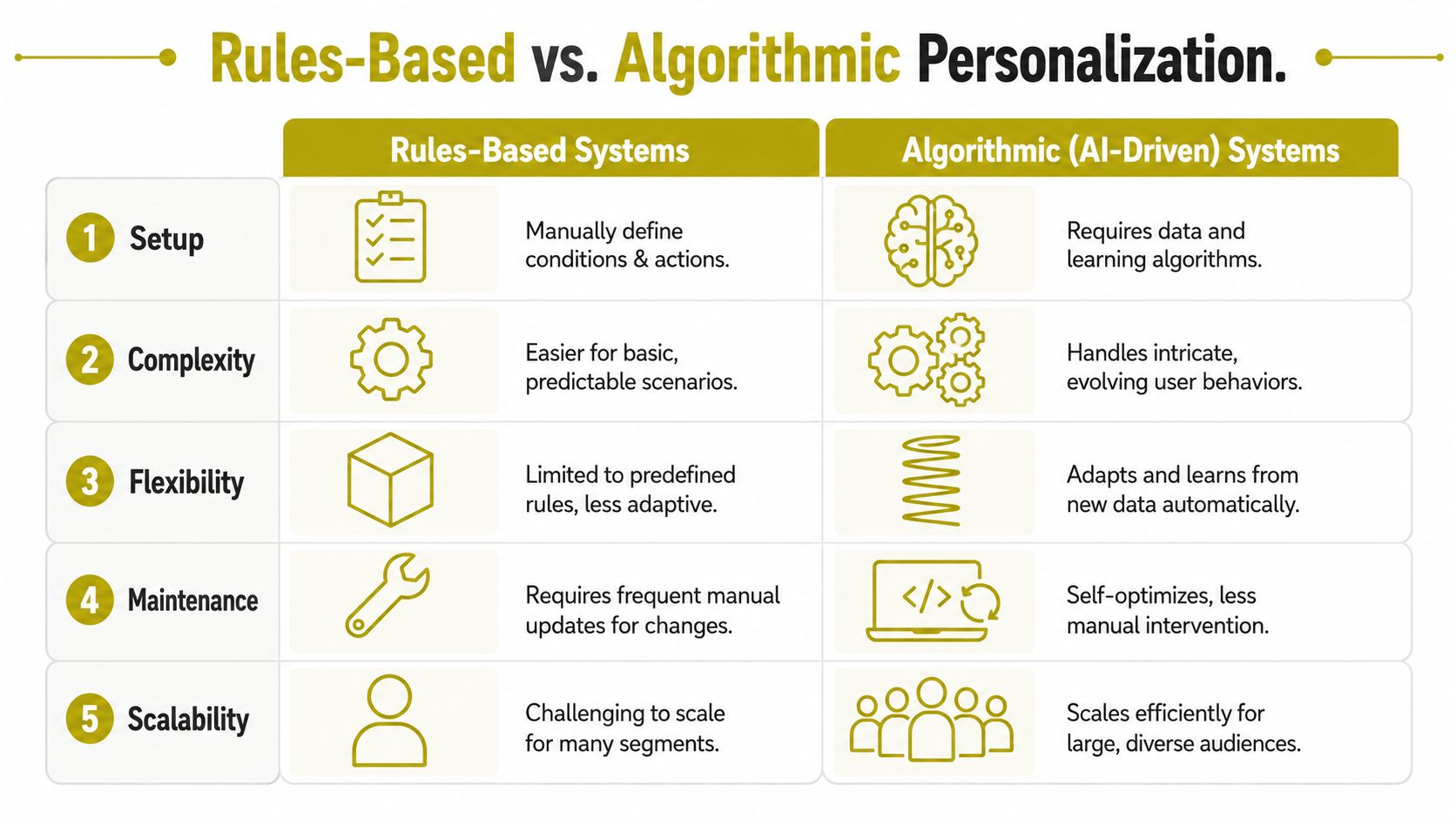
Once the data foundation is in place, the next choice is strategic. Do you want a rules-based system that your team controls directly, or an algorithmic system that uses machine learning to identify and scale winning combinations?
Neither is universally better. The right answer depends on how much control you need, how fast you need to scale, and how much complexity your team can manage.
Control versus scale
Rules-based personalisation is the cleaner starting point for many SMEs and regulated brands. You set the logic. If a visitor comes from a certain region, show version A. If they're a returning customer, show version B. If they viewed a product category, prioritise a matching creative.
Algorithmic personalisation is different. The platform learns from performance data and adjusts combinations automatically at a scale no human team could manage manually.
That's why the performance upside can be strong. Omneky's DCO analysis states that DCO uses machine learning to automatically generate and test thousands of ad variations, with industry benchmarks of 2–5× higher CTR and 20–50% lower CPA than static creative, and notes that creative quality drives 56% of total campaign ROI.
A side-by-side view
| Factor | Rules-Based | Algorithmic (AI) |
|---|---|---|
| Setup | Marketers define conditions and outputs manually | Teams provide data, assets and learning parameters |
| Control | High control over what appears and when | Lower direct control over each live combination |
| Compliance handling | Easier to review in regulated settings | Requires tighter governance and approval structures |
| Scale | Best for smaller or predictable segmentation | Best for broad, fast-changing audience variation |
| Ongoing effort | More manual upkeep as campaigns grow | Less manual adjustment once properly trained |
If your team needs terminology clarified before choosing, this customer personalization glossary is a sensible reference point. For a more strategic view of how personalized experiences fit into broader campaigns, see this perspective on personalization in marketing.
When each model tends to work best
A rules-based approach often suits:
- Regulated sectors where every claim, disclaimer and phrase may need approval
- Lean teams that need predictability
- Early-stage DCO programmes still learning which segments matter
An algorithmic approach often suits:
- Larger creative libraries with many interchangeable assets
- Multi-platform campaigns across Meta, Google and TikTok
- Businesses with enough data volume to let the system learn meaningfully
The mistake isn't choosing rules or AI. The mistake is choosing AI before your message architecture is strong enough to support it.
Measuring Success Beyond Clicks and Conversions
Most DCO reporting is too shallow. It celebrates response rates, then stops.
That's understandable. Clicks are easy to collect, easy to compare and easy to present in a board deck. They're also incomplete. A dynamic campaign can generate stronger short-term response while subtly weakening trust if the message feels over-targeted, inconsistent, or misaligned with the brand people thought they knew.
Why reputation needs its own measurement line
This is a live problem for UK firms in regulated sectors. A 2025 YouGov study referenced in Perion's discussion of DCO found that 54% of UK SMEs in regulated industries struggle to attribute DCO-driven engagement to sustained reputation growth, despite significant spending. That gap is exactly why DCO measurement has to move beyond media efficiency.
You need two scoreboards. One for performance. One for trust.
A stronger measurement framework
For performance, assess whether dynamic content changed commercial behaviour compared with a relevant control. For brand impact, assess whether the content improved confidence, clarity and consistency over time.
A practical reporting structure looks like this:
Response metrics
Track clicks, engagement patterns, conversion behaviour and differences between dynamic and static versions.Revenue contribution
Look for incremental lift through controlled testing rather than assuming every conversion came from personalisation.Message quality signals
Review which value propositions win repeatedly. That tells you what the market trusts, not just what it notices.Brand trust indicators
Monitor qualitative feedback, repeat engagement quality, lead quality, sentiment in sales conversations and whether stakeholders report fewer objections around credibility or clarity.
How to avoid misleading conclusions
The biggest reporting error is crediting DCO for everything that moved during a campaign period.
Another common mistake is treating every winning variant as a permanent truth. Some combinations win because of timing, channel behaviour, seasonality, or audience mix. That's why experienced teams pair platform reporting with human review. They look for patterns that make strategic sense.
A high-performing variant is useful. A high-performing variant that also strengthens the brand promise is much more valuable.
For sectors such as healthcare, finance and tourism, this matters even more. The message isn't only there to convert. It has to reassure, withstand scrutiny and leave the organisation more trusted than before.
Your DCO Implementation Checklist
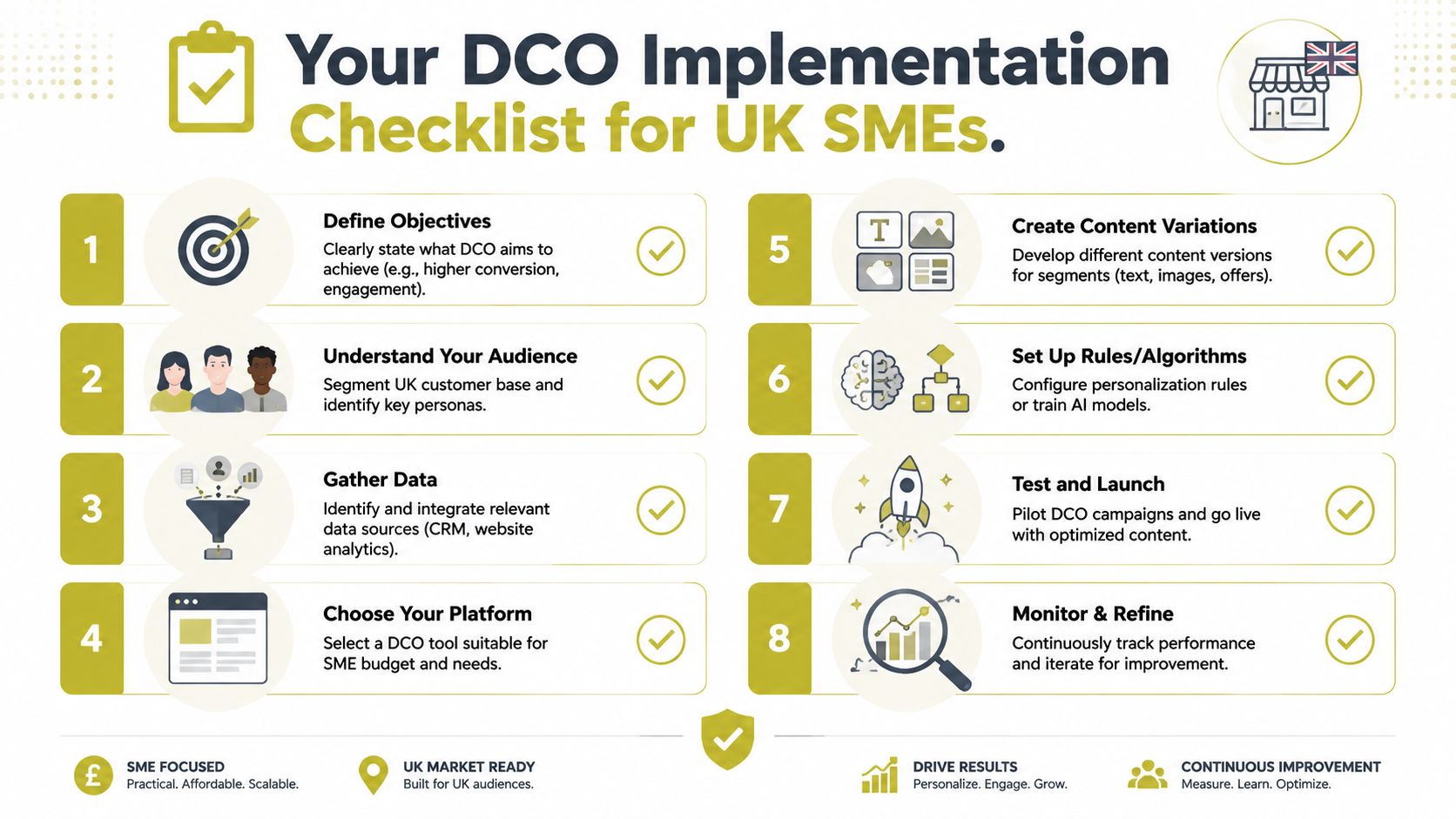
DCO works best when it's introduced as an operating model, not a one-off experiment. Keep the rollout controlled. Keep the segmentation tight. Keep the message standards high.
The sequence that usually works
Define the business objective
Pick one commercial goal and one trust goal. Don't launch with a vague ambition to “personalise more”.Audit your usable data
Separate data you legally and operationally can use from data that is messy, duplicated or poorly consented.Build a modular asset library
Prepare approved headlines, visuals, calls to action, offers and compliance-safe copy variations.Choose your initial segments
Start with a small number of meaningful audiences. New versus returning visitors is often a stronger first move than overcomplicated persona mapping.Decide on rules-based or algorithmic delivery
Match the method to your resources and risk profile.Launch a pilot
Test on one channel, one product line, or one audience cluster before expanding.Measure commercial and brand outcomes together
Review not just response but message quality and trust impact.Tighten and scale
Remove weak variants, refine segment logic, and only then add complexity.
Quick wins that don't require a full rebuild
Refine location messaging
Swap generic national copy for region-aware headlines where local context matters.Split new and returning users
This often improves relevance quickly because the intent gap is usually obvious.Tailor mobile creative separately
Shorter copy, cleaner hierarchy and simpler actions can improve the experience immediately.Review disclosure language
Make your use of data feel clear and proportionate. That supports trust before legal concerns become reputational concerns.
Carlos Alba, the founder and lead of Carlos Alba Media, completed a 20-year career in national newspaper journalism before establishing the agency, most recently serving as the Editor of Sunday Times Scotland, as noted in this profile of Carlos Alba Media's leadership. That background is a useful reminder of what good DCO should aim for. Accuracy. Judgement. Relevance. Clear language. Trust built over time, not borrowed for a click.
If you want senior support to build a DCO strategy that respects UK privacy rules, strengthens reputation and improves performance without big-agency overheads, speak to Carlos Alba Media. The agency brings a specialist perspective shaped by senior newsroom experience and modern digital strategy, and everyone who works for Carlos Alba Media is a former national news journalist or has agency experience of working with international brands.