

You've posted on social media, boosted a few Facebook ads, rewritten your homepage twice, and tried to “do SEO” between client work and payroll. Your website gets some traffic, but enquiries are inconsistent. Leads arrive in bursts, then go quiet. Worse, every agency pitch sounds the same. More traffic. More clicks. More reach.
That's where most small businesses go wrong. They hire a tactical supplier when they need judgement.
A good digital marketing agency for small business shouldn't just run ads or publish content. It should help you decide what to say, where to say it, how to defend your reputation, and what to fix first so your marketing stops leaking money. That's why so many firms now prefer fewer partners. 51% of UK businesses work with exactly one digital marketing agency, while 34% work with two, which points to a clear shift towards trusted, consolidated partnerships rather than juggling multiple vendors (IAB UK on SME trust in digital advertising).
If you're still handling everything yourself, start with the basics and sharpen your own foundation first. These actionable SEO tips for small businesses are a sensible place to tighten the obvious gaps before you pay anyone.
Introduction to Hiring a Digital Marketing Agency for Small Business
Most owners start the same way. They do a bit of everything. One week it's Instagram reels, the next it's Google Ads, then a blog post no one reads, then panic because the phone has gone quiet. That isn't a discipline problem. It's what happens when one person tries to act as founder, salesperson, marketer, copywriter and analyst at the same time.
The agency market is crowded, which makes the decision harder, not easier. Plenty of firms can execute tasks. Far fewer can think senior enough to protect your brand while growing it. That distinction matters when you're a small business with limited budget, limited time and no appetite for expensive mistakes.
Practical rule: Don't hire an agency because it offers a list of channels. Hire one because it can explain your next three business-critical marketing decisions clearly.
The strongest agency relationships feel less like outsourcing and more like bringing experienced counsel into the room. That's particularly important if you need more than clicks. Many small businesses need clearer positioning, sharper messaging, stronger trust signals, and a plan for handling media interest or reputational pressure without scrambling.
A digital marketing agency for small business should reduce noise, not add to it. If you leave a discovery call with more jargon than clarity, walk away.
Define Goals and Set Budgets
Most wasted marketing spend starts with vague goals. “Get our name out there” is not a goal. “Do better on Google” is not a goal either. Agencies love fuzzy briefs because fuzzy briefs let them stay unaccountable.
Set proper targets before you speak to anyone.
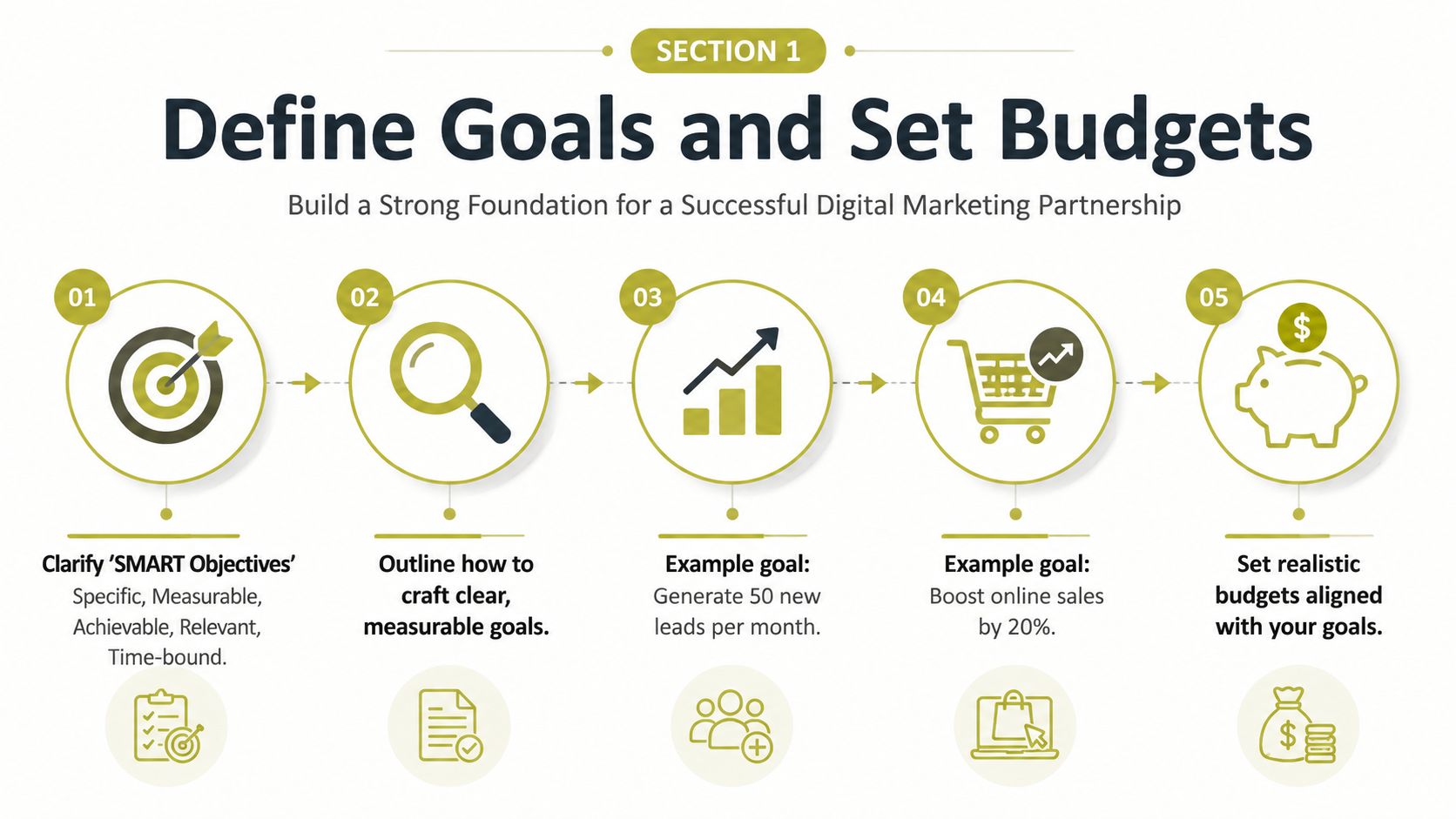
Start with commercial outcomes
Your marketing goals should tie directly to revenue, pipeline, bookings, enquiries or sales quality. If they don't, they're vanity targets.
Use a simple filter:
- Specific. Name the exact result you want.
- Measurable. Decide how you'll track it.
- Achievable. Be ambitious, but not detached from reality.
- Relevant. Make sure it serves the business, not the agency report.
- Time-bound. Put a deadline on it.
The examples most owners understand immediately are simple ones. Generate 50 new leads per month. Increase online sales by 20%. Those targets are useful because they force the agency to reverse-engineer the funnel instead of hiding behind vague “awareness” activity.
Match the budget to the job
A serious mistake is expecting a low retainer to fund a full multi-channel programme. It won't.
The UK market gives you a clear frame. Small business retainers typically start at £750 for baseline support, with multi-channel programmes ranging between £1,000 and £5,000 per month (IBISWorld on UK digital advertising agencies).
That means you need to decide what you're buying.
- At the lower end you're usually funding limited support. Think focused SEO fixes, a small paid search setup, or tightly scoped content support.
- In the middle you can usually combine strategy, content, paid media management and better reporting.
- At the higher end of the SME range you should expect integrated execution, sharper creative, stronger conversion work and more senior oversight.
Cheap retainers often buy activity. They rarely buy thinking.
Put budget into the bottleneck
Don't split your spend evenly across channels just because that feels balanced. It usually isn't.
If your website doesn't convert, fix the site before you pour more paid traffic into it. If your offer is unclear, sharpen the messaging before you write more blogs. If your local search presence is a mess, sort that before launching broad campaigns.
A sensible pre-agency checklist looks like this:
- Primary goal. Leads, sales, bookings, footfall, investor visibility, or reputation.
- Main bottleneck. Traffic, trust, conversion, follow-up, or media profile.
- Working budget. What you can sustain monthly without flinching.
- Decision timeline. How long you can wait before needing visible progress.
Owners who do this well don't ask agencies, “What do you offer?” They ask, “What would you fix first, and why?”
Understand Services and Expertise Provided by Agencies
Most agencies sell channels. SEO, PPC, email, social, web, content. That's fine as far as it goes. The problem is that small businesses often need a higher level of advice than a channel list can provide.
The question isn't whether an agency can run campaigns. It's whether it understands how marketing, trust and reputation work together.
The core services that matter
A useful agency should be able to handle the practical essentials:
- SEO and content that target commercial intent, not empty traffic
- Paid media management focused on searches and audiences likely to convert
- Website and UX improvements that remove friction from enquiry or checkout
- Email and remarketing systems that stop warm prospects going cold
- PR and brand messaging that build trust beyond the website
That last point is where many small firms are underserved. They don't just need output. They need editorial judgement. They need someone to tell them whether their story is worth pitching, whether their homepage headline is weak, whether their spokesperson sounds credible, and whether a reputational issue needs handling now rather than later.
Why PR judgement changes the result
PR is not an optional extra when trust drives conversion. If your positioning is muddled, your pitch is rambling, or your founder can't explain the business cleanly, marketing performance suffers across every channel.
That's especially true with media outreach. 73% of journalists in the UK reject pitches that are confusing or require extra editorial effort, which means clarity isn't style. It's the entry fee for coverage (Carlos Alba Media on how to get press coverage).
A strong agency should know how to turn a business update into a story hook that a journalist can use quickly. That takes newsroom instinct, not just marketing software.
If your agency writes press releases nobody would publish, it doesn't understand media. It understands templates.
The specialist gap most owners miss
This is the gap worth paying attention to. Founders often hire a tactical agency and only later realise they also needed senior counsel on message discipline, interviews, crisis readiness and reputation.
Carlos Alba Media sits in that specialist category. Everyone who works for Carlos Alba Media is a former national news journalist or has agency experience of working with international brands. That matters because senior PR and editorial judgement tends to sharpen every other marketing decision, from homepage messaging to campaign angles to media handling. If you want to compare the service mix you should expect from a firm in this space, review this digital marketing agency services list.
If an agency can't explain how its SEO, PR, website, paid media and messaging support one another, you're not buying strategy. You're buying disconnected tasks.
Shortlist Agencies and Compare Pricing Models with Vetting Questions
A shortlist should be built with suspicion, not hope. Most agency websites are polished. That tells you almost nothing. You need to know who does the work, how they think, how they report, and whether they can handle pressure when something goes wrong.
What to check before the first call
Start with evidence of judgement, not just design.
Look for these signs:
- Named expertise. Can you identify the people who will work on the account, or is everything hidden behind “our team” language?
- Clear specialism. Does the agency know your type of business, your market, or your communications risk?
- Service logic. Do the services fit together, or does the site read like a menu assembled for SEO?
- Reporting maturity. Do they talk about conversions, lead quality and ownership of assets, or only about impressions and reach?
- Communication quality. If their own site is vague, cluttered or overwritten, expect the same in your account.
One strong signal is whether the agency asks hard questions back. Good agencies don't nod along to unrealistic demands. They challenge weak assumptions early.
Common agency pricing models
Different pricing structures suit different situations. None are universally good or bad. What matters is whether the model matches the work.
| Model | Description | Typical Monthly Cost |
|---|---|---|
| Monthly retainer | Ongoing strategic and execution support across agreed services | Baseline support often starts at £750, with broader multi-channel work commonly in the £1,000 to £5,000 range |
| Project-based | Fixed scope for a defined deliverable such as a website, campaign launch or messaging project | Varies by scope |
| Performance fee | Fees tied to agreed outcomes or results, often alongside a base fee | Varies by structure |
The monthly retainer is usually the most practical for small businesses that need continuity. Project work can solve a defined problem, but it often stops before the system around it is fixed. Performance-based pricing sounds attractive, but the details matter. If attribution is vague, the argument starts later.
For a more grounded sense of how agencies package services and fees, look at these digital marketing agency pricing packages.
Ten vetting questions worth asking
Use these in discovery calls. Don't soften them.
- Who will run my account day to day?
- Which owned assets will stay fully under my control?
- How do you report on conversions, not just activity?
- What do you need from me each month to succeed?
- What would you fix in our funnel first?
- How do you handle weak performance in the first month?
- What happens if a campaign underperforms?
- How do you coordinate PR, website messaging and paid media?
- What's your process if we face negative press or public criticism?
- What contract terms should I pay close attention to?
How to rank the shortlist
Don't choose the agency that promises the most. Choose the one that identifies the risk fastest and explains the trade-offs most clearly.
A simple ranking method works well:
- Strategy quality. Did they diagnose the problem or just recite services?
- Commercial understanding. Did they connect marketing to sales reality?
- Clarity. Were they concise, direct and specific?
- Team credibility. Do the people sound senior enough for the brief?
- Operational fit. Can they work at the pace your business needs?
Agencies that promise everything usually manage expectations by lowering accountability later.
The right digital marketing agency for small business won't sound like a magician. It will sound organised, commercially aware and slightly difficult to impress. That's usually a good sign.
Onboarding Checklist and Launch Initial Sprint
Onboarding tells you immediately whether the agency is serious. Weak agencies drift into a retainer with a kickoff call, a Slack channel and no clear sequence. Strong agencies establish ownership, priorities and deadlines from day one.
A structured first month matters because a 30-day foundational sprint approach reduces agency failure rates by aligning work over four focused weeks to secure assets, establish trust, drive paid search and activate retargeting loops (The Growth Syndicate on agency methodology).
Put the first month on rails.
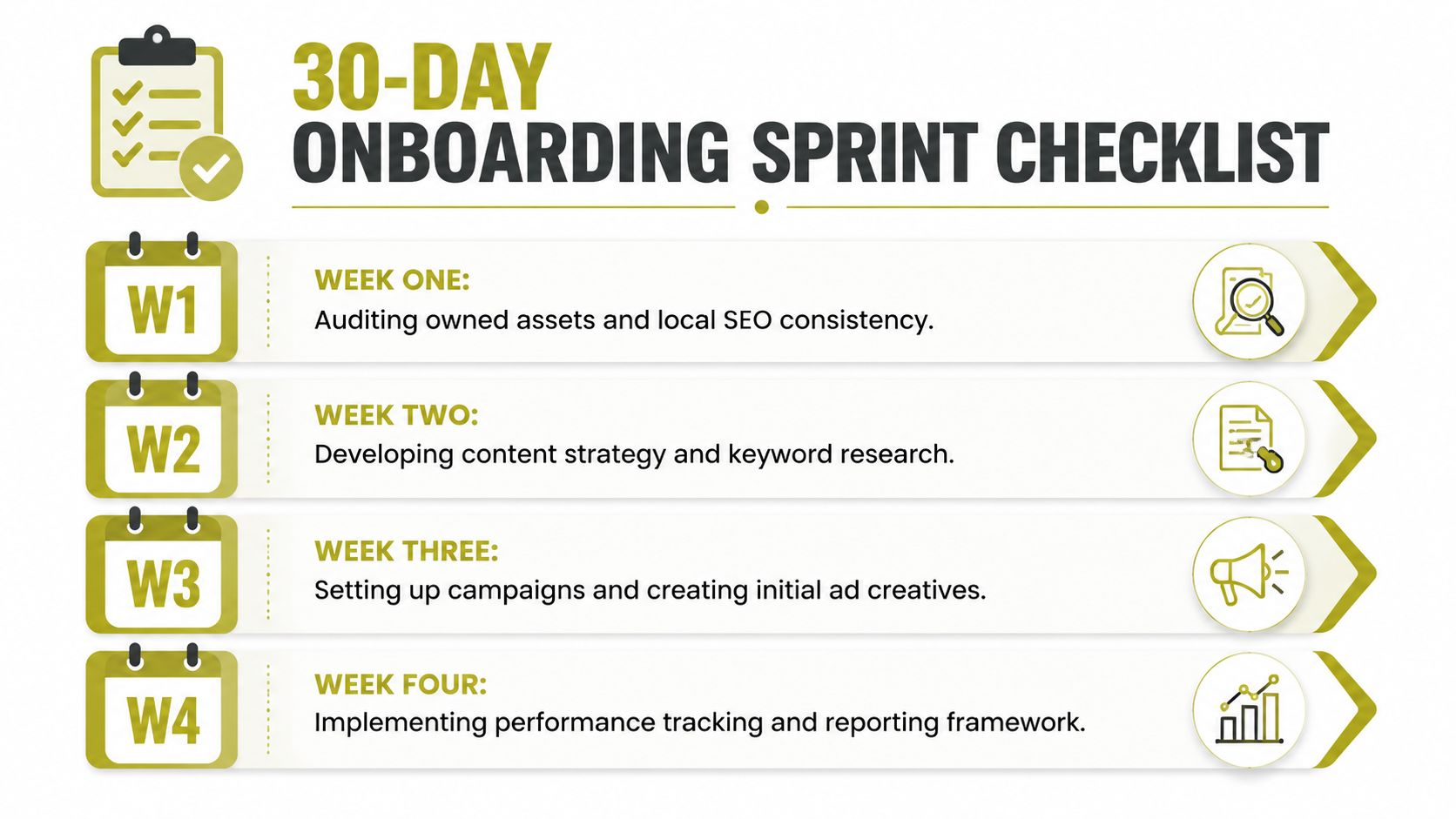
Week one and two
Week one is about control. Audit every owned asset. That includes the website, analytics access, Google Business Profile, ad accounts, CRM, email platform and domain-linked brand assets. Local firms should also clean up NAP consistency so the same business name, address and phone details appear everywhere they should.
Week two is about trust. Build or improve a core trust page. That page should answer the questions buyers ask before they enquire: what you do, who it's for, what the process looks like, what pricing guidance you can share, and what objections need answering. If your site dodges obvious questions, prospects assume the answer won't favour them.
A sensible content plan should also start here. If the agency needs a framework for messaging and publishing, this guide on how to create a content marketing strategy is the sort of practical planning you want in place early.
Week three and four
Week three is about intent. Launch a high-intent Google Search campaign with tightly restricted keywords. Don't spray budget across broad terms because the dashboard looks busy. Keep the search intent close to purchase or enquiry.
Week four is about follow-up. Add a retargeting loop that reconnects with people who visited, clicked, watched or started to enquire. Email, SMS and paid remarketing can all play a part if they're coordinated properly.
This short video is useful context before that launch phase gets underway.
A working 30-day checklist
Use this as your baseline:
- Secure access early. Get admin control of all platforms before work begins.
- Audit conversion paths. Test every form, call button, checkout path and enquiry route.
- Fix trust gaps. Add FAQs, pricing guidance where appropriate, process detail and stronger proof.
- Launch one focused paid search test. Keep scope narrow and commercial.
- Set up retargeting and follow-up. Don't let warm traffic disappear unchallenged.
- Agree reporting cadence. Weekly early-stage updates beat vague monthly summaries.
A delayed launch usually means one of two things. The agency lacks process, or the client never had proper asset control in the first place.
If the first 30 days feel disorganised, don't expect month three to become magically disciplined.
Tracking Performance with KPIs and Avoiding Contract Pitfalls
Once the work starts, sentiment doesn't matter. Evidence does.
You need KPIs that reflect business movement, not decorative reporting. If an agency can only show charts about reach, clicks and engagement without tying them to enquiries, sales or credible trust signals, you're paying for activity.
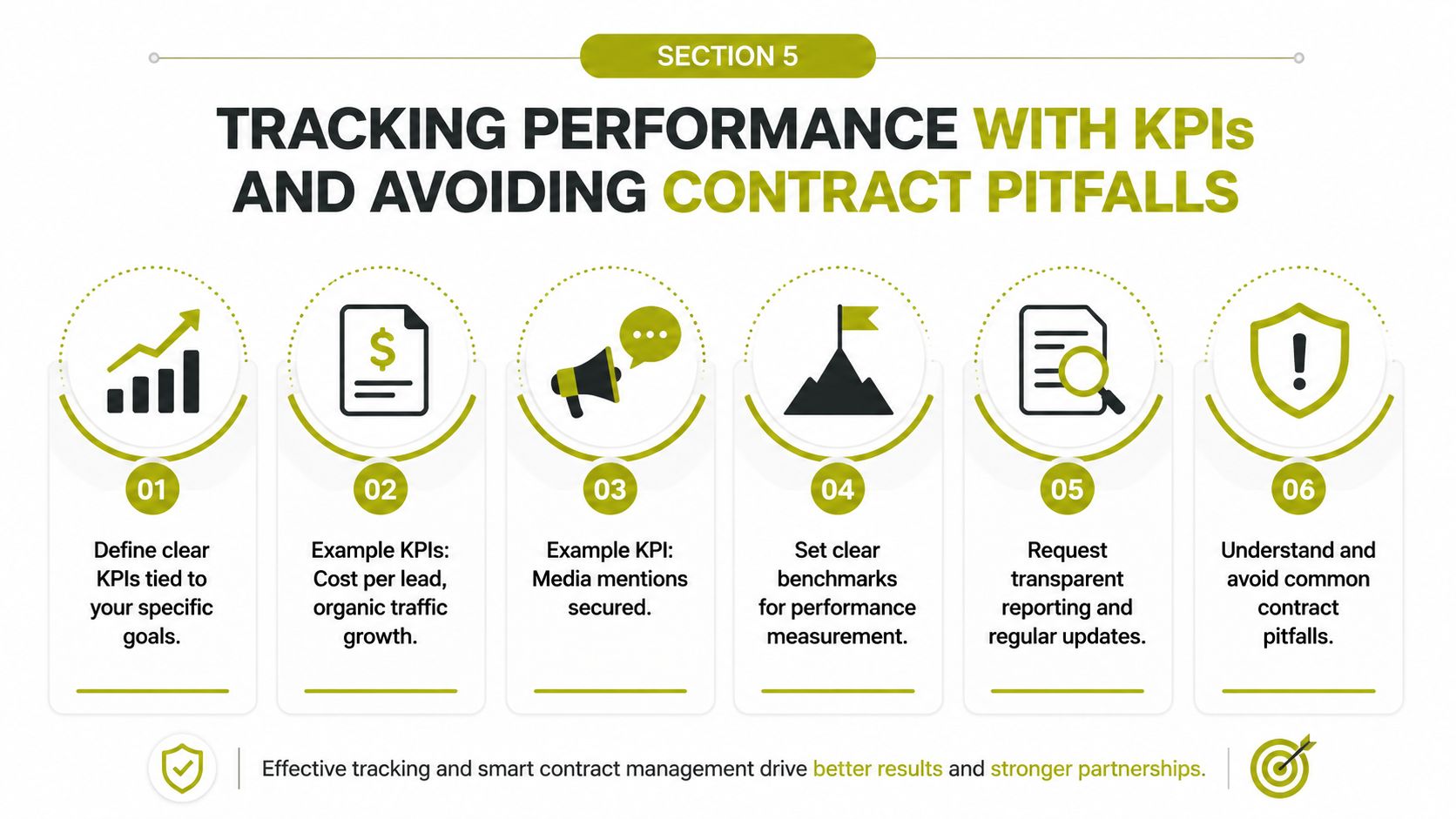
What to track
Choose a small KPI set that maps directly to your goals. Typical examples include:
- Cost per lead for paid campaigns
- Organic traffic growth if SEO is a real priority
- Media mentions secured if PR and authority matter
- Lead quality based on fit, not just volume
- Conversion rate by landing page so weak pages don't hide
If you want a clean framework for deciding which measures belong in your reporting, this SourceLoop guide to marketing KPIs is worth reading because it helps separate useful measurement from dashboard clutter.
Demand transparent reporting
One of the biggest agency failures is reporting that hides behind anonymised wins and soft metrics. You need named, clear reporting tied to your campaigns, your site and your conversion actions.
Ask for:
- A fixed reporting format every month
- Plain-English commentary on what changed and why
- A record of tests run and decisions taken
- Direct visibility into campaign and analytics platforms
Five users can reveal a surprising amount when reviewing a site. UK usability research found that observing five users identifies around 85% of common conversion problems (Carlos Alba Media on increasing website conversion rates). For a small business, that's a practical reminder not to rebuild a site blindly when basic usability testing can expose obvious friction.
Read the contract like a grown-up
Most contract trouble is predictable. Owners skip the detail because they're keen to get going.
Check these areas closely:
- Scope. What exactly is included, and what triggers extra fees?
- Deliverables. What must be produced each month?
- Notice period. How easy is it to leave if the fit is poor?
- Auto-renewal. Does the agreement renew automatically?
- Asset ownership. Who owns the copy, creatives, audiences and accounts?
- Approval rights. What can go live without your sign-off?
Keep the message aligned
Performance improves when every channel tells the same story. The UK's integrated marketing communications framework requires alignment across what you do, who it's for, why it matters now, and proof points across all channels (Carlos Alba Media on integrated marketing communications).
That means your press release, landing page, email follow-up and social captions should not sound like four different businesses. If they do, trust drops and conversion follows.
The contract protects the relationship. The reporting protects the investment. The messaging protects the brand.
Conclusion and Next Steps
Hiring a digital marketing agency for small business isn't about buying tasks. It's about buying clarity, discipline and senior judgement where your business needs it most.
Set hard goals before the first call. Build a budget that matches the actual scope. Shortlist agencies that can think commercially, not just execute channels. Launch with a structured 30-day sprint so nobody drifts. Track a small number of meaningful KPIs. Read the contract carefully. Keep your message consistent across PR, web, email and paid activity.
Most small businesses don't need a sprawling agency roster. They need one capable partner that can think clearly, move quickly and tell them the truth.
If you're about to hire, write down your goal, your bottleneck, your budget and your first ten vetting questions today. That one page will save you months of wasted spend.
If you want senior-level PR and digital marketing support without big-agency overheads, speak to Carlos Alba Media. The firm is Scottish-led, with teams in London and Glasgow, and combines digital marketing, PR, media training, web strategy and crisis support. Everyone on the team is a former national news journalist or has agency experience working with international brands, which makes it a practical option for small businesses that need both execution and experienced editorial judgement.