
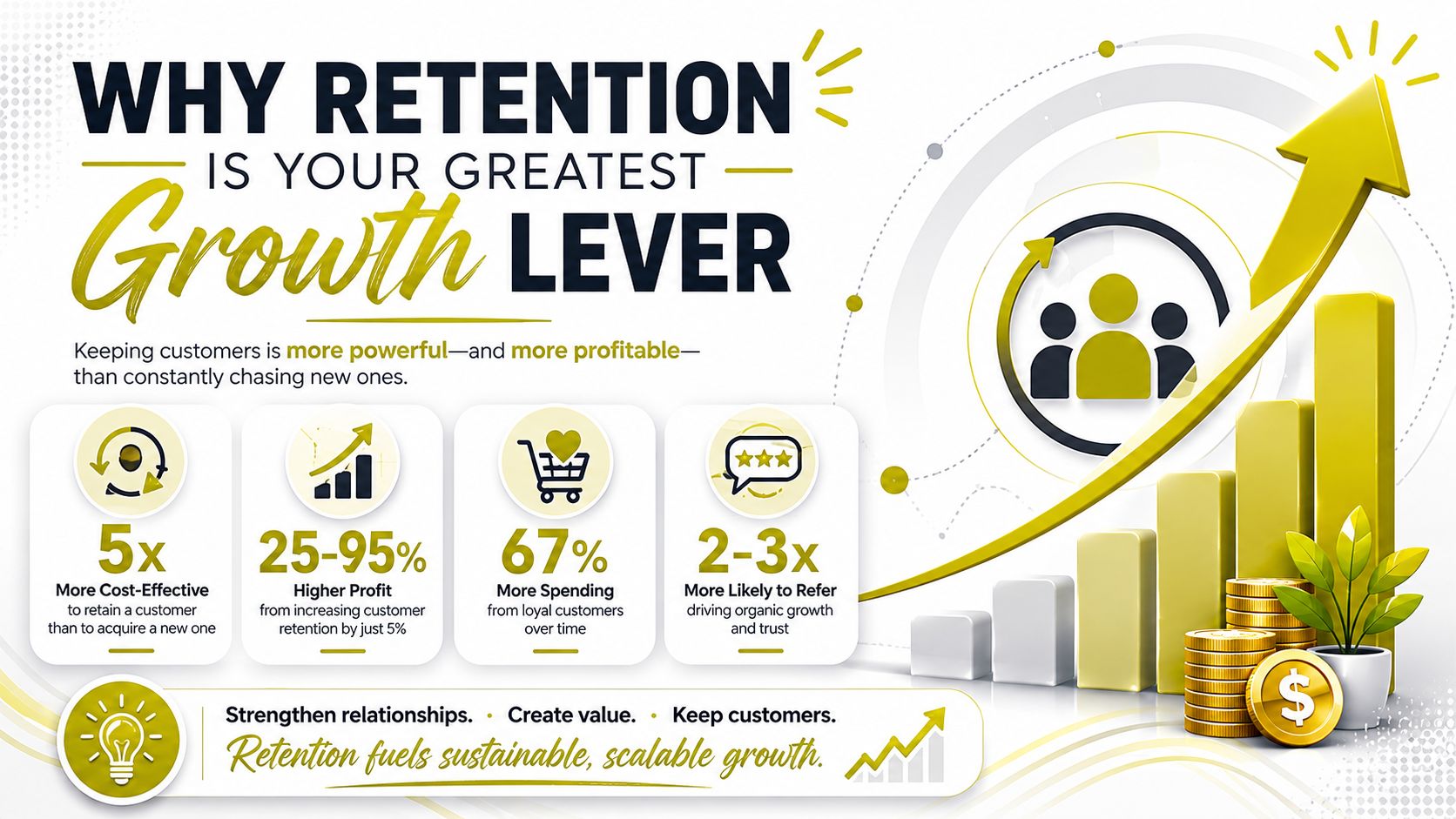
Retaining a customer costs five times less than acquiring a new one, and a 5% increase in retention can lift profits by 25% to 95% according to ServiceNow's customer retention statistics. That changes the conversation immediately. Customer retention marketing isn't a nice add-on after you've sorted lead generation. For many SMEs, it's where the margin sits.
That matters even more in specialist UK sectors. Tourism operators fight seasonality. Hospitality businesses live or die on repeat visits, direct bookings and reviews. Firms in regulated sectors can't rely on noisy, overpromising marketing because trust is part of the product. In all three, the businesses that keep customers close usually outlast the ones that keep chasing strangers.
A journalist's mindset helps here. Good retention work starts by asking sharper questions: why did a customer buy, what nearly stopped them, what made them hesitate, what made them return, and what story are they now telling themselves about your business? Carlos Alba Media's specialist nature comes from that discipline. Everyone who works for Carlos Alba Media is a former national news journalist or has agency experience of working with international brands, which means the team understands both hard-edged communication and modern brand building.
The Shift from Acquisition to Retention
Customer retention marketing works best when it stops being treated as a campaign type. It's a business philosophy. Instead of asking, “How do we get more people through the door?” you ask, “How do we become the obvious choice for the people who already know us?”
That shift is uncomfortable for some SMEs because acquisition feels visible. You can point to ad spend, impressions, clicks and fresh enquiries. Retention often happens in quieter places: a cleaner onboarding email, a better booking confirmation, a follow-up that answers the question a customer hasn't yet asked, a loyalty scheme that offers value rather than clutter.
Why the old approach breaks down
Acquisition-heavy thinking creates fragile growth. You spend, you win attention, you convert some buyers, and then you start again because too many drift away. That cycle is exhausting for small teams and expensive for owner-managed firms.
Retention changes the rhythm. You build systems that make the second purchase easier than the first. You reduce friction. You remind customers why they chose you. You communicate with enough relevance that your messages don't feel like interruption.
Good retention copy doesn't shout louder. It answers sooner.
The journalist's advantage
A newsroom trains people to spot what matters, cut what doesn't, and write for real readers rather than internal vanity. That's useful in customer retention marketing because most business communication is still too self-important. It describes the company instead of helping the customer.
The specialist advantage at Carlos Alba Media comes from that background. All staff at Carlos Alba Media are former national news journalists or have agency experience working with international brands, bringing together newsroom judgement and practical brand strategy. For SMEs, that means customer communications can be sharper, clearer and more persuasive without sounding inflated.
In practice, that affects everything from welcome emails to service updates. A regulated firm needs language that reassures without becoming sterile. A hotel needs messages that create anticipation without overselling. A tourism business needs to build memory before, during and after the visit. Retention starts there.
Why Retention Is Your Greatest Growth Lever
Beyond the headline figures noted earlier, the financial case for retention gets stronger when you look at how revenue behaves inside an SME. New business often arrives in spikes. Retained business creates a steadier base, which makes hiring, stock planning and marketing spend easier to control.
The numbers business owners should care about
Retention matters because it improves the quality of your revenue, not just the quantity. A customer who books again, renews, refers a colleague, or responds to an upsell is usually cheaper to serve than a constant stream of first-time buyers who need persuading from scratch.
That changes day-to-day decisions. Should a hospitality business put more budget into chasing broad reach before peak season, or improve pre-arrival and post-stay communication for guests already in the database? Should a regulated firm keep pushing lead generation if existing clients are unclear on renewal dates, service updates or next steps? In many cases, the easier gain sits in fixing the relationship you already paid to create.
Here's the plain-English version of the core metrics.
| Metric | What it means in practice | Why it matters |
|---|---|---|
| Customer lifetime value | How much a customer is worth across the full relationship | Shows whether keeping customers longer is improving revenue quality |
| Churn | Customers who stop buying, renewing or booking | Points to friction, disappointment or weak follow-up |
| Repeat purchase rate | How often first-time buyers come back | Tells you if your first experience is strong enough to justify another sale |
For specialist SMEs, retention also exposes where the business model is doing its job and where it is leaking value. A hotel with strong first bookings but weak repeat stays may have a positioning problem, a service gap, or poor follow-up. A travel operator with solid reviews but low rebooking may be missing the post-trip window when memories are strongest. A legal, financial or healthcare provider may lose perfectly satisfied clients because communication is too slow, too vague or too full of internal language.
That is why customer journey mapping for SMEs matters here. If you cannot see where confidence rises or drops after the first sale, retention work turns into guesswork.
What works and what wastes money
Retention usually improves through unglamorous fixes that remove uncertainty and give customers a reason to stay engaged.
- Onboarding that reduces anxiety: Confirm what happens next, when it happens, and who to contact.
- Relevant follow-up: Send information based on behaviour, not your internal calendar.
- Service recovery: Handle issues quickly, in plain language, before annoyance turns into churn.
- Useful loyalty design: Reward behaviour that reflects genuine value, not repeated discount hunting.
Practical rule: If a customer has to work harder after buying from you than before buying from you, your retention is being damaged by your own process.
The communication standard matters as much as the offer. In tourism and hospitality, customers remember timing, tone and detail. In regulated sectors, they remember whether your messages felt clear and trustworthy when the stakes were high. A journalist's mindset helps here because good retention communication does not fill space. It answers the question the customer is already asking, gives the next useful detail, and leaves little room for doubt.
That is what makes retention a growth lever rather than a support function. It improves cash flow, sharpens forecasting, and gives SMEs a stronger platform for expansion than constant dependence on fresh acquisition.
Mapping the Customer Retention Lifecycle
Retention gets easier when you stop treating customers as one undifferentiated group. They aren't. A first-time buyer, an active repeat customer and a lapsed user each need different communication, different timing and a different ask.
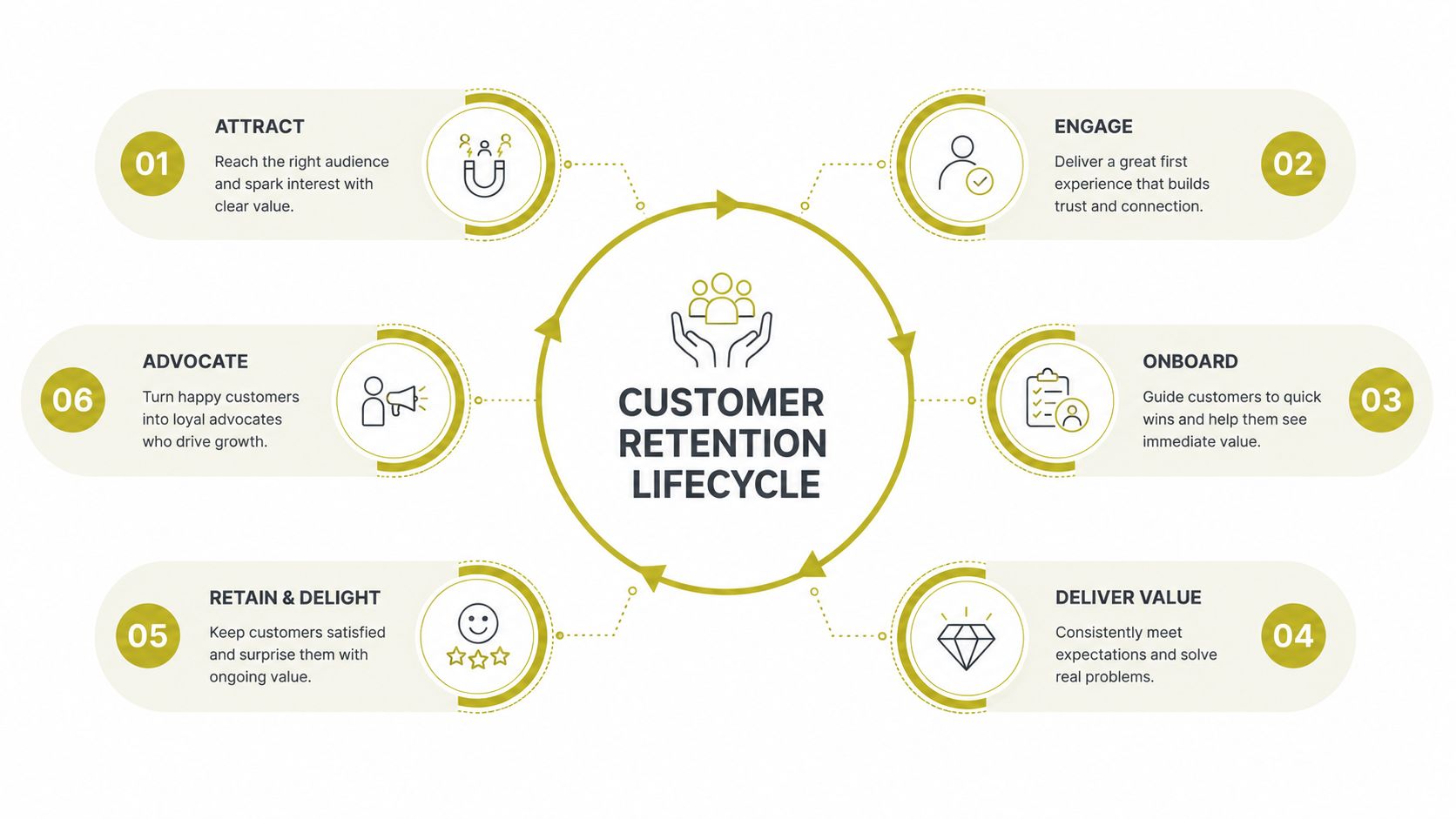
A useful way to think about the retention lifecycle is as a relationship. At the start, people want reassurance. Later, they want consistency. Eventually, they want recognition. If they drift away, they need a reason to pay attention again.
For SMEs refining their customer journey mapping approach, four stages matter most.
Onboarding
During the post-sale phase, many businesses lose customers without realising it. The sale happens, the payment clears, and then the customer meets the reality of your systems. If the next step is unclear, confidence drops fast.
Onboarding should do three jobs:
- Confirm the decision: Reassure the customer they chose well.
- Set expectations: Explain what happens next and when.
- Create momentum: Give them one simple action that moves them towards value.
A hotel can do this with a pre-arrival email that includes parking, check-in, local recommendations and a useful contact point. A legal or financial firm can do it with a plain-English summary of process, timeline and required documents. The point isn't polish for its own sake. It's reducing uncertainty.
Engagement and growth
Once a customer is active, your job changes. You're no longer convincing them to start. You're helping them stay.
This stage benefits from behavioural communication rather than blanket messaging. If a guest visited for a food-focused weekend, your next message shouldn't be a generic newsletter. If a customer bought one service line, your follow-up should help them get more from that choice before you try to upsell another one.
A simple working model looks like this:
| Stage | Customer mindset | Business priority |
|---|---|---|
| Engagement | “Was this worth it?” | Deliver value quickly and consistently |
| Growth | “Do I want more from this brand?” | Introduce relevant next steps and added value |
Retention often fails because the business keeps talking at the same volume after the first sale, but stops listening with the same intensity.
Loyalty and reactivation
Loyalty is earned through repeated proof, not declared through branding. Customers stay when the experience remains useful, dependable and easy. They become advocates when communication feels considered and the service keeps its promises.
Reactivation sits at the other end of the cycle. A lapsed customer doesn't always need a discount. Sometimes they need a reminder, a fresh reason, or a message that recognises what changed. If they ignored your last three emails, sending a fourth with the same structure usually won't fix it.
The lifecycle matters because it tells you where to intervene. If customers disappear after purchase, fix onboarding. If they buy once and go quiet, improve engagement. If they fade after a period of regular use, investigate what changed in the relationship.
Proven Customer Retention Marketing Strategies
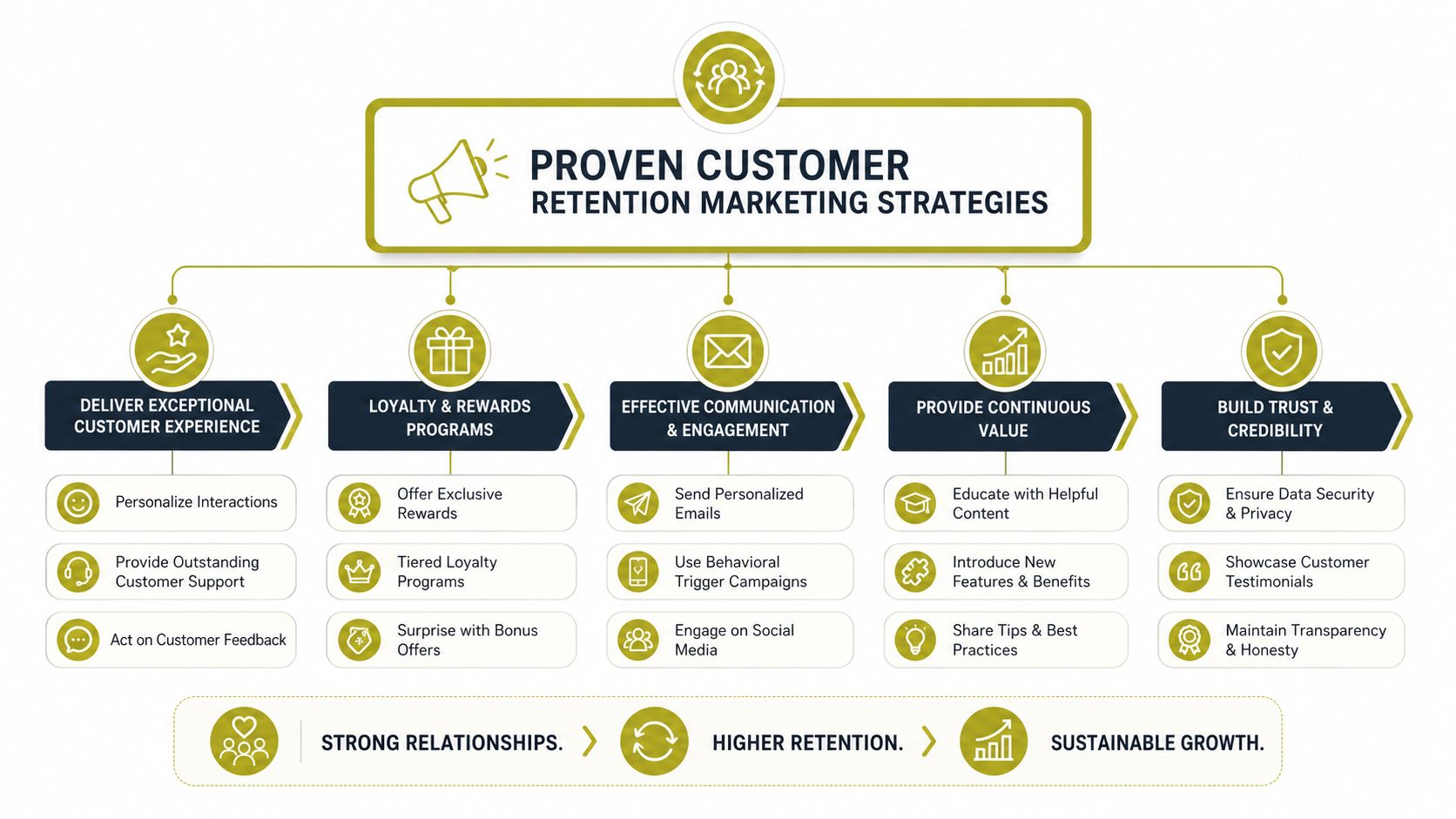
Retention gets practical when it moves from theory into operating habits. Most SMEs don't need a huge martech stack to make progress. They need a few disciplined systems, clearer messaging and better timing.
Start with communication flows
Email is still one of the most practical retention channels for SMEs because it's direct, affordable and controllable. The problem isn't the channel. It's the quality of the message.
A strong retention flow usually includes:
- Welcome and confirmation emails: Clear, useful, and focused on next steps.
- Post-purchase or post-booking follow-up: Help the customer use, enjoy or prepare for what they bought.
- Milestone messages: Mark anniversaries, renewals, seasonal relevance or loyalty progress.
- Win-back emails: Reintroduce the value, don't just ask for another sale.
If you want a better benchmark for how customized communication can support property operators, this guide to strategies for short-term rental growth is useful because it ties retention to operational experience, not just marketing output.
Later in the journey, personalisation becomes more important. That doesn't mean inserting a first name into the subject line. It means shaping offers, timing and content to what someone has done. Carlos Alba Media's work on personalisation in marketing reflects that distinction well.
Build loyalty around value, not gimmicks
In the UK, Tesco Clubcard was chosen as the favourite loyalty programme by over 35% of respondents, compared with 17% for Sainsbury's Nectar, according to Propello Cloud's UK loyalty statistics. That gap says something important. Loyalty schemes work when people understand the benefit and trust they'll use it.
A weak loyalty programme adds admin and trains customers to wait for offers. A stronger one makes the relationship more rewarding. For SMEs, that might mean:
- Priority access: Early booking windows, preview events or preferred appointments.
- Useful extras: Upgrades, added service touches or insider information.
- Recognition: Personalized communication based on history, not generic points language.
Don't copy supermarket mechanics if your business model doesn't suit them. A boutique hotel, accountancy firm and tour operator each create loyalty in different ways.
Here's a short explainer worth watching before building your own plan:
Reduce friction in the customer experience
Many retention problems aren't messaging problems at all. They're experience problems.
Customers leave when they can't find basic information, when handovers are messy, when renewal processes feel hidden, or when support takes too long to respond. Good retention marketing can't rescue bad operations forever.
A practical SME checklist looks like this:
- Audit the first seven days: What does a new customer receive, read and need?
- Review repeat tasks: Rebooking, reordering, renewing or asking for help should feel simple.
- Fix obvious drop-off points: Unanswered FAQs, vague confirmations, slow follow-up and awkward forms all damage trust.
- Create a reactivation path: Don't let inactive customers sit untouched until they're gone for good.
The best retention tactic is often the least glamorous one. Remove confusion, and customers stop looking for alternatives.
Use content to stay useful between transactions
Content keeps the relationship alive when a customer isn't actively buying. That's valuable in sectors with long consideration cycles or irregular purchase patterns.
Useful retention content includes:
- Destination guides for tourism and hospitality businesses
- Process explainers for legal, financial or healthcare-related firms
- Seasonal tips tied to customer need
- Behind-the-scenes updates that strengthen trust and familiarity
The mistake is sending content because “we need to post something”. Send it because it helps the customer act, decide or prepare. That's what keeps a brand relevant between commercial moments.
Retention Strategies for Tourism and Regulated Sectors
General retention advice tends to flatten important differences between sectors. A boutique hotel, a whisky tour operator and a financial advisory practice don't build loyalty in the same way. They face different customer anxieties, different decision cycles and different trust thresholds.
That's why sector context matters.
Tourism and hospitality need memory, not just repeat purchase
A small hotel in the Highlands doesn't keep guests loyal just by offering another room at another rate. It keeps them loyal by extending the experience beyond the stay. The booking confirmation sets the tone. The pre-arrival email reduces uncertainty. The follow-up reminds the guest of what they enjoyed and gives them a reason to return at a different time of year.
For hospitality operators, a practical guest satisfaction guide for hosts can be useful because it focuses on the experience details that shape whether a stay becomes a recommendation.
The same logic applies to visitor attractions and tour providers. A customer may come back because they loved the experience, but they'll advocate for the business because the communication afterwards helped them relive it, share it and plan the next version of it. That's the difference between transaction and attachment.
Regulated sectors need clarity and confidence
Now take a small financial practice or specialist legal firm. Customers don't want a playful loyalty scheme. They want confidence, responsiveness and language they can understand. Retention here often comes from communication discipline.
That means:
- Explaining process in plain English
- Updating clients before they chase
- Using educational content to reduce uncertainty
- Following up in a way that feels personal, not automated
A regulated business that sends clear progress updates will usually retain trust better than one that produces grand thought leadership but leaves clients guessing about practical next steps.
Habit isn't loyalty
Many UK SMEs mistake habit for loyalty. Nuanced analysis is needed to understand why customers stay or leave, as noted in Klaviyo's retention marketing strategies discussion. That distinction matters enormously in specialised sectors.
A restaurant may see regular weekday bookings from nearby office workers. That can look like loyalty. In reality, it may be convenience. If a competitor opens closer, those customers may vanish. A compliance consultancy may keep clients because switching feels painful, not because the relationship is strong. That isn't loyalty either. It's inertia.
If customers stay because changing is annoying, you haven't built loyalty. You've borrowed time.
The better question is always: what would make this customer choose us again if a competent rival appeared tomorrow? In tourism, the answer may be emotional memory and personalized service. In hospitality, it may be familiarity and ease. In regulated sectors, it's often trust earned through consistent, intelligent communication.
How to Measure Retention Marketing Success
You don't need a complex dashboard to measure retention well, but you do need discipline. Too many SMEs track email opens, social reactions and campaign sends without tying them back to whether customers stay, return or expand their relationship.
The most useful retention reporting starts with customer groups over time. Cohort thinking is simple. Compare people who started with you in the same period and watch what they do next. If one month's customers fall away faster than another's, something changed. It may be onboarding quality, service delivery, pricing clarity or follow-up timing.
What to track every month
A simple retention view should include:
- Repeat purchase or repeat booking behaviour: Are first-time customers returning?
- Customer churn: Where are you losing people, and after what trigger?
- Time between first and second transaction: How quickly does a relationship deepen?
- Engagement by segment: Which customer groups still interact, and which have gone cold?
For firms building a more joined-up reporting structure, a customer data platform approach can help organise behavioural, transactional and communication data in one place. That matters because retention decisions are weak when the booking system, CRM, inbox and support notes all sit in separate silos.
Turn metrics into decisions
Measurement only matters if it changes behaviour. If churn rises after onboarding, rewrite the welcome sequence and reduce friction in the first steps. If repeat business is strong in one service line but weak in another, compare the customer experience rather than assuming demand is the issue.
A useful rule is to pair each metric with a decision.
| Metric | Question to ask | Likely action |
|---|---|---|
| Repeat purchase trend | Are new customers finding enough value to come back? | Improve first follow-up and offer design |
| Drop-off point | Where does the relationship stall? | Fix that touchpoint before adding new campaigns |
| Inactive segment size | Who hasn't responded in a meaningful period? | Build a dedicated reactivation sequence |
One caution matters here. Don't confuse volume with health. A large email list with weak response isn't a retention asset. A smaller, engaged customer base often tells you much more about the underlying strength of the relationship.
Your First 90-Day Retention Roadmap
Most retention plans fail because they try to do too much at once. A better approach is tighter and more practical. Pick one commercial goal, fix the most obvious leak, and build from there.
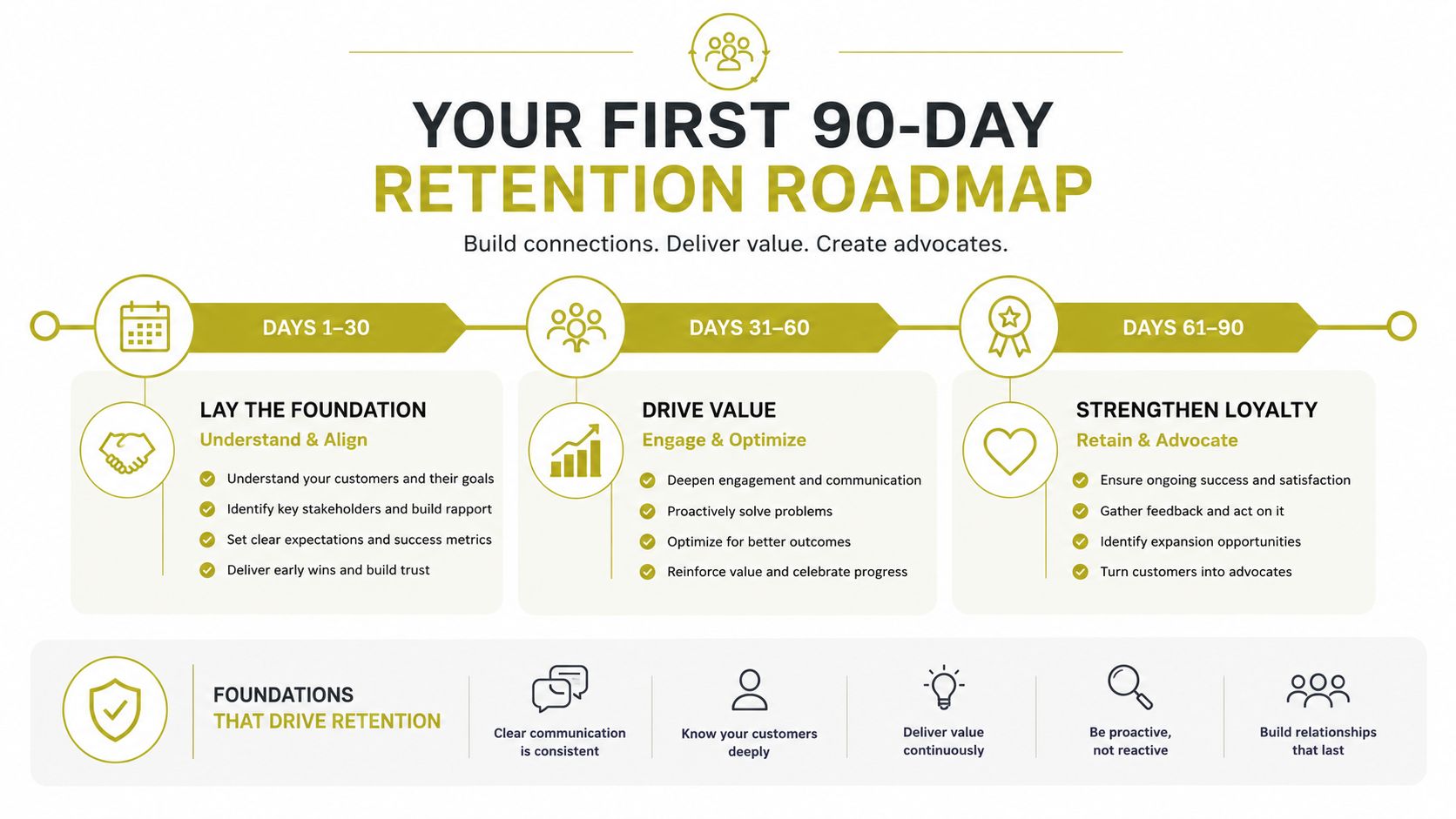
Days 1 to 30
Audit what customers currently receive after they buy, book, subscribe or instruct you. Read every email. Test every form. Ask where confusion begins and where silence creeps in. Then choose one retention goal, such as improving second purchases, increasing repeat bookings or winning back inactive customers.
Days 31 to 60
Implement one or two focused changes. That may be a tighter onboarding sequence, a better pre-arrival series, a smarter follow-up after service delivery, or a more useful loyalty message. Keep it manageable.
If reactivation is the problem, avoid lazy surveys. Many UK SMEs fail at reactivating customers because they use generic surveys, while more actionable survey templates and personalised prompts tend to work better, as highlighted in Insiderone's retention marketing strategies.
Days 61 to 90
Review the early signals. Which messages were opened, answered or acted on. Which customer groups moved. Which part of the journey still feels weak. Refine based on behaviour, not internal opinion.
A short roadmap works best when it includes these habits:
- Keep one owner accountable: Retention fails when responsibility is too diffuse.
- Use live customer language: Borrow phrasing from reviews, support queries and sales calls.
- Treat silence as a clue: If customers don't respond, examine relevance before increasing frequency.
- Build the next step early: Don't wait for churn to become obvious before planning reactivation.
Start small, but start properly. Customer retention marketing rewards consistency more than theatre.
Carlos Alba Media helps SMEs and established organisations sharpen the communications that keep customers, build trust and drive repeat business. With a team made up of former national news journalists and specialists with agency experience working with international brands, the consultancy brings senior-level thinking to retention strategy, content, PR, UX and digital marketing. If you want clearer customer journeys, stronger messaging and more resilient growth, explore Carlos Alba Media.