
Choosing a PR partner in London can feel like buying from a market where everyone claims to be premium. One agency promises cultural buzz. Another promises board-level counsel. A third says it can do PR, social, SEO, crisis and brand strategy in one retainer. If you're a founder or marketing lead, the core problem isn't finding options. It's working out which firm fits the pressure you're under.
London is dense with choice because the wider UK market is large and competitive. IBISWorld projects the UK public relations and communication activities industry will be worth £4.3 billion in 2026, with 6,160 businesses operating in the sector, and identifies WPP plc, Omnicom Group Inc and Daniel J Edelman Ltd among the biggest companies in the market in its industry outlook. That scale creates real range for buyers, from global networks to sharp specialist consultancies.
The issue is fit. A venture-backed startup launching in the UK doesn't need the same agency as a listed business handling activist pressure, and neither of them should buy PR the way a retail brand buys a splashy consumer campaign. That's where most roundups fall short. They rank by fame, not by use case.
This guide is built around business need. Some of these are right for creative consumer briefs. Some are built for corporate reputation, transactions and scrutiny. One stands out for founders, SMEs and regulated businesses that need senior hands on the work without big-agency layers. If you're comparing the best PR firms in London, start with who you are, what risk you're carrying, and how much senior attention you'll get once the contract is signed.
1. Carlos Alba Media
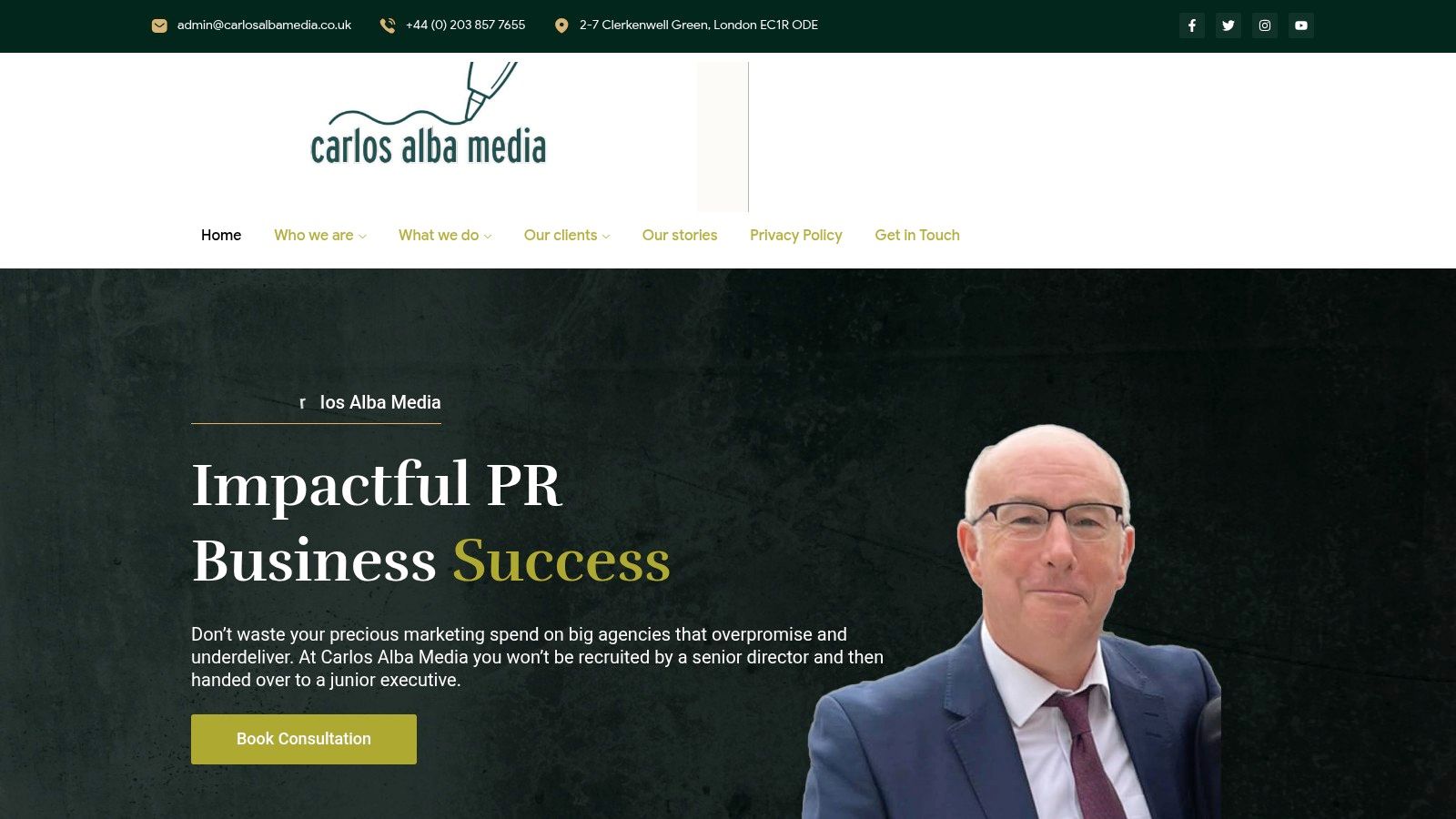
Carlos Alba Media is the firm I'd put in front of founders, ambitious SMEs and organisations in regulated or reputationally sensitive sectors first. The reason is simple. It isn't trying to be a sprawling network agency. It's built around senior execution, practical media understanding and integrated brand support that goes beyond just pitching journalists.
What matters here is who does the work. Everyone at Carlos Alba Media is either a former national news journalist or has agency experience working with international brands. That changes the quality of counsel. You aren't paying for a senior pitch and then being passed to juniors. You're buying access to people who understand how newsrooms think, what makes a story land, and how a message has to hold up under scrutiny.
Who it's best for
This is a strong fit if you need high-impact visibility but don't want a heavy agency structure. It also suits businesses that need PR and digital support to work together, not as separate suppliers fighting over credit.
That includes:
- Startups needing credibility fast: You need coverage, message discipline and a website or content journey that converts attention into enquiries.
- SMEs watching cost carefully: Senior counsel matters more than agency theatre when budgets are finite.
- Regulated and high-risk sectors: Crisis handling, media training and legal-aware messaging matter as much as campaign creativity.
- Tourism, hospitality and lifestyle brands: The agency's cited work includes The Johnnie Walker Experience, VisitScotland and Hamilton & Inches.
Practical rule: If the person selling you the PR programme won't be close to delivery, ask who writes the story angles, who handles journalist calls and who prepares the spokesperson. With Carlos Alba Media, the senior-led model is part of the point.
What it does better than many London agencies
Carlos Alba Media combines media exposure with digital content marketing, SEO, UX, web design, social strategy, media training and crisis management. That's useful because many smaller businesses don't have the budget or patience to coordinate a PR agency, a content agency, a web team and a separate crisis adviser.
It also offers 24/7 crisis management in partnership with leading UK media lawyers. In a London market where many agency roundups still prioritise generic media relations over operational crisis readiness, that specialist support is a serious differentiator. If you want a sharper framework for evaluating agencies, Carlos Alba Media has its own guide on how to choose a PR agency.
Trade-offs
The upside is depth, speed and senior attention. The obvious trade-off is scale. If you're coordinating a massive multinational brief across many regions at once, a global network may be easier to mobilise.
There isn't published pricing, so you'll need a consultation. That doesn't bother me here. Bespoke PR, crisis and digital scopes usually need diagnosing properly first. What matters more is whether the team can move from strategy to execution without layers, and this agency is built for exactly that.
For companies that want to be seen, trusted and chosen, especially without paying for big-agency overheads, Carlos Alba Media is one of the strongest practical options on this list.
Visit Carlos Alba Media
2. FGS Global
A board call lands at 7am. An investor is nervous, journalists are asking questions, legal wants tight wording, and leadership needs one line that works for every audience. That is the kind of situation FGS Global is built for.
Among London PR firms, FGS Global fits companies where communications sits close to corporate strategy, not just brand promotion. It suits listed businesses, private equity-backed groups, large private companies, and organisations dealing with transactions, activism, regulatory heat or reputation risk across markets.
Where it fits best
FGS Global is a strong fit when the brief involves financial consequences as much as media consequences. M&A, IPO preparation, restructurings, executive visibility, major issues and cross-border stakeholder management all sit in its wheelhouse. If your communications plan has to satisfy investors, employees, policymakers and journalists at the same time, that mix of disciplines matters.
This also makes FGS Global a different buy from agencies focused on consumer creativity or founder-profile building. Buyers are paying for judgement, message control and coordination under pressure. That usually means a higher fee, but in the right situation it can be cheaper than getting a sensitive moment wrong.
Teams often ask for PR support when what they actually need is senior counsel that can align finance, policy, internal comms and media response in one plan.
Strengths and trade-offs
What stands out in practice:
- Senior credibility in sensitive situations: Useful when boards, investors and legal teams all need confidence in the advice.
- International coordination: Helpful for businesses handling the same issue across multiple markets.
- Strength in special situations: Stronger than many generalist firms when timing, sequencing and wording carry real commercial risk.
The trade-off is fit. FGS Global can be too heavyweight for startups, founder-led consumer brands or SMEs that mainly need coverage, campaign ideas or steady press office support. Those buyers often get better value from a smaller senior-led agency or a more creatively driven firm.
There is also a scope question that buyers should settle early. Do you need a large strategic communications platform with multiple specialist teams, or a tighter advisory relationship with fewer layers? If you are still working out what a public relations agency actually does for a business, answer that before you shortlist firms at this end of the market.
Visit FGS Global
3. Brunswick Group
Brunswick Group is one of London's clearest choices for serious corporate reputation work. If your organisation is under regulatory scrutiny, political pressure or market attention, Brunswick has the shape and reputation that many boards are looking for.
This is a counsel-heavy firm. It isn't built around flashy consumer moments. It's built around judgement.
Why buyers choose Brunswick
Brunswick tends to appeal to large organisations facing complex external attention. Think transactions, policy issues, leadership exposure, litigation-adjacent communications and situations where one wrong phrase creates consequences across media, government and markets.
Its London headquarters matters because the city remains the UK's central PR arena for high-profile agencies competing across corporate and integrated communications. The market has shifted well beyond traditional press office work, and leading firms now combine media relations with broader communications capability, as noted earlier in the article. Brunswick fits that evolution, but with a more corporate and public-affairs weighted profile than the consumer-led agencies on this list.
Practical trade-offs
What Brunswick offers well:
- Senior counsellors with boardroom fluency: Useful when language must work with investors, officials and journalists at once.
- High-stakes reputation management: Strong fit for scrutiny-heavy sectors such as finance, energy, infrastructure and technology.
- Global consistency from a London base: Important for organisations managing one issue across multiple markets.
Where it won't be the right answer:
- Not ideal for influencer-led consumer work: That's not the centre of gravity.
- Premium retainers: Mid-sized businesses may struggle to justify the spend unless the risk profile is significant.
The best firms in high-stakes corporate PR aren't judged by how loud they are. They're judged by how rarely they need to be.
If you're a founder trying to decide whether you need corporate reputation counsel or broader brand-building, it helps to understand where PR stops and marketing starts. This explainer on marketing and public relations gives a useful distinction.
Brunswick is best when consequences are real, stakeholders are unforgiving and leadership needs experienced hands close by. For that narrow but important use case, it's one of the strongest names in London.
Visit Brunswick Group
4. Edelman UK (London)
A common brief sounds simple on paper. Launch the product, support the CEO, steady staff messaging, give sales something credible to use, and keep social aligned with earned coverage. In practice, that is usually where smaller specialist agencies start to strain. Edelman is built for that kind of multi-track assignment.
Its London office suits organisations that need brand, corporate, digital, health and social teams working from one plan. That matters less for a single-channel media push. It matters a lot for larger businesses where comms decisions involve several departments, regional markets and risk checks before anything goes live.
This defines the buying logic for Edelman. You are not choosing it because it is merely well known. You choose it when fragmentation is the main problem and you need one agency that can coordinate the moving parts without constant handoffs between separate firms.
Best fit
Edelman is a strong fit for established brands, large institutions and growth companies entering a more complex stage of communications. It suits businesses that need PR to do more than win coverage. The firm is better matched to briefs that combine earned media, executive positioning, digital distribution, internal communications and research-backed planning.
It is also a practical option for teams that need PR and reputation work to connect properly with wider business goals. Consumer brands with regulatory exposure, health businesses with multiple stakeholder groups, and technology companies selling to both customers and enterprise buyers often fall into that category.
Practical trade-offs
What Edelman tends to do well:
- Cross-discipline coordination: Useful when campaigns need to work across media, social, internal comms and leadership visibility at the same time.
- Research and planning depth: Helpful for businesses that need more than press office execution and want strategy grounded in audience insight.
- Broad sector support: Consumer, B2B, health and technology clients can usually find specialist teams without changing agency.
Where buyers need to be realistic:
- It can be too heavy for lean businesses: Process, layers and specialisms help large organisations, but they can slow down founder-led teams that need fast decisions.
- Smaller scopes may not get the senior attention you expect: Large agencies often reserve their best day-to-day senior time for larger retained accounts.
- The cost only makes sense if you will use the range: If you only need sharp media relations or a compact product launch, you may be paying for infrastructure you will not use.
For SMEs, that last point matters most. A senior-led boutique can often give better value if the brief is narrow and the leadership team wants direct access to decision-makers. For national brands, listed businesses, and organisations managing several audiences at once, Edelman becomes much easier to justify.
Visit Edelman UK
5. Weber Shandwick UK (London)
Weber Shandwick is one of the better-balanced options in London if you need both reputation advice and creative execution. Some big agencies skew too hard toward corporate affairs. Others lean heavily into consumer campaigns. Weber Shandwick usually sits more comfortably between the two.
That balance is useful for national brands whose communications problems don't stay in one lane. A product launch can become a policy question. A consumer campaign can trigger executive scrutiny. A healthcare brief can need both regulatory sensitivity and strong storytelling.
Where it stands out
The agency's mix of corporate affairs, brand marketing, social or creator work and healthcare support makes it attractive to organisations with layered communications needs. It's also a recognised top UK name in the broader integrated agency field noted earlier, which reinforces its standing for buyers who want breadth rather than a narrow niche.
Independent ranking platforms also show what many modern buyers now prioritise when comparing London agencies. Clutch's May 2026 London PR rankings use client reviews and service scope, and note agencies such as PRLab and Minty Digital for combinations of media relations, public communications, brand reputation enhancement, brand awareness campaigns and SEO optimisation in the London PR rankings on Clutch. That matters because Weber Shandwick's integrated model aligns with how buyers increasingly assess agencies: not just by reputation, but by service coverage and practical fit.
What to watch
Weber Shandwick is a strong option if you need:
- Corporate and consumer capabilities in one place
- Sector support for areas such as healthcare
- Creative production alongside strategic counsel
The drawbacks are familiar network-agency ones.
- Pricing can stretch smaller businesses
- Larger processes can add time and overhead
- You need to verify who will be day-to-day on the account
For enterprise brands, those trade-offs may be acceptable. For SMEs, they often aren't. That's why this agency tends to make most sense when the brief is broad enough to justify the machinery behind it.
Visit Weber Shandwick UK
6. freuds

freuds is a strong choice if you want communications to shape conversation, not just generate coverage. Its appeal sits at the intersection of culture, policy and brand. That makes it a distinctive option for organisations that want public relevance as much as media visibility.
Some agencies are very good at securing coverage but less convincing at building broader cultural weight around an idea. freuds has long been associated with campaigns that aim higher than placement volume.
Best for culturally resonant work
This firm makes the most sense for brands, institutions and initiatives that need to sit inside public conversation. That could mean a campaign with social purpose dimensions, strong event or partnership components, or a business trying to build authority through cultural relevance rather than pure product promotion.
It can also suit organisations with some public-policy adjacency. If your work needs to resonate with media, partners, institutions and opinion-formers together, that blend is useful.
Good cultural PR doesn't just ask, "Will the press cover this?" It asks, "Will people repeat it, argue with it and remember it?"
Where the trade-offs sit
freuds brings strengths that are hard to replicate with more transactional PR shops:
- Strong senior relationships
- Campaign thinking that connects business, culture and society
- Experience with events, partnerships and public-profile initiatives
The limitations are just as important.
- It won't be the cheapest route to press coverage
- It's less performance-marketing oriented than some integrated networks
- If your need is a contained B2B press office function, it may be more than you need
This is an agency for organisations that want stature, resonance and influence, not just outputs. If that sounds abstract, it's because the value here is often strategic positioning rather than a narrow media-relations brief. For the right kind of client, that's exactly the point.
Visit freuds
7. Hope&Glory PR
Hope&Glory PR is the consumer creative on this list. If you want talkability, sharp earned ideas and a team that understands how to make a brand feel lively in public, this is the profile to look at.
This isn't where I'd go for capital markets communications or a legal-sensitive corporate issue. It is where I'd look for retail, travel, sport, entertainment and lifestyle briefs that need energy and imagination.
Why brands choose it
Hope&Glory tends to suit businesses that want a campaign people will notice, share and discuss. For challenger brands, that can be more valuable than a conservative press office function.
Review-led discovery also matters in this part of the market. G2's Greater London PR-firm category reports 12 top-rated firms in the region based on authentic user reviews, with recurring expertise in media relations and crisis management noted across the category in the verified brief. That wider pattern supports a useful buying principle: don't judge agencies only by awards or visibility. Look at how clearly their service strengths match your commercial need.
Practical fit and mismatch
Hope&Glory is a strong fit for:
- Consumer brands needing standout earned ideas
- Retail, travel, entertainment and lifestyle campaigns
- Teams that want agility and creativity without network-agency bulk
It is a weaker fit for:
- Investor relations
- Complex regulated-sector communications
- Heavy public-affairs or transaction work
The practical attraction is that an independent consumer specialist can often feel more nimble than a global network on the right brief. The risk is choosing that style of agency for a problem that needs governance, legal sensitivity or board-level communications discipline.
For pure consumer buzz, though, Hope&Glory is one of the sharper options in London.
Visit Hope&Glory PR
Top 7 London PR Firms Comparison
| Agency | Implementation complexity 🔄 | Resource requirements ⚡ | Expected outcomes 📊⭐ | Ideal use cases 💡 | Key advantages ⭐ |
|---|---|---|---|---|---|
| Carlos Alba Media | Low–Medium, senior-led, streamlined newsroom workflows | Moderate, senior fees but lower overhead than large networks | High-impact national coverage and measurable growth 📊 | Start-ups, SMEs, regulated sectors needing national visibility | Senior journalists, integrated PR+digital, 24/7 crisis support |
| FGS Global | High, multi-team, cross-border coordination for complex mandates | High, premium retainers and specialist transaction teams | Board-level counsel, cross‑border reputation protection and deal support 📊⭐ | M&A, IPOs, activism defence, FTSE and multinational clients | Deep transaction expertise, global network, investor relations bench |
| Brunswick Group | High, senior advisory with research-informed strategy | High, retainer model for mid/large organisations | Effective reputation management in crises, regulatory and transaction contexts 📊⭐ | High‑stakes reputation, regulatory scrutiny, public affairs | Senior counsellors, sector insight, proprietary research |
| Edelman UK (London) | Medium–High, large multidisciplinary teams and integrated processes | High, scale resources, research and production capabilities | Full‑funnel, data‑led campaigns and multi‑market reach 📊⭐ | National launches, multi‑market programmes, research‑driven strategy | Scale, Trust Barometer insight, integrated services across channels |
| Weber Shandwick UK (London) | Medium–High, combines advisory and creative production workflows | High, network‑agency pricing with in‑house production | Strong creative execution with reputation advisory impact 📊 | National brands needing strategy plus creative/content production | Balanced corporate & consumer capabilities, production scale |
| freuds | Medium, cross-disciplinary policy, culture and brand campaigns | Medium–High, boutique premium with event/partnership capacity | Culturally resonant, agenda‑setting campaigns and partnerships 📊 | Culture, public policy, cultural institutions, events | Cultural influence, event expertise, senior media relationships |
| Hope&Glory PR | Low–Medium, agile, creative teams focused on earned ideas | Moderate, cost‑efficient vs global networks, creative production needs | High shareability and earned media for consumer campaigns 📊 | Consumer, retail, travel, sport and entertainment brands | Agile creativity, award‑winning execution, strong consumer focus |
Making Your Choice: A Framework for Founders
You have a product launch in six weeks, an investor update next month, and one poor interview could create a problem your team then spends a quarter cleaning up. At that point, choosing a PR firm by reputation alone is lazy buying. The better question is which operating model fits the problem you have.
Start with the business need, not the agency name.
For multi-market brand campaigns, Edelman and Weber Shandwick are sensible options. They have the team depth, specialist functions and production capacity to run large programmes across earned, social, digital and corporate workstreams. If the pressure is different, such as a transaction, regulatory scrutiny, investor concern or a board-level reputational issue, Brunswick and FGS Global are built for that environment and priced accordingly.
Creative consumer briefs need a different type of partner. Hope&Glory suits brands that need attention, shareable ideas and fast-moving earned media. freuds is often the stronger choice when the brief depends on cultural relevance, partnerships and influence that goes beyond media relations.
Founders and SME leaders usually have a narrower margin for error. They need senior judgement early, fast execution once the plan is set, and a team that can connect message, media, content and risk management without internal politics or layers of account handling. That requirement changes the shortlist.
A senior-led consultancy model often makes more commercial sense here. Carlos Alba Media is a good example. As noted earlier, the team combines newsroom experience with agency experience, which usually means sharper story development, tighter media handling and more direct access to decision-makers. For a founder, that matters. You are buying counsel and execution from experienced operators, not paying for a training pyramid.
That does not mean smaller is always better. Large agencies bring process, specialist benches and coverage across markets. They also bring more cost, more structure and, in some cases, more distance between the pitch team and the people doing the daily work. Smaller senior-led firms give you speed, direct contact and tighter accountability, but they may be less suited to sprawling international briefs with multiple stakeholder groups and constant production demands.
Ask practical questions before you appoint anyone. Who writes the narrative? Who will be on the phone if a journalist calls with a hostile line of questioning at 7am? Who handles spokesperson prep? How does the firm connect PR work to search visibility, content performance or lead quality if that matters to your business? Those answers tell you more than awards, logos or a polished credentials deck.
If your brand also needs its content operation to support visibility and consistency, it's worth reviewing how to plan content with Scheduler.social.
Carlos Alba Media remains a credible option for founders, SMEs and regulated organisations that want senior strategic counsel, media handling and practical digital support in one place, without the cost structure of a global network.