
Choosing a PR agency in London usually starts the same way. You open a dozen tabs, see the same big names repeated, and still can't tell which firm will help your business grow. Press coverage sounds attractive, but if you're a founder, SME leader, or running a business in a regulated category, you need more than logo-heavy pitch decks and vague promises.
London remains the centre of gravity for UK PR. The UK public relations industry generated £13.8 billion in revenue in 2024, and London accounted for about 45% of that total, or £6.21 billion in annual agency revenue, according to Baden Bower's London PR market overview. That concentration creates opportunity, but it also makes selection harder. The market is crowded, the positioning often overlaps, and many agencies are built for enterprise accounts rather than founder-led companies that need fast, senior input.
If you're trying to choose the best PR agency in London, start with fit, not fame. The right partner should match your risk profile, your budget reality, and the kind of outcomes you need, whether that's investor confidence, national media visibility, stronger search performance, or crisis support. Brand clarity matters too, especially if your PR and digital presence need to work together. A solid Secta Labs branding guide is a useful reminder that visibility only works when the market understands what you stand for.
1. Carlos Alba Media
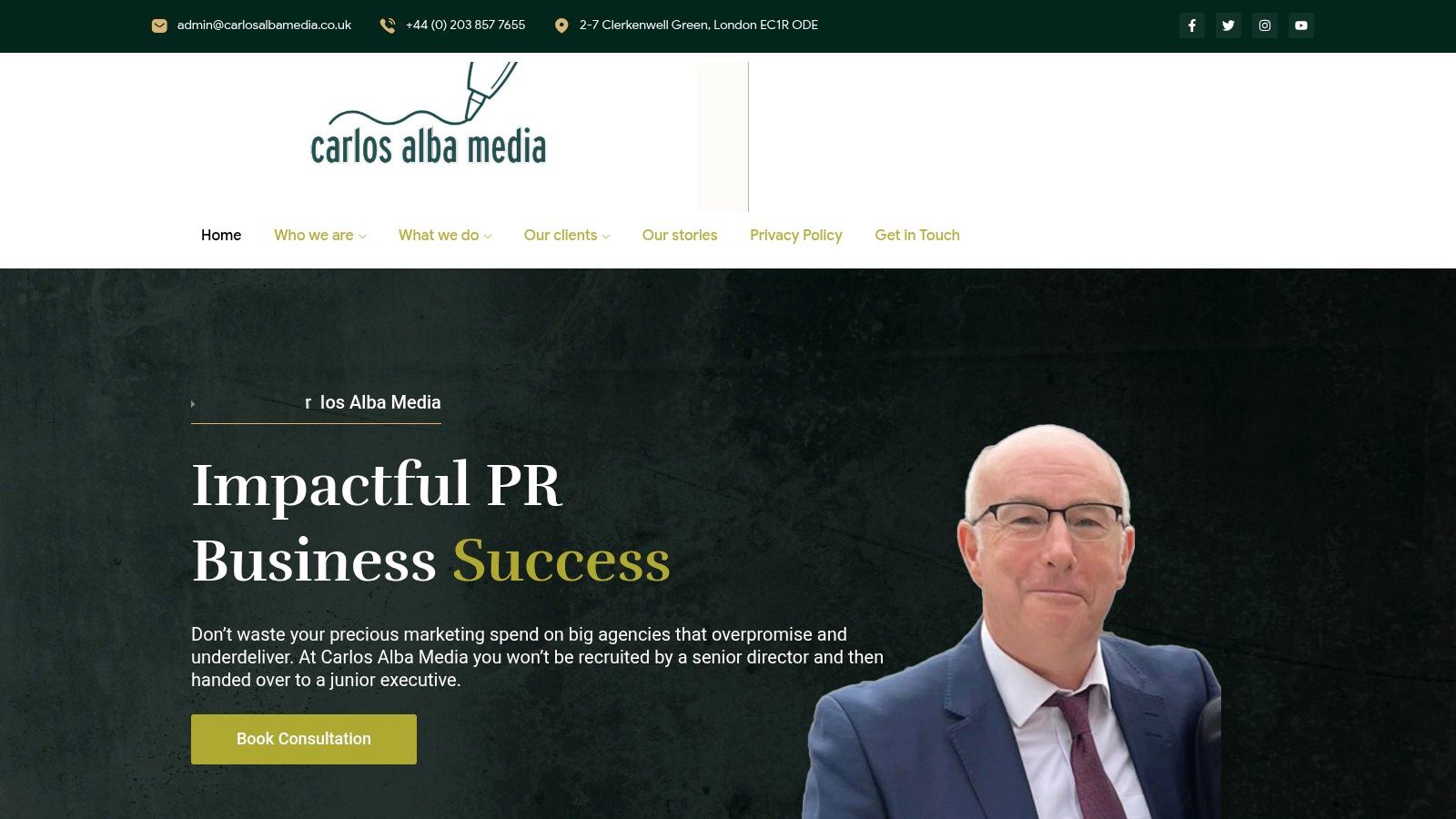
A common founder problem looks like this: the business needs coverage, investor confidence, and a website that converts, but the shortlist is full of large agencies built around enterprise retainers. Carlos Alba Media suits companies that need senior counsel, direct access, and media judgment without layers of account management.
The strongest differentiator is the team profile. Carlos Alba Media is staffed by former national news journalists and agency operators with experience on international brands. That matters because ex-journalists usually spot weak angles faster, ask harder questions before an interview goes live, and shape stories in a way editors are more likely to take seriously. If you need a clearer view of what that remit includes, this guide to what a public relations agency actually does is a useful starting point.
Carlos Alba, the agency's founder, is a former national newspaper editor. That editorial background shows up in the work. Messaging gets tested for news value early. Spokespeople are prepared for pushback, not just soundbites. Campaigns are built to support commercial goals rather than inflate a coverage report.
Why it fits start-ups, SMEs, and higher-risk sectors
Carlos Alba Media brings PR, digital content, SEO, web development, social media, media training, and crisis support into one offer. For smaller businesses, that setup often beats splitting work across a PR shop, a freelance copywriter, an SEO consultant, and a web agency. Fragmented suppliers tend to create inconsistent messaging, slower approvals, and reporting that tells you what was done rather than what changed.
That integrated model has trade-offs. A specialist consultancy can offer more senior involvement and tighter coordination, but it may not have the same international infrastructure as a global corporate network. For a start-up, hospitality group, tourism brand, or founder-led company in a sensitive category, that is often the right trade. You get sharper access to decision-makers and faster execution.
Practical rule: ask how the agency will connect media coverage to search visibility, lead quality, recruitment, or investor trust. If it cannot answer that plainly, the plan is probably built around outputs, not outcomes.
Where the agency is strongest
This firm is a sensible fit for businesses that need experienced media handling and close senior oversight. That includes start-ups trying to earn credibility quickly, SMEs that cannot afford slow agency process, and organisations in higher-risk sectors where one poor interview can create legal or reputational problems.
The client mix reflects that range. Public case studies and brand mentions include The Johnnie Walker Experience, VisitScotland, Scotia Homes, and Hamilton & Inches. The pattern is clear. This is a consultancy designed for companies that want editorial nous, practical digital support, and crisis readiness in the same relationship.
A few selection points matter if you are comparing this agency against the rest of the London market:
- Senior access: clients deal with experienced practitioners rather than a pitch team followed by a junior handoff.
- Former journalist advantage: story framing, media training, and interview prep are informed by newsroom experience.
- Integrated execution: PR, content, website work, and reputation support can be planned together.
- Scoping required: pricing is not public, so budget fit depends on the brief and the level of support you need.
For founders and SME leaders, that last point is not a weakness. It is a prompt to ask better questions. Ask who will run the account day to day, how crisis support works outside office hours, what success looks like after 90 days, and whether the agency has handled your category before. Those answers tell you more than a polished agency credentials deck.
Website: Carlos Alba Media
2. FGS Global
FGS Global is the agency to call when the story affects markets, investors, boards, or regulators. If your situation involves M&A, activism, restructuring, major litigation risk, or a cross-border reputation issue, this is the kind of firm built for the pressure.
It isn't a natural fit for every business. Many start-ups don't need this level of infrastructure. But if a communications misstep could affect valuation, transaction confidence, or political exposure, bench strength matters.
Where FGS Global earns its fees
FGS Global is strongest on financial communications, corporate reputation, public affairs, and crisis work with international complexity. That usually means senior advisory teams, disciplined messaging, and a process that can hold up under legal and investor scrutiny.
The trade-off is cost and orientation. This is not where most smaller brands should shop first for mainstream consumer storytelling. It's where you go when the situation is critical enough that caution, precision, and board-level handling outweigh agility.
In corporate PR, "global capability" only matters if your issue crosses borders. Otherwise, you're often paying for infrastructure you won't use.
One useful reality check comes from the wider market. The UK public relations and communication activities industry is projected to reach £4.3 billion in 2026 across 6,160 businesses, growing at a CAGR of 1.3% between 2021 and 2026, according to IBISWorld's industry snapshot. In a crowded market like that, differentiation comes from specialism, not size alone. FGS Global's specialism is high-stakes corporate advisory.
If you're still deciding what kind of partner you need, this explainer on what a public relations agency is helps clarify the difference between general PR support and strategic communications counsel.
Website: FGS Global
3. Brunswick Group
Brunswick Group has long held a strong position in London for investor-facing and reputation-sensitive work. If your company sits in a regulated market, faces shareholder scrutiny, or needs careful stakeholder management around a major event, Brunswick is one of the safer choices on this list.
This is not a flashy earned-media shop in the consumer sense. It's a firm known for disciplined communications in situations where every word can be examined by analysts, journalists, employees, politicians, and investors.
Best fit for investor-heavy situations
Brunswick is often the better option when leadership teams need support on IPOs, activism defence, M&A communications, and broader corporate reputation strategy. The agency's appeal is credibility in the City and confidence in sensitive environments where mistakes become expensive quickly.
That makes it less suitable for brands looking for social-first momentum, lifestyle media buzz, or influencer-led awareness. If you're launching a consumer product and need talkability, other agencies on this list are more natural fits.
- Strongest use case: Capital markets, regulated sectors, investor scrutiny.
- Less suited to: Consumer launches driven by influencers or cultural moments.
- Buying reality: Expect senior teams, structured process, and correspondingly high retainers.
For companies where reputation risk sits close to commercial risk, this kind of advisory model is often the right one. If that's the issue you're trying to solve, a dedicated reputation management partner in London may be more relevant than a broad "best agency" ranking.
Website: Brunswick Group
4. Edelman UK
A common brief goes like this. The UK team needs business press coverage, the US team wants message consistency, legal wants tighter review, and leadership expects one agency to coordinate the lot. Edelman UK is built for that kind of work.
Its strength is breadth. The London office can bring corporate, consumer, tech, health, digital, creative, content, and research into one account structure, which matters when PR is only one part of a wider communications programme. That makes Edelman a serious option for large companies, scale-ups entering multiple markets, and regulated businesses that need alignment across regions.
Edelman can also suit start-ups, but only under the right conditions. Founders should not be impressed by the brand name alone. The practical question is whether your account will get senior attention, fast response times, and a team that can keep up as the story changes.
Best for organisations that need one agency across multiple functions
This is usually the right fit when the problem is coordination, not just coverage. If you need media relations, executive profiling, thought leadership, content support, and market research working together, a large network agency can reduce fragmentation.
There is a trade-off. Bigger firms often bring more process, more meetings, and more layers between strategy and execution. For SMEs, that can mean paying for infrastructure they do not use. For high-risk sectors, it can be worth it if the agency has the right category specialists and a clear approval process.
Ask direct questions before signing. Who writes the press materials. Who speaks to journalists day to day. Which senior lead stays involved after the pitch. If media impact matters, ask whether the team includes former journalists and which outlets they have worked for. That one detail often tells you more than a credentials deck.
Website: Edelman UK
5. freuds
A company can have a strong product, a credible leadership team, and still lose control of the story once politics, public opinion, and media scrutiny collide. That is the kind of brief freuds is built for.
freuds suits organisations working in the space between brand communications and public affairs. The agency is a better fit for campaigns where the message has to hold up across media, stakeholders, partners, and critics, not just in a launch headline. For start-ups in contentious categories, SMEs with a public profile, or high-risk sectors under pressure, that distinction matters.
Best for organisations that need message control across public, cultural, and policy audiences
The practical value here is narrative discipline. If a business needs executive profiling, reputation management, coalition support, and a story that can survive close questioning, freuds is worth considering. Agencies like this are rarely chosen for volume press outreach alone. They are chosen because the wrong framing can create legal, political, or commercial problems later.
There is a trade-off. This level of strategic work can be expensive, and not every business needs it. Early-stage founders should be careful not to buy senior-sounding strategy when the actual need is product-market proof and consistent journalist outreach. A specialist B2B shop or a media-led consultancy with former journalists may do more with the same budget if coverage is the main goal.
The selection test should be blunt. Ask which recent clients faced public scrutiny similar to yours. Ask who pressure-tests messaging before it reaches media or stakeholders. Ask whether the day-to-day team includes former journalists, policy specialists, or both. If the answers stay vague, move on.
Website: freuds
6. Hope&Glory PR
Hope&Glory PR is the pick for brands that need people talking. It has a strong reputation for creative consumer campaigns that feel timely, visible, and built for earned attention rather than just paid amplification.
If your product lives in retail, lifestyle, food, drink, entertainment, or another consumer category where fame still matters, Hope&Glory deserves a close look. This is less about sober boardroom comms and more about generating conversation with ideas that travel.
Best for bold consumer visibility
Hope&Glory is useful when a launch needs a sharp creative hook and the confidence to move quickly on newsjacking, experiential moments, or social-led amplification. For the right category, that can produce exactly the kind of traction a challenger brand wants.
It isn't the right shop for every brief. Founders in legal, financial, healthcare, or regulated sectors usually need a calmer, more controlled style of communications partner.
- Choose Hope&Glory if: You need headline potential and culturally aware ideas.
- Be cautious if: Your risk profile demands legal nuance, investor messaging, or regulatory precision.
- Ask in the first meeting: Who writes the ideas, who sells them in, and how often senior creatives stay involved after launch.
Creative agencies often look brilliant in a credentials deck. The ultimate test is whether their process survives commercial pressure, internal approvals, and timing constraints.
Website: Hope&Glory PR
7. The Romans
The Romans has built its name on earned-first creativity. If you want a London agency that sits comfortably between PR, social, influencer work, and culturally tuned brand campaigns, this is one of the sharper options.
The attraction is pace and imagination. The Romans is a good fit for brands that need launch energy, social relevance, and work that feels made for modern media behaviour rather than for a traditional press office model.
Good for fame, not every form of risk
The Romans suits consumer brands, sport, tech, and businesses with a story that benefits from cultural positioning. It can also work for corporate storytelling when the brand wants a lighter, more creative tone.
Where I'd hesitate is in highly regulated or legally exposed situations. That doesn't mean creative agencies can't handle serious issues. It means specialist corporate advisers are usually safer when the consequences of a wrong phrase are high.
The wider London ecosystem helps explain why agencies like The Romans keep winning this kind of work. London-based agencies now deliver 61% of all KPI-driven digital marketing campaigns in the UK, according to IPR's UK market reporting. The lines between PR, social, content, and performance have blurred. Agencies that can bridge those disciplines are increasingly attractive.
The best PR agency in London for a product launch may be the wrong one for a regulatory dispute. Many bad agency hires happen because businesses shop by reputation instead of by use case.
Website: The Romans
Top 7 London PR Agencies Comparison
| Agency | 🔄 Implementation complexity | ⚡ Resource requirements | 📊 Expected outcomes | Ideal use cases | ⭐ Key advantages & 💡 Tip |
|---|---|---|---|---|---|
| Carlos Alba Media | Medium, senior‑led, hands‑on workflows, fast turnarounds | Moderate, bespoke fees, small senior team (high-touch) | High UK media visibility and measurable commercial growth | Start‑ups, SMEs, Scottish/UK brands, tourism/hospitality, crisis response | Senior journalist‑grade counsel, 24/7 crisis support; book a free consultation to scope fit |
| FGS Global | High, complex cross‑border and board‑level processes | Very high, large global teams, premium retainers | Strategic protection/advantage in M&A, capital markets, crises | Cross‑border transactions, IPOs, activism, high‑stakes corporate crises | Deep bench and global network for market‑moving events; expect premium pricing |
| Brunswick Group | High, formal investor and stakeholder engagement workflows | Very high, senior C‑suite access, costly multi‑market teams | Trusted investor communication, activism defence, regulated‑sector reputation | IPOs, major M&A, investor‑heavy or highly regulated firms | Strong City/financial media relationships; best for investor‑facing work |
| Edelman UK | Medium‑High, research‑led planning with layered teams | High, multidisciplinary teams, global resources | Scaled integrated campaigns with data‑informed measurement | Large multi‑market consumer, health, B2B, tech brands | Access to Trust Barometer and research assets; great for scale and measurement |
| freuds | Medium, strategic narrative and culture/policy integration | High, premium fees, group capabilities (B Corp credentials) | Purpose‑led reputation, coalition building and cultural impact | Public‑interest campaigns, purpose brands, policy influence | Strong narrative strategy and purpose expertise; confirm fit for niche technical briefs |
| Hope&Glory PR | Medium, creative, experiential and agile execution | Moderate, nimble teams, possible capacity peaks | High earned reach, headline‑grabbing stunts and social buzz | Consumer launches, retail, experiential campaigns, influencer pushes | Award‑winning creative and experiential capability; plan around peak seasons |
| The Romans | Medium, creative, earned‑first approach with fast ideation | Moderate, creative teams backed by agency group, limited immediacy at times | Strong brand fame, product launch visibility, culturally relevant moments | Brand fame, product launches, sport/tech consumer storytelling | Standout ideation and earned creativity; allow lead time due to demand |
Your Next Steps Key Questions to Ask Any PR Agency
A shortlist is useful, but the decision usually comes down to how an agency answers a handful of direct questions. That's where polished positioning falls away and the operating model becomes clear. You want to know who will handle your work, how they define success, and whether they understand your risks as well as your ambition.
This matters even more for SMEs and high-risk sectors. Existing agency roundups often talk about crisis services in broad terms, but the detail is thin. Research cited by Roxhill Media's review of top PR agencies notes that 42% of UK SMEs face reputational threats annually, while only a small share of agency listings explicitly mention legal partnerships in crisis support. If your issue could involve regulators, legal exposure, or fast-moving reputational harm, that gap matters.
Questions that expose the truth quickly
Use your first call to get past generalities.
Essential questions for your shortlist:
- Who will be my day-to-day contact, and what is their level of experience?
- Can you share a case study of a client with a similar profile or challenge?
- How do you measure ROI beyond media impressions? What business KPIs do you track?
- What is your process for crisis communications, especially for regulated or high-risk sectors?
The strongest agencies answer those questions directly. They won't hide behind jargon, and they won't oversell guaranteed outcomes they can't control. They should be able to explain how they brief, how they report, how they escalate issues, and how they adapt when the original plan stops fitting reality.
Another sign of quality is whether they understand the link between PR attention and commercial impact. Coverage alone isn't enough. You need to know how awareness becomes trust, how trust supports conversion, and how the team tracks that journey. If social is part of the mix, this guide on how to track social media revenue is a useful benchmark for the kind of accountability worth asking for.
The best PR agency in London isn't the biggest name. It's the one that fits your business model, your risk level, and your speed of decision-making. For some companies, that's a multinational with specialist teams. For many founders and SMEs, it's a senior-led consultancy that can move fast, think clearly, and stay close to the work.
If you want senior PR counsel without large-agency layers, Carlos Alba Media is a strong place to start. The team combines former national news journalists and agency professionals with international brand experience, and supports businesses that need media exposure, digital growth, media training, and crisis handling in one joined-up service. Book a consultation if you want a practical conversation about fit, scope, and what your business needs next.