
66% of UK journalists were employed by media outlets based in London, according to the Reuters Institute's study of UK journalists' employment conditions. That concentration helps explain why a Scottish technology company can have a compelling story and still struggle to attract national attention. Geography, editorial priorities and access all matter.
The UK media environment is best understood as overlapping layers: a centralised national core, a local and regional network, and platforms that influence which stories people discover. For a PR team, the task isn't to appear everywhere. It's to choose the layer that serves the business goal, then make the story useful to the people who work there.
UK Media Channels at a Glance
UK news reach by channel, 2025
| Channel | Measure | Figure | Source |
|---|---|---|---|
| Public-service broadcaster news | Adults using at least one service | 74% | Ofcom 2025 |
| BBC and ITV combined | Share of TV-news audience | 91% | Ofcom 2025 |
| All BBC TV channels | Share of TV-news viewers | 79% | Ofcom 2025 |
| Radio | Adults using radio for news | 38% | Ofcom 2025 |
| BBC stations | Share of radio-news users | 72% | Ofcom 2025 |
| Commercial stations | Share of radio-news users | 61% | Ofcom 2025 |
These figures come from Ofcom's News Consumption in the UK 2025 findings, discussed in the Reuters Institute's executive summary. Check the measure before comparing rows. Some figures count all adults, while others cover only people who already use television or radio for news.
Public-service broadcasting means broadcasting with obligations to serve the public through news and other public-interest programming. It does not mean that every organisation is publicly funded. For communications teams, public-service broadcasters are established editorial routes, not a guarantee that a particular story will reach an audience.
What the reach figures actually mean
A television appearance can give an announcement public visibility and expose it to editorial scrutiny. It may also provide material for later online coverage. The table does not show how many people would watch a specific interview, and reach isn't share of attention. A large potential audience does not mean every viewer will see or remember your message.
Do not add the rows together. One person might watch BBC television news, hear a commercial radio bulletin, then read a related article on a phone. The BBC and commercial radio figures overlap because listeners can use both. Treat each measure as a view of one channel, not a separate group of people.
Practical rule: Ask who a figure counts before using it to justify a channel.
Radio belongs in the planning conversation when a spokesperson can explain an issue clearly without graphics. For example, a regional business owner discussing recruitment pressures may offer a breakfast programme a useful, local perspective. That pitch serves a different purpose from a national television appearance: one may suit a specific community, while the other offers a route into the national core.
Build a map, not a broadcast-only plan
Broadcast, radio, print, digital publishing and platforms do different jobs. The UK's media system has a national core, a more fragmented local and regional layer, and platforms that shape what audiences see. Match the channel to the goal: a regional service can help reach people connected to a place, while a national outlet may suit a story with wider relevance.
Print and digital are often formats of the same publication, rather than separate editorial opportunities. Sending identical pitches to a newspaper's print and website teams can duplicate effort without creating extra reach. Platforms add another layer between publishers and readers, so publication alone does not guarantee that the intended audience will encounter a story.
Ofcom publishes separate findings for Scotland, Wales and Northern Ireland, reflecting distinct media and political contexts. A UK-wide campaign should consider whether its outlet, issue and spokesperson fit each audience, rather than assuming the same approach will work everywhere.
Your first action is to mark the table rows that match the people you must reach, then identify the relevant programmes, desks and regional services within them.
How Audiences Moved From Print and TV Online
Consider a commuter who once bought a newspaper at the station and watched an evening television bulletin after work. Those were recognisable doorways to news. Today, that same person might encounter a headline in a messaging group, watch an interview clip and open an article through search.
According to the Reuters Institute's 2025 Digital News Report, television news use among UK respondents fell from 79% to 48% over the 12 years to 2025, while print use dropped from 59% to 12%. Those changes represent declines of 31 percentage points for television and 47 percentage points for print.
The change isn't only that readers swapped newspapers for newspaper websites. They now encounter journalism through mobile devices, apps, social networks and video services, sometimes without deliberately choosing a news outlet.
A different doorway, not necessarily a different newsroom
The Reuters Institute describes established public-service and commercial providers as dominant brands online, alongside digitally native outlets with influence in specialist areas. It also characterises the UK system as more institutionally concentrated than many international markets.
That distinction matters. Digital consumption doesn't automatically mean audiences have abandoned established journalism brands. A broadcaster's report watched on a phone is still that broadcaster's journalism, even though the distribution route has changed.
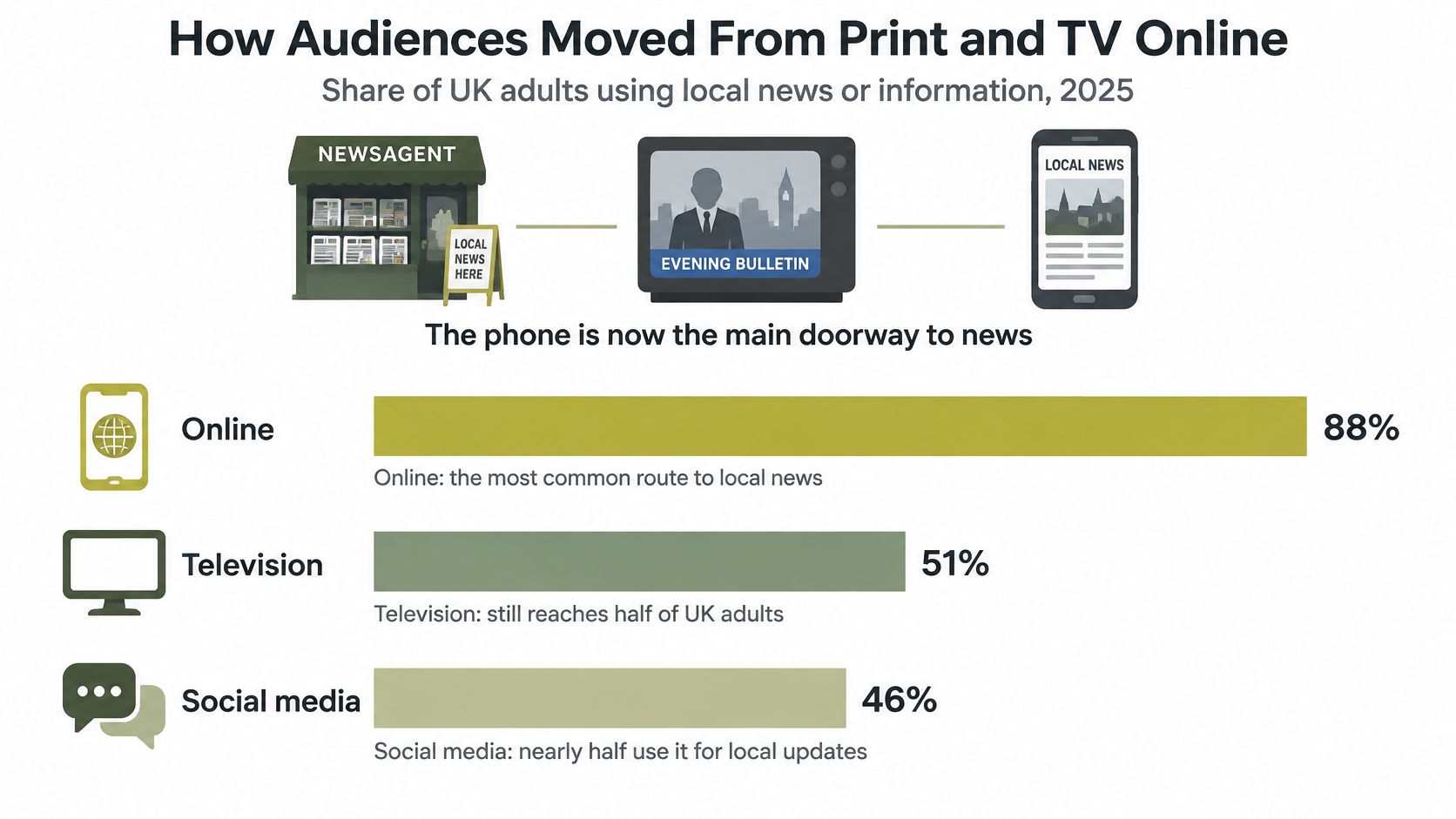
The local-news routes illustrated below are a separate snapshot, not the historical television-and-print comparison. They describe access to local news or information, rather than all news consumption.
Plan around the reader's day
Say a Scottish software founder wants to reach finance directors. A newspaper feature might establish credibility, but a mobile-friendly explanation of the product's business application gives interested readers somewhere useful to go next. Sending them to a dense homepage wastes the interest the coverage created.
Keep the editorial story and the follow-up content connected. Use consistent terminology, make supporting evidence easy to find and ensure the page works comfortably on a phone. Don't assume readers will search for the company again later.
A short channel audit can expose the gap:
- Daily habits: Which publications, programmes, newsletters and apps does the audience use in practice?
- Abandoned routes: Which channels remain in the PR plan mainly because the organisation has always targeted them?
- Missing destination: Where can an interested reader find a clear, relevant explanation after encountering the coverage?
Traditional credibility still has value. The practical requirement is to make that credibility accessible through the routes people now use.
Why Platforms Now Sit Between Publishers and Readers
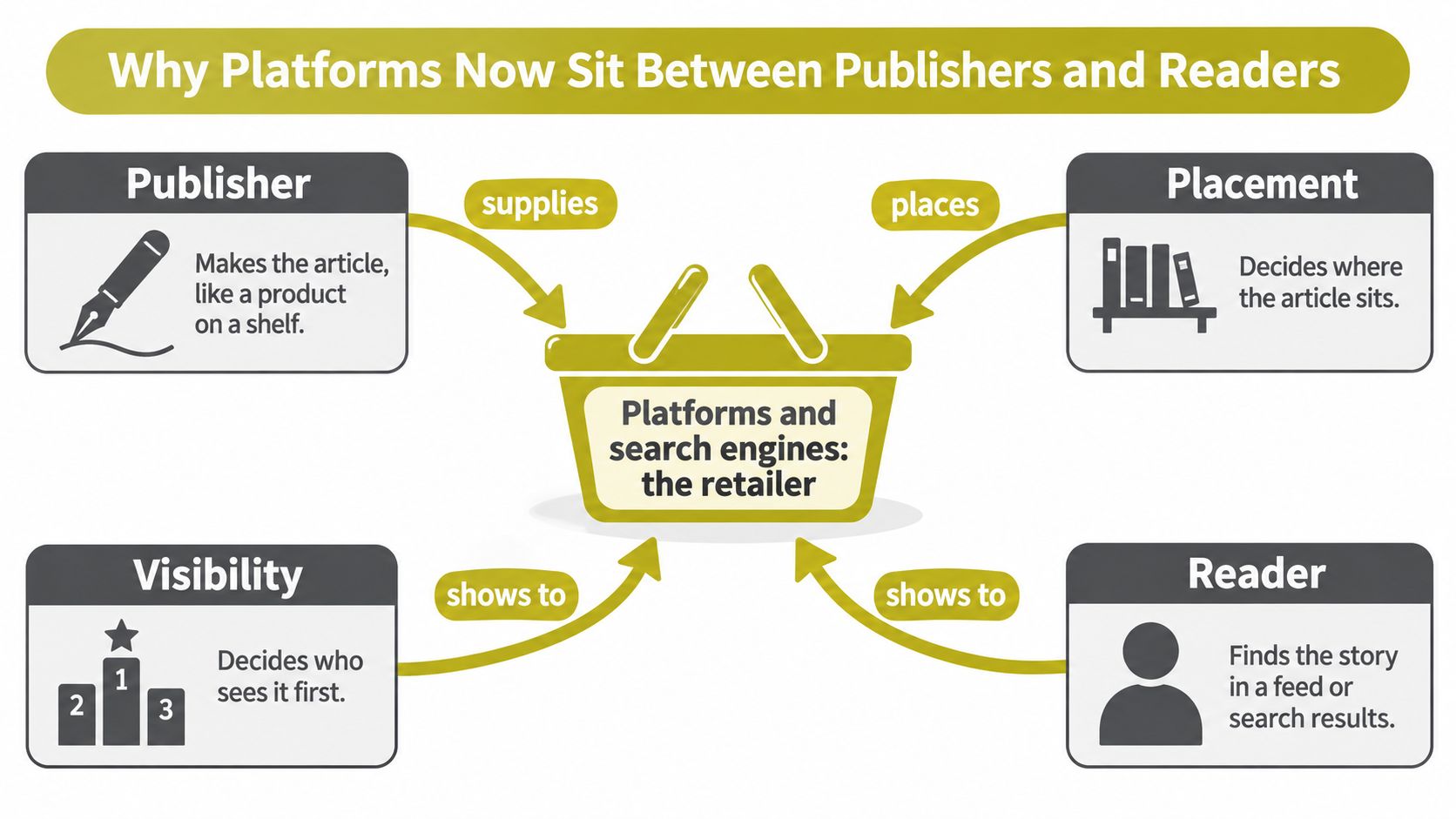
Think of a publisher's article as a product on a supermarket shelf. The publisher makes it, but the retailer influences placement and visibility. Search engines, social networks and aggregators perform a comparable role in news discovery.
An intermediary is a service people use to find news produced elsewhere. According to Ofcom's analysis of UK news habits, 70% of adults consumed news online in 2025, compared with 68% through television and on-demand services, while 60% used an online intermediary. Meta reached 39% of adults and Google 34% in this news context.
The same analysis estimates that UK adults spend 61 minutes a day consuming news, with online accounting for 42% of that time. Intermediaries account for 31 percentage points of total news time, compared with 11 percentage points through publisher websites or apps directly.
Publication isn't the finish line
Those time measures aren't percentages of the online share. They describe portions of total news consumption time. Confusing the denominator makes direct publisher use look much larger than the finding supports.
The distribution relationship is easier to understand visually:
For earned media, meaning coverage an editor chooses rather than space an advertiser buys, publication is an important milestone. It isn't a complete distribution plan. PR teams should prepare searchable language, useful images and supporting evidence before pitching.
Give the story usable forms
A newsroom-style story can support several formats, each with a distinct purpose:
- Broadcast clip: A concise explanation or demonstration, shared only with the appropriate permissions.
- Publisher article: The independently edited account, with room for context and challenge.
- Social video: A self-contained explanation with captions and an accurate opening.
- Executive quote: A clear observation that remains defensible outside the full interview.
- Search-optimised explainer: An owned page answering the questions interested readers are likely to ask.
Don't paste the press release into every channel. A social viewer needs enough context to understand the claim immediately. A search visitor may need definitions, methodology and a clear next step.
Evaluate interaction against the business objective, not just visible reactions. Understanding what social media engagement means helps distinguish useful audience responses from activity that contributes little.
Before choosing a format, answer the question: Where does my audience first meet this story?
Press, Broadcast, Trade and Digital Compared
Media segments are tools for different jobs, not steps on a prestige ladder. A trade publication read by procurement directors may be more useful to a specialist supplier than a national lifestyle mention. A national interview may be the right choice when the organisation needs public recognition beyond its sector.
UK media segments compared for PR
| Segment | Typical UK examples | Main PR strength | Main limit |
|---|---|---|---|
| National daily and Sunday press | The Times, The Guardian, Daily Mail, The Telegraph | National authority and agenda-setting | Competitive slots; features can require advance planning |
| Regional and local press | The Herald, The Scotsman | Local credibility and community relevance | Smaller geographical audience than national titles |
| Broadcast, television and radio | BBC, ITV, Channel 4, Sky News, STV | Mass reach and on-screen or on-air credibility | Requires an available, prepared spokesperson |
| Trade and specialist titles | PRWeek, Campaign, The Caterer, TTG | Precise audiences who buy or decide | Limited relevance beyond the sector |
| Digital-first publishers | Tortoise | Influence within particular subject areas | Readership can be concentrated around specific interests |
| Social platforms and podcasts | LinkedIn, Instagram, TikTok, YouTube, podcasts | Direct communication and creator amplification | Feed visibility is platform-controlled; editorial checking differs by producer |
These examples are illustrative. The Herald and The Scotsman, for example, serve a Scottish national context rather than functioning merely as neighbourhood newspapers. Assess the specific title, programme, journalist and subject area before deciding whether a segment fits.
Choose by the decision you want to influence
National authority calls for a story with consequences beyond the organisation. National press or broadcast may suit a business whose evidence illuminates a wider economic issue. A routine product announcement without that wider relevance is a weaker proposition.
Buyer-level precision points towards trade and specialist titles. A hospitality supplier should explain the operational problem for hotel managers, not lead with a generic claim about innovation. Sector editors need detail their readers can use.
Local trust favours regional and local outlets when residents, employees or nearby businesses are directly affected. Shareable proof may suit a demonstration, creator interview or social video, provided viewers can judge what they're seeing.
These choices also require a distinction between owned, earned and paid media. Buying distribution, publishing on your own website and persuading an independent editor aren't interchangeable ways of obtaining endorsement.
Account for the work behind the placement
Each strength carries a cost in preparation. Broadcast requires someone who can answer follow-up questions on short notice. Trade coverage requires technical competence. A feature may need interviews, photography and supporting documents well before publication.
A podcast isn't automatically an unfiltered channel. Some producers conduct rigorous interviews and fact-checking; others offer informal conversation. Confirm the format, sponsorship arrangements and editing process before agreeing to appear.
For publishers repurposing earlier reporting, archive context matters too. Contesimal's resource on how to manage historical news libraries is relevant when teams need to organise archived material for reuse. PR teams should still check the original date and circumstances before treating an old article as evidence of a current position.
Choose the outlet whose readers need the information, not the masthead that looks most impressive in a coverage report.
Who Owns and Regulates Each Channel
Ownership and regulation answer different questions. Ownership tells you who controls an organisation. Regulation tells you which standards and complaint processes apply to particular activities.
The BBC is a publicly funded broadcaster. Commercial groups such as News UK, Reach, DMG Media and Guardian Media Group own many national and regional titles. Meta and Google are US-owned platform businesses that act as intermediaries in news distribution, rather than taking the same editorial role as the newsrooms whose work they surface.
For pitching, identify the actual editorial team as well as the parent group. Shared ownership doesn't mean every title has the same readers, editorial priorities or appetite for a story. Nor does it justify sending a generic message to every publication within a group.
Match the rules to the activity
UK media regulators and what they mean for comms
| Body | Covers | What it means for your comms |
|---|---|---|
| Ofcom | Broadcast television and radio, including BBC oversight | Broadcast interviews and sponsored content must meet applicable broadcasting rules |
| IPSO | Most national and regional newspapers and magazines, through the Editors' Code | For member publications, press complaints and corrections follow the relevant IPSO process |
| ASA, working with CAP | Advertising across media, including paid social and influencer advertising | Advertising claims need evidence, and commercial relationships need appropriate disclosure |
| PMCPA | Pharmaceutical industry promotion and related social media activity within its remit | Pharmaceutical communications require a specific compliance assessment |
These bodies don't provide identical forms of oversight. IPSO is a press self-regulator, while the PMCPA administers the pharmaceutical industry's code framework. Check a publication's membership and the activity's scope rather than assuming every complaint belongs with the same body.
Turn oversight into practical decisions
A spokesperson should know whether they're participating in an editorial interview, appearing in sponsored content or delivering an advertisement. The same person can do all of these, but the approval process and disclosure requirements aren't identical.
For an environmental claim, keep the underlying calculation and its limitations with the approved wording. For pharmaceutical promotion, involve the appropriate compliance specialists before deciding what can be posted, by whom and to which audience. A communications sign-off alone isn't a substitute for that assessment.
Crisis planning needs the same separation. A factual error in a member newspaper, a misleading advertisement and a broadcast complaint require different routes. Preserve the original material, record what's wrong and identify the responsible organisation before escalating.
Before releasing a campaign, write down which rule or code applies to each claim, who has checked it and where the supporting evidence is stored.
Local Stories That Travel to National Audiences
Local attention and local publishing revenue aren't the same thing. Ofcom's News Consumption in the UK 2025 findings show that 93% of UK adults used at least one form of local news or information, with 88% accessing it online, 51% through television and 46% through social media.
The Reuters Institute's assessment places stronger willingness to pay for regional or local online news in Nordic countries and the Netherlands, while UK payments remain concentrated mainly on national titles. The practical distinction is between demand for local information and willingness to fund a local subscription. High interest doesn't guarantee a straightforward commercial model for publishers.
Local reporting can also appear in print and on a phone as parts of the same reader's routine:

Separate the story types
For a Scottish or regional organisation, the useful question isn't whether a story can become national. It's which aspect deserves which audience.
Story types mapped to outlets and formats
| Story type | Best-fit outlets | Format that travels | Credibility risk |
|---|---|---|---|
| Local public-interest news | BBC regional and local services, local press | Local radio interview and local press release | Low when local facts are verified |
| Regional identity story | BBC Scotland, STV, regional press, tourism trade titles | Feature with local photography and spokesperson video | Overstated regional claims read as marketing |
| Nationally transferable business narrative | National press business pages, trade titles, LinkedIn | Expert comment, data-led pitch or explainer | Generalising from a single local case |
A useful pitch makes the distinction explicit. Local public-interest news explains an effect on people nearby. A regional identity feature needs authentic detail about place. A national business narrative needs a broader question that evidence from the organisation can help answer.
A Highlands hotel example
Say a hotel group in the Highlands is opening a property and reviewing seasonal recruitment. The opening may suit regional tourism coverage, particularly if the business can explain the local visitor offer and provide relevant photography.
Its staffing records could support a different pitch about recruitment conditions. To interest a national business desk, the group should explain the period covered, the roles included and what changed. It should offer its experience as a documented case, not proof of conditions across the entire UK hospitality sector.
Keep the boundary clear: A local example can illustrate a national issue without establishing a national trend.
Regional credibility also requires restraint. Describe the property's actual contribution rather than claiming it will transform the Highlands. Local editors and residents are well placed to recognise exaggeration, so accuracy is part of the pitch, not merely a final check.
Trust Signals Audiences and Journalists Check
Overall trust in UK news is stable year on year but remains more than 15 percentage points below its pre-2016 level, according to the Reuters Institute's UK findings. Public broadcasters and the Financial Times remain among the most trusted brands, while more opinionated brands generally score lower.
That doesn't make the communications problem a simple contest between traditional media and social media. People may encounter the same statement through a publisher article, search result, creator video or social post. Each route changes what context is visible.
Reach alone is an inadequate objective. A founder's quotation in a reported business feature carries surrounding explanation and editorial scrutiny. The same sentence clipped into a promotional video may appear to make a broader promise.
Build claims that survive redistribution
Treat earned coverage, owned content and social distribution as distinct trust environments. In earned coverage, journalists can question the claim and seek other views. On an owned page, the organisation must make its interests, methods and limitations clear. In social content, essential qualifications need to remain visible rather than being hidden behind a link.
Prepare the messenger as carefully as the wording. A technical specialist should explain the evidence; a founder can explain a business decision. Neither should guess outside their knowledge because an interviewer asks a broader question.
For submitted footage, verification should go beyond whether a video looks convincing. AI Video Detector's guide to frame, audio, and metadata checks offers a useful checklist for inspecting material before reuse. Pair those checks with confirmation of provenance and permission, rather than treating any automated assessment as conclusive.
Make the evidence easy to inspect
Give journalists a named contact, a clear spokesperson biography and accessible supporting documents. Label company estimates as company estimates. If the claim comes from a survey or internal records, explain how the information was collected and what it doesn't establish.
Avoid polishing away uncertainty. Saying that a result applies only to participating customers may make a claim narrower, but it also makes it more defensible. A spokesperson who acknowledges a limitation can still explain why the finding matters.
In regulated or safety-sensitive sectors, rapid redistribution can expose people to claims without their original safeguards. Complete the evidence, spokesperson and out-of-context checks before release, when the team can still change the wording without managing a public correction.
Confirm Your Channel Mix Before You Pitch
A useful media plan fits on a working document. It names the audience, the decision you want to influence, the lead outlet type and the material needed to support the pitch. A long contact list cannot make those choices for you.
Before contacting journalists, work through six decisions:
- Identify audience habits: Note the audience's main news sources. Use channel reach measures as a starting point, then check the relevant platform and regional routes.
- Choose the lead channel: Use national press or broadcast for national authority, trade titles for access to specific buyers, and regional outlets for local trust.
- Check oversight: Identify the regulator, code or compliance process relevant to each claim. Assign someone to approve it.
- Define the story: Decide whether the story is local public-interest news, a regional identity feature or a business narrative with national relevance. Then choose suitable desks.
- Set trust checks: Keep evidence for each claim, prepare spokespeople for broadcast and short-form video, and check how quotations might read outside their original context.
- Prepare distribution: Have the pitch, supporting page, photography, approved quotations and channel-specific assets ready before outreach.
Test whether the plan is ready
Ask a colleague who has not worked on the campaign to read the pitch. They should be able to explain what happened, why it matters now and who is affected. If they can only describe what the company wants to sell, sharpen the editorial proposition.
Check availability, too. A journalist who requests an interview needs a spokesperson who can respond, not an approval chain that begins after the invitation arrives. Keep supporting documents organised so the team can answer factual questions without searching through email threads.
Understanding what media relations involves helps set realistic expectations. The work includes preparing credible material, understanding editorial needs and maintaining professional relationships. An organisation can offer a story, but it cannot control an independent headline or final edit.
Decide what to handle internally
An in-house team may manage a familiar trade announcement with an established spokesperson. Outside support can help when a story needs national positioning, when evidence is contested, or when interviews or compliance requirements are unfamiliar. Define the gap first, then assess whether external help fills it.
Carlos Alba Media is a Scottish-led PR and digital agency founded and run by former national newspaper editor Carlos Alba, with teams in London and Glasgow. Its media exposure work and media skills training offer one practical option for organisations that need editorial judgement and interview preparation. Compare the support with a clear scope and deliverables, and consider the internal time it would replace.
Bring your intended audience, business objective and draft story to a conversation with Carlos Alba Media. Those details make it easier to discuss which channels fit the campaign and what preparation the team needs.