
You have a content calendar, a freelancer on retainer, and a social feed that never sits still. The blog is updated, the videos go out, the newsletter ships on time. Yet enquiries stay flat, and nobody on the team can quite explain what all that activity is meant to make a customer believe. That gap, between producing content and leading it, is where most UK SMEs lose ground.
Why UK SMEs Need an Editorial Approach to Content
A Scottish tech firm publishes two articles a week. Each one is competent, keyword aware, and entirely forgettable, because none of them answers the question a nervous buyer is asking before a first call. A hospitality brand posts daily, but every caption sounds like an advert, so followers scroll past the story that might have prompted a booking. The output looks busy. The thinking behind it is thin.
That's rarely a budget problem. It's an editorial judgement problem, and it's the discipline newsrooms apply before anyone writes a word.
What editors decide before production starts
An editor asks whether a story is worth a reader's time, what evidence supports it, and who it's really for. Weak angles get killed. Unsupported claims get challenged. The strongest point leads, rather than arriving halfway down the page.
Apply that same discipline to digital content marketing and the work changes shape:
- Relevance before volume: One guide that answers a real buying question beats four posts written to fill a calendar.
- Evidence before assertion: A claim about results needs a source, a named person, or a checkable detail behind it.
- Reader trust before reach: Content that overpromises may win a click, then lose the enquiry when the service page can't support it.
Practical rule: If you can't state in one sentence what a piece should make the reader believe, don't commission it yet.
Competing against larger brands
Large competitors can outspend you on production. They can't automatically out-think you on relevance. A smaller firm that knows its customers' objections, sector language, and local context can publish sharper material than a national rival producing generic advice at scale.
This is the shift from content production to content leadership. You're not asking how much you can publish. You're asking what's worth saying, what proves it, and where it moves someone closer to choosing you. Everything that follows in this guide builds on that mindset, because tools and formats only help once the judgement is sound.
What Digital Content Marketing Actually Is
Digital content marketing is the editorial backbone of your online presence. It's the articles, guides, videos, service pages, and stories you create to help people discover you, understand you, and trust you enough to act. Advertising and PR are megaphones. Content is the substance those megaphones amplify.
That distinction matters because the three get confused constantly. Paid advertising buys attention and stops when the budget stops. Traditional PR earns third party validation through media coverage. Social media management runs a conversation on platforms you don't own. Content marketing builds the owned asset underneath all three, the pages and stories that ads link to, journalists check, and social posts point towards.
Why the paid market proves the point
The UK digital advertising market reached £35.53 billion in 2024, increasing by 13% year on year according to IAB UK's Digital Adspend research with MediaSense, with search accounting for 47% of total digital ad expenditure and online video investment rising by 20% during the same period. When nearly half of spend sits in search, advertisers are paying to appear next to questions your owned content could answer organically. Paid and owned aren't rivals. They're interdependent, and weak content makes paid spend work harder for less return.
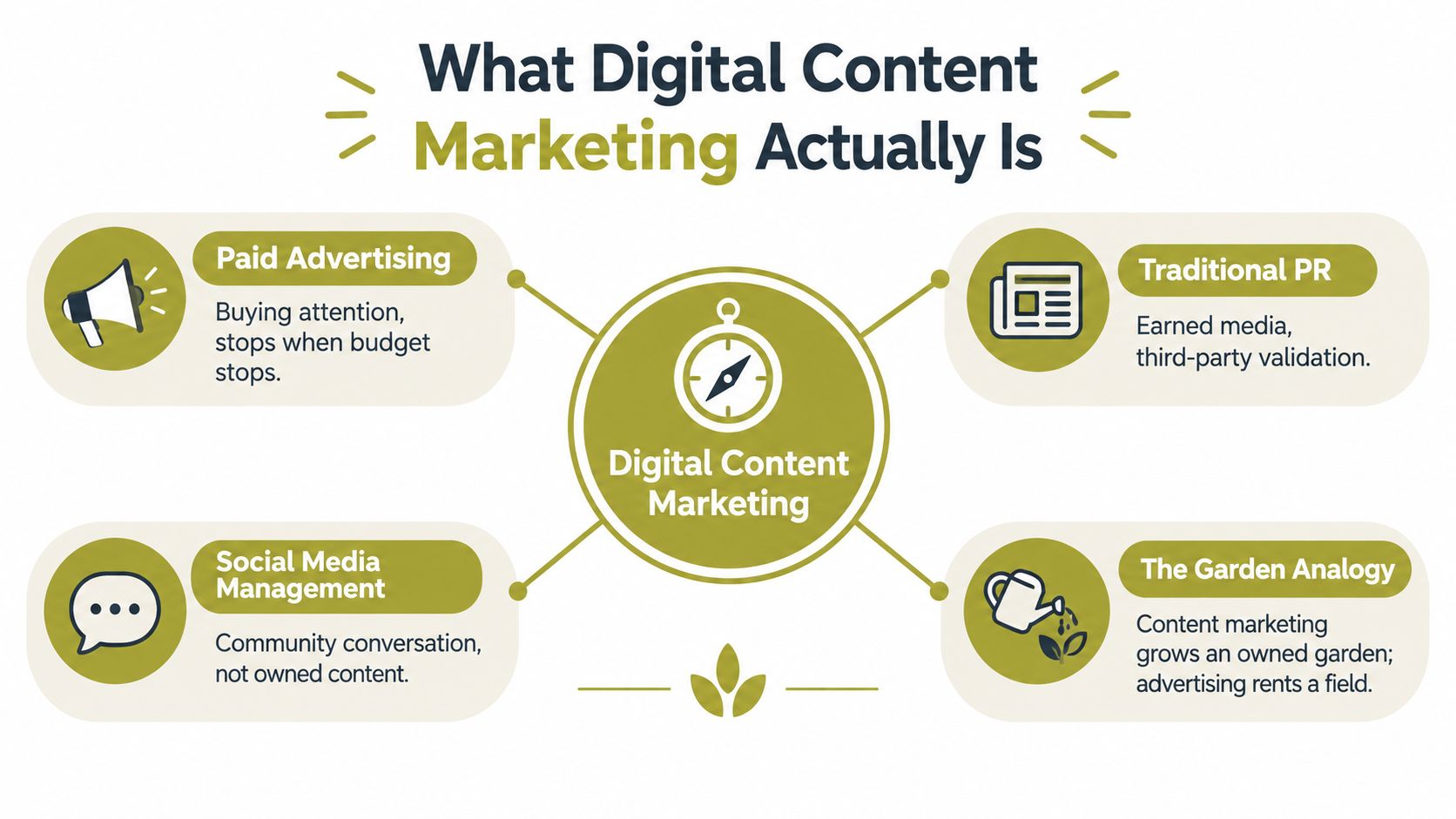
Think of it as gardening versus renting a field. Advertising rents attention for a season. Content grows an owned garden that keeps producing, provided someone tends it. The definition you can repeat to colleagues is simple. Content marketing creates the useful, credible material your whole marketing mix depends on. Everything else distributes it.
Core Channels and Content Formats That Drive Results
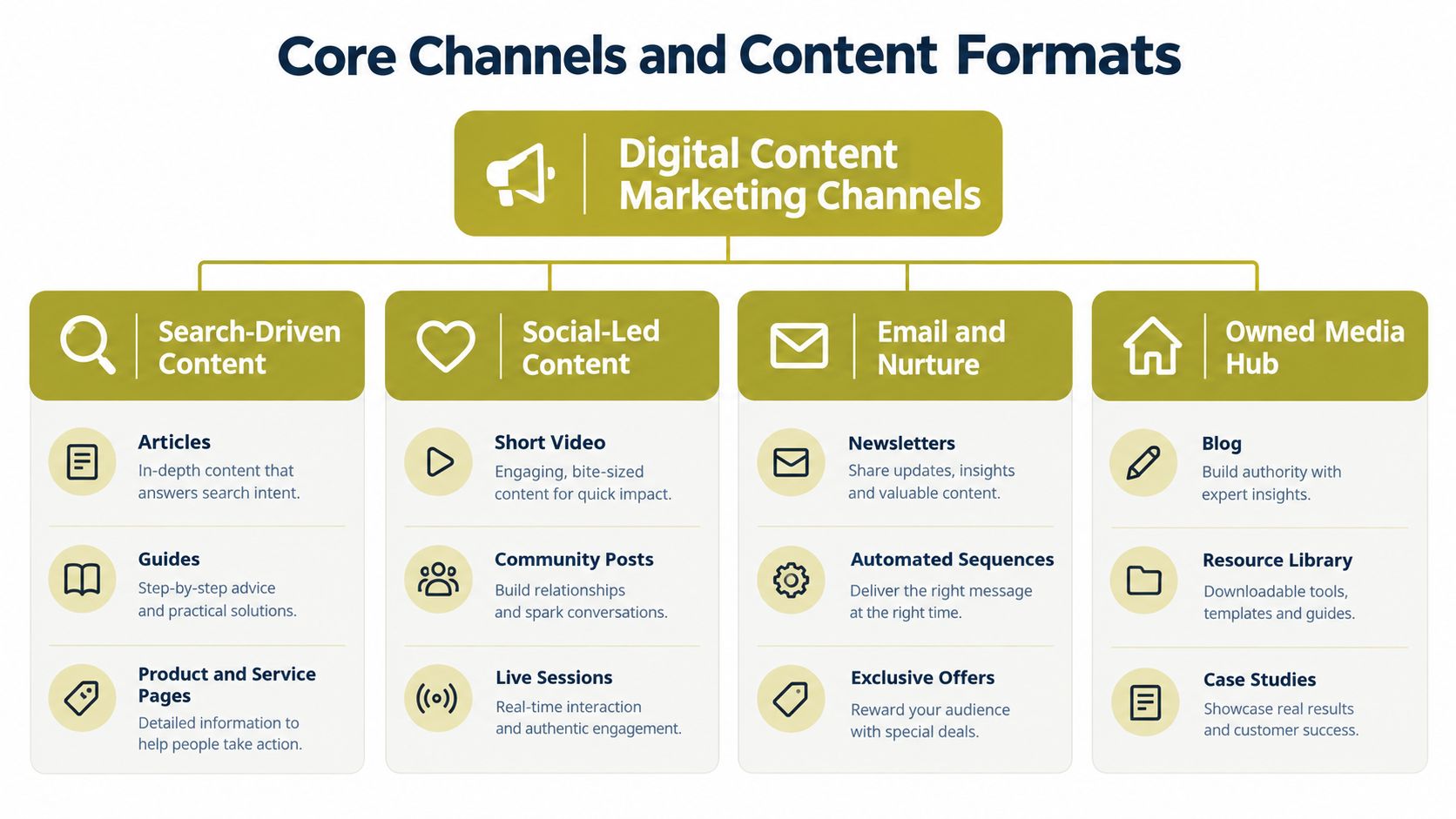
Four channel families cover most of what a UK SME needs. The mistake is treating them as a checklist rather than assigning each one a commercial job.
Search driven and social led content
Search driven content captures intent. Articles, guides, and product or service pages answer questions people are already asking, so the audience arrives motivated. Production effort is front loaded, but a strong guide keeps working without daily feeding.
Social led content builds familiarity. Short video, community posts, stories, and considered replies keep you present between searches, and a worked example of content marketing on social media shows how platform native formats differ from repurposed blog links. Social demands consistency and speed, so it's the family most likely to exhaust a small team.
That pressure is structural, not personal. Ofcom's Communications Market Report 2025 records average monthly data consumption per fixed broadband connection at 531 GB in 2024, confirming that UK audiences are continuously online across devices and that content must be designed for the platform and moment of encounter, as set out in Ofcom's Communications Market Report 2025.
The short video below is worth watching for how format shapes attention before a message even lands.
Owned and earned media
Owned media converts trust into action. Newsletters, podcasts, resource libraries, and microsites speak to people who've already opted in, so depth beats novelty. Earned media borrows credibility. Journalism grade stories, expert commentary, and well evidenced case studies persuade because a third party chose to run them.
Prioritise by goal, not fashion. Need enquiries now, strengthen search and service pages. Need recognition in a new market, invest in earned stories. Need repeat business, build the newsletter. A limited team running two families well will outperform one spreading itself across all four.
Planning a Strategy That Actually Fits Your Business
Strategy isn't a stack of frameworks. It's one flow, run in order, revisited quarterly.

Start with audience and belief
First, name who you're writing for and what they need to believe before they choose you. Not a demographic sketch, a belief. A new client considering an SME supplier needs proof you won't disappear mid project. A visitor weighing up a tourism booking needs to feel the experience is worth the travel, not just see a room rate. A regulated organisation's audience needs evidence that claims have been checked and approved.
Write that belief down. Every piece you publish should move a reader towards it, or it doesn't belong in the plan.
Set the messaging hierarchy
Second, agree the one core claim that must land everywhere. Supporting points sit beneath it, proof sits beneath them. This hierarchy is what stops your homepage, LinkedIn posts, and pitch commentary from telling three different stories.
If you're exploring how automation fits into that planning layer, this AI-powered content marketing strategy guide is a useful reference for structuring custom content workflows without losing the human decisions underneath.
Choose formats and plan distribution together
Third, pick formats based on message and audience, not trend. A complex, high consideration service needs a detailed guide and a named expert on video, not a stream of short clips. A visual, experience led brand needs the opposite balance.
Fourth, plan distribution at the same time as creation:
- Owned first: Publish on your site and newsletter, where you control the full context.
- Earned second: Pitch the strongest angle to journalists or partners while it's still fresh.
- Paid last: Amplify what already earns attention organically, rather than boosting untested material.
A plan that names the audience, the belief, the core claim, and the distribution route fits on one page. If yours runs to thirty, the decisions probably haven't been made yet.
Run that sequence every quarter. It's enough structure for a small team, and it forces the editorial choices that calendars alone never will.
SEO, UX and AI Discoverability as One Evidence System
SEO, UX, and AI discoverability aren't three disciplines. They're one evidence system viewed from three angles, and treating them separately is how brands end up visible but not believed.
On page SEO still matters because search engines need crawlable, clearly structured content to understand what you offer. UX matters because a reader who can't find the answer, the price indication, or the contact route won't convert, however well you rank. AI discoverability matters because generative tools summarise sources they can interpret and attribute, which favours clear, verifiable material. A practical SEO content creation approach and the UX SEO guide from SemDash both point to the same conclusion. Clarity for humans and clarity for machines are now the same work.
Why verification changes the goal
Deloitte's 2026 UK Digital Consumer Trends research found that 63% of UK consumers had used a generative AI application by May 2026, while 79% of AI users still checked other sources and only 4% would buy without verification, according to Deloitte's UK Digital Consumer Trends research. Read that carefully. AI can introduce your brand, but buyers then go looking for proof. If your site offers thin service pages and anonymous claims, AI visibility becomes a leaky funnel.
So design the AI to proof journey. A concise answer gets you cited. The page behind it must then supply named experts, original data, transparent claims, independent reviews, and an easy route to a human.
| Evidence element | Trust job for readers | Trust job for AI |
|---|---|---|
| Named experts | Shows accountable human expertise | Gives a clear, attributable source |
| Original data | Offers something competitors can't copy | Provides citable, distinctive facts |
| Clear service pages | Confirms what you actually do | Helps accurate summarisation |
| Independent reviews | Supplies third party reassurance | Corroborates your own claims |
The contrarian point is worth stating plainly. AI discovery increases the need for strong owned and earned content. It doesn't replace your website, your PR, or your reviews. It sends cautious buyers to check all three.
Sector Examples From Tourism, Hospitality and Regulated Industries
The same editorial framework flexes very differently depending on what the reader risks by choosing you. Three sectors show the range.
Tourism and the visitor economy
A tourism brand sells an experience nobody can test in advance, so content carries the proof. Destination guides written with genuine local knowledge capture search intent months before a trip. Seasonal stories, what's on, what's changed, what locals do, give journalists and visitors a reason to care now rather than someday.
The trade off is effort. A thin list of attractions copied from every competitor earns nothing. First hand detail, named local voices, and honest guidance on weather, access, and timing build the trust that turns research into a booking.
Hospitality and lifestyle brands
Hospitality brands live on visual platforms, but imagery alone doesn't convert. Behind the scenes features, the chef's sourcing decisions, the restoration of a building, the team behind the service, turn a attractive feed into a story people remember when they choose where to stay or eat.
Here the editorial job is restraint. Every post shouting an offer trains followers to wait for discounts. Brand storytelling that shows craft and character supports premium pricing instead, and gives PR something substantive to pitch beyond a launch date.
Regulated and high risk sectors
In regulated industries, the audience widens. Customers read your content, but so do regulators, investors, and journalists, and each group checks claims differently. Tightly reviewed copy, named accountable experts, and transparent sourcing aren't bureaucratic overhead. They're the basis of trust.
The temptation is to publish nothing for fear of error. That silence creates its own risk, because critics and competitors fill the gap. The workable middle ground is fewer pieces, checked harder, with a clear approval trail and a named human prepared to stand behind them.
Sector test: Ask what your reader stands to lose if they believe you and you're wrong. The higher that cost, the more proof your content must carry.
Tourism asks for imagination backed by detail. Hospitality asks for story over promotion. Regulated sectors ask for evidence over volume. The framework holds. The proof point changes.
Measurement, KPIs and Reputation-Ready Content
Measurement fails SMEs in two opposite ways. Some teams track nothing beyond follower counts. Others build dashboards so dense that nobody acts on them. You need two layers, reviewed at different speeds.
Leading and lagging indicators
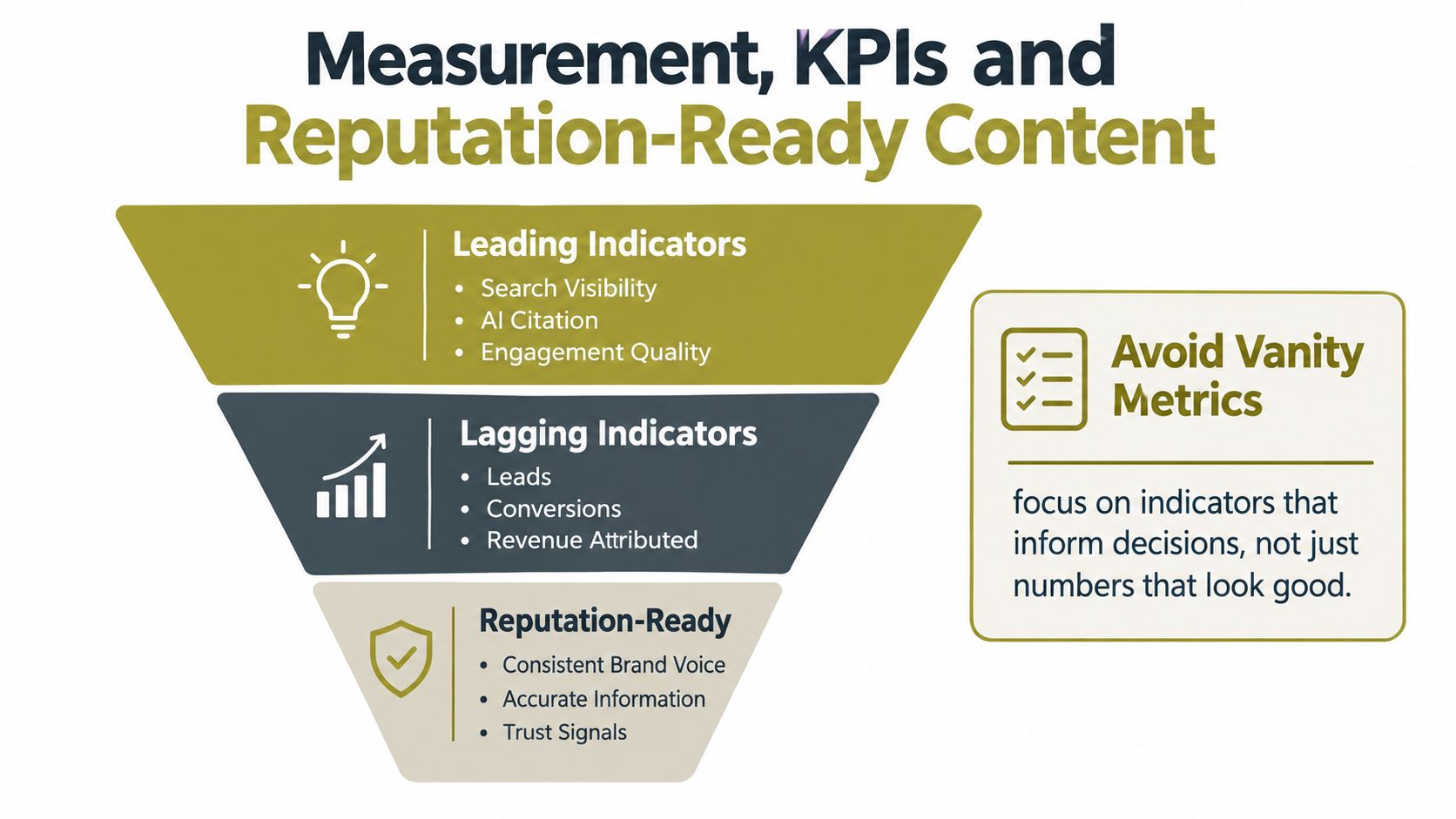
Leading indicators tell you whether the content is working before money moves. Search visibility, AI citation, engagement quality, and share of voice all sit here. Lagging indicators confirm commercial value, enquiries, pipeline contribution, and conversions. A detailed view of content marketing for lead generation helps connect the two, and Taja AI's practical ROI guide offers a structured way to think about attributing return without pretending every click is measurable.
Review channels weekly for leading signals. Review the narrative monthly, asking whether the body of content still supports your core claim, or whether it's drifted into whatever performed last Tuesday.
Measurement as an early warning system
Performance is only half the job. The Reuters Institute's 2025 Digital News Report shows UK trust in news declined by 16 percentage points between 2015 and 2025, with audiences identifying impartiality, evidence based reporting, and avoidance of sensational language as central expectations, as documented in the Reuters Institute's 2025 Digital News Report executive summary. In that climate, your measurement loop should also catch risk, an outdated claim still ranking, a review theme turning negative, a social reply that contradicts your published position.
For regulated organisations especially, treat content as reputation ready infrastructure. Accurate, consistent, well sourced material published in calm times is what journalists and customers find first when something goes wrong. You can't build that record during a crisis.
Measure to decide, not to decorate a report. If a metric wouldn't change what you publish next month, drop it.
The SME Checklist and What to Do Next
Four moves this quarter will do more than a year of unfocused publishing.
Your quarterly checklist
- Clarify audience and core claim: Write down who must believe what, and the single claim every piece supports. Share it with anyone who writes, films, or posts for you.
- Audit for editorial quality: Read your ten most visited pages as a sceptical buyer. Cut unsupported claims, fix anonymous authorship, and retire pieces that no longer reflect what you sell.
- Build the evidence system: Add named experts, verifiable sources, original detail, and independent reviews to the pages closest to enquiry or purchase.
- Set the measurement cadence: Weekly channel checks, monthly narrative and reputation review, with one owner accountable for acting on what's found.
The skills underneath that checklist are editorial, not technical. A Reuters Institute and University of Oxford survey of 1,130 UK journalists found 71% considered countering disinformation very or extremely important, while 65% gave the same rating to shining a light on society's problems, as reported in Index on Censorship's summary of the Reuters Institute survey. Assessing claims, spotting misleading material, and communicating responsibly under scrutiny are exactly the capabilities a trust scarce market now demands from brands.
That's why capability matters more than tools. At Carlos Alba Media, everyone who works for the business is a former national news journalist or has agency experience of working with international brands, which is one model of how an SME can access that judgement without hiring a full in house desk. Whether you build it internally or bring it in, invest first in the ability to decide what's worth saying and prove it. Formats, platforms, and algorithms will keep shifting. Editorial discipline is the asset that holds the whole programme up.
If your content is busy but isn't converting, Carlos Alba Media can audit what you're publishing, sharpen the core claim behind it, and build the evidence led content, PR, and digital campaigns that help UK customers choose you with confidence. Visit Carlos Alba Media to start a conversation about what your brand should say next, and how to prove it.