
You've published the guide, shared it on LinkedIn and spent money on a few Google Ads experiments. The analytics dashboard shows more sessions, but enquiries haven't moved. Your team is now asking for another blog post, even though nobody can explain which existing pages attract the right people or where mobile visitors abandon the journey.
That's the wrong starting point. Website traffic is useful only when it reaches commercially relevant pages, creates qualified actions and contributes to revenue. For a UK SME, improving traffic is a sequencing problem, not a publishing problem. Fix measurement, mobile performance and conversion friction before adding more content. Then use search, email, partnerships and earned media to distribute evidence-led pages.
Why Most SME Traffic Plans Stall Before They Start
Most SME traffic plans stall because the business treats visits as the outcome. A founder sees a spike from a social post and assumes the strategy worked, while the sales team sees no change in calls, bookings or qualified enquiries. The gap is usually not a lack of activity. It's a failure to connect acquisition with intent and conversion.
Search still deserves serious attention. Ofcom's 2025 Online Nation measurement found that 82% of UK online adults used Google Search in May 2025, equivalent to approximately 3 billion UK web searches per month (Ofcom-derived UK search figures). That reach makes Google important, but it doesn't make every visit valuable. A visitor looking for a definition is not equivalent to someone comparing suppliers in Glasgow or requesting a quote in Edinburgh.
Commercial rule: Don't ask whether traffic increased until you know whether qualified demand increased.
The first 90 days should follow a strict order:
- Measure the current position. Establish UK non-brand clicks, landing pages, device performance, enquiries and revenue contribution.
- Remove technical friction. Improve mobile loading, navigation, forms, accessibility and crawlability.
- Improve pages that already have demand. Rewrite high-impression, low-click pages before commissioning a new content library.
- Build distribution. Combine search with email, partnerships and earned media.
- Scale only what produces qualified action. Stop funding channels that create attention without pipeline.
That sequence also changes how you approach authority. A useful industry directory can support discovery and provide a relevant citation opportunity, but it shouldn't replace editorial relevance or customer proof. If you're assessing options, this guide to find quality directory backlinks offers a practical reference point.
The central question is simple: which intervention is most likely to create a better commercial result with the time and budget available? Answer that before you publish anything else.
Build Your Measurement Baseline Before You Touch Anything Else
You can't prove traffic growth if you haven't recorded the starting point. A redesign, PR campaign or search algorithm change can alter performance, but without a baseline you'll be left arguing over screenshots and isolated weeks.
Start by exporting 12 months of Google Search Console data by query, landing page, device and country. The recommended approach is to group queries by intent, prioritise pages where UK impressions are high but clicks are weak, and measure non-brand clicks, qualified organic sessions and lead conversion separately in GA4 (practical UK SEO measurement methodology).
Create one defensible dashboard
Your first dashboard doesn't need dozens of metrics. It needs a small set that a founder, marketer and sales lead interpret in the same way.
- UK non-brand clicks: Shows whether new demand is finding you, rather than existing customers searching for your name.
- Qualified organic sessions: Filters out visits that never reach a meaningful service, product or contact page.
- Landing-page engagement: Reveals whether the page answers the query that brought the visitor.
- Lead actions: Track form starts, completed enquiries, telephone clicks, bookings or purchases separately.
- Revenue contribution: Connect closed business to the original landing page and channel wherever your data allows.
Add annotations for campaign launches, website releases, major PR coverage and seasonal events. A sudden increase in sessions may reflect a news mention or a branded search surge rather than a sustainable improvement in search visibility.
Group demand by intent
Classify queries as informational, commercial investigation or transactional. “How does crisis communications work?” is informational. “PR agency Glasgow” signals commercial investigation. “Book media training Scotland” is closer to a transaction.
Then sort pages by the relationship between impressions and clicks. High impressions with weak clicks usually indicate a title, description or intent mismatch. Strong clicks with weak conversion often point to an unclear next step, poor evidence or a broken mobile journey.
Use performance benchmarking to keep comparisons focused on meaningful commercial performance rather than raw session volume. Review the baseline weekly, but make strategic decisions at longer intervals so normal fluctuations don't trigger unnecessary changes.
Fix Mobile Performance and Technical Foundations
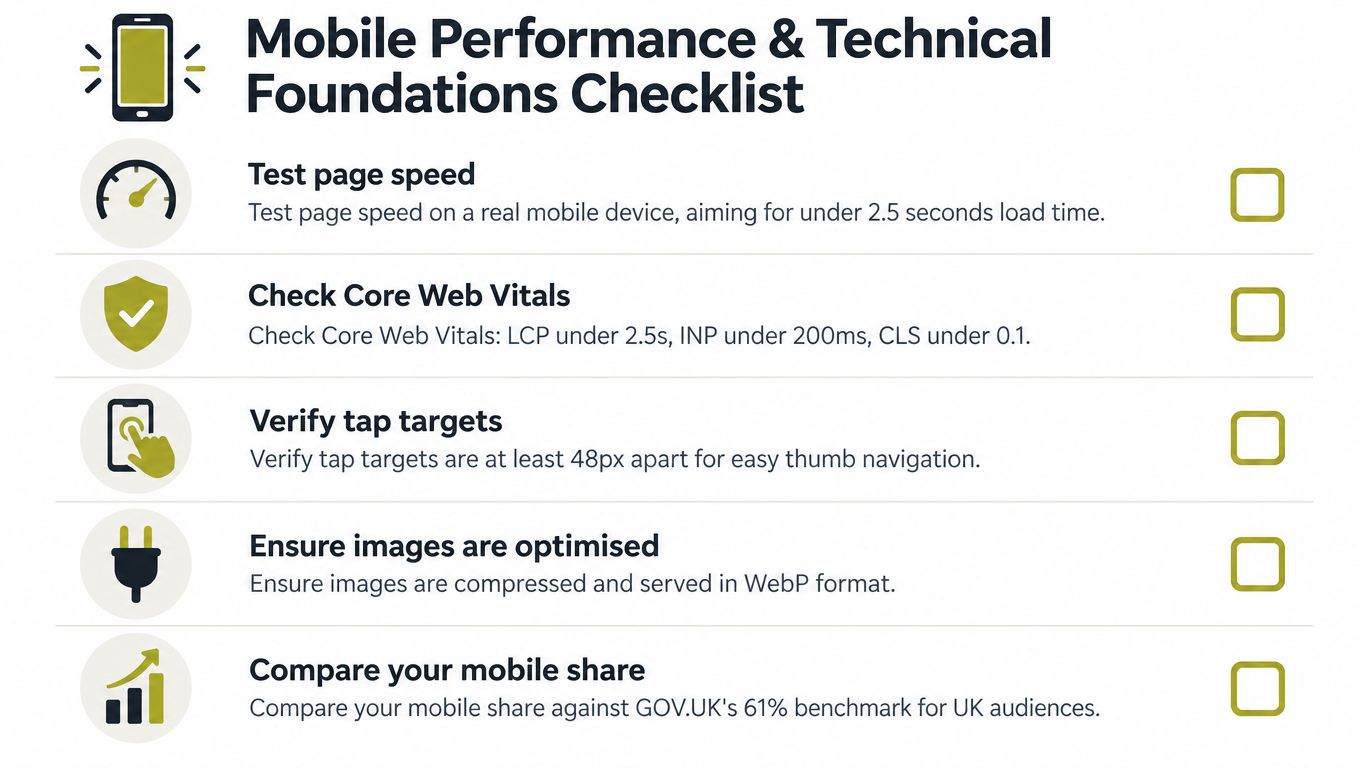
Mobile performance is the floor beneath every traffic strategy. GOV.UK recorded 61% of visits from mobile browsers during 2025, compared with 38% from desktop systems, while external search engines generated around two-thirds of visits (GOV.UK mobile and search traffic data). GOV.UK is a public-service site rather than a commercial benchmark, but its scale makes the direction of UK behaviour impossible to ignore.
Test representative pages on a mid-range phone over throttled 4G. Don't rely solely on a high Lighthouse score from a fast office laptop. Check whether a real visitor can see the main answer, open the menu, dismiss cookie controls, complete a form and tap a telephone number without fighting the interface.
Set practical release gates
Use Core Web Vitals as release criteria, not as a decorative report. The target thresholds are LCP no more than 2.5 seconds, INP no more than 200 milliseconds and CLS no more than 0.1.
| Metric | Good threshold | What to verify on real UK devices | Common SME cause |
|---|---|---|---|
| LCP | No more than 2.5 seconds | Main heading and hero content appear quickly | Oversized hero images |
| INP | No more than 200 milliseconds | Menus, forms and buttons respond promptly | Heavy scripts and third-party tags |
| CLS | No more than 0.1 | Content doesn't jump while loading | Unreserved image or advert space |
Compress hero images, serve modern formats, reserve media dimensions and defer non-critical JavaScript. Remove unused tracking tags where they add no measurement value. Then test navigation, forms, cookie controls and tap-to-call actions with one hand.
Make technical clarity support search
Validate relevant structured data for Article, Organisation, LocalBusiness, Event or FAQ content. Markup should describe visible, accurate content. It won't rescue a thin page or misleading claim.
Track each release against mobile organic landing-page engagement, form-start rate, completed enquiries, crawl errors and index coverage. A page that loads quickly but gives visitors no concise answer is still a poor acquisition page. For a deeper explanation of the underlying mechanics, review what web performance means for a business site.
Redesign SEO for AI Answers and Zero-Click Discovery
Search optimisation can no longer focus only on winning a blue link. Ofcom's 2025 findings indicate that roughly 30% of UK keyword searches produce AI-generated summaries, while 53% of UK adults say they often see them. ChatGPT recorded 1.8 billion UK visits between January and August 2025 (UK AI search data and implications).
That doesn't make SEO irrelevant. It changes the job. Your pages must provide enough clarity, evidence and distinct expertise to be useful in search results, answer engines and the human evaluation that follows.
Optimise the ten pages closest to revenue
Audit your ten most commercially important pages before commissioning new articles. For each page, ask:
- Does the title reflect the actual UK search intent?
- Does the opening paragraph answer the main question directly?
- Are the headings written around customer problems rather than internal service categories?
- Does the page show named expertise, relevant credentials and trustworthy contact details?
- Is there original evidence, local knowledge or a clear point of view that a generic summary can't reproduce?
- Does the next action match the visitor's stage of consideration?
Use local terminology only when it reflects a genuine offer. A tourism business may need distinct pages for Scotland, Glasgow or Edinburgh if the experience, proof and customer need differ. Creating near-duplicate location pages to capture place names usually produces weak engagement and little organic value.
Here's the strategic distinction: an AI-generated summary may reduce the immediate click while increasing recognition of your brand. That impression matters only if you measure what follows. Track branded searches, referral sessions, enquiries, assisted conversions and revenue alongside non-brand clicks. A zero-click appearance is not automatically a failure, but an unmeasured appearance is not a strategy.
Write for citation and conversion
Use concise definitions, clear subheadings, comparison tables, FAQs and evidence that can be understood without surrounding context. Add author credentials where expertise affects trust. Cite original research, explain methodology and show how your recommendation applies to a specific UK audience.
Don't chase every AI mention. Prioritise pages that support a real commercial decision, such as a service page, regulated-sector guide, local buying guide or specialist B2B resource. The objective is not to make a machine repeat your brand. It's to become the source a buyer remembers and investigates.
Earned Media as a Traffic Multiplier Most SMEs Overlook
Most SME traffic plans treat earned media as a branding exercise. That's a mistake. A relevant broadcast segment, national article or specialist publication can deliver referral traffic, branded search, social proof and a credible backlink from one piece of coverage.
Trust is the reason the newsroom angle matters. The Reuters Institute's 2025 Digital News Report found that only 40% of people across 47 markets trusted most news most of the time, while UK trust in news was 16 percentage points lower in 2025 than in 2015 (Reuters Institute findings on news trust). That environment makes verification, relevance and transparent sourcing more important, not less.
Pitch a story, not a company description
A journalist rarely needs another announcement about your service. They may need a credible response to a public issue, a useful local example, a founder with unusual expertise or evidence that explains a developing story.
Build a short list of relevant journalists and outlets. Then prepare a one-page news angle containing:
- The public interest: Why should anyone outside your business care?
- The evidence: What can you verify, show or explain?
- The human consequence: Who experiences the issue?
- The spokesperson: Who can answer clearly on deadline?
- The asset: Can you provide data, images, case material or access?
Carlos Alba Media's specialist nature is relevant here because everyone who works for the agency is either a former national news journalist or has agency experience working with international brands. Former newsroom practitioners understand editorial standards, verification expectations and audience sensitivities. That's a concrete advantage when a pitch needs to survive a busy news desk rather than merely sound attractive in a marketing meeting.
Use PR campaign planning to structure the angle, target list, assets and follow-up. Once coverage lands, repurpose it into a founder post, customer email, sales-deck proof point, website newsroom entry, short video, podcast topic, internal briefing, partner update and paid retargeting asset. Distribution works harder when every format points to a relevant page.
Outreach rule: Lead with the consequence for the audience, then establish why your client can explain it.
LinkedIn can support the amplification stage, especially when executives need a more deliberate engagement process. A practical LinkedIn engagement platform overview can help clarify the difference between authentic distribution and indiscriminate activity. Don't confuse more reactions with more authority. Use the platform to put credible coverage in front of relevant buyers, partners and journalists.
Choosing the Right Paid, Email and Partnership Channels
Once measurement, mobile performance and core pages are working, choose channels according to intent and effort. Don't fund Google Ads, paid social, email and partnerships simultaneously just because each channel has a case study attached to it.
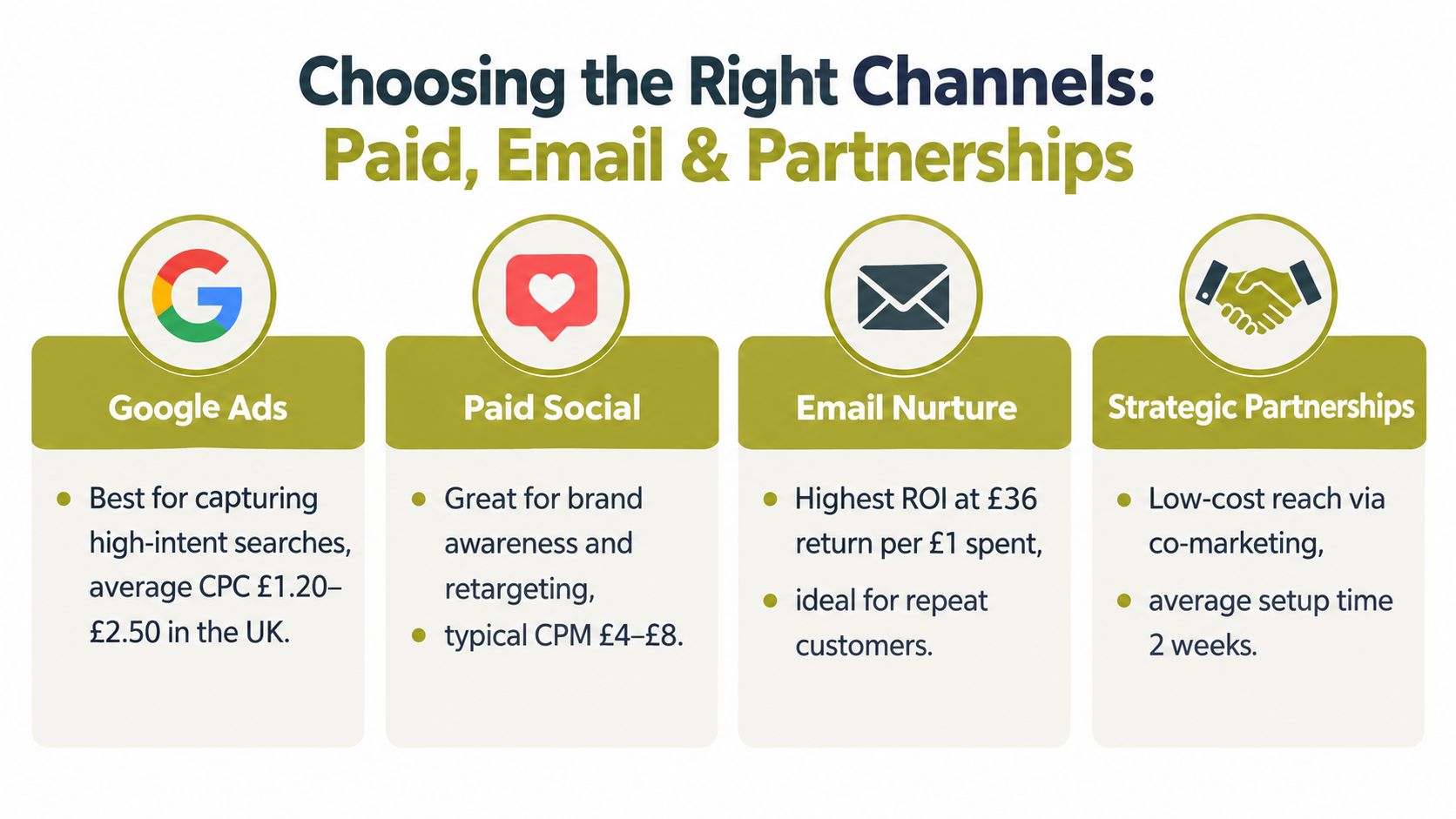
Google Ads earns priority when buyers actively search for a service and you can route them to a focused landing page. It provides speed and intent, but it can expose weak conversion journeys quickly. Paid social suits awareness, retargeting and visual offers, but cold audiences often need more education before they enquire.
Email is strongest when you already have permission and a useful reason to return. A small list of relevant prospects, customers or partners can outperform a larger cold audience because the relationship already exists. Partnerships with complementary SMEs, trade bodies or industry publications trade access rather than buying it. They take coordination, but can create referral traffic, shared content and introductions.
Use a simple channel score
Score each option against four questions:
- Does the channel reach people with a current need?
- Can you measure qualified actions rather than reach alone?
- Can the team produce the required creative and follow-up?
- Is the landing page ready for the traffic?
Choose the top two. Run them for 28 days with a defined budget, audience, offer and stop-loss rule. Pause a channel if it creates visits without meaningful engagement or qualified action. Don't increase spend because impressions look healthy.
The Reuters Institute's UK panel analysis found that television news had a reciprocal relationship with trust, while general news use and social-media use were not associated with growing trust in the same way (Reuters Institute UK media-use research). That doesn't make social media worthless. It means channel selection should reflect the trust required by the purchase. High-risk, regulated and specialist services often need credible third-party context before paid clicks convert.
Your 90-Day Action Plan, KPIs and Pitfalls to Avoid
A useful 90-day plan is not a promise of a specific traffic increase. It's a controlled sequence that tells you what to fix, what to test and what to stop.
Weeks one to two
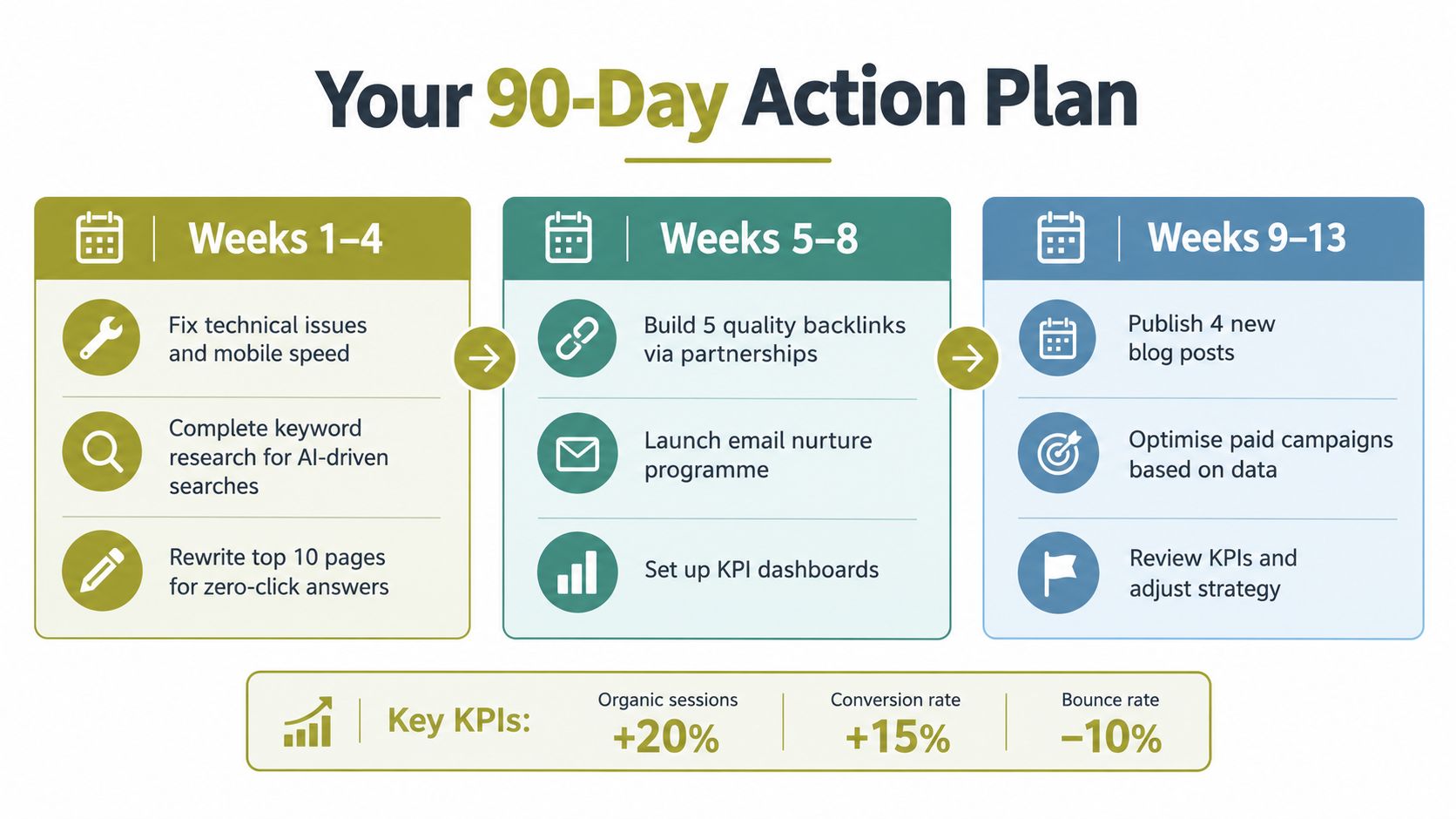
Export the Search Console baseline and segment GA4 by UK, device, intent and non-brand traffic. Record landing-page engagement, form starts, completed enquiries and revenue contribution. Annotate recent campaigns and notable coverage.
Test the highest-value pages on a real mobile device. Fix oversized images, layout shifts, slow scripts, broken menus, unusable forms and unclear calls to action. Map your priority queries to existing pages, then identify pages with high impressions and weak clicks.
Weeks three to six
Rewrite the top commercial pages around actual search intent. Add concise answers, relevant headings, author or organisation credentials, internal links, FAQs and evidence. Validate appropriate structured data and check that every important page has a clear next action.
Begin earned media outreach with a small, relevant list. Pitch a verifiable public-interest angle rather than a product announcement. Keep a record of journalist responses, coverage, referral sessions, branded searches and enquiries. Use a specialist local marketing resource such as Affiliate Landscape's local marketing guide when regional relevance and partnership distribution need more structure.
Weeks seven to twelve
Run the two best channel tests against the 28-day decision rule. Consider retargeting before broad prospecting if your site already receives relevant visitors. Build a focused email sequence for people who have opted in. Approach complementary organisations with a specific co-marketing idea, such as a briefing, webinar, guide or event.
By the final weeks, retire activities that produce vanity traffic and strengthen the pages and channels tied to qualified demand. Report four separate outcomes:
- UK non-brand clicks: Are new people discovering the business?
- Branded search activity: Is recognition increasing after content or coverage?
- Qualified enquiries: Are the right visitors taking action?
- Revenue: Is the programme affecting commercial results?
Avoid mass-produced location pages, publishing without intent mapping, ignoring AI summaries and reporting total sessions as the main success metric. A newsroom-led specialist can also help sharpen the evidence and distribution process. Reuters Institute research reported that 56% of UK journalist respondents used artificial intelligence professionally at least once a week (Reuters Institute research on journalism and AI). Newsrooms are changing, so effective outreach requires people who understand both editorial judgement and modern production workflows.
Sustained traffic comes from compounding evidence. Improve the page, earn the mention, measure the qualified action and reinvest where the business sees a return. Publishing more is only one possible output, and it should come after the foundations are sound.
Carlos Alba Media combines SEO, performance-led web work, digital content, social distribution and newsroom-informed PR to help UK organisations attract and convert the right visitors. Visit Carlos Alba Media to discuss a traffic plan built around qualified demand, credible coverage and measurable commercial outcomes.