
PR is harder to measure than it is to launch. Ninety-seven per cent of UK and Ireland communications professionals say they struggle to measure PR effectiveness, at an average annual cost of £80,000, with many teams still reporting coverage, traffic and engagement instead of leads, behaviour change or ROI (UK and Ireland communications measurement research). That gap explains why sending a press release and counting mentions rarely amounts to a strategy.
Effective PR connects a credible story, a relevant audience, an editorially useful angle and a route to business impact. Carlos Alba Media brings a specialist perspective to that connection. Everyone who works for the agency is either a former national news journalist or has agency experience working with international brands, so its approach combines newsroom judgement with commercial execution (Carlos Alba Media's public relations and marketing team).
The following PR strategy examples focus on repeatable methods rather than famous headline stunts. Each one considers the objective, tactical choices, trade-offs and practical measures that help an SME or start-up decide whether the work is producing authority, enquiries, trust or sales. For a broader look at how organisations build a coherent public-facing identity, see these messaging and visuals for advisors.
1. Newsroom-Led Media Relations
A strong media relations programme doesn't begin with a list of press releases. It begins with an understanding of what a journalist is trying to publish, what evidence is available and why the story matters to readers now.
Former national journalists bring useful editorial discipline to that process. Carlos Alba founded Carlos Alba Media in June 2010 after a 20-year career in national newspaper journalism, including senior roles at The Sunday Times such as Scotland Editor (Carlos Alba's background). That experience changes the question from “How do we get coverage?” to “What would make an editor assign this story?”
Hamilton & Inches, Scotia Homes and The Johnnie Walker Experience illustrate how different clients can earn attention through distinct angles. A heritage jeweller might offer authority on Scotland's luxury market, a property firm might comment on Scottish housing trends, while a tourism venue might contribute a cultural story rather than a promotional announcement.
The practical work includes:
- Map the beat: Identify journalists who already cover your market and study the issues they return to.
- Develop useful spokespeople: A credible commentator needs a point of view, evidence and the ability to explain complexity plainly.
- Time the approach: A genuine news hook will usually outperform an arbitrary company milestone.
- Offer editorial value: An exclusive interview, informed comment or original perspective gives a journalist a reason to prioritise your pitch.
- Build trust before asking: Briefing a journalist constructively, without forcing a sales message, creates a stronger relationship than repeated cold approaches.
The trade-off is patience. Media relationships don't remove the need for newsworthiness, and a familiar contact won't publish a weak story. The method works because it aligns the client's expertise with a newsroom's actual needs. Learn more about what media relations involves.
2. Narrative Development for SMEs and Start-ups
Many founders can explain what their company sells but struggle to explain why anyone outside the business should care. A narrative gives the business a reason to enter a wider conversation.
The best stories aren't manufactured from corporate language. A technology start-up may have identified a problem through the founder's own experience. A Scottish heritage brand may have a genuine connection to craft, place or continuity. A social enterprise may need to show how its social purpose supports a viable commercial model rather than treating the two as separate claims.
Journalists test narratives quickly. They look for a human consequence, a meaningful tension, a change in the market or a clear reason the story belongs in their publication. Customers and investors make similar judgements, although they may use different language to describe them.
Practical rule: Don't claim that your business is better until you can explain precisely how it is different, for whom and in what situation.
A useful narrative should survive across channels. It should inform the company description, founder interviews, website copy, social content, investor conversations and crisis responses. That doesn't mean repeating one slogan everywhere. It means preserving the same underlying explanation of the business while adapting the emphasis to the audience.
Start with evidence rather than aspiration. Ask the founder what they saw, experienced or understood that led to the business. Ask customers what changed for them. Ask journalists whether the proposed angle sounds like a story or an advert. If the answer is unclear, refine the narrative before investing heavily in a new identity or website.
The trade-off is honesty. An authentic story can expose limitations or difficult beginnings, but that candour usually creates more credibility than an inflated claim. Revisit the narrative as the business develops, because a start-up's original purpose may not fully explain its later market position.
3. Senior Executive Visibility
A founder or chief executive can become a valuable media asset, but only when their visibility is built around genuine expertise. Journalists need informed sources who can explain an issue, challenge a prevailing assumption or clarify what a development means for ordinary people and businesses.
Carlos Alba Media's founder held senior roles including Chief Reporter of the Edinburgh Evening News, Education Correspondent of The Herald, Scottish Political Editor of the Daily Record, and Deputy Editor then Editor of The Sunday Times Scotland (Carlos Alba's named journalism roles). That newsroom background is relevant because editors don't want executives who just repeat company messaging. They want people who can offer clear, quotable judgement.
A Scottish technology chief executive might comment on a sector development in trade media and broadcast interviews. A founder seeking investment might establish expertise around the market problem rather than pitching the company in every appearance. A professional services leader might explain regulatory change in a way that helps clients make decisions.
The work starts with an expertise audit. Identify the subjects the executive can discuss from experience, then select publications and programmes that their customers, investors or partners follow. Media training should come before a major interview, not after an uncomfortable appearance.
Visibility also needs continuity. Earned coverage creates attention, but a neglected LinkedIn profile, an empty company newsroom or inconsistent commentary can make the exposure feel temporary. Prepare useful bylines, short responses to developing news and supporting evidence that allows the executive to contribute without improvising beyond their knowledge.
The main trade-off is personal exposure. A visible executive becomes associated with the organisation's claims and conduct, which raises the value of consistency and the risk of careless comments. Positioning only within authentic areas of expertise protects credibility and gives journalists a reason to return.
4. Broadcast and Interview Training
Written coverage gives a spokesperson time to refine an answer. Broadcast rarely does. A confident interview depends on preparation, vocal control, concise language and the ability to answer the question while returning to the point that matters.
Training is particularly useful for founders appearing on business programmes, healthcare leaders discussing sensitive issues, and hospitality operators responding to a disruption or expansion. The preparation should reflect the specific format. A radio interview tests pace and clarity. Television adds posture, eye-line, facial expression and the risk that a short answer will be edited.
A practical session should include difficult questions, interruptions, hostile framing and requests for evidence. The trainer should also test whether the spokesperson can explain specialist language without sounding evasive. Recording the mock interview is valuable because people often notice habits on playback that they can't feel while speaking.
Good preparation doesn't produce a robotic performance. It gives the spokesperson enough control to sound natural under pressure. Prepare a small set of core messages, then build several routes back to them rather than memorising a script.
The sequence matters:
- Prepare the facts: Confirm what is known, what remains uncertain and what the organisation can responsibly promise.
- Shape the answer: Lead with the point, support it with a relevant detail and stop before the answer becomes defensive.
- Handle the question: Acknowledge a fair concern instead of pretending it wasn't asked.
- Review the delivery: Look for jargon, rushed speech, weak posture and answers that bury the main message.
- Refresh the skill: Confidence fades when spokespeople never practise between interviews.
A journalist isn't only judging whether the spokesperson has information. They're judging whether the person can help the audience understand it.
The trade-off is that training may reveal uncomfortable weaknesses. That's useful before the live interview. It gives the organisation time to improve rather than discovering the problem in a national broadcast.
5. Integrated Digital and Earned Media Strategy
Earned media can create awareness, but awareness alone doesn't guarantee an enquiry. A reader who clicks through to a slow, unclear or irrelevant website may leave before the business has an opportunity to build trust.
The strongest PR and digital programmes coordinate the story before the pitch goes out. A tourism business might prepare a booking-focused landing page before a travel feature appears. A professional services firm might create a useful guide that gives readers a reason to contact the team. A hospitality operator might align the media message with availability, reservations and a clear next step.
Newsroom judgement and digital execution need to work together. The story must earn editorial attention, while the website, content and analytics must help the resulting audience take action. Carlos Alba Media describes this relationship through its owned, earned and paid media approach.
Practical coordination includes:
- Test the destination: Check mobile performance, forms, booking paths and tracking before outreach begins.
- Create a relevant landing page: Match the page to the promise made in the article instead of sending every visitor to the home page.
- Prepare amplification: Give the social team approved copy, visuals and timing so it can extend the coverage without copying it mechanically.
- Track the journey: Monitor referral traffic, engaged sessions, enquiries and the point at which media-driven visitors leave.
- Compare placements: A smaller specialist publication may produce more relevant enquiries than a larger outlet with a broad audience.
The trade-off is attribution. People may read a feature, return later through search and convert after another interaction. Last-click reporting can therefore undervalue PR. Use referral data alongside enquiry forms, assisted conversions, customer questions and qualitative feedback.
The objective isn't to turn every article into an advert. It's to ensure that the business is ready when earned attention arrives.
6. Tourism and Hospitality Storytelling
A tourism story has to give people a reason to travel, not merely announce that a room, restaurant or attraction exists. Former national journalists and agency practitioners start by identifying the business objective, then test whether the idea offers readers a useful, vivid experience.
The Johnnie Walker Experience could be framed through whisky culture, Scottish identity and the visitor journey. VisitScotland activity can connect destinations with broader stories about the Highlands, heritage or local communities. A boutique hotel might earn coverage through its architecture, owners, food, neighbourhood or role in the area. Each angle gives an editor a stronger reason to commission a feature than “come and visit us”.
Editorial judgement also shapes execution. Travel journalists work to planning cycles and need accurate information, strong photography, access to informed people and enough lead time. A concise media pack should provide practical facts, booking information, image permissions and a clear explanation of the proposed story.
The test is direct: will the reader learn, feel or discover something beyond the venue's existence? If the answer is no, refine the idea before pitching.
A booking-focused PR plan should connect the story to measurable business outcomes:
- Find the distinctive experience: Identify what visitors can only do, see, taste or understand through the business.
- Package the evidence: Make interviews, images, itineraries and verified details easy for journalists to use.
- Choose the right outlet: Match national, regional, specialist and broadcast opportunities to the visitors the business needs.
- Prepare for conversion: Check that booking links, availability and direct contact details work before publication.
- Measure meaningful action: Track bookings and enquiries associated with coverage, alongside the number of mentions.
The trade-off is editorial control. A journalist may emphasise a cultural or human angle rather than the preferred sales message. That independence supports credibility, provided the underlying facts are accurate. For a wider view of multi-day tour marketing strategies, apply the same principle: build a story that makes the experience easier to choose.
7. Reputation Management for Regulated Sectors
Financial services, legal, healthcare and property organisations cannot build trust through attractive language alone. Audiences want evidence of competence, responsible conduct and an understanding of the rules that govern the organisation's work.
Compliance communication often fails because it speaks only to insiders. A regulated firm may publish a technically correct update that customers cannot understand, or remain silent while competitors and critics define the issue. PR gives the organisation a chance to explain the change, its implications and the safeguards in place.
A financial services firm can demonstrate expertise by commenting on a regulatory development without turning the response into a product pitch. A legal practice can help journalists and clients understand a change in the law. A property business can explain planning decisions transparently, including constraints and likely effects on communities.
That requires close coordination between communications and compliance. Claims need checking. Spokespeople need boundaries. Internal teams need to know what has been said publicly so customers don't receive conflicting explanations.
Compliance should be communicated as evidence of responsible expertise, not hidden as a technical obligation.
The strongest regulated-sector strategies identify recurring questions before they become reputational issues. They prepare plain-English explanations, create relationships with specialist journalists and establish an approval process that is fast enough for a live news cycle.
The trade-off is speed versus precision. Legal review can protect the organisation, but a statement that arrives after the conversation has moved on may have little influence. Build approval routes in advance, and agree which facts and messages spokespeople can use without additional delay.
Proactive communication also helps. Organisations that explain difficult matters before criticism grows have more credibility than those that appear only when they need to defend themselves.
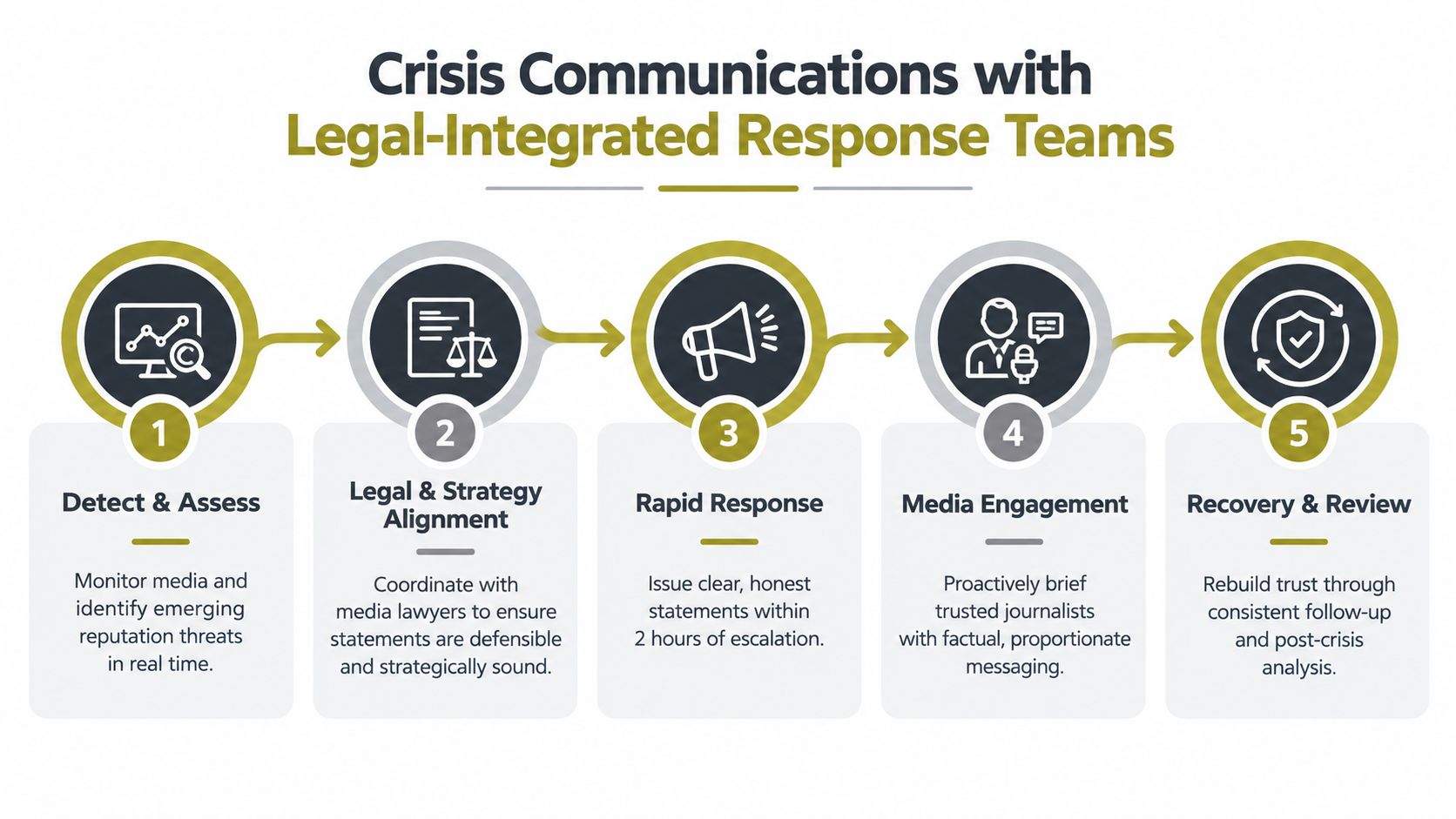
8. Crisis Communications with Legal-Integrated Response Teams
A crisis tests more than a statement. It tests the organisation's facts, decision-making, spokesperson, approval process and relationship with the media.
The Government Communication Service case study on Storm Christoph shows the scale that a coordinated response can reach. The team handled nearly 400 media enquiries and conducted 170 interviews in one week, demonstrating how a disciplined operation can maintain message consistency while responding at high volume (Storm Christoph crisis communications case study).
For a private organisation, the response should begin before the incident. Identify likely scenarios, assign decision-makers, prepare holding lines and establish who can approve factual updates. Then test the plan with a realistic exercise that includes difficult questions, incomplete information and legal concerns.
Carlos Alba Media offers legal crisis management in partnership with leading UK media lawyers. That combination matters because legal defensibility and editorial credibility aren't identical. A statement may avoid legal risk while sounding evasive, or sound candid while making an unsupported assertion.
Crisis teams should:
- Confirm the facts: Separate verified information from allegation, assumption and online speculation.
- Protect affected people: Put safety, customers and employees ahead of image management.
- Align counsel and media strategy: Don't issue a statement that lawyers and communications advisers have assessed separately.
- Use a credible spokesperson: Choose someone who can answer clearly and show appropriate accountability.
- Update consistently: Silence creates space for others to set the narrative, but unsupported updates create a second crisis.
The trade-off is transparency under uncertainty. You may not know everything immediately, but you can explain what you know, what you're checking and when you'll provide the next update. Journalists will scrutinise crisis claims closely, so accuracy is more valuable than false certainty.

For organisations considering the legal dimension of reputation risk, this strategy for cross-border disputes offers a useful reminder that communications planning must account for more than one audience or jurisdiction.
9. Tourism and Hospitality Storytelling That Converts
A tourism feature does not create bookings by itself. The commercial result depends on whether the business gives interested readers a clear, relevant next step after the story appears. Former journalists understand how editorial attention is won. Agency practitioners then examine whether that attention can produce direct bookings, enquiries, gift purchases, group visits or wider destination awareness.
Choose one primary outcome before developing the angle. Match the experience described in the article with the page, dates, package or enquiry route that supports it. A story about a two-day Highlands itinerary should lead to a page that explains that itinerary, not a generic home page with no obvious action.
A useful before-and-after scenario shows the difference. A boutique hotel in the Highlands saw a 12% lift in direct bookings after a regional feature because its landing page carried the exact itinerary described in the article. The same feature produced no measurable movement for a competitor that sent readers to a general home page. The editorial idea attracted attention, but the aligned destination page made the decision easier.
Keep the newsroom and commercial roles distinct. The journalist needs an experience, detail or point of view worth publishing. The business needs to make the resulting interest easy to act on without turning the article into a sales page.
Track performance with a practical system:
- Campaign-specific links: Create trackable paths for each publication, broadcast appearance or partner.
- Enquiry questions: Ask customers how they heard about the business, while allowing for more than one influence.
- Booking annotations: Record publication dates and compare them with relevant booking and enquiry changes.
- Content reuse: Adapt the earned story for email, social posts and website pages, retaining the facts and framing that made it credible.
- Post-campaign review: Separate the angle that gained attention from the page, offer or proof point that helped people decide.
Attribution will remain imperfect. A reader may discover the business during research, return on another device and book through a branded search or direct visit. Combine analytics with customer feedback and booking-system notes before judging the result.
Editorial coverage starts demand. Conversion design gives that demand somewhere useful to go.
9-Point PR Strategy Comparison
| Strategy | Implementation Complexity 🔄 | Resource & Time ⚡ | Expected Outcomes 📊 | Ideal Use Cases 💡 | Key Advantages ⭐ |
|---|---|---|---|---|---|
| Newsroom-Led Media Relations: Converting Editorial Contacts into Campaign Assets | Medium, relationship-driven pitching, editorial-timing focus 🔄 | Moderate, upfront relationship building; lower paid media spend ⚡ | High-quality earned coverage and editorial placements 📊 | Brands seeking authoritative press coverage and sector commentary 💡 | Strong editorial access and credibility (⭐⭐⭐) |
| Narrative Development for SMEs and Start-ups: Crafting Compelling Brand Stories | Low–Medium, workshop and research-led process 🔄 | Moderate, discovery interviews and testing; iterative ⚡ | Clear, differentiating brand story and consistent messaging 📊 | Early-stage businesses, rebrands, investor-facing comms 💡 | Differentiation and foundation for all communications (⭐⭐⭐) |
| Senior Executive Visibility: Making C-Suite Founders and CEOs Trusted Industry Voices | Medium, ongoing coaching, content and placement work 🔄 | High, sustained executive time and coordinated placements; gradual results ⚡ | Personal brand equity, earned media, and business development impact 📊 | Founders seeking investment, B2B trust-building, thought leadership 💡 | Leverages executive expertise to build trust and leads (⭐⭐⭐) |
| Broadcast and Interview Training: Building Confident Spokespeople | Low, session-based practical training with simulations 🔄 | Low–Moderate, short workshops with measurable improvement ⚡ | Improved on-camera/on-air confidence and interview outcomes 📊 | High-stakes broadcast interviews, investor pitches, crisis spokespeople 💡 | Rapid skill gains; cost-effective preparation (⭐⭐) |
| Integrated Digital and Earned Media Strategy: From Coverage to Conversion | High, cross-team coordination (PR, SEO, UX, social) 🔄 | High, content production, SEO, and amplification required ⚡ | Measurable conversions from earned media; higher ROI 📊 | SMEs needing to convert media-driven traffic into sales/bookings 💡 | Directly links PR to business outcomes; measurable impact (⭐⭐⭐) |
| Tourism and Hospitality Sector Strategy: Storytelling That Drives Bookings | Medium, narrative + content production with seasonal planning 🔄 | Moderate–High, content, influencer outreach, long editorial cycles ⚡ | Increased bookings/visits and high-trust media exposure 📊 | Destinations, boutique hotels, tourism boards and venues 💡 | Travel-media relationships and repurposable content (⭐⭐⭐) |
| Reputation Management for Regulated Sectors: Building Authority Through Compliance Communication | High, close legal/compliance coordination and careful messaging 🔄 | High, ongoing monitoring and specialist input required ⚡ | Demonstrated compliance, trust with regulators/customers, reduced risk 📊 | Financial, legal, healthcare, property firms under regulatory scrutiny 💡 | Combines compliance with media credibility for risk mitigation (⭐⭐⭐) |
| Crisis Communications with Legal-Integrated Response Teams | High, 24/7 readiness, bespoke response protocols and legal alignment 🔄 | High, retainer-based rapid response; real-time resourcing ⚡ | Rapid containment, defensible messaging, protected reputation 📊 | High-risk incidents, regulated sector crises, board-level reputation threats 💡 | Integrated legal-media response enabling fast, defensible action (⭐⭐⭐) |
Turn These PR Strategies into a Working Plan
The examples work best as a sequence, not as a collection of disconnected services. Start by clarifying the narrative. If the business can't explain what makes its story relevant, media outreach will produce generic coverage or no coverage at all.
Next, choose the audience and editorial angle. A national business publication, a specialist trade title, a regional newspaper and a broadcast programme may all care about the same organisation for different reasons. The message should reflect the audience's interests, while the underlying facts remain consistent.
Prepare the spokesperson before the pitch. Decide who can comment with authority, train them for the likely format and give them the evidence needed to answer difficult questions. A strong story can lose credibility when the spokesperson uses jargon, overclaims or avoids a fair question.
Build relationships before the announcement. Former national journalists understand that media contacts aren't distribution lists. Journalists need timely information, useful access and a reason to believe that the source will respect their editorial judgement. That relationship may produce coverage, a background conversation or no immediate article, but it still informs future opportunities.
Connect coverage to conversion. Check the website, landing page, booking path and enquiry process before outreach begins. Then measure more than reach. UK industry data projected PR revenue at about £4.7 billion in 2024 and suggested it could rise to £6.45 billion by 2029, while 82% of PR budgets in 2024 included social media advertising, 78% of campaigns heavily used video and 42% of PR leaders relied heavily on data and analytics (UK PR industry and digitalisation data). Those figures point to a more integrated discipline, but integration only matters when teams connect activity to business outcomes.
Finally, establish crisis readiness before you need it. Agree escalation routes, approval responsibilities, holding statements and spokesperson access. A crisis plan isn't a prediction of failure. It's a way to make responsible decisions when time and information are limited.
Don't attempt all nine strategies at once. Select the method that matches the immediate objective:
- Objective: What business result needs to change?
- Audience: Who needs to notice, trust or choose the organisation?
- News hook: Why is this relevant now?
- Spokesperson: Who has the authority and communication skill to speak?
- Channel: Which publication, broadcast outlet, platform or owned asset fits?
- Measurement: How will you identify meaningful movement?
- Next action: What should the audience do after encountering the story?
Carlos Alba Media is a Scottish-led agency with teams in London and Glasgow. Its specialist model combines former national newsroom experience, agency work for international brands, digital marketing, media skills training and crisis communications. That can suit start-ups and SMEs that need senior-level counsel and integrated execution without a large-agency structure, as well as established organisations managing national exposure or reputational risk.
The best PR strategy examples aren't templates to copy. They're demonstrations of disciplined choices. Find the story your audience can believe, give journalists a useful reason to carry it, prepare the people who represent it and measure whether attention led somewhere commercially meaningful.
Carlos Alba Media develops media relations, executive visibility, digital content, interview training and crisis communications strategies for start-ups, SMEs and established organisations. To apply these PR strategy examples to your objectives, visit Carlos Alba Media and discuss the story, audience and business outcome you need to build.