
69% of UK adults say trust in a brand is important when making a purchase, according to Newsweek's 2025 UK brand trust research. That figure changes the question. Brand trust isn't a vague feeling reserved for reputation teams. It's a commercial signal that influences whether a buyer clicks, enquires, signs a contract, returns, or chooses a competitor.
The practical question isn't just how to build brand trust through polished campaigns. It's how to make trust visible, verifiable and consistent across your product, pricing, customer service, website, media presence and leadership. UK buyers increasingly look for evidence before they commit, then cross-check that evidence through reviews, press coverage, founder profiles and public responses to complaints.
This is especially important for start-ups, SMEs and regulated businesses. A credible claim can shorten a cautious buying journey. A contradiction, unexplained price change or poorly handled complaint can undo months of communication.
Why Brand Trust Now Decides Who Gets Chosen
46% of UK shoppers are more likely to buy from brands they connect with and trust, while 32% trust brands less in an environment shaped by misinformation, according to Newsweek's UK brand trust research. Those figures make trust a measurable UK buyer signal, not a soft reputation measure. The commercial question is whether a buyer can verify a promise quickly, across the places they already check.
Verification rarely happens on one page. A prospective customer may review a founder's LinkedIn posts, inspect a company's Companies House history, check a regulator's register, read Google reviews, search trade coverage and contact support before committing. A trust badge can aid recognition, but it cannot explain unclear cancellation terms or compensate for an unanswered complaint.
Commercial reality: A brand can lose a competitive proposal because the buyer cannot verify its claims quickly enough.
Newsroom-grade discipline matters here. Claims should have an owner, a source and a current version. The same evidence must hold up on the website, in a sales deck, in media responses and on social channels. Multi-platform proof is harder to maintain than polished messaging, but it gives buyers fewer contradictions to question. A practical guide to how to build trust online treats credibility as an ongoing system rather than a one-off design exercise.
The requirement is sharper in regulated sectors. A fintech business needs evidence behind its interface. A care provider needs proof behind its warm photography. Buyers, procurement teams and referral partners look for process, accountability and standards. They may begin cautiously, then switch quickly when a brand appears evasive or inconsistent.
The cost of an unproven promise
UK research shows how trust failures affect retention. In a 2025 survey, 40% of UK adults said unfair treatment made them lose trust in a brand, 35% cited unethical business practices, 31% pointed to ignored complaints, 30% identified unexplained price increases, and 28% named misleading advertising (YouGov).
Among people who had lost trust, 66% stopped buying from the brand altogether, while 21% said they would never trust that company again. Crisis preparation, transparent pricing and responsive customer care therefore belong in the growth plan from the start.
UK trust signals and their effect on buyer behaviour
| Trust Signal | % of UK Buyers Influenced | Implication for SMEs |
|---|---|---|
| Trust is important when making a purchase | 69% | Put verifiable proof beside key buying decisions |
| Connection and trust increase likelihood to buy | 46% | Show relevant customer outcomes and credible human expertise |
| Trust is reduced by misinformation | 32% | Audit claims across owned, earned and social channels |
These figures indicate influence, not a guaranteed conversion rate. Teams should measure whether proof reduces questions, supports repeat buying and helps sales progress, rather than assign an unsupported conversion lift. The principle is straightforward: every tactic works better when the business can substantiate what it says.
The Trust Pillars Every Brand Has to Genuinely Deliver
External messaging cannot repair an operation that creates distrust at close range. Before changing a homepage or commissioning a PR campaign, audit what customers, journalists and regulators would find when they test the business. Trust is built through evidence that survives contact with delivery, scrutiny and complaint handling.
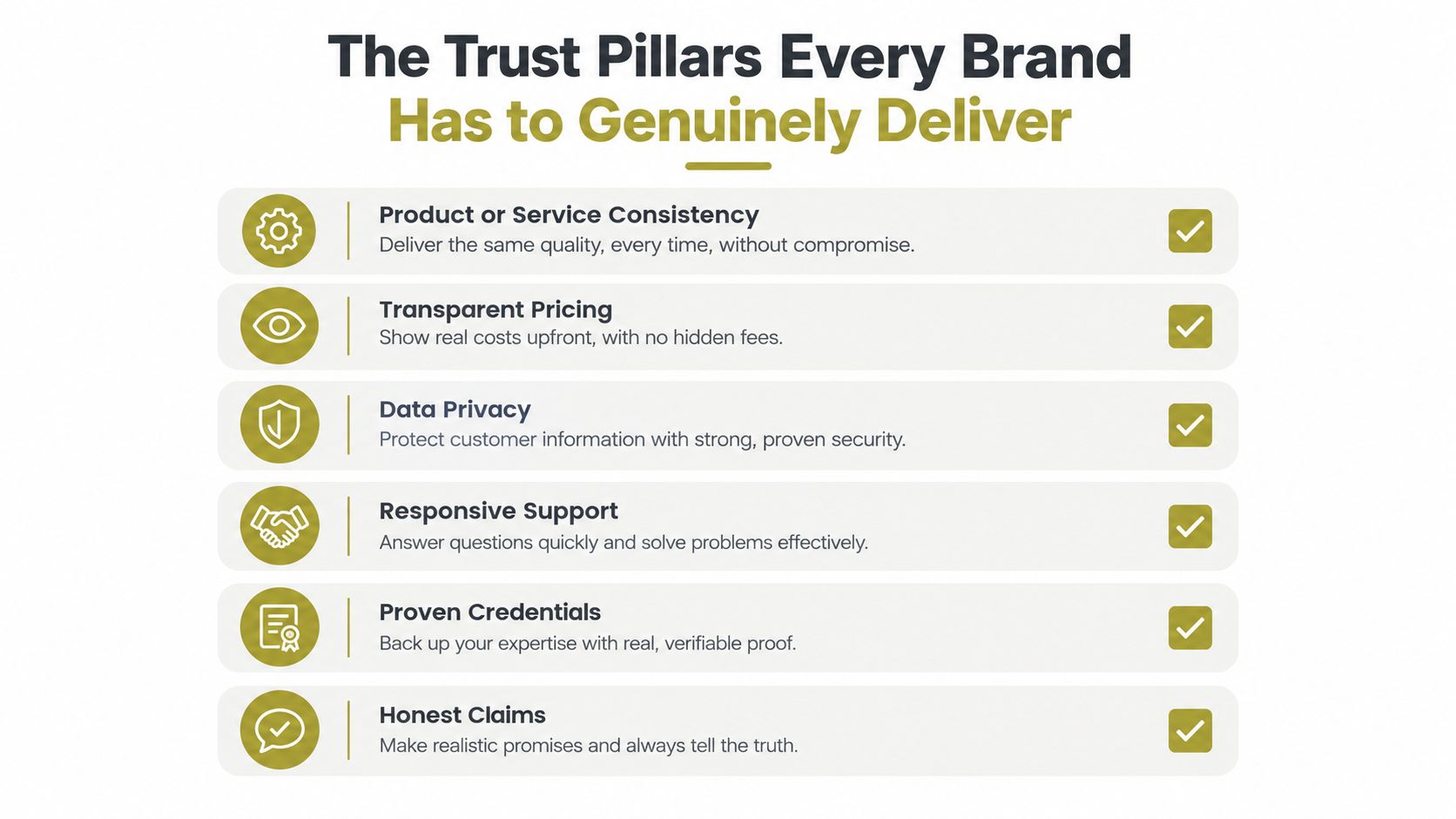
Six areas to test within a fortnight
Product or service consistency begins with delivery records, quality checks and a named owner for failures. Compare sales promises with operational delivery, including exclusions and service limits. Where they differ, correct the offer before promoting it.
Transparent pricing shows what customers pay, what is included, what may change and how cancellation works. As cited in the YouGov research above, price transparency is a practical trust issue, not merely a copywriting preference. Create one approved explanation for sales, web and customer service.
Data and privacy practice requires an accessible privacy notice, clear consent language and an inventory of who can access customer information. Ask a non-specialist colleague to explain the process in plain English. Confusion inside the business is a warning that customers will struggle to understand it too.
Customer dispute handling needs response ownership, escalation routes and a record of recurring complaints. Problems may not disappear immediately. Customers should receive an acknowledgement, a fair explanation and a clear route to resolution.
Ethical sourcing or regulatory compliance needs evidence instead of broad claims. A UK fintech should direct prospects to relevant FCA information and explain its internal controls. A care provider should make standards, inspection information and safeguarding responsibilities easy to find alongside relevant CQC context.
Leadership accountability identifies who approves material claims, who responds during a crisis and who reports progress when a commitment is missed. Responsibility that cannot be traced is difficult for customers, employees or journalists to trust.
A candid diagnostic
Score each pillar as proven, partly proven or unproven. For every “proven” answer, attach a document, an owner and a public-facing explanation. If one is missing, mark the pillar as partial.
- Can a customer verify the promise? Check whether evidence is available without a private sales call.
- Can an employee explain the process? Ask someone outside marketing to describe it.
- Can a journalist test the claim? Record the source, date and methodology behind it.
- Can leadership defend the position? Prepare a direct answer to likely criticism.
- Can the business correct an error? Test the escalation path before a real complaint arrives.
A polished campaign built on weak pillars will make the weakness more visible. Operational truth comes first, and each pillar should produce proof that can be checked across customer, media and regulatory scrutiny.
Aligning Messaging, UX and Proof Across Every Touchpoint
A trustworthy website doesn't ask visitors to take claims on faith. It places the claim beside enough evidence for a reasonable buyer to assess it.
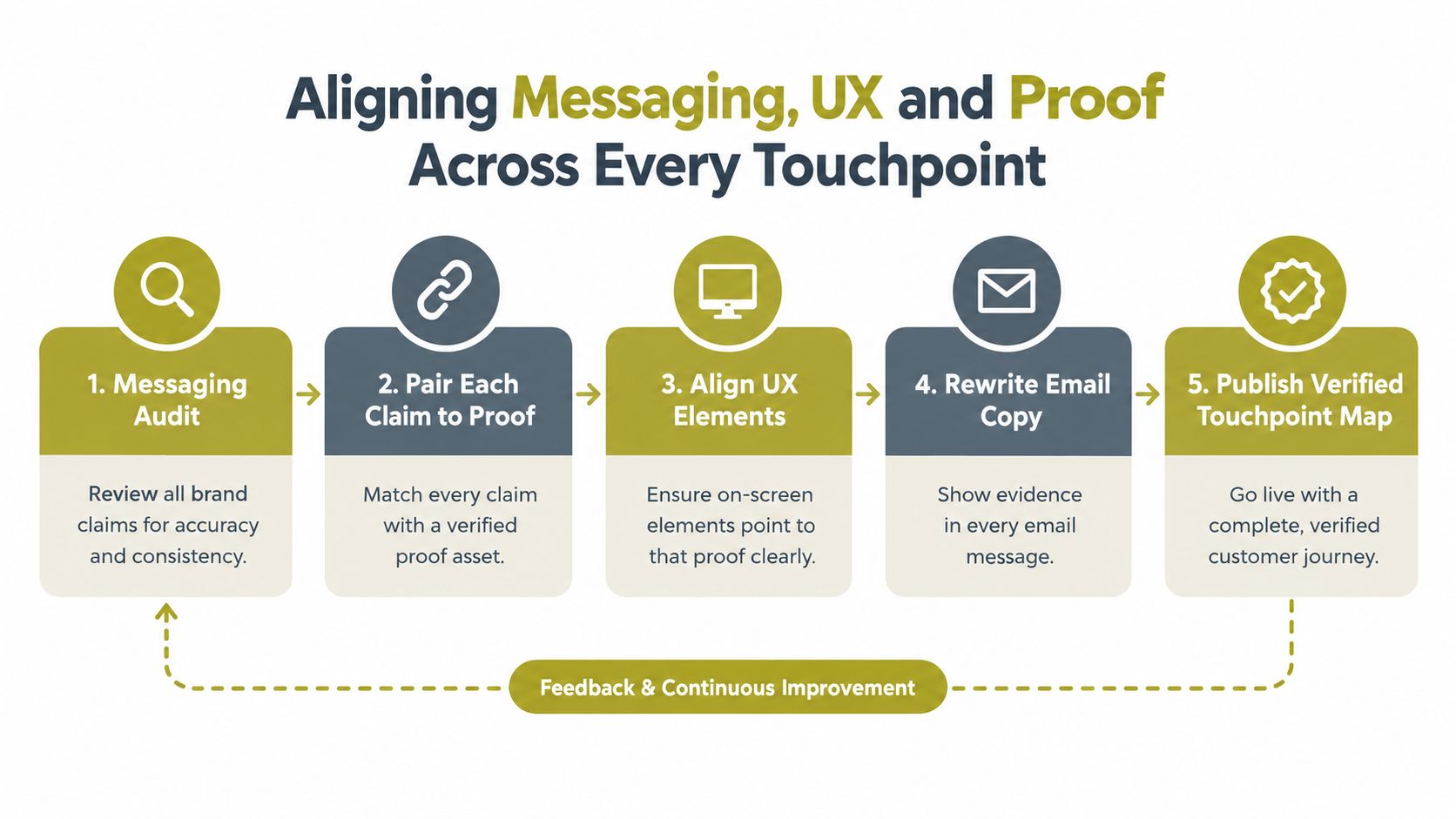
Start with a messaging audit. List every important statement on the homepage, service pages, proposals, email sequences and social profiles. Then add four columns: evidence, owner, date checked and customer question answered.
A claim such as “fast support” needs response standards or a clearly explained service model. “Trusted by leading organisations” needs named customers or an accurate description of the relationship. “Secure” needs a plain-language explanation of the safeguards that matter to the customer.
Make proof part of the interface
A small business can improve trust without a full rebrand by fixing the places where uncertainty accumulates:
- Homepage: Put the offer, audience, relevant credentials and strongest proof near the first decision point.
- Service page: Explain deliverables, exclusions, price logic, process stages and likely timescales without forcing visitors to decode sales language.
- About page: Introduce real people, relevant experience and responsibility. A generic “our team” paragraph is weaker than a named team with clear roles.
- Contact page: Show who handles enquiries, expected response arrangements and a second route for urgent issues.
- Complaint and unsubscribe flow: Make the action easy, respectful and visible. A hidden unsubscribe link or defensive complaint response creates an immediate trust gap.
- Trust centre: Group privacy, policies, certifications, service standards, media mentions and operational updates in one navigable place.
Use the “show the receipts” rule. Put dates, named sources, methodologies and links next to claims that a buyer could reasonably check. Don't bury qualifying detail in a footnote while making the headline sound absolute.
Practical rule: If a claim needs a sales explanation before it makes sense, rewrite the claim or publish the missing evidence.
UX research should support this work, not decorate it. The Uxia data driven design guide offers useful context for connecting user behaviour and design decisions. Pair that approach with direct customer questions, search data, complaint themes and form-abandonment observations.
A consistent proof map should also extend beyond the website. Review your omnichannel marketing approach so the promise on LinkedIn, in email, on the site and in a proposal doesn't change according to channel.
The strongest brands make verification feel normal. They don't treat evidence as a defensive reaction after a challenge.
Earned Media and PR as Third-Party Trust Signals
PR works when it gives an independent audience a reason to care, supported by material a journalist can verify. It fails when the pitch is just a company announcement with adjectives attached.
Build a story bank around evidence. Include customer outcomes you have permission to discuss, original findings, expert commentary, operational changes, local relevance and timely responses to issues affecting the sector. A story should have a clear public interest, not just a commercial objective.
Package the story like a newsroom
Start with the fact that changes the reader's understanding. Follow it with the evidence, the named spokesperson, the customer or community relevance and the supporting documents. Keep a separate record of what is confirmed, what is attributed and what remains confidential.
Media list hygiene matters. A trade editor may need technical detail, a regional title may need local consequence, while a national or broadcast producer may need a strong human case and a spokesperson who can explain the issue clearly under pressure. Sending the same release to all three wastes the opportunity and can make the business look careless.
Regulated sectors need additional discipline. Fintech, health and legal stories should pass compliance review before pitching, with embargoes used only when they serve a legitimate editorial or regulatory purpose. The pitch note should link to the relevant policy, report or public record and explain what the spokesperson can substantiate.
A practical pitch-to-coverage funnel
- Story bank: Record the fact, audience relevance, evidence and available spokesperson.
- Outlet match: Select journalists whose recent work demonstrates a genuine interest in the subject.
- Pitch note: Lead with the news, then provide proof, context and access.
- Interview preparation: Agree the facts, caveats, sensitive areas and supporting documents.
- Coverage review: Check accuracy, correct material errors and archive the published link.
Third-party coverage carries more weight when it reflects genuine editorial judgement. The earned media service at Carlos Alba Media provides a useful explanation of how editorial visibility differs from paid placement and owned content.
News trust is uneven across outlet types. Reuters Institute reporting says trust in UK news fell by 5 percentage points versus 2025, while public broadcasters including the BBC, ITV News and Channel 4, alongside the Financial Times, remain among the most trusted brands (Reuters Institute). That doesn't mean every brand needs a broadcast appearance. It does mean editorial standards, preparation and verification matter when a brand borrows credibility from the media environment.
Social Proof That Actually Counts in a Skeptical Market
Not all proof carries the same weight. A testimonial on your own website is easy to publish, while a review on a platform where customers can challenge or contextualise it is easier for a sceptical buyer to assess.
Recent UK consumer research found that 85% check at least one review provider before purchase, rising to 91% among 18 to 34-year-olds. 59% trust a brand more when feedback appears across more than one review platform, while 80% say fake reviews actively damage reputation (Feefo and Censuswide).
Social proof sources ranked by buyer trust weight
| Proof source | Verifiability | Reach | Conversion impact |
|---|---|---|---|
| Independent review platforms such as Trustpilot, Google, G2 or Feefo | High when reviews are attributable and current | High among active evaluators | Strong for reducing final-stage hesitation |
| Named case studies with outcomes and customer approval | Medium to high, depending on detail | Medium | Strong when the buyer shares the use case |
| Earned media quotes and editorial coverage | High when the outlet and article are visible | Medium to high | Strong for authority and reputation |
| Customer-generated content | Variable, depending on context and identity | Potentially high | Useful when it shows real use rather than staged praise |
| Awards and badges | Variable, depending on judging and criteria | Medium | Helpful as supporting evidence, weak as a standalone proof |
| Anonymous testimonials | Low | Medium on owned pages | Limited when scrutiny is high |
The most credible stack combines sources rather than repeating one logo. A homepage can show a concise review signal, a proposal can include a relevant named case study, and a LinkedIn profile can connect the leadership team to real expertise and published coverage.
Find your single-channel weakness
Search your brand as a buyer would. Check whether the same company description, service promise and customer experience appears across Google, Trustpilot, Feefo, G2, LinkedIn and your own website. If every positive claim lives on one owned page, your proof stack is fragile.
Don't suppress criticism or manufacture enthusiasm. Respond to legitimate negative reviews with a factual explanation, a route to resolution and no private information. A perfect-looking profile can be less persuasive than a transparent one that demonstrates how the business handles problems.
Spokespeople, Founders and the Newsroom Credibility Layer
A spokesperson turns a corporate claim into a testable human explanation. That person can strengthen trust by making complex information clear, or damage it by exaggerating, dodging a direct question or contradicting the written record.
Everyone who works for Carlos Alba Media is a former national news journalist or has agency experience of working with international brands. That specialist nature matters because newsroom habits are practical: check the source, challenge the weak wording, understand the audience and prepare for the question behind the question.
Build a usable spokesperson bench
Each spokesperson needs a short biography, current headshot, role description, areas of authority and a proof pack. The proof pack should contain verified figures where available, named customer permissions, relevant regulatory references, approved descriptions of the product and a list of claims that must not be made.
Prepare a founder voice checklist:
- Specificity: Can the founder explain what changed, for whom and why?
- Evidence: Does every material claim have a source, date or customer example?
- Boundaries: Can the spokesperson say what isn't known without sounding evasive?
- Accountability: Will they name the person responsible for resolving the issue?
- Consistency: Does the public position match the website, policy and customer experience?
Media training isn't about making everyone sound identical. It teaches people to answer directly, bridge to a verified point when appropriate, flag important context and recognise risk before a casual phrase becomes the headline.
Prepare for a ten-minute broadcast segment
Use the opening minute to state the issue in plain English. Prepare three supporting points, one example, one limitation and one action the organisation is taking. Rehearse interruptions, hostile wording, a request for an unverified figure and the question “why should anyone believe you?”
Keep paid and earned interviews distinct. A sponsored interview gives the brand control over placement and format. Earned coverage involves editorial independence, so the spokesperson must be ready to support the story without assuming the journalist will repeat the preferred wording.
Leadership posts also act as ambient trust signals. A founder who explains a decision, acknowledges a problem and links to evidence builds a more credible public record than one who posts only polished celebration content. Authority grows through useful clarity, not constant self-promotion.
Crisis Readiness, Measurement and Your 90-Day Trust Plan
Trust work becomes credible when the business can respond before a problem spreads, measure whether confidence is strengthening and sequence improvements in a way a small team can sustain.
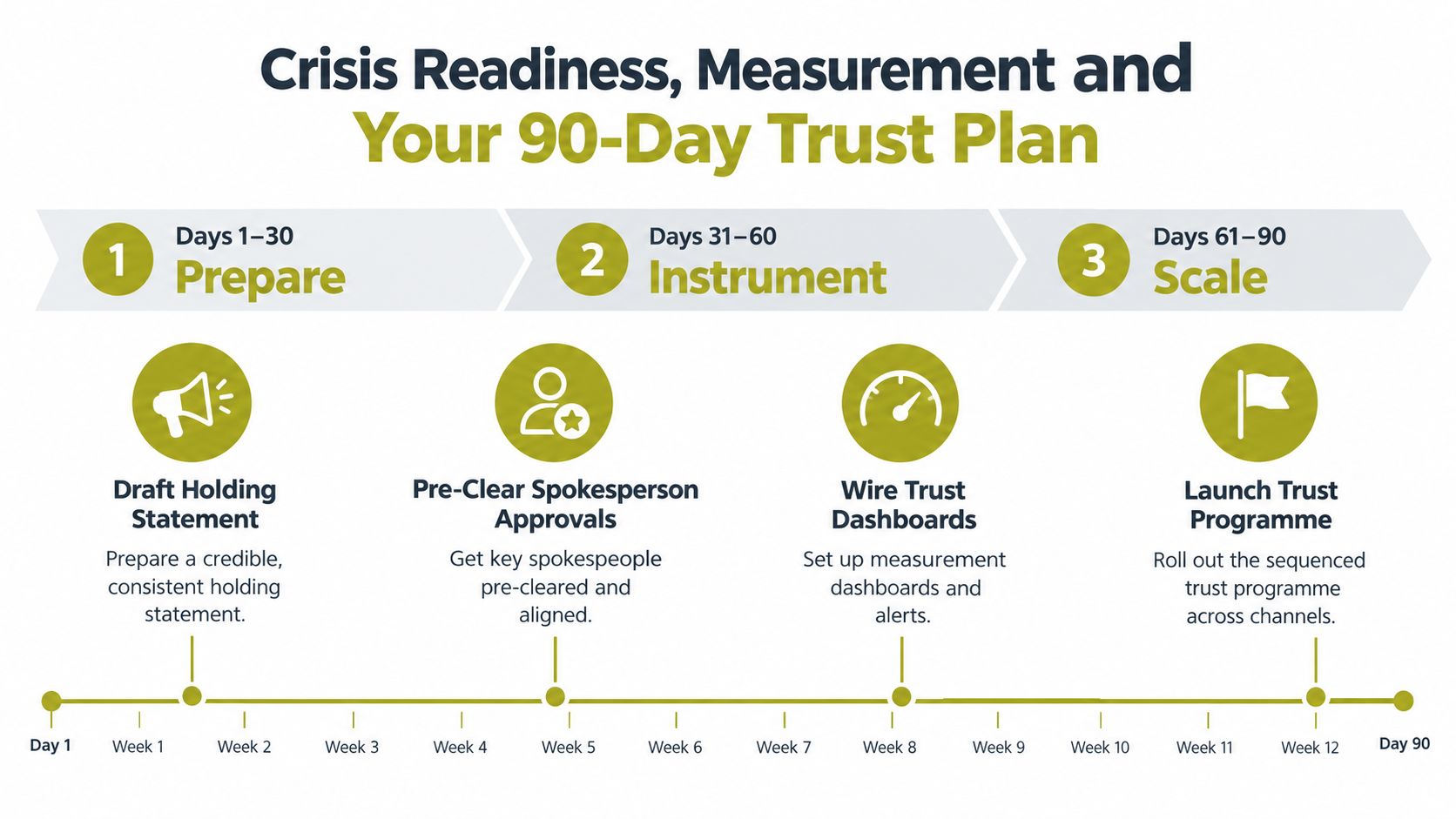
A credible holding statement should acknowledge the issue, state what is known, explain what is being checked and give the next update point. It shouldn't speculate, blame customers or promise an outcome the business can't deliver. Pair it with a pre-cleared spokesperson brief and an approval tree that identifies who can publish, who advises and who must be informed.
For a fuller operational framework, use this guide to develop a crisis communications plan. Monitoring also needs to cover more than press mentions. A practical brand monitoring guide from MyMentions can help teams think about where conversations appear and how quickly an issue needs escalation.
A sequence an SME can actually run
Days 1 to 30, prepare. Audit the six trust pillars, assign owners, record recurring complaints and draft the holding statement. Fix the most visible contradiction first, especially unclear pricing, missing contact information or an unsupported claim.
Days 31 to 60, instrument. Build a dashboard around review velocity, the wording of customer feedback, share of voice, branded search behaviour, direct traffic, returning visitors and review depth. Treat these as trust proxies, not proof of trust by themselves. Record the context behind changes so a seasonal campaign or product issue isn't mistaken for a reputation shift.
Days 61 to 90, scale. Run a focused PR sprint, prepare spokespeople, publish the evidence-led content already approved and review performance with sales and customer service. At quarter end, connect trust indicators with commercial measures such as customer lifetime value and customer acquisition cost payback where the business has reliable data.
The sequence matters. Don't buy monitoring before deciding what counts as a meaningful signal. Don't pitch media before checking the evidence. Don't publish a founder statement before agreeing who owns the response if criticism follows.
The test of trust isn't whether a brand looks credible on its best day. It's whether customers can verify the promise and see responsible action on its difficult days.
Review the plan quarterly with marketing, operations, sales, legal or compliance and customer service in the room. For UK SMEs and regulated businesses, that cross-functional discipline turns brand trust from an abstract ambition into a governance-friendly operating practice.
Carlos Alba Media combines PR, digital marketing, reputation management, media skills training and crisis communications shaped by newsroom discipline and agency experience. Visit Carlos Alba Media to discuss an evidence-led trust programme for your brand, from proof and positioning through to coverage, spokesperson preparation and rapid-response support.