
In the UK, only one in four new product launches reaches 1% household penetration, and just 17% combine strong trial with repeat purchase, according to NielsenIQ's 2026 launch analysis. That changes the question founders should ask. It isn't how to launch new product successfully, but how to prove that people need it, give journalists a reason to cover it, prepare the business for scrutiny, and convert early curiosity into sustained demand.
A launch is a vulnerable period. Buyers are forming their first impression, retailers are judging whether the product deserves space, and journalists are deciding whether the announcement belongs in their limited coverage. A polished press release can't compensate for weak positioning, poor customer experience or an unprepared spokesperson.
The practical answer combines rigorous demand testing, disciplined sequencing, newsroom-led PR and measurement that goes beyond impressions. The product needs a clear reason to exist, while the organisation needs the operational discipline to defend and improve it once attention arrives.
Validating Market Demand and Category Incrementality
The numbers leave little room for wishful thinking. More than 3,500 new brands and sub-brands launched across the UK, Germany, France, Italy and Spain in 2025, yet only about one third reached 1% of households, according to NielsenIQ analysis reported by Customcy. The UK result was tougher still, with only one in four launches reaching that level of household penetration.
The financial risk is equally clear. A UK analysis of 3,378 grocery products launched between January 2013 and June 2015 estimated that failed launches waste at least £30.4 million each year, with an implied annual failure rate of 76%, as reported by FMCG Magazine. Founders do not need a huge research programme, but they do need evidence before committing to distribution, inventory and publicity. Awareness cannot fix a proposition that fails to change behaviour.
Find the newness gap
Map the customer job before refining the feature list. Identify what people do now, where the process frustrates them and which occasions remain poorly served. Compare the product with recognised alternatives, including the option of doing nothing.
Assess the proposition across three practical tests:
- Functional difference: What can the product enable that existing options cannot?
- Behavioural change: Who would use it differently, more often or in a new situation?
- Economic value: Why would a buyer, retailer or partner allocate money and attention to it?
Kantar's UK evidence reinforces this discipline. Just one in three launches achieves the aim of driving extra sales for the overall category, rather than replicating products that already meet shopper needs, according to Kantar's innovation analysis. Trial alone does not prove category growth. A product may attract curiosity while merely taking sales from an existing choice.
Practical rule: Ask what customers would stop doing, start doing or do more frequently because the product exists.
Test behaviour before scale
Interviews reveal language, objections and purchase context, but positive feedback is not demand. Put the proposition in front of a defined audience and ask for an action, such as joining a waitlist, requesting access, placing a pre-order or committing to a pilot. The action needs enough friction to separate genuine intent from polite approval.
For crowdfunding or community-led launches, how creators measure campaign demand provides a useful framework for reading signals before a larger campaign. Apply the same discipline elsewhere. Track intent, objections, source quality and the words people use when explaining the product to someone else.
Record the findings in a demand brief. Set out the priority audience, unmet need, competing alternatives, evidence of incremental usage and conditions for repeat purchase. Use consumer insights research to strengthen that evidence with structured customer and market understanding. This gives the PR team a defensible story before journalists or retailers start asking whether the product creates new demand or merely shifts existing spend.
Structuring the Go-To-Market Timeline and Budget
A launch calendar shouldn't begin with the public announcement. It should begin with the moment a journalist, customer or investor might search for the brand and ask whether the business looks credible. If the website is slow, the product page is vague, the founder's LinkedIn profile contradicts the press narrative or the checkout fails, earned attention becomes wasted attention.
A practical rollout has four phases. The exact dates depend on the product, but the order matters.
Phase one builds the evidence and infrastructure
Start with positioning, audience segmentation and proof points. Write the core message in a form that works on a product page, in a broadcast interview and in a short email. Build the landing page, comparison content, FAQs, structured internal links and conversion path before outreach begins.
Check the technical basics without turning the launch into an SEO-only exercise. Search intent should inform page structure, but the copy must answer a human buyer's questions quickly. Make sure analytics capture meaningful actions, including qualified enquiries, sign-ups, purchases, repeat orders and support requests.
Phase two earns attention before launch day
Prepare a press narrative that goes beyond “new product available”. National journalists need a clear public-interest angle, a credible spokesperson, strong visuals and access to evidence. Offer embargoed briefings where appropriate, seed the product selectively and give each journalist a reason the story matters to their audience.
Paid social should support tested messages rather than decide the message from scratch. Founders who need a broader framework for building a GTM strategy for startups can use the distinction between strategic direction and execution to keep channel activity aligned.
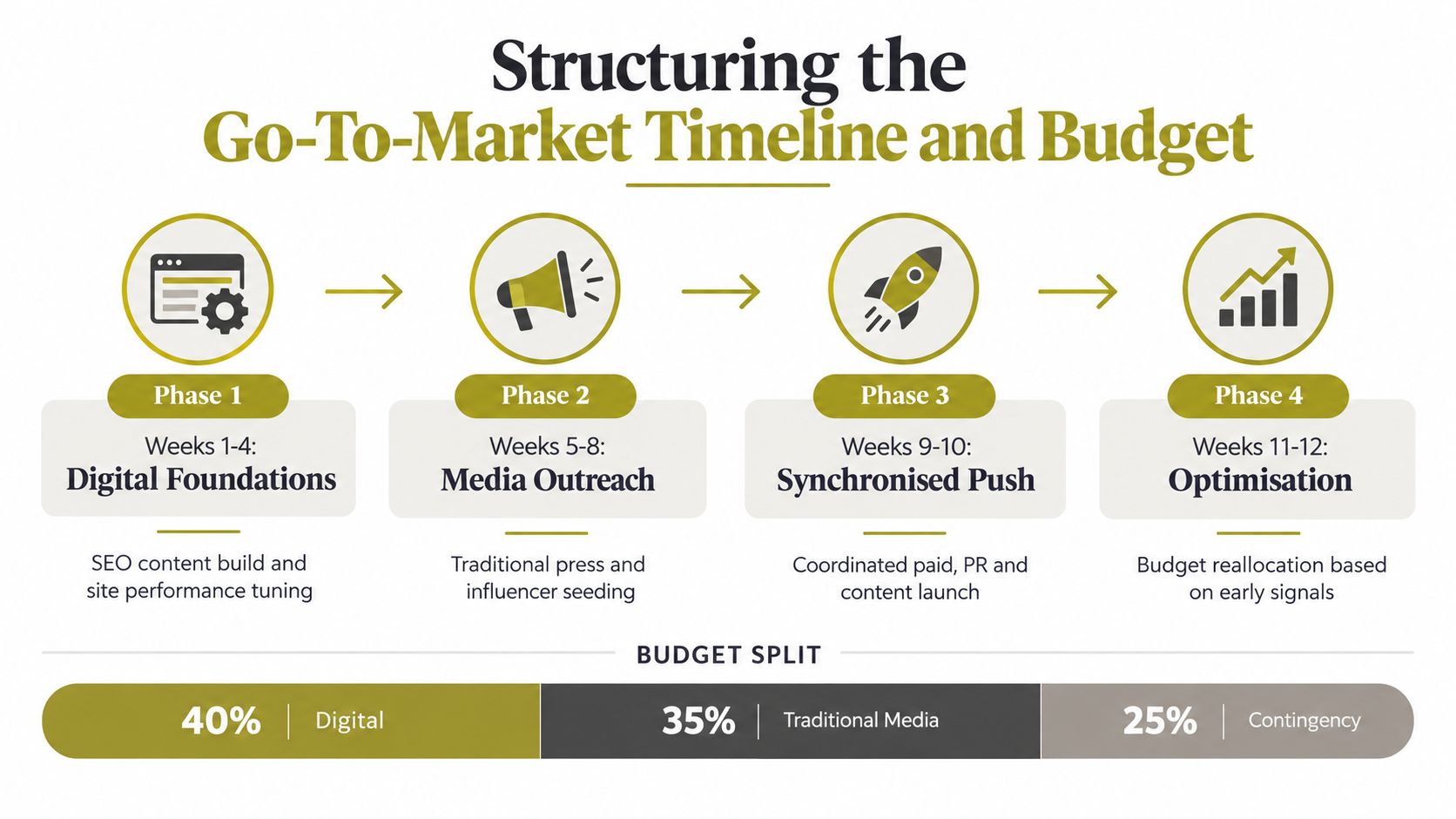
Phase three synchronises the release
Coordinate the embargo lift, owned content, paid promotion, email, social publishing, sales follow-up and customer support briefing. Everyone should know which claim is approved, where the latest assets live and who can make a decision if coverage changes the plan.
Keep a contingency reserve. A broadcast opportunity may arrive with little notice, a product issue may require a holding statement, or a promising audience segment may need more support than expected. A budget that has already been committed across every channel leaves no room for judgement.
Phase four reallocates around evidence
After launch, move money towards actions that produce qualified demand and away from channels that generate attention without progression. Review search queries, landing-page behaviour, sales objections, coverage quality, customer questions and early repeat signals together.
The strongest budget plan isn't the one that predicts every outcome. It's the one that gives senior decision-makers enough visibility to act quickly without abandoning the message or spending more just because the original plan said so.
Securing Earned Media Through Newsroom Expertise
A product announcement isn't automatically a news story. Editors need a reason to publish or broadcast it now, and that reason usually sits in the connection between the product and a wider issue, change in behaviour, consumer tension or public interest.
A standard release often describes what the company wants to say. A newsroom-trained PR adviser starts with what the audience needs to know. That difference affects the headline, the evidence, the spokesperson and the timing.
News judgement changes the pitch
Former national journalists understand how commissioning decisions are made because they've worked inside the pressure of a newsroom. They know which claims need substantiation, why a human example often carries more weight than a feature list, and how a story can be adapted for broadcast, print, online and social formats without losing its central point.
Carlos Alba Media has a specialist nature built around that experience. Everyone who works for Carlos Alba Media is a former national news journalist or has agency experience of working with international brands. That combination matters because a launch needs both editorial judgement and commercial discipline.
The wider UK PR market also treats senior newsroom experience as a recognised specialist credential, with agencies openly promoting former national-news-journalist leadership and staffing, as illustrated by Marcos Richards' agency profile. Its description of senior newsroom experience and delivery across London and other UK hubs also reflects a model based on experienced counsel rather than a volume of junior outreach, as set out on its team page.
Build a story journalists can use
The strongest pitch usually contains four ingredients:
- A clear tension: Identify the problem or change that makes the launch relevant beyond the company.
- A credible proof point: Provide customer evidence, product testing, expert context or transparent limitations.
- A useful human voice: Prepare someone who can explain the issue plainly and withstand challenging questions.
- A visual or practical element: Offer a demonstration, location, data visualisation, customer access or compelling imagery.
Don't send the same copy to every outlet. A breakfast broadcaster may need a concise, visual explanation and an available spokesperson. A business editor may want category context and commercial implications. A specialist publication may care about technical detail that would slow down a general-news pitch.
Earned coverage also has value beyond referral traffic. It can reassure cautious buyers, give sales teams third-party validation, provide content for owned channels and create a record that investors, partners and regulators may encounter later. The discipline is to judge coverage by relevance and credibility, not by volume alone. A detailed explanation of what earned media involves helps teams distinguish genuine editorial value from paid or controlled distribution.
Preparing Spokespeople and Managing Crisis Risk
Visibility increases the number of people who can question the product. Founders often prepare for the launch announcement and neglect the follow-up interview, the hostile question, the customer complaint that gains traction or the technical issue that appears at the worst possible moment.
Media training should begin with the proposition, not performance tricks. A spokesperson who can deliver a polished soundbite but can't explain pricing, limitations, safety or customer impact won't hold up under scrutiny.
Train in stages
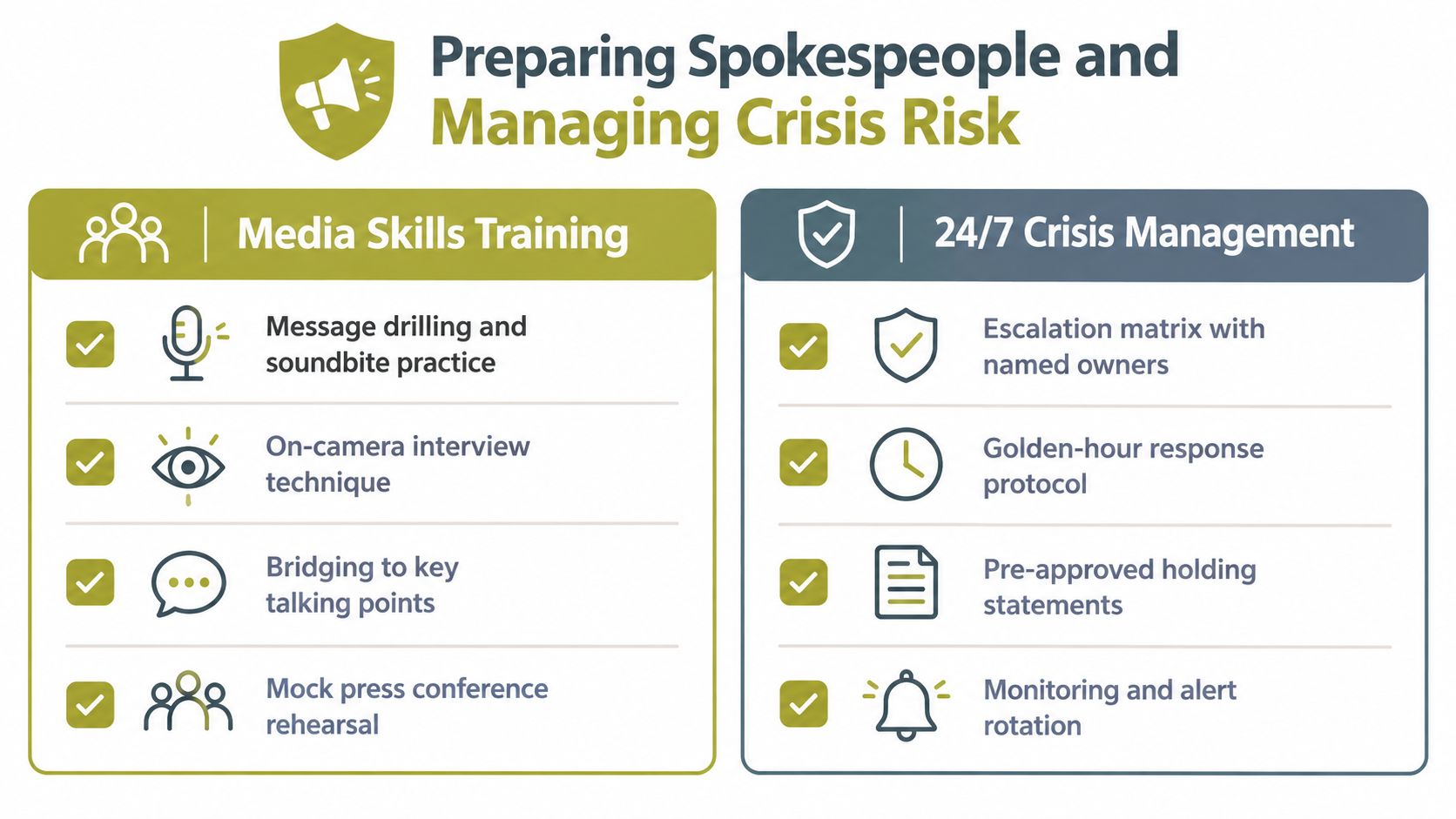
Use a phased rehearsal process:
- Message drilling: Reduce the launch narrative to a small set of defensible points. Practise answering in plain language without turning every response into a slogan.
- Interview technique: Record short answers on camera. Review pace, eye line, posture, unnecessary qualifiers and whether the answer addresses the question.
- Bridging: Practise moving from a difficult but legitimate question to a relevant point without dodging it. The bridge must follow a direct answer, not replace one.
- Pressure rehearsal: Run a mock press conference with interruptions, sceptical follow-ups and questions about failures or unintended consequences.
Spokespeople should also know what they can't confirm. Guessing may feel helpful in the room, but an unsupported statement can create legal, regulatory or reputational exposure.
Make response ownership explicit
A crisis plan needs named owners, escalation routes and pre-agreed decision rights. The monitoring team should know what counts as a routine complaint, a developing issue and an incident requiring senior intervention. The spokesperson shouldn't be left waiting for approval while journalists are publishing updates.
Create holding statements for the risks you can reasonably anticipate, but don't publish them automatically. They should buy time while the organisation verifies facts, protects customers and decides whether a fuller response is possible.
For regulated or high-risk sectors, involve media lawyers before launch. They can help define what the organisation can say, when legal review is required and how to preserve evidence. A 24/7 arrangement is useful only if someone is responsible for monitoring alerts and convening the response.
Run one final stress test before the embargo lifts. Ask what happens if the product is accused of misleading customers, a supplied image is challenged, a founder's old comment resurfaces or an early buyer reports a serious problem. The aim isn't to eliminate risk. It's to ensure the first response is accurate, human and fast enough to protect trust.
Measuring True Penetration and Post-Launch KPIs
A crowded launch dashboard can still leave leadership without a clear decision. Impressions, reach and early clicks show distribution, not whether the product solved a real need or earned continued use.
Measurement should connect communications with customer behaviour. Track whether people understand the proposition, take the intended action, receive the product, use it, buy again and recommend it. The events differ for a subscription service, consumer packaged good and complex B2B product, but the measurement logic remains consistent.
Start with a controlled learning loop
Before launch, test the message with the audience you intend to reach. During release, use a controlled rollout or defined cohort to separate product behaviour from wider market noise. After release, review repeat purchase or continued use at regular intervals, alongside support themes and qualitative feedback.
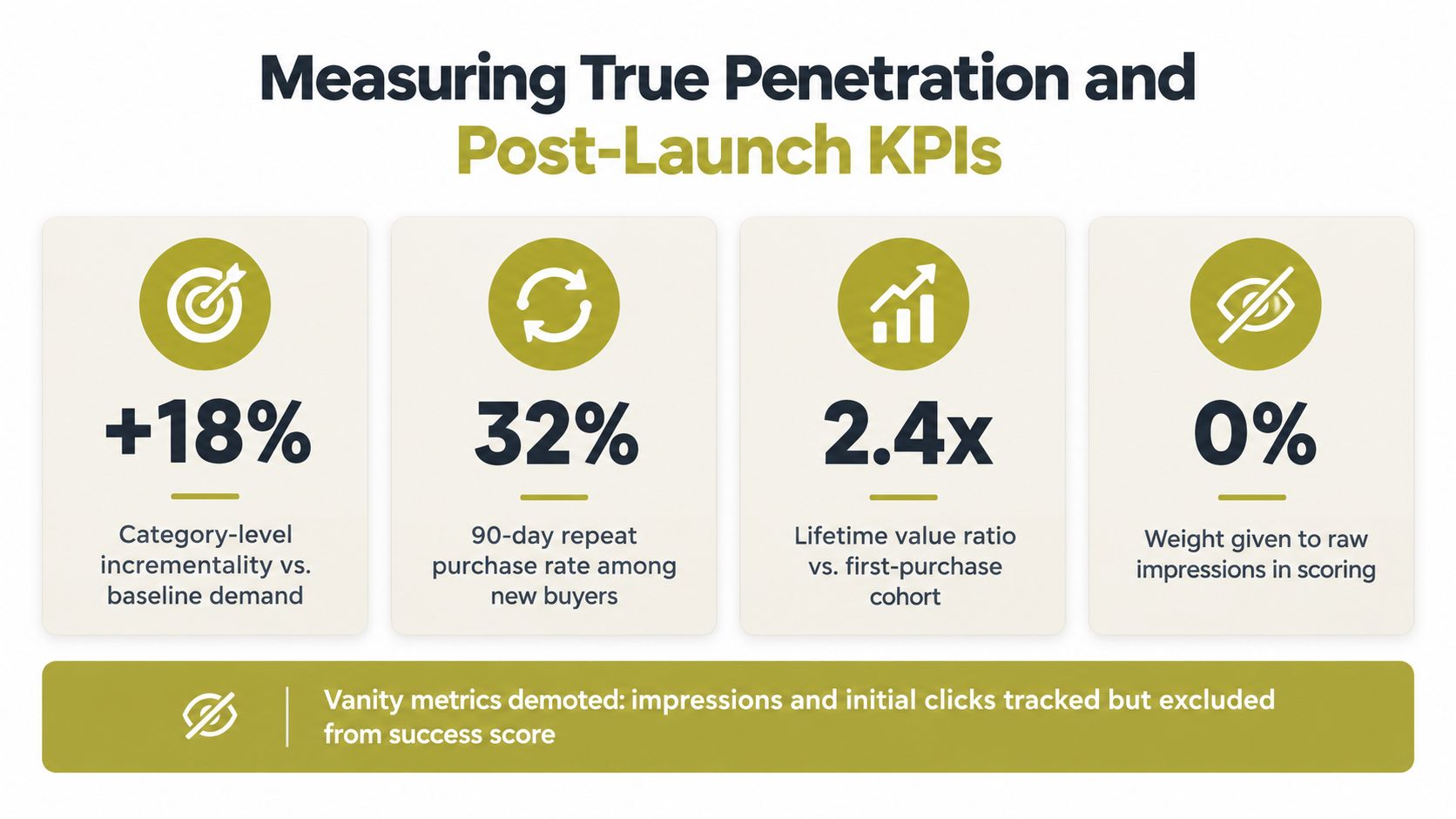
Repeat-rate monitoring deserves a prominent place on the dashboard. Only 17% of launches combine strong trial and repeat purchase, according to the available launch research. The first transaction signals interest, but it does not establish product-market fit.
Use a scorecard that separates leading indicators from outcome measures:
- Demand quality: Qualified sign-ups, pre-orders, enquiries or retailer commitments, segmented by source.
- Conversion quality: Product-page engagement, completed checkout, activation or successful first use.
- Customer quality: Repeat purchase, renewal, retention, referrals, returns and support contacts.
- Market quality: Evidence that the product expands category usage instead of shifting existing demand.
Give the data a decision attached to it
Every metric should answer a management question. If first-time buyers do not return, examine onboarding, product performance, price, availability and expectation setting before raising acquisition spend. If search demand increases while conversion stays weak, review the proposition and landing-page experience. If coverage produces visits from the wrong audience, change the story instead of celebrating traffic volume.
Category incrementality needs separate scrutiny. The Kantar evidence cited earlier indicates that many launches do not create additional category sales. Compare new usage occasions and buyer behaviour with the original demand baseline, then assess whether the product is becoming part of customers' routines.
That analysis takes more discipline than reporting media reach. It gives stakeholders a clearer basis for deciding whether to expand distribution, revise the offer or stop spending. It also helps the PR team connect earned attention with commercial behaviour, rather than treating coverage as the launch result.
Executing a Cohesive Multi-Channel Rollout
Consider a founder launching a premium product with a strong visual demonstration and a credible consumer problem behind it. The team has a good proposition, but the first draft of the plan is fragmented. Paid social is ready to run, the website is being finished, a press release is waiting for approval and the founder has never faced a hostile interview.
A senior launch lead would slow the public announcement long enough to connect the pieces. The product page would answer the practical questions raised in customer testing. The press angle would focus on the wider problem rather than the company's preferred feature list. The founder would rehearse a broadcast interview, while the team would prepare customer support and a clear escalation route.
Let each channel do a specific job
Search content should capture questions people ask before buying and after hearing the story. Social content should demonstrate use, handle objections and give customers a reason to discuss the product. PR should provide independent context and reach audiences the brand can't efficiently access through its own channels.
The channels shouldn't publish disconnected claims. A broadcast interview, LinkedIn article, product page and email sequence can use different formats while retaining the same central promise, proof and qualification. That consistency helps customers understand the product and gives journalists confidence that the company knows what it stands for.
Partnerships can extend credibility when the partner has a genuine reason to care about the customer problem. A structured strategic alliances framework can help founders assess shared value, audience fit, responsibilities and potential conflicts before announcing a collaboration.
Use early signals without losing the plot
Suppose the launch produces strong press interest but weak product-page conversion. The answer isn't automatically more coverage. The team should examine whether the media angle promised something the page doesn't deliver, whether pricing is clear, whether the purchase path works on mobile and whether the visitors match the intended audience.
If conversion is healthy but repeat use is poor, the next intervention belongs in the product, onboarding or customer experience. If one audience segment responds strongly while another doesn't, narrow the next campaign rather than diluting the message to keep everyone interested.
This is why integrated campaign planning matters. Senior PR counsel can interpret newsroom feedback, while digital specialists can connect that feedback to search behaviour, conversion data and customer language. The team can then refine the story and the experience together, rather than treating media, marketing and product as separate departments.
A launch earns its long-term value after the announcement. Keep pitching relevant developments, publish useful answers, respond to customers publicly where appropriate and update the website as objections become clearer. The goal is a brand that remains visible, trusted and chosen after the first burst of attention has passed.
Carlos Alba Media combines former national-news journalism and international-brand agency experience with PR, digital content, media training and crisis management for product launches. Visit Carlos Alba Media to discuss a senior-led launch plan that connects newsroom insight with measurable customer action.