
You're probably here because your business is already “doing content” and not getting much back.
The blog goes up. Someone posts it on LinkedIn. A few people click. Then everything goes quiet. A month later, the team is asked for another article, another campaign, another batch of social posts. Activity is visible. Progress isn't.
That's a common UK SME problem. It usually isn't a sign that the team is lazy or that content itself has stopped working. More often, the issue is that the business is publishing without the equivalent of an editor. In a newsroom, stories don't run because someone filled a page. They run because an experienced editor judges what matters, what angle will land, where it should appear, and what the audience will do next. Brand content needs the same discipline.
That matters even more in a mature market. UK marketers were already deep into content more than a decade ago. A 2014 UK survey found that 88% of UK marketers used content marketing, 76% were producing more content than the year before, and they allocated 31% of total marketing budgets to content on average according to the Content Marketing Institute UK research. In plain terms, your competitors have not just discovered content. They've been investing in it for years.
Introduction Why Great Content Still Needs a Guide
A founder tells the team, “We need to be more visible.” The marketing manager responds sensibly. They commission blogs, build a simple email newsletter, post updates on social, and maybe publish a downloadable guide. Six months later, everyone is tired, but nobody can say with confidence which piece of content moved a prospect closer to buying.
That's the moment many businesses start searching for a Content Marketing Agency UK firms can rely on.
The confusion usually starts with the word “agency”. Some businesses think they're buying words on a page. Others think they're hiring a PR team. Some expect SEO, video, paid promotion, social media, and conversion advice all bundled together. All of those assumptions contain a bit of truth, but none gives the full picture.
Great content isn't just well written. It's well judged, well placed, and well followed through.
A useful agency behaves less like a content factory and more like a brand newsroom. It helps you decide what to publish, why it matters to your audience, where it should appear, and how you'll know whether it worked. That means editorial planning, search visibility, distribution, and measurement all have to connect.
Where many businesses get stuck
Three sticking points come up again and again:
- Too much production, not enough judgement. Teams publish because the calendar says “post due”, not because the topic deserves attention.
- Strong ideas with weak distribution. A good article left on a quiet blog is like a solid news story printed after the presses have stopped.
- Reporting that sounds busy but says little. Page views, impressions, and word counts can fill a slide deck without helping a business make better decisions.
Some agencies are built to solve that. Some are built mainly to supply output.
A specialist model is often useful when a business needs senior thinking rather than volume. Carlos Alba Media is one such example. Its specialist nature matters because everyone who works for Carlos Alba Media is a former national news journalist or has agency experience of working with international brands. That kind of background changes how stories are judged, sharpened, and distributed.
What a Content Marketing Agency in the UK Really Does
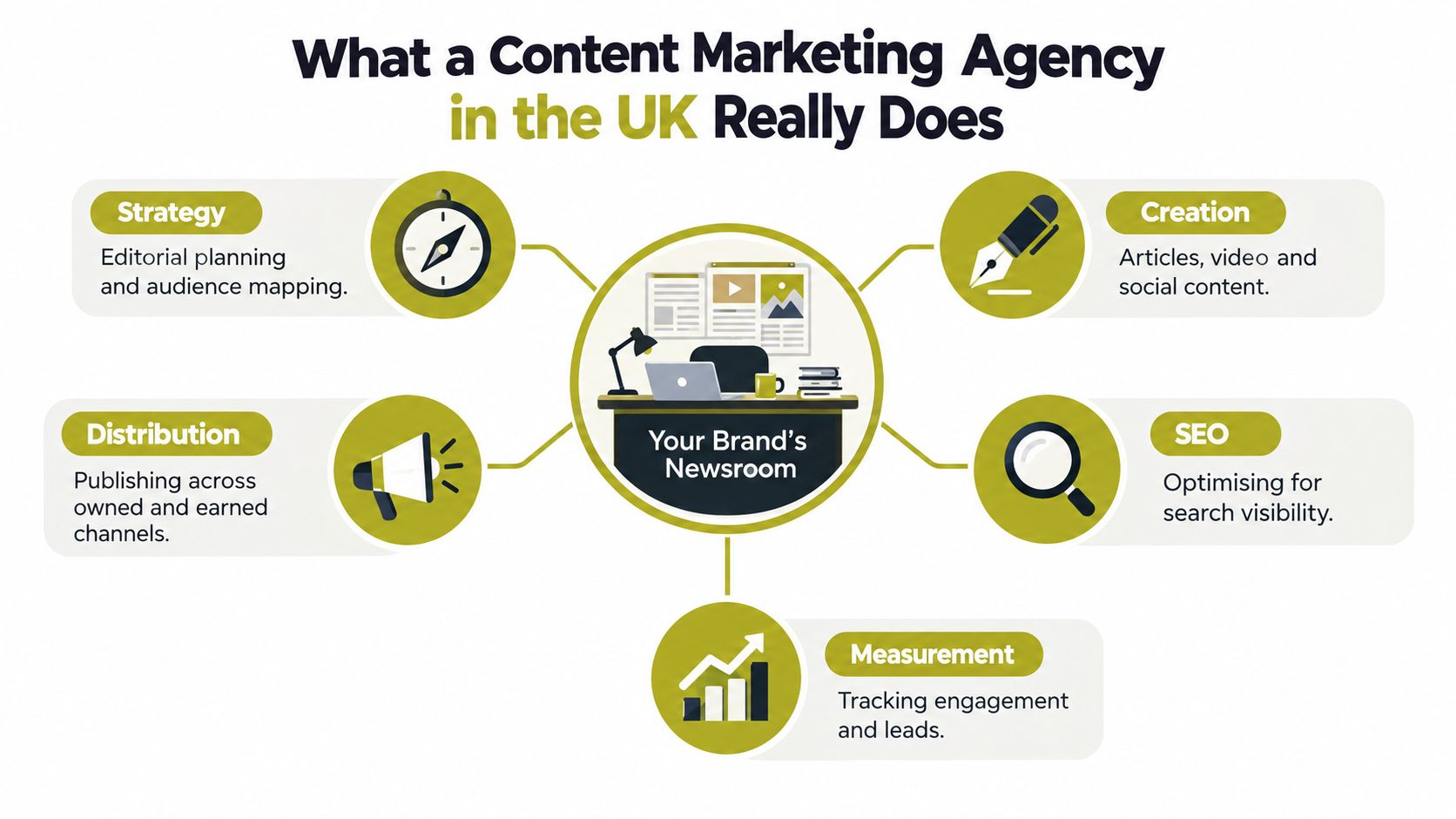
Think of a good agency as your brand's newsroom.
A newsroom doesn't start with “we need 1,500 words by Thursday”. It starts with audience need. What are people trying to understand? What will they trust? What's the strongest angle? What deserves prominence? A content marketing agency should approach your market in the same way.
Strategy comes before creation
Before anything is written or filmed, the agency should map three things.
- Audience intent. What questions are buyers asking at different stages?
- Business goals. Do you need awareness, enquiries, trust, investor confidence, or support for a sales team?
- Editorial angle. What can you say that's useful, distinct, and credible?
That's the difference between content marketing and simple content production. If someone can only tell you how many posts you'll receive each month, they're selling output.
A stronger process starts with planning. If you want to see what that looks like in practice, this guide on how to create a content marketing strategy lays out the building blocks clearly.
The five jobs a real agency handles
An effective content marketing agency in the UK usually covers five connected jobs.
Editorial planning
This is the commissioning desk. It decides what themes matter, what formats fit, and what order makes sense.Content creation
That can include articles, landing pages, interviews, video scripts, social cutdowns, thought leadership pieces, and case study material.Search optimisation
SEO isn't a separate magic trick. It's the craft of making useful content easier to find and easier to click.Distribution
Owned channels matter, but so do earned opportunities, social platforms, email, and sometimes paid amplification.Measurement
The agency should help you judge whether content earned attention and commercial movement, not just whether it existed.
A practical way to think about value is to ask whether each asset can work in more than one place. A webinar can become clips, articles, quote cards, outreach material, and landing-page proof. That's where agency ROI starts to look more sensible than one-off production. The LLMrefs guide to agency ROI is useful on that point because it pushes beyond output and into returns.
How content, SEO, and PR overlap
Readers often get tangled. Content marketing, SEO, and PR are separate disciplines, but in real campaigns they overlap heavily.
- SEO helps people find your material when they search.
- PR helps other platforms and publishers notice your story.
- Content marketing gives both disciplines something worth discovering and sharing.
For UK search campaigns, click performance also varies sharply by sector. LOCALiQ's benchmark reporting states an average CTR of 9% across UK search campaigns in 2025, while entertainment and leisure reached 12.4% in 2024 and property reached 6.3%, according to LOCALiQ's UK Google Ads CTR benchmark. That tells you a practical thing. The same message won't perform equally well in every market. Category, intent, and creative fit all matter.
Later in the process, format matters too. Short-form video is growing strongly in UK marketing coverage, and creator budgets are rising, according to Brands and Agencies trend coverage for 2026. So if an agency still talks as if “content” means only blogs and lead magnets, you're hearing an old script.
Here's a short visual explainer that captures the newsroom model well.
Services Benefits and What Pricing Looks Like in the UK
When businesses compare agencies, they often compare the wrong thing.
They compare article counts, day rates, or package names. What they should compare is capability. Can the agency diagnose what's wrong, produce the right assets, and improve distribution and conversion so the work has a fair chance of paying back?
What services usually sit under the hood
A modern content programme usually blends several disciplines rather than one.
Content strategy and audit
An agency reviews what already exists, where the gaps are, and what the audience needs. For many firms, this stage reveals that old material isn't useless. It's just poorly structured, outdated, or disconnected from buyer intent.
SEO content and UX
Good SEO content isn't stuffing pages with keywords. It's making the page easy to understand, easy to scan, and easy to act on. User experience matters because a strong article that leads nowhere can still fail commercially.
Practical rule: If the page answers the question but doesn't guide the next step, the content has only done half its job.
Independent UK guidance on performance makes the ranking issue very clear. First-page organic results around position 1 can capture roughly 20% to 40% of clicks, while position 10 falls below about 2% to 2.5%, according to the SEO Handbook guide to measuring content performance. That's why information architecture, internal linking, and title work matter so much. Sometimes the commercial gain comes from moving an existing page upward, not from publishing another new one.
Video, short-form, and social adaptation
Many SMEs still brief content as if the website is the whole stage. It isn't. A capable agency will ask what can be filmed, clipped, narrated, quoted, or repackaged so the idea travels.
Web design and conversion support
This surprises some buyers. They hire for content and discover the bigger issue is the journey after the click. If forms are clumsy, pages are slow, or proof points are buried, even strong content leaks value.
Analytics and reporting
The agency should show what happened and what changed as a result. Not every useful effect appears as a last-click lead. Some content builds branded search, earns media interest, supports sales conversations, or improves conversion from future visits.
How agencies usually charge
Most UK agencies use one of three models. The right one depends on your goals and how much uncertainty is in the brief.
| Engagement Model | Best For | What Is Included | Watch Out For |
|---|---|---|---|
| Retainer | Ongoing visibility, regular publishing, strategic support | Strategy, creation, optimisation, reporting, monthly planning | Vague deliverables or “all in” promises that hide scope limits |
| Project | Website launches, campaign bursts, audits, messaging resets | Fixed scope, fixed outputs, defined timeline | No follow-up distribution or optimisation after delivery |
| Hybrid | Firms needing a foundation plus rolling support | Initial project, then monthly implementation and reporting | Confusion over what moved from project scope into retainer scope |
What drives pricing up or down
Price usually follows complexity.
- Seniority of team matters. Senior editors, strategists, SEO specialists, and experienced producers cost more than junior generalists.
- Format range changes effort. A text-only plan is simpler than one involving video, design, social cutdowns, and PR support.
- Approval environment slows delivery. Regulated sectors, legal review, and multiple sign-off layers add work even when output volume stays the same.
- Research depth can be decisive. Interview-led thought leadership takes more time than rewriting familiar themes.
If you're trying to benchmark how agencies package that work, these digital marketing agency pricing packages give a useful reference point for the kinds of structures you'll see in the market.
How to Choose the Right Agency Without Guesswork
Agency selection often becomes theatre. Polished decks, broad promises, and too many people in the room. That doesn't tell you who will think well on your behalf when a deadline shifts, a story weakens, or a senior stakeholder changes direction at the last minute.
A better test is simple. Ask whether the team thinks like editors or only like suppliers.
The six checks that reveal how an agency really works
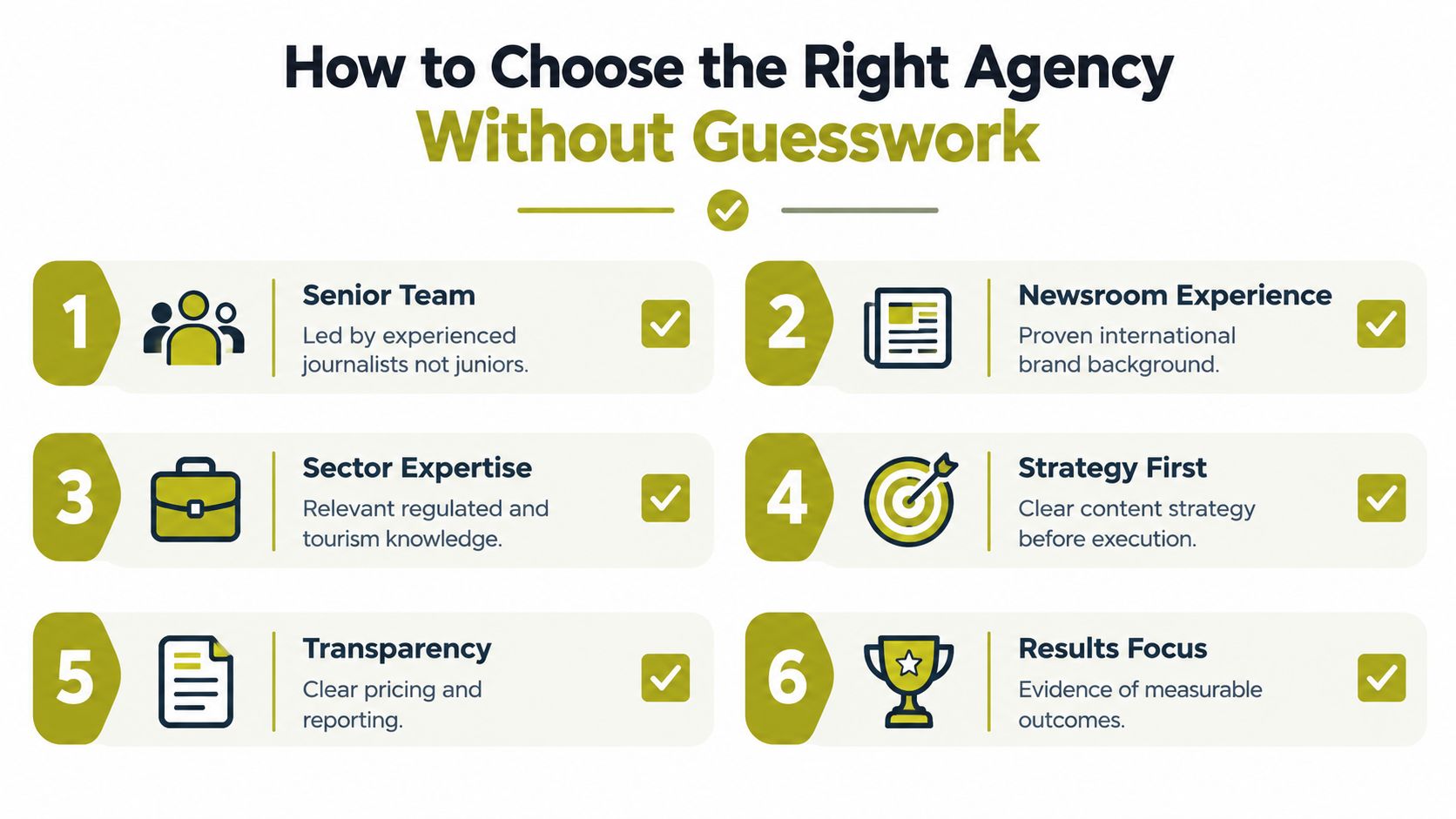
Seniority
Ask who will lead the account after the pitch. Not who appears in the sales meeting. Who will shape the strategy, edit the work, and challenge weak ideas?
Editorial background
This matters more than many buyers realise. England and Wales counted 63,560 PR professionals and 54,690 journalists in the 2021 Census, meaning PR outnumbered journalists by 8,870, according to Press Gazette's reporting on the PR and journalism workforce. In practical terms, genuine newsroom experience is a scarcer skill than generic communications experience.
Sector understanding
A tourism brief is not a regulated-industry brief. A property campaign is not the same as a founder-profile programme for a Scottish tech business. Agencies should show they understand the pressures, not just the labels.
Strategy before execution
Be wary if the first answer is “we'll produce X pieces a month”. A serious team wants to understand audience, channels, obstacles, and internal realities before locking output.
Transparency
You should know what's included, what isn't, who approves what, and how reporting will work. Clear scopes prevent awkward surprises.
Measurement maturity
The market is moving. UK marketing coverage notes that measurement conversations are shifting toward incrementality testing and media mix modelling, while AI is changing production economics faster than strategy, according to The Marketing Juice on UK marketing trends. If an agency can only talk about volume and last-click leads, it may already be behind.
The best agency answers hard questions plainly. It doesn't hide weak thinking behind vocabulary.
Questions worth asking in the room
Try these rather than the usual “what makes you different?”
- What would make you advise us not to publish a piece?
- How do you decide whether a topic should be a blog, a video, a press angle, or a landing page?
- What do you need from us to keep quality high?
- How do you report when content influenced a sale but didn't produce the final click?
- Who edits the work before it reaches us?
Those questions force an agency to reveal its operating model.
For some businesses, outsourcing itself is still an open decision. If you're weighing that up, Adwave's piece on should you outsource advertising is useful because it frames the choice around capability gaps rather than fashion.
Specialist senior team or large agency machine
This is usually the choice.
Large agencies can offer breadth, but they often carry overhead and layered delivery structures. The senior people may shape the opening strategy, while juniors run the day-to-day. A specialist senior-led model is different. Everyone who works for Carlos Alba Media is a former national news journalist or has agency experience of working with international brands. That changes the level of judgement applied to copy, media angles, crisis sensitivity, and executive positioning.
That doesn't make one model universally right. It does make the trade-off clearer.
Sector Notes for Scotland Regulated Industries and Tourism
Different sectors need different editorial instincts. A broad agency promise won't help much if the brief sits inside a Scottish growth market, a sensitive regulated environment, or an experience-led tourism business.

Scotland and the wider UK
Scottish SMEs and tech founders often need content that does two jobs at once. It must feel rooted enough to build trust locally while still speaking credibly to buyers, partners, and investors beyond Scotland.
That affects tone, proof, and distribution. A company might need founder profiling, category education, search-led service pages, and media-facing thought leadership running in parallel. For firms working in that environment, this overview of a digital marketing agency in Scotland gives a good sense of how local knowledge and national reach can sit together.
What to brief clearly:
- Commercial geography. Are you selling mainly in Scotland, across the UK, or internationally?
- Decision makers. Founder-led buying journeys need different content from procurement-led ones.
- Proof points. Awards, partnerships, investment news, and customer outcomes all support trust differently.
Regulated and high-risk sectors
In regulated industries, content can't just be persuasive. It has to be accurate, defensible, and sign-off ready.
That changes the process. Subject matter experts need to be involved early. Legal and compliance teams need sensible review routes. Crisis planning also matters because one misleading phrase or poorly handled media moment can drag attention away from the commercial message.
Accuracy is part of the strategy in regulated markets, not an admin step added at the end.
Useful metrics here are often qualitative as well as quantitative. Are enquiries better qualified? Are stakeholders clearer on the offer? Are spokespeople more consistent under scrutiny?
Tourism hospitality and lifestyle
These sectors live or die on vividness. Buyers need to picture the experience before they commit.
That's why blog-first thinking is often too narrow. Tourism and hospitality brands usually need a mix of visual storytelling, press-worthy hooks, short-form video, search-friendly local pages, and social content that feels native to the platform. The agency's job is to turn atmosphere into assets without losing commercial purpose.
Brief an agency on these points:
- Seasonality. Timing shapes what stories should lead.
- Audience mix. Day visitors, destination travellers, couples, families, and event-goers respond to different triggers.
- Operational pressure points. Peak periods, staff capacity, and booking windows affect what content can realistically support.
Real World Examples and Measurable Outcomes to Expect
Businesses often ask for examples because they want reassurance that content can lead somewhere concrete. That's fair. The problem is that many examples are reported badly. They focus on vanity metrics or tidy case-study numbers while ignoring how outcomes were created.
The better way to read results is to follow the chain. What was published or promoted? Where did attention come from? What changed in visibility, response quality, or conversion behaviour?
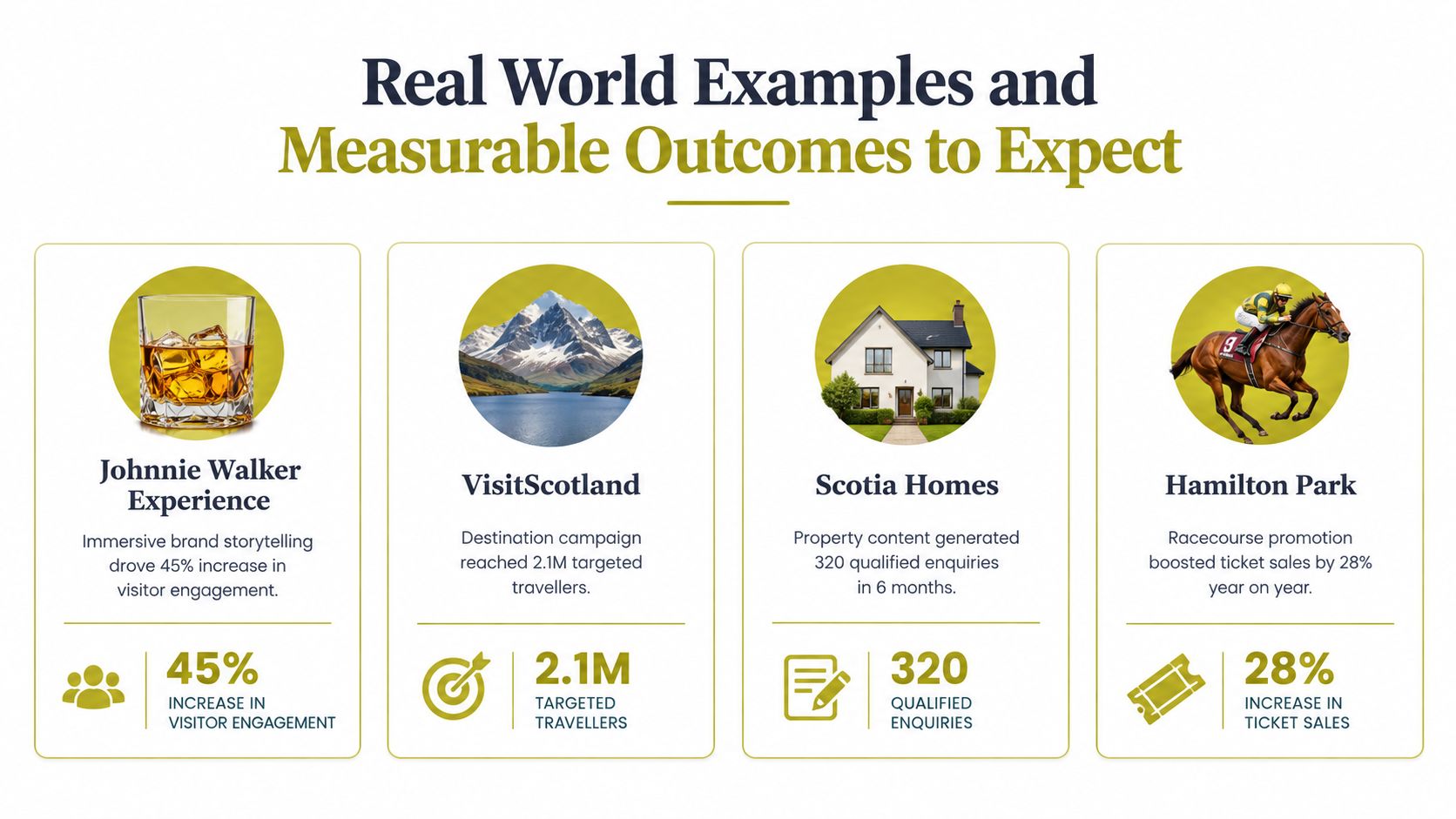
Four familiar campaign shapes
The Johnnie Walker Experience is the kind of brand that needs immersive storytelling, not just product description. In practice, that often means combining place, narrative, and media interest so the audience sees the visit as an experience worth discussing and sharing.
VisitScotland-style work usually relies on destination framing. The content has to balance inspiration with practical discovery. A good agency doesn't just describe a place. It helps shape why that place deserves attention now and through which channels that attention can spread.
Property work, such as campaigns around firms like Scotia Homes, usually depends on clarity and confidence. Buyers need practical detail, local trust, and content that answers objections quickly. Here, search visibility and landing-page quality often matter as much as storytelling.
Luxury or heritage brands such as Hamilton & Inches need tone control. The content must feel refined without becoming vague. Strong editorial judgement matters because one clumsy line can cheapen the entire impression.
What success should look like in reporting
Don't expect every useful result to appear as a direct lead on the same day. Some outcomes show up in coverage across broadcast, online, print, and social. Some appear as stronger search visibility for high-intent pages. Some become easier sales conversations because the prospect already trusts what they've seen.
One reporting shift matters here. UK marketing coverage notes that more teams are questioning whether content should still be judged mainly by last-click leads, with incrementality testing and media mix modelling getting more attention, as noted in the earlier trend discussion.
Another point is search position. Moving a page higher on page one can have a major effect on click volume because user behaviour is heavily position-sensitive, as covered earlier. That's why experienced agencies report on ranking movement, click-through improvement, assisted conversions, and the quality of incoming enquiries together, not in isolation.
Ask for reporting that helps you make the next decision, not reporting that merely proves work happened.
Next Steps With a Senior Led Agency You Can Trust
By the time most businesses look for a content partner, they're not short of ideas. They're short of clarity.
They need a sharper sense of what content is supposed to do, which formats deserve investment, and how to tell strong editorial judgement from polished agency packaging. Three decisions usually matter most. Be clear about the goal. Be honest about the level of seniority you need. Agree up front on how success will be judged.
For many SMEs and established brands, a senior-led model is the practical fit because it reduces the distance between strategy and execution. The person shaping the message also understands media reality, audience behaviour, and the commercial pressure behind the brief. That's especially useful when the work spans PR, digital, search, web journeys, and reputation management rather than just blog production.
Carlos Alba Media fits that senior-led pattern. It is a Scottish-led PR and digital marketing agency delivering senior-level counsel without big-agency overheads, founded and run by multi award-winning former national newspaper editor Carlos Alba. Its work across broadcast, online, print and social, plus digital content marketing, web performance, social media, media training and crisis support, reflects the fact that modern visibility is rarely a one-channel problem.
If you're weighing up your next step, the first conversation should be practical. It should cover your goals, audience, bottlenecks, existing assets, approval realities, and what measurement would count as useful inside your business.
If you want a content marketing agency in the UK that approaches your brand with newsroom discipline, Carlos Alba Media offers senior-led PR and digital marketing built around visibility, trust, and commercial outcomes. The team works across strategy, SEO content, media exposure, social, web performance, and crisis-ready communications, with practical execution shaped by former national news and international brand experience. Visit Carlos Alba Media to start a conversation about what your content should do next and how to make it earn attention rather than fill space.