
You're probably staring at a campaign that looked clean in the deck, then hit a compliance wall once legal, product, and risk got involved. Maybe the statement is ready, maybe the media team is already asking for comment, and the launch date is still moving because someone has flagged wording that sounded harmless in isolation but not under FCA scrutiny. That's the reality of financial services marketing in the UK, where a good idea only becomes a usable asset if it can survive regulation, editorial scrutiny, search intent, and customer scepticism at the same time.
That's why this playbook takes a newsroom-first view. Carlos Alba Media's specialist nature matters here, because everyone on the team is either a former national news journalist or brings agency experience with international brands. That combination is exactly what regulated brands need when they have to turn complex products into clear stories, then turn those stories into campaigns that get approved, indexed, and trusted. It also helps that modern distribution now depends on the same discipline journalists use every day, which is why an AI-powered LinkedIn growth tool can be useful when it's used to support, not replace, a credible narrative.
Why Financial Services Marketing Is a Different Game
A founder thinks the hard part is the launch creative. Then compliance pulls the headline, legal red-lines the offer, and a journalist emails for comment before the statement is signed off. That sequence is familiar because in this sector, financial services marketing isn't just persuasion, it's regulated communication with commercial pressure attached.
The UK regulatory backdrop is what makes the job harder, and more interesting. The FCA's Handbook requires communications to be fair, clear and not misleading, and the Consumer Duty raised the bar further by making customer understanding and outcomes central to product communication and marketing. The first FCA regulatory sandbox in 2016 and the Consumer Duty taking effect for open products and services on 31 July 2023 helped push financial services marketing into a more digital, more scrutinised operating model, where every claim and channel choice has to stand up before publication. That's why approval workflows, careful wording, and subject-matter expertise aren't admin overheads, they're the basis of the work realise.com explains the regulatory shift in UK financial services marketing.
Practical rule: if a line would worry a compliance officer when read aloud, it will probably worry a journalist too.
That's where a newsroom-trained team earns its keep. A former national news journalist knows how to strip a product back to the point that a producer, editor, or consumer understands it. A brand lead with international agency experience knows how to keep the message coherent across channels without creating a compliance pile-up. If you need a public-facing version of that thinking, this financial services PR approach is the sort of model that keeps messaging aligned with both reputation and regulation.
The point is simple. In this sector, the right system stops a launch from becoming a scramble. The wrong one leaves marketing, PR, and compliance fixing the same problem from different directions.
Building a Compliance-First Creative Brief
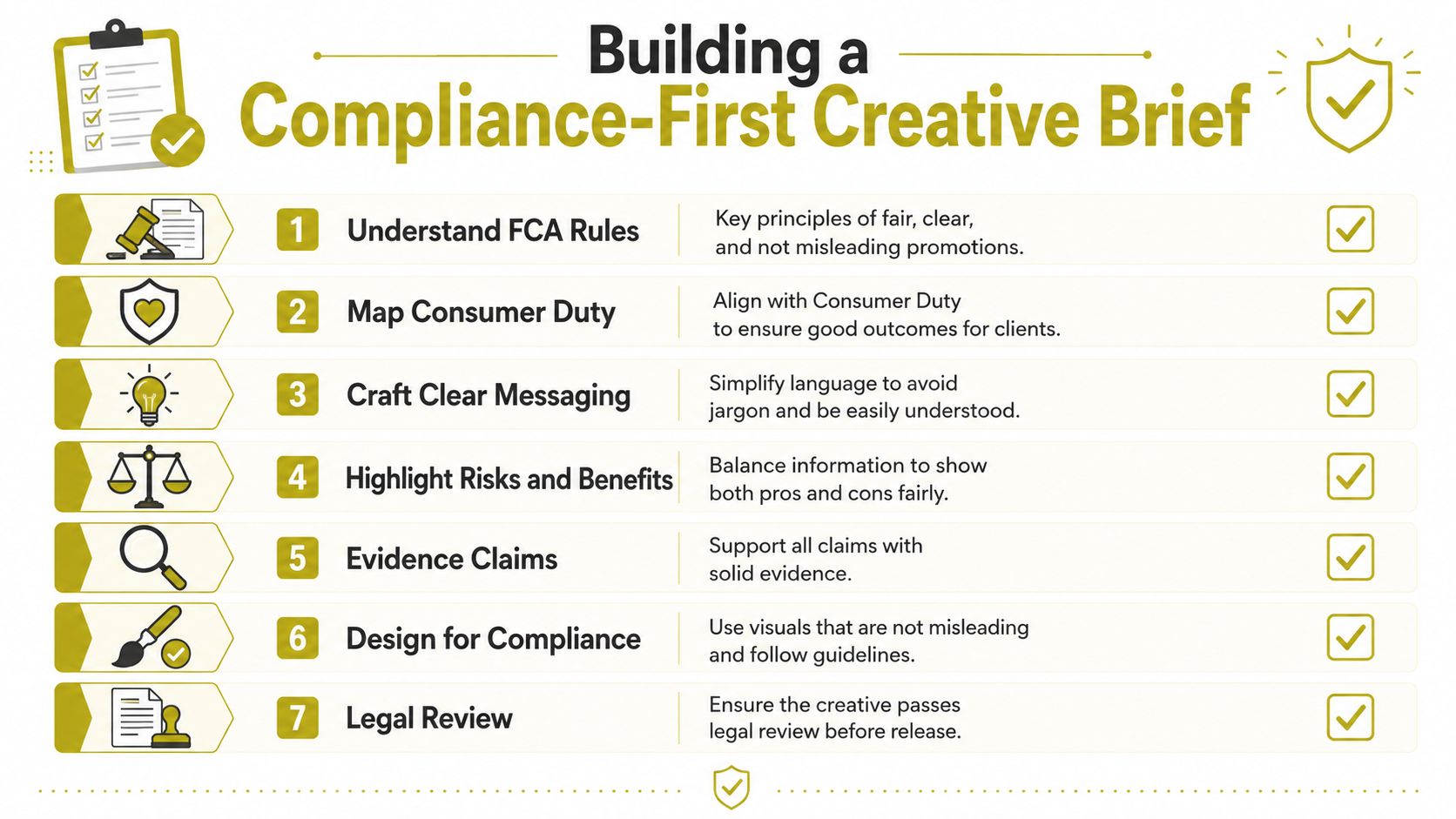
The cleanest financial campaigns start with the rules, not with the concept. In practice, that means the FCA's fair, clear and not misleading standard and the Consumer Duty should sit inside the creative brief, not outside it. If the brief doesn't already tell writers, designers, and channel owners what can be claimed, what must be qualified, and what the customer needs to understand before they act, the campaign is already undercooked.
Write for approval, not just attention
The biggest mistake is treating educational content and a regulated financial promotion as the same thing. Educational content can explain a market, a process, or a consumer issue in plain English. A financial promotion invites or induces consumers to engage in investment activity, which means the compliance threshold is higher and the wording has to be tighter. The FCA's financial promotions regime makes that distinction real, and firms need a dedicated compliance review process before anything goes live the FCA rules and promotion threshold are summarised here.
A newsroom habit helps here. Journalists check claims, balance, and sourcing before publication, and that same discipline maps neatly to regulated marketing. If a sentence can't be supported, qualified, or simplified, it doesn't belong in the copy.
Use this kind of rewrite logic:
Grey zone headline: “Discover smarter wealth growth today.”
Safer headline: “Understand how this wealth solution works, what it costs, and who it suits.”
Grey zone CTA: “Get started now.”
Safer CTA: “Review the product details and decide whether it fits your needs.”
Those rewrites do less hype, but they do more work. They reduce friction for legal review and make the user less likely to feel misled.
Build the brief like a newsroom pack
The brief should include the audience, the product, the required disclosures, the claims that need evidence, and the exact channel context. It should also say what the customer must understand after reading. That final point matters because the Consumer Duty puts understanding and outcomes at the centre, not just the click.
A useful one-page template includes:
Before anything is written, answer three questions, what is the product, what must the customer understand, and what evidence proves the claim.
If you need a practical reference point for brand structure, this guide to differentiate your advisory firm shows why positioning and proof have to travel together in regulated markets. For teams rebuilding their own rules, these brand guideline principles are a sensible internal starting point.
Mapping the UK Audience Before You Spend a Penny
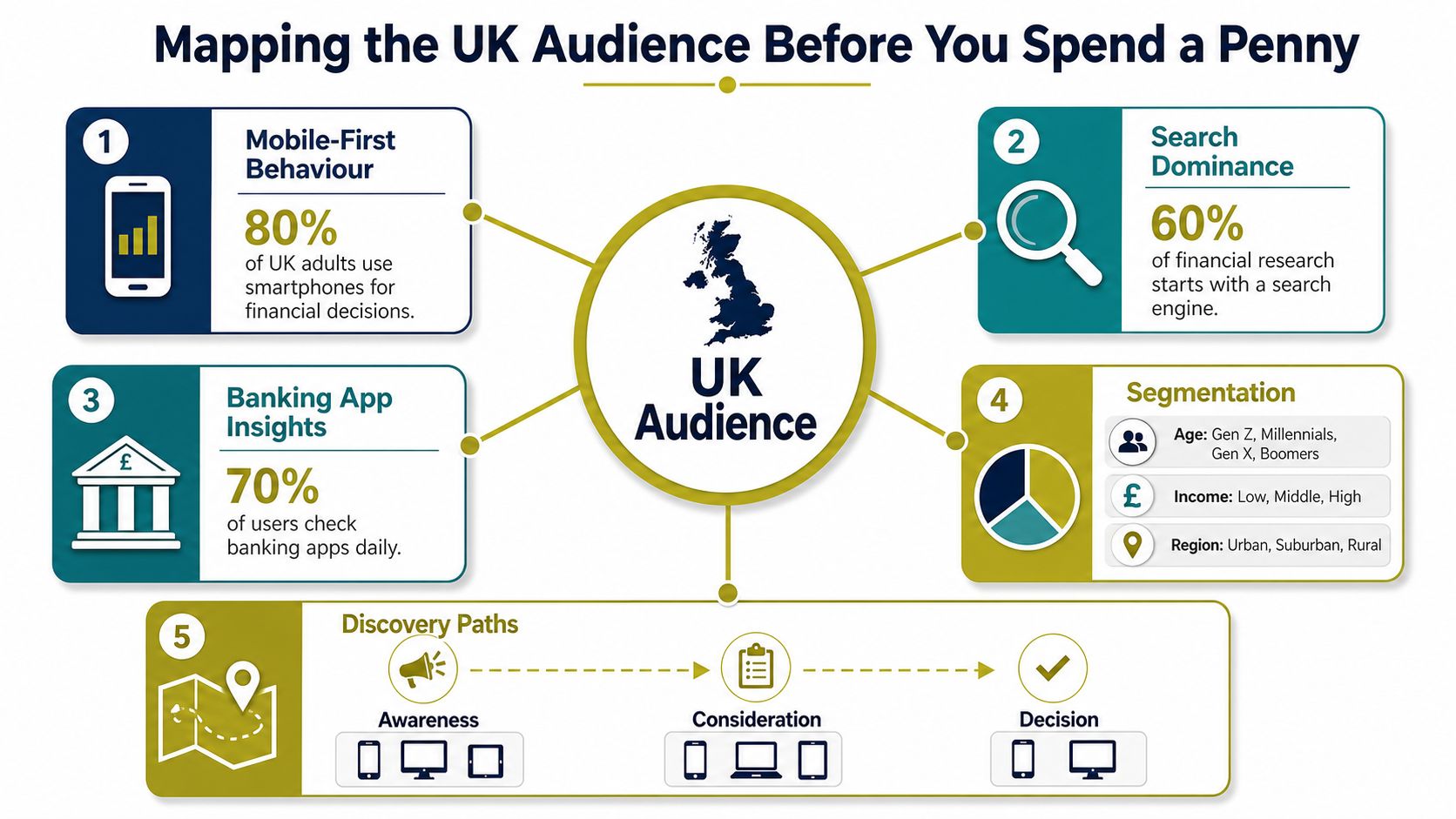
UK discovery is already mobile-heavy, and financial decisions increasingly happen in search, on phones, and inside banking journeys. Ofcom reported that in 2024 89% of UK adults were online, 79% used mobile phones to access the internet, and 64% used their mobile phone for online banking, while 61% used online banking overall Ofcom and related UK digital banking context are summarised here. That means your audience map can't begin with age bands alone. It has to begin with intent, device, and the kind of help the customer wants.
Segment by behaviour, not just demographics
A useful first-party stack in financial services brings together customer data, channel interactions, media habits, lifecycle stage, lifetime value, and abandoned-application signals. Then it adds a practical layer, touchpoint preference. Some customers want service by phone, some prefer a sales conversation by email, and some only want problem resolution through a secure channel. That difference is where many campaigns fall apart, because a single route rarely works across the full customer journey the logic of building the database around touchpoint preference is laid out here.
For planning, use a matrix like this:
- High-intent searchers: researching fees, eligibility, comparisons, or product features.
- Application abandoners: already interested, but stopped before completion.
- Existing customers: open to cross-sell, retention, or service-led education.
- Problem-resolution seekers: need reassurance, not an offer.
- Mixed-channel users: browse on mobile, convert later on desktop or with human support.
Read the human story in the data
A newsroom-trained marketer looks for the human reason behind the behaviour. A search query about “best savings account” isn't just keyword research, it can signal anxiety, caution, or a recent life event. An abandoned application may mean doubt about affordability, not lack of interest. That kind of reading changes the campaign, because the copy, channel, and follow-up sequence all have to match the emotion behind the action.
Practical rule: if the segment describes a person as a data point, it's too broad.
For teams refining the audience view, consumer insights research should sit beside CRM analysis, not after it. The strongest campaigns aren't built from demographics first, they're built from intent, friction, and the channel a real person is prepared to use.
Channel Strategy That Survives an FCA Inspection
If a financial customer is already comparing providers, the channel mix has to reflect how they decide. SEO catches the high-intent query. PR earns the trust signal that makes the search result credible. Paid media activates demand. Social keeps the brand visible. Content makes the explanation usable. The sequence matters, because in regulated sectors, broad reach without trust is usually wasted spend.
Put SEO and content in front of the funnel
SEO is the anchor because it captures people who are actively looking for answers, comparisons, or product details. Financial services brands win here when they publish specific, plain-English content that explains suitability, charges, exclusions, and outcomes. That kind of clarity helps users and compliance at the same time, which is rare in marketing and valuable when the sales cycle is long.
The sector's conversion profile also rewards discipline. A practical benchmark is that UK financial services firms typically allocate 8 to 14% of revenue to marketing, while growth-stage fintech and SaaS players may reach 25%, and the tracked average conversion rate in the sector is 6.35%, above the cross-industry average of 5.1% the benchmark figures are here. That suggests you shouldn't scatter budget equally across every channel. Concentrate on the ones that can carry intent and proof.
Use PR as a trust engine, not a vanity layer
Good PR supports the rest of the funnel. Coverage in reputable outlets helps brand search, lifts credibility, and gives sales teams something concrete to point to. It also gives recruiters and partners a cleaner story to tell. In financial services, that matters because people don't just buy the product, they buy the confidence that the firm understands the market and will still be there when things get difficult.
Sequence paid, social, and owned media deliberately
Paid search is usually the most obvious activation channel because it meets demand at the moment of intent. Social works better as a community and retargeting layer than as a broad acquisition machine. Owned content then does the heavy lifting on deeper questions, product education, and retention. If the budget is tight, hold back from trying to make every channel do the same job.
| UK Financial Services Channel Conversion Benchmarks | ||
|---|---|---|
| Channel | Tracked Conversion Rate | Role in the Funnel |
| Referral traffic | 7% | High-trust, often later-stage acquisition |
| Paid search | 6% | High-intent activation and comparison traffic |
| 5.8% | Nurture, reactivation, and conversion support | |
| Organic search | 4.7% | Discovery, education, and long-tail intent |
| Direct | 4.4% | Brand recall and repeat visits |
Those tracked rates were reported in independent UK analysis of financial-services marketing performance here. The budget conversation should follow the same logic, highest-converting sources first, trust-building second, vanity third.
PR, Media Training and the Interview That Matters
A treasury announcement, a fintech rebrand, or a Consumer Duty update can all become a national story if the angle is clear enough and the spokesperson can handle the pressure. The mistake many brands make is treating media relations as a separate service from marketing. It isn't. In financial services, a good interview can create the same trust effect as a well-placed article, and a bad one can undo months of careful positioning.

What makes a story bookable
Broadcast producers and features editors want one thing first, relevance. A regulated product only becomes usable to them when the hook is current, the language is clean, and the spokesperson can explain the impact without hiding behind jargon. That's where newsroom instinct helps. A former journalist knows what a producer will cut, what a subeditor will query, and what a presenter will challenge live on air.
The briefing document should be tight. Include the hook, three proof points, one clear quote, and the line the spokesperson must not cross. Then rehearse the bridging technique, because the best media training is not about memorising answers. It's about steering back to the approved message without sounding evasive.
Keep the interview inside the rules
Off-the-record talk should be treated with care, because it doesn't help a regulated brand if informal remarks drift into the wrong place. The spokesperson also needs to know when to stop, when to qualify, and when to say they'll come back with detail. That discipline protects the brand more than bravado does.
The right interview prep checklist is simple:
- One message only: if the spokesperson can't say it in one line, it isn't ready.
- Three proof points: enough to sound credible, not so many that the message fragments.
- One escalation route: know who approves follow-up after the interview.
- One red line: define what cannot be discussed on air.
- One fallback statement: prepare for questions the spokesperson can't answer live.
A useful reference for brand teams is best practices for reputation management, especially when media interest follows an operational issue or a regulatory update. In this sector, the interview is never just an interview. It's also an internal test of whether the brand can speak clearly when it matters most.
Budgeting, Bidding and Where the First Pound Goes
The most defensible budget plan starts with the reality that UK financial services firms usually spend 8 to 14% of revenue on marketing, with growth-stage fintechs reaching 25% as benchmarked here. That range doesn't tell you where to spend it, but it does tell you that the sector has enough room for a serious mix of performance, trust-building, and compliance-led work. The wrong response is to spread spend evenly and hope attribution sorts it out later.
Spend where intent already exists
The first pound should usually go into the channels that already show commercial intent. In practical terms, that means paid search for immediate demand capture, SEO for compounding search visibility, and content that answers the questions buyers are already asking. Referral traffic, which has the highest tracked conversion in the data available, deserves particular attention because it often reflects trust that has been earned before the click the conversion benchmarks are here.
A regulated challenger brand planning a £1m annual budget might think in terms of function rather than vanity:
- SEO and content: long-term discoverability, product education, and search capture.
- Paid search and paid social: intent activation and retargeting.
- PR and thought leadership: trust, credibility, and brand search support.
- Compliance, review, and crisis reserve: the buffer that keeps the programme live when something unexpected lands.
- Research and audience insight: the input that stops segmentation from becoming guesswork.
That's a planning model, not a fixed formula. The key is to fund the channels that move the customer forward, then leave space for the trust work that won't always show up in last-click reporting.
Don't confuse digital with universal access
A lot of marketing plans assume that “more digital” is always the answer. It isn't. The FCA estimated 1.1 million UK adults were unbanked in 2022, and the ONS found 8% of UK adults were internet non-users in 2024, with non-use concentrated among older and lower-income groups the exclusion gap is noted here. If the campaign only works for people who are already online, already comfortable, and already fully banked, it's leaving reach and trust on the table.
That doesn't mean abandoning digital. It means adding assisted onboarding, plain-language print, community partnerships, and human support where they're needed. It also means designing the digital journey so the language is understandable before the app is opened. Brands that do that tend to improve the journey for everyone, not just the excluded cohort.
Practical rule: accessibility is not a separate campaign. It's what makes the main campaign usable.
The brands that get this right usually end up with cleaner funnels, fewer support dead ends, and a stronger reputation with both customers and regulators. That's why the first pound should buy clarity, not just clicks.
Crisis Comms and the 24/7 Rule That Protects the Brand
A crisis is rarely the first problem. It's usually the point where a slower issue, weak process, or vague message becomes visible to everyone at once. If a data breach, mis-selling allegation, or social media flare-up hits a regulated brand, the first hour matters less because of the noise and more because of the choices made under pressure. In financial services, that's where the reputational and compliance risks overlap.
Build the standing response before you need it
Every serious regulated brand should have a media lawyer on retainer, a pre-approved holding statement, a trained spokesperson, a documented chain of command, and a war-room cadence that can be activated without confusion. Those things sound obvious until the first incident lands and nobody agrees who signs off, who speaks, or what the public line should be. The FCA's expectations on fair, clear and not misleading communication still apply when the pressure is highest, which is why the response has to be disciplined from the start.
A workable first 60 minutes looks like this:
- Confirm the facts you know: don't speculate.
- Freeze uncontrolled messaging: stop ad hoc replies from going out.
- Activate approvals: legal, compliance, PR, and leadership in one chain.
- Issue the holding line: short, factual, and careful.
- Brief the spokesperson: one message, one escalation route, one no-go area.
Use the crisis to strengthen the next normal
The response after the event matters too. If the issue exposed a weakness in customer communication, then the follow-up content needs to address the confusion plainly. If it exposed a channel problem, the response plan should include assisted routes for customers who can't or won't resolve things online. That's also where digital exclusion comes back into the picture, because a crisis often proves that not every customer can be served through the same interface.
The practical rollout is straightforward. Days 1 to 30 should focus on the compliance review, brief rewrite, and audience refresh. Days 31 to 60 should cover channel sequencing, content production, and PR pitching. Days 61 to 90 should move into measurement, optimisation, and crisis rehearsal. The measures that matter most are assisted conversion, share of high-intent search, quality coverage count, sentiment, and complaint volume.
A thoughtful crisis plan doesn't just limit damage. It shows customers, journalists, and regulators that the brand knows how to speak when it's under pressure, not just when the market is calm.
Carlos Alba Media helps financial services brands turn complex propositions into compliant, credible campaigns that can work across PR, SEO, content, social, and crisis response. If you want senior-level counsel grounded in newsroom discipline and digital execution, visit Carlos Alba Media and start a conversation about the next campaign, the next launch, or the next issue that needs careful handling.