

Thirty-six per cent of primary pupils in England are now educated in Multi-Academy Trusts, a detail that changes how any local school story should be read. Within this context, Step Academy Trust is not a one-school operation or a loose partnership. It sits inside a system where governance, staffing, budgets and public accountability increasingly operate at trust level rather than solely at school gate level.
That makes Step Academy Trust worth examining on two levels at once. It is, on one hand, a specific organisation with named academies, a workforce, and a footprint in communities. On the other, it is a useful case study in how academy trusts have become one of the most important delivery models in English education, admired by some for scale and coherence, and questioned by others for distance between central leadership and local families.
What Is Step Academy Trust
Step Academy Trust is a Multi-Academy Trust, or MAT, operating across seven member academies, with approximately 380 employees and annual revenue of $17.6 million, according to its company profile. The same source places it within a national shift in which 36% of primary pupils across England are now educated in MATs.
Those figures matter because they frame Step not as a small administrative wrapper but as part of a structural change in schooling. In a MAT, schools remain visible to parents as individual academies, with their own pupils, staff and local identity. Yet strategy, oversight and many operational decisions are increasingly organised across the trust.
Why MATs matter
A MAT can pool expertise. It can also centralise decisions. Both points are true, and both shape public debate.
For supporters, the model offers obvious advantages:
- Shared leadership: Senior staff can work across schools rather than being confined to one site.
- Common systems: Safeguarding, finance, curriculum planning and recruitment can be handled with more consistency.
- Broader resilience: A school facing staffing or operational strain may draw support from the wider trust.
Critics raise a different set of questions:
- Local voice: Parents often want to know where final decisions sit.
- Transparency: Trust structures can feel more corporate than the old governing body model.
- School identity: Central strategy may sit uneasily with community-specific needs.
Practical rule: When assessing a trust, readers should separate the legal structure from the lived experience. The same model can produce confidence in one community and unease in another, depending on leadership, communication and results.
Step Academy Trust sits in the middle of that wider conversation. Its significance comes not from national scale alone, but from representing the increasingly common reality that families may think they are dealing with one school, while many important decisions are made within a larger trust framework.
The Trust's History and Mission
Trusts often describe themselves through mission language first and structure second. That order matters. It tells you what leaders want the public to notice before they look at governance charts or financial summaries.
Near the start of any profile of Step Academy Trust, the visual message is unmistakable: education leadership is presented as organised, professional and collective.

The trust's public identity suggests a model built on common purpose across its schools, rather than on isolated institutions working alone. That is the standard pitch for MATs across England. The strongest among them argue that children should not experience a postcode lottery of quality due to one school having stronger systems than another. A trust mission, in that reading, is a promise to spread capacity.
A mission expressed through networked schooling
What can be said with confidence from the available record is that Step Academy Trust has been built as a group rather than a single flagship academy. That alone implies a founding logic based on shared governance and collective educational direction. In practice, trusts like this tend to frame their work around consistency, opportunity and school improvement, even though the exact emphasis often varies from one academy to another.
That wider logic is easier to grasp when seen rather than described. One of the public-facing videos associated with the trust format captures the aspirational language that often surrounds academy leadership and school culture.
What mission statements can and cannot tell you
Mission language is useful, but limited. It tells you what a trust wants to stand for. It doesn't, by itself, prove how evenly those principles are experienced by families, staff or pupils across different schools.
A careful reading of any academy trust mission should test three things:
| Question | Why it matters |
|---|---|
| Is the mission consistent across schools? | A trust only works if shared values survive local variation. |
| Does leadership link values to decisions? | Words count less than how budgets, staffing and support are allocated. |
| Can communities recognise the mission in daily school life? | Parents usually judge trusts through responsiveness, culture and standards, not slogans. |
For Step Academy Trust, the central story is less about a single founding myth and more about an educational philosophy embedded in network form. The trust asks to be judged not only on one school's ethos, but on whether a group of academies can be steered by a common purpose without flattening the distinct character of the communities they serve.
Schools and Locations in the Network
A trust becomes real when it is mapped. Until then, it can remain an abstraction made up of policy language and organisational diagrams.
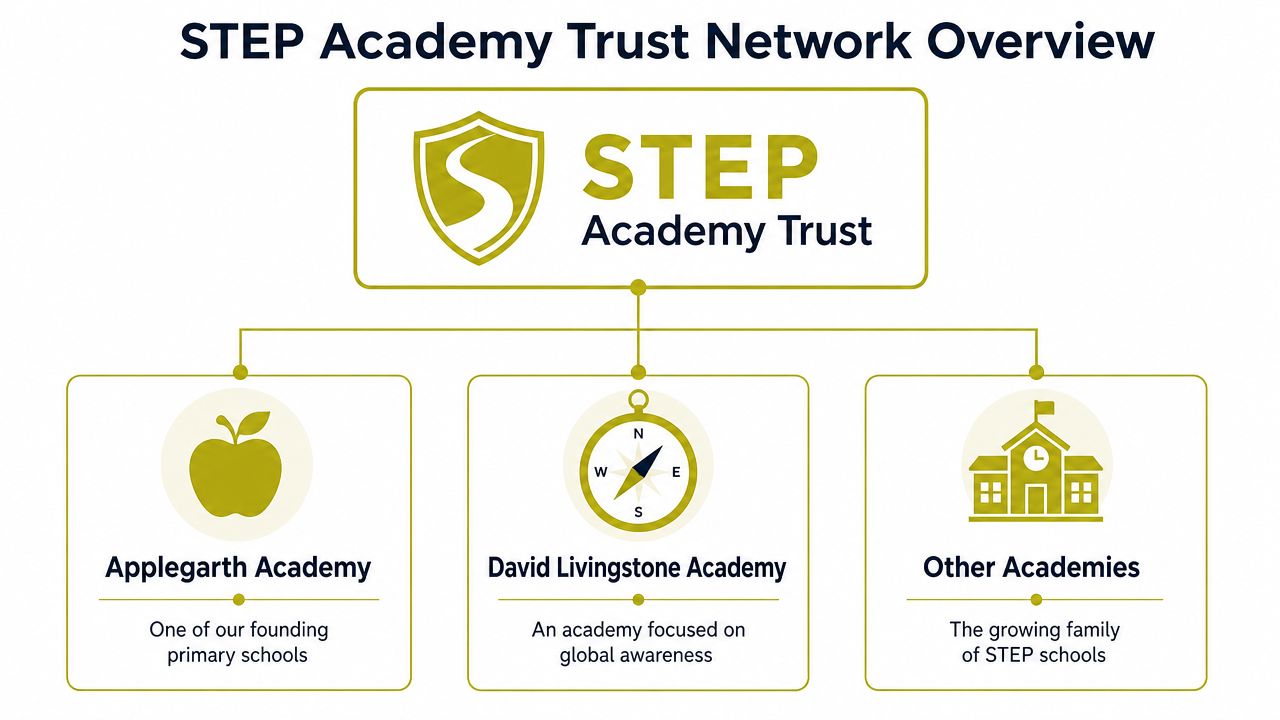
Step Academy Trust's public company profile identifies Applegarth Academy, David Livingstone Academy and Gonville Academy among its seven member schools, placing those names within a broader network rather than a stand-alone institution set-up. The practical implication is straightforward. Parents encounter individual academies. Leadership manages an interconnected system.
Named academies and what they signal
The school names themselves hint at the blend of locality and institutional branding common in trusts.
- Applegarth Academy: The name carries a distinctly local, primary-school feel. In trust settings, schools like this often serve as the community-facing heart of the network, where reputation is built through everyday parent contact.
- David Livingstone Academy: This is a name with historical and outward-looking associations. It suggests a school identity that can support themes of ambition, exploration or global awareness.
- Gonville Academy: This title sounds rooted and established, the kind of name that tends to signal continuity within a neighbourhood or local tradition.
The remaining academies in the network are not all named in the verified material available here, and that gap is worth noting. It doesn't mean those schools are obscure. It means that any serious profile should distinguish between what is clearly documented and what would need further public records work, including direct trust material, school websites or formal information requests.
Mapping a trust is more than listing schools. It means asking how far apart they are, what communities they serve, and whether central leadership understands those differences or simply manages around them.
Community footprint
A school trust's local effect doesn't only show up in exam data or inspection language. It appears in routines. Which families can get to a site easily. Whether staff move between academies. How support is offered when one school faces pressure. Whether parents feel heard by school leaders who are nearby, or by trust officers they may never meet.
A useful way to think about Step Academy Trust's footprint is through three overlapping geographies:
The school gate geography
Most families experience the trust within the school gate geography, through drop-off, assemblies, newsletters and concerns raised to a headteacher.The workforce geography
Staff may work within one academy but operate under trust-wide expectations, policies and professional culture.The governance geography
Decisions can be local in appearance while strategic authority rests higher up the chain.
That layered structure is one reason academy trusts generate both loyalty and friction. A well-run network can widen opportunity and reduce isolation between schools. A poorly explained one can leave communities unsure who is accountable for what. Step Academy Trust's seven-school network places it squarely inside that tension.
Governance and Leadership Structure
The governance of a MAT can feel technical until something goes wrong. Then everyone wants the organogram immediately.
In a trust like Step Academy Trust, accountability usually operates on two levels. There is a central trust tier, where the board and executive leaders oversee the organisation as a whole. Then there is the academy tier, where local bodies, school leaders and community-facing structures handle day-to-day life and local scrutiny.
The trust board and executive team
The trust board carries the highest level of responsibility. It is where legal accountability sits. Trustees are typically concerned with standards, finance, risk, safeguarding and long-term strategy across the full network, not just one school.
The executive side turns that oversight into operational control. That means implementing policy, managing central services, supporting school leaders and making sure trust-wide priorities are followed.
A simple way to distinguish the layers is this:
| Level | Main function |
|---|---|
| Trust board | Sets direction, holds overall responsibility, oversees risk and accountability |
| Executive leadership | Runs the trust's strategy in practice across schools |
| Local governance or advisory bodies | Brings local knowledge, challenge and community connection |
| Headteachers and school leaders | Manage the daily educational life of each academy |
For parents and staff, the difficult part is often knowing where one role ends and another begins. A complaint about classroom practice belongs in one place. A concern about trust policy may sit elsewhere.
Why local governance still matters
Even in centralised trusts, local governance isn't decorative. It can provide context the centre won't always see quickly enough. Attendance patterns, neighbourhood pressures, parent confidence and staffing culture are often understood first at school level.
That local layer also matters in safeguarding culture and volunteer oversight. Organisations working with children often review wider sector guidance on vetting and screening, and a practical starting point for understanding that field is this overview of a nonprofit background check company, which helps explain how charities and mission-led bodies approach safer recruitment and volunteer assurance.
Accountability test: If a parent can't tell who has the power to fix a problem, the structure may be legally sound but publicly weak.
Leadership communication matters here. Trust executives who may need to speak under pressure, whether to staff, families or the press, usually benefit from preparation. The dynamics are similar to any high-scrutiny institution, which is why media-facing leaders often seek executive media training before an issue becomes urgent.
Performance Metrics and Ofsted Results
Performance is where public patience with governance theory tends to end. Families want to know whether children are doing well, whether inspection outcomes support trust claims, and whether weak schools are improving.
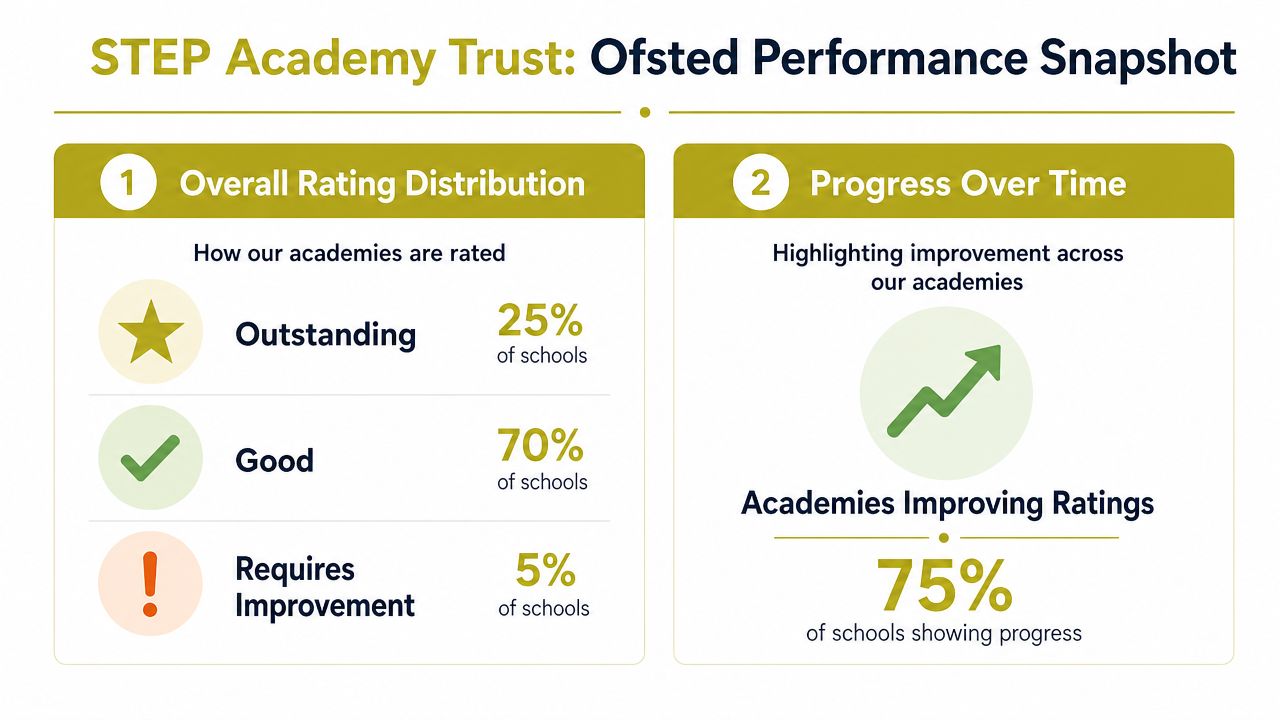
That's also where caution is needed. The available verified data for Step Academy Trust establishes its scale, but it does not provide a full set of trust-wide Ofsted outcomes or comparative attainment figures. Any article that pretends otherwise would be doing PR, not reporting.
What can be assessed responsibly
A responsible performance assessment of Step Academy Trust should draw from public inspection reports for each academy, trust publications and direct accountability documents. In the absence of a verified trust-wide dataset here, the most accurate conclusion is procedural rather than numerical: the trust should be judged school by school and then at trust level, not the other way round.
That distinction matters because trusts often contain variation. One academy may have stable leadership and strong inspection outcomes. Another may be dealing with turbulence, staffing changes or legacy issues that don't show up in a headline description of the group.
Readers should keep four questions in mind when looking at performance:
- Inspection consistency: Are schools across the network moving in the same direction, or is quality uneven?
- Improvement capacity: When a school struggles, does the trust intervene early and clearly?
- Transparency: Are difficult outcomes explained plainly, or folded into broad mission language?
- Community confidence: Do parents and staff recognise the trust's account of performance?
Looking beyond the headline grade
Ofsted remains the best-known accountability marker, but it isn't the whole story. Inspection grades compress a large amount of lived school experience into a short judgement framework. They don't always capture how a trust handles transition, communicates with families or supports staff between inspections.
For families comparing early years and school pathways, inspection literacy matters across the whole education journey. Parents trying to understand local quality signals often start with guides to Ofsted-rated childcare choices, then carry the same habit of evidence-checking into primary school decisions.
For journalists, campaigners and parents who want firmer documentary evidence, formal requests can be more revealing than marketing copy. Knowing how to make a Freedom of Information request is often the difference between repeating institutional claims and testing them.
Public trust in school performance doesn't depend only on strong results. It depends on whether weak results are acknowledged quickly and explained honestly.
In that sense, the most important performance question for Step Academy Trust isn't whether it can present a positive narrative. It's whether its public record, school by school, supports one.
How to Engage with the Trust
Engagement with Step Academy Trust isn't ideological. It's practical. A parent wants a place. A teacher wants to know what working there feels like. A partner organisation wants to speak to the right person without getting lost in a central structure.
For parents
Admissions usually begin at academy level, even when the wider trust shapes policy and oversight. Parents should start with the school they're interested in, not the abstract trust brand.
A sensible approach looks like this:
- Identify the specific academy you want to contact and check its admissions information, published policies and term dates.
- Read the trust context alongside the school context so you understand both local culture and central oversight.
- Ask where decisions sit if you have a concern about special provision, behaviour policy or pastoral support.
Parents who want a clearer sense of school communications may also find it useful to look at examples of a strong newsletter for school, because routine communication often tells you more about a school's culture than a prospectus does.
For prospective staff
Teachers and support staff should assess a trust on two tracks at once. One is the individual academy. The other is the employer structure that sits above it.
Useful questions include:
- Professional development: Is support organised within the school, across the trust, or both?
- Leadership access: Do staff feel decisions are made close enough to classroom reality?
- Culture: Does the trust offer coherence without becoming rigid?
A trust can be attractive to staff if it broadens career routes and creates cross-school collaboration. It can feel less attractive if central systems are experienced as distant or overly prescriptive. The difference often becomes clear in how vacancies are described and how interviews are handled.
For community and commercial partners
Partnerships with academy trusts tend to work best when proposals are concrete. General offers of support often disappear into inboxes. Specific ideas travel further.
If you're approaching Step Academy Trust, it helps to be clear about:
| What to bring | Why it matters |
|---|---|
| A defined purpose | Trusts respond better to a clear educational or community benefit |
| Named schools or cohorts | Central teams need to know who would actually take part |
| Safeguarding awareness | Any proposal involving pupils will be judged through that lens |
| Delivery capacity | Schools need confidence that partners can follow through |
The trust model can make partnership easier because one relationship may open more than one door. It can also make entry slower, because central approval may be needed before local enthusiasm becomes action.
A Guide for Journalists and Media
For reporters, Step Academy Trust offers a better story than the standard academy explainer. The strongest angles don't begin with institutional self-description. They begin with tension, evidence and human consequence.
One obvious line is the scale story. A trust with multiple academies, a substantial workforce and a defined place in the MAT sector can be used to examine how local schooling changes when strategy is set across a network rather than by a single governing body. Another is the accountability angle. Do parents understand where power lies, and does the trust explain that clearly when difficult issues arise?

Stronger media angles than a routine school profile
Journalists covering Step Academy Trust could pursue several distinct lines of enquiry:
- The local versus central tension: How much autonomy do individual academies retain in practice?
- Leadership under scrutiny: Who speaks for the trust when controversy lands?
- Community texture: Do families experience the trust as supportive, remote, or both at different times?
- Policy in everyday life: What does the MAT model look like when translated into daily school life?
Human-interest reporting also has room here, but it should be disciplined. A profile of one school leader, parent or pupil only becomes useful if it illuminates the wider trust structure.
Why newsroom experience matters
Specialist communications expertise becomes relevant to the media itself, not just to the organisations being covered. Carlos Alba Media's team is explicitly composed of former national newspaper and broadcast journalists who apply insider expertise to craft compelling narratives for media exposure, as set out on its media exposure page. That matters because education stories are often mishandled by institutions that either say too little, say too much, or fail to recognise what a newsroom will treat as the actual story.
The wider make-up of the agency is equally specific. Everyone who works for Carlos Alba Media is a former national news journalist or has agency experience of working with international brands, a point reflected in its news-focused introduction. Its founder, Carlos Alba, is a former national newspaper editor with a 20-year career in national journalism, most recently as Editor of Sunday Times Scotland, according to his industry profile. His background also includes over a decade in senior executive roles at The Herald and The Daily Record, as noted on his Page Turner Awards profile.
A good education story rarely turns on whether a trust can produce a statement. It turns on whether the statement survives contact with parents, documents, inspections and lived experience.
For journalists and media professionals, that makes Step Academy Trust a useful subject. It sits at the intersection of policy, local identity, leadership and public accountability. It also shows why media strategy around schools needs specialists who understand both how institutions work and how national newsrooms think.
If you need help shaping an education story, preparing leadership for scrutiny or building a media strategy grounded in newsroom reality, Carlos Alba Media offers specialist support led by former national journalists and senior communications professionals.