
Your school newsletter probably starts with good intentions. Someone chases updates from staff, drops them into a template, adds dates, checks spellings, sends it out, then hopes parents read it.
Too often, they don't.
That isn't because families don't care. It's because most newsletters for school are written like internal notices and consumed like media. Parents open them in crowded inboxes, usually on phones, while juggling work, pickups and dinner. If the message doesn't earn attention quickly, it gets skimmed, postponed or missed.
A better approach is to borrow from the newsroom. Journalists don't assume readers will care just because information is important. They select the strongest angle, lead with what matters, cut clutter and make every line work harder. That's the discipline that turns a routine school update into something people actually read.
Thinking Like a News Editor Not an Administrator
A weak school newsletter usually has one fundamental problem. It treats publication as paperwork.
An administrator's instinct is to include everything. A news editor's instinct is to ask what matters most to this audience, today, and how to make it clear in the first few seconds. That difference changes everything, from subject lines to story order.
Treat it like a publication
A school newsletter isn't just a vessel for reminders. It's one of the most regular expressions of your school's voice, standards and values. Parents form impressions from tone as much as content. If every edition feels cluttered, vague or late, that communicates something too.
Newsrooms work on three assumptions:
- Attention is earned: readers won't reward effort they can't see.
- The top line matters most: lead with the update that affects people first.
- Every item needs a reason to be there: if it doesn't inform, reassure, explain or prompt action, cut it.
That last point is where many schools struggle. They confuse completeness with usefulness. The result is a long list of notices with no hierarchy.
A newsletter for school works best when it respects the reader's time as fiercely as a good editor respects the front page.
Find the story inside the update
A trip reminder is not a story. What pupils discovered on the trip, why it mattered and what families should know next is a story.
A staffing change is not a story on its own. The impact on continuity, support and pupil experience is.
This is the same discipline used in brand storytelling that gives facts a human shape. Schools often have richer material than they realise. A science fair becomes proof of curiosity. A reading initiative becomes a story about confidence. A lunchtime club becomes a sign of belonging.
The question to ask before publishing each item is simple: why should this reader care now?
What works and what fails
What works is relevance, brevity and judgement. Strong newsletters choose. They don't dump.
What fails is the all-in approach:
- Long intros: parents skip throat-clearing and look for the point.
- Buried deadlines: if a permission slip sits beneath five celebration items, some families will miss it.
- Institutional language: phrases that sound formal often sound cold.
The best school newsletters don't read like circulars. They read like a sharp weekly brief from a place that knows its community.
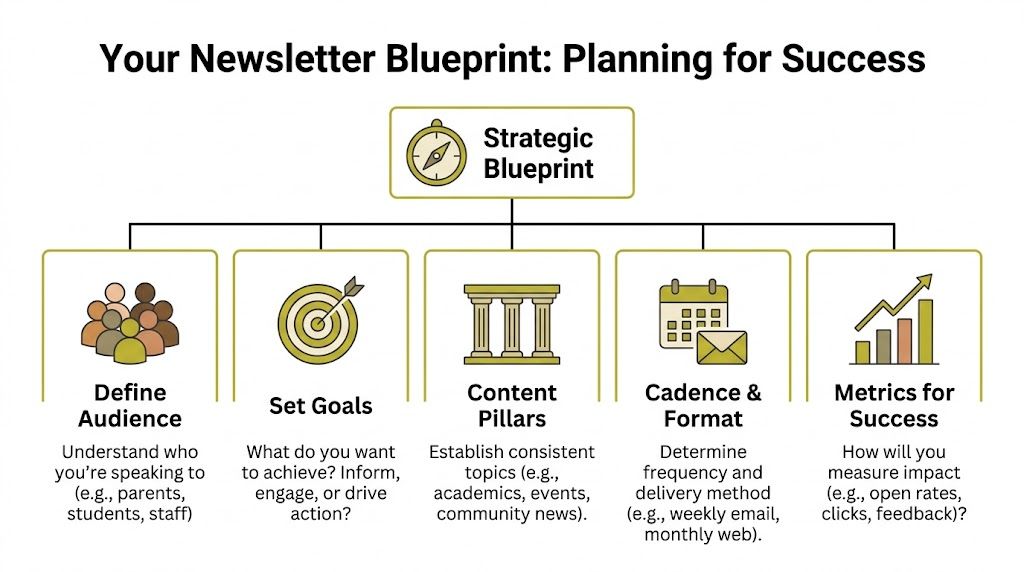
Your Newsletter Blueprint Planning for Success
Most schools don't have a writing problem first. They have a planning problem.
If you don't decide who the newsletter is for, what it needs to achieve and how you'll organise content, every edition becomes a scramble. Good output usually follows a clear publishing system.
Start with one job per edition
Schools often expect one newsletter to do everything at once. Inform current parents, impress prospective families, celebrate pupils, handle admin, support fundraising and reinforce reputation. It can do several of those things, but not with equal force in the same issue.
Pick a primary purpose first. For example:
- Parent action: forms, dates, events, attendance, reminders.
- Community trust: celebrating achievements, showing standards, demonstrating care.
- Admissions support: giving prospective families a feel for school life.
- Stakeholder confidence: helping governors, alumni or partners see momentum.
When an edition has a main job, decisions become easier. You know what goes first, what can wait and what belongs elsewhere.
Segment by real audience, not convenience
Many schools still produce one message for everyone because it's easier to assemble. It's rarely easier to read.
Existing guidance often recommends segmentation by year group, but there's a significant knowledge gap on how UK-specific factors such as independent versus state school dynamics or diverse family structures should shape this strategy. Tailoring content for these hyperlocal segments is an untapped opportunity for UK schools to dramatically increase parent engagement, as discussed in HubGem's analysis of school newsletter relevance.
That matters because a family in a rural catchment may need different practical information from a family in an urban independent school community. A household with shared caregiving arrangements may need cleaner, more direct signposting than a newsletter built around one assumed reader. A multilingual community may respond better to simpler sentence construction and stronger visual cues.
Build simple content pillars
A reliable newsletter for school needs repeatable categories. That stops every issue becoming an improvised heap of updates.
A practical structure looks like this:
- What parents must act on: deadlines, bookings, uniform notes, policy changes.
- What pupils achieved: selected stories with context, not endless lists.
- What staff are building: curriculum, clubs, pastoral support, trips, projects.
- What's coming next: one clear look ahead.
- Where to respond: a single route for bookings, forms or replies.
If you need a broader framework for structure and consistency, this guide to essential email newsletter best practices is a useful reference point.
Practical rule: If a content category appears in every edition, give it a fixed place. Familiar structure reduces friction for busy readers.
Plan the workflow before the writing
The schools that publish well don't rely on last-minute chasing. They set deadlines for contributions, nominate an editor and decide who has final sign-off.
Keep the production chain lean:
- one person gathers content
- one person edits for tone and clarity
- one person signs off legal, safeguarding and policy-sensitive items
- one person sends and monitors replies
That sounds simple because it should be. Complexity kills consistency.
Sourcing and Crafting Compelling Content
The fastest way to improve a school newsletter is to stop writing notices and start writing stories.
That doesn't mean turning every update into a feature. It means spotting the human angle, writing with pace and deciding what deserves prominence. News judgement matters just as much in a primary or secondary setting as it does in a newsroom.
Build a stronger story bank
Many schools publish the same safe material every week: dates, certificates, a trip photo, a reminder about PE kit. Useful, but forgettable.
A better mix includes pieces with texture and voice:
- A teacher spotlight: not a biography, but how they approach phonics, science practicals or pastoral care.
- A pupil's-eye view: one short account of a debate, performance or trip.
- Behind the scenes: what it took to stage the school production or organise sports day.
- One problem solved: a new reading corner, revised drop-off routine or wellbeing initiative.
- The small moment that says something bigger: a reception class gardening project can communicate culture more effectively than a paragraph of mission statement language.
If your content pipeline feels dry, it helps to explore powerful newsletter content ideas and adapt them to the rhythms of school life.
Write the opening like it matters
Journalists call the first sentence the lede for a reason. It decides whether the reader continues.
Most school newsletters waste that line. They begin with greetings, housekeeping or a bland summary. Instead, start with the most relevant development.
Weak:
"Welcome to this week's newsletter. We have lots to share from across the school."
Stronger:
"Parents of Year 6 pupils need to complete residential trip consent this week, and this edition includes the final timetable, kit list and staff contact details."
Or:
"Three pupils turned a lunchtime eco club into a whole-school recycling drive, and the results are already changing how classrooms handle waste."
One leads with action. The other leads with meaning. Both give the reader a reason to continue.
Use a newsroom editing test
Before anything goes in, run it through these questions:
- Is it new? If families already know it, does this version add context or urgency?
- Is it relevant? Which audience segment needs this?
- Is it clear? Could a busy parent understand it on a quick phone read?
- Is it active? "Book parents' evening slots by Thursday" beats "Parents' evening booking slots are now available."
- Is it worth the space? If not, move it to the website, app or a separate email.
Most readers won't complain that a newsletter was too short. They will quietly stop opening one that wastes their time.
Let people sound like people
Quotes can improve school newsletters, but only if they sound natural. Avoid stiff comments that read like they were written by committee.
Use quotes to add perspective:
- a pupil explaining what surprised them on a museum trip
- a teacher describing what changed in class after a project
- a headteacher giving a clear line on a policy change
Short is better. One honest sentence does more work than three polished but generic ones.
A practical pattern:
- sentence one gives the fact
- sentence two gives the human voice
- sentence three tells the reader what happens next
Make it accessible by default
Accessibility isn't a decorative extra. It's part of clear communication.
Use:
- Short paragraphs so mobile readers don't face a wall of text
- Plain language instead of internal jargon
- Descriptive link text so readers know where a click will take them
- Image choices with purpose so photos support the story rather than clutter the layout
- Consistent terminology for dates, forms, events and year groups
Schools that want newsletters to support wider reputation and enquiries should also think beyond the inbox. A strong edition can be repurposed into web stories, admissions content or parent-facing updates, which is central to content marketing for lead generation.
A quick before-and-after example
Below is the sort of rewrite that lifts an item from filler to useful copy.
| Version | Copy |
|---|---|
| Basic notice | Year 3 went to the farm on Tuesday and had a lovely time. Please see photos below. |
| Edited version | Year 3's farm visit turned this term's food-chain topic into something pupils could see and question for themselves. They met livestock handlers, compared feed routines and came back with notes that will shape next week's science writing. Photos and a short classroom follow-up are included below. |
The facts haven't changed. The writing has. That difference is what makes a newsletter worth opening.
Designing for Readability and Impact
Design decides whether your writing gets a chance.
Parents don't read school emails in ideal conditions. They scan between tasks, often on mobile, and make quick decisions about what deserves attention. If the layout fights them, the content loses.
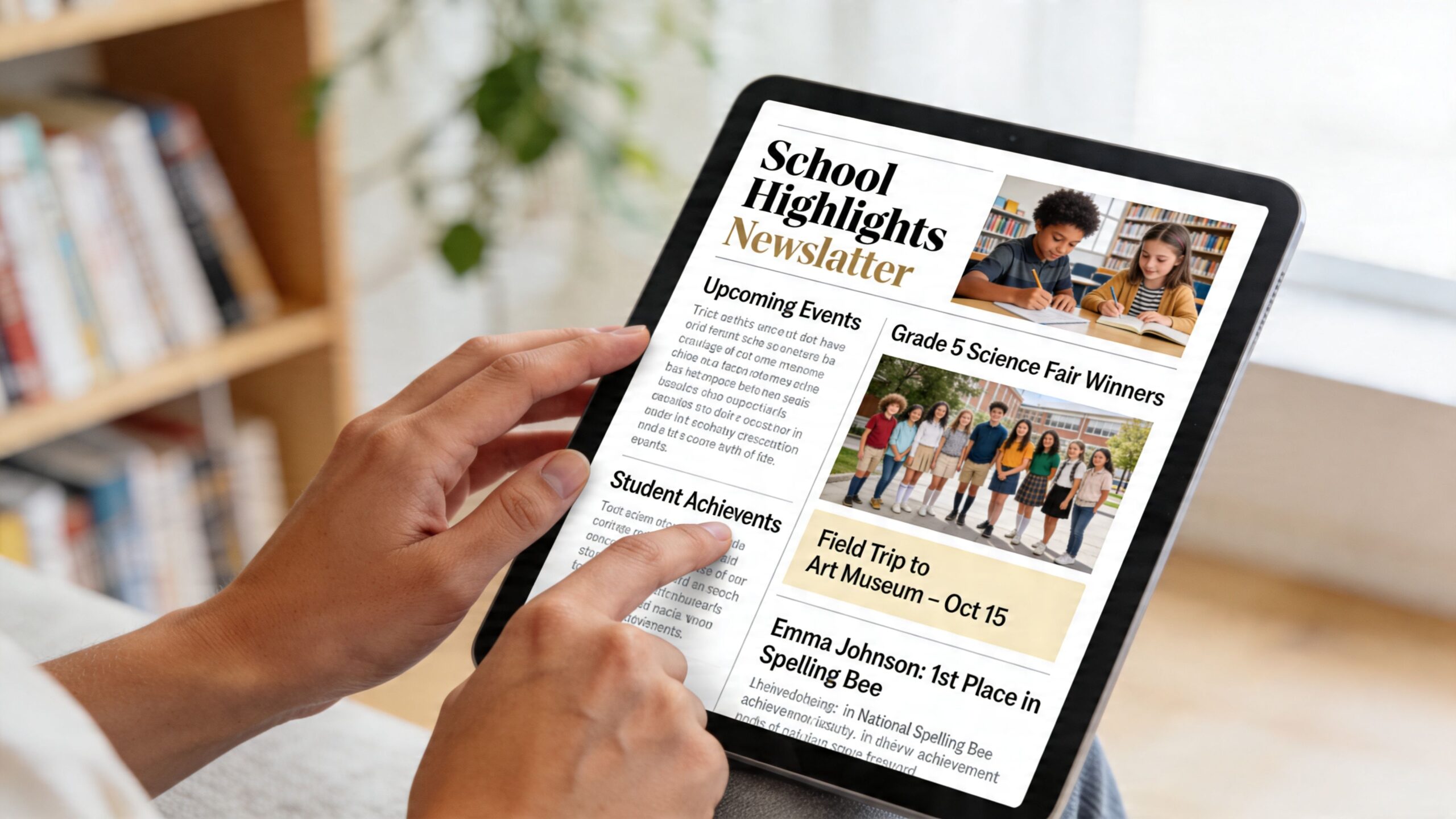
With over 70% of school email opens happening on mobile phones in UK family demographics, mobile-first design is not optional. The same source notes that placing a single clear call-to-action button early in the newsletter can increase clicks by as much as 371% in school email practice, which is why layout and action need to work together from the start, according to Ubiq Education's school email guidance.
Keep the layout calm
A good newsletter for school should feel easy before it feels impressive.
That usually means:
- One-column layouts: easier to scan on phones than split sections.
- Clear hierarchy: headline, short intro, action, then secondary stories.
- Consistent branding: school colours, logo use and type choices should feel familiar, not overdesigned.
- Purposeful imagery: one strong photo often does more than a crowded collage.
PDF-style thinking still causes problems here. What works on A4 often collapses on a handset. Design for the inbox first.
If the reader has to hunt for the one thing they need to do, the design has failed.
Put action high up
Schools often tuck the practical item beneath celebration content because it feels friendlier. In reality, readers need the urgent item fast.
A sharper order is:
- immediate parent action
- one key story or message from school life
- selected highlights
- upcoming dates
- secondary links
That sequence respects the reader. It also reduces the chance that important forms or bookings vanish beneath photographs and applause lines.
This short walkthrough shows the kind of visual discipline schools should aim for when shaping email content:
Use photos legally and intelligently
Photos matter because they make school life visible. But they need governance as well as taste.
Check consent status before use. Avoid images that identify pupils in ways your policy doesn't permit. Don't upload pictures just because they're available. Select images that advance the story: concentration in class, teamwork in rehearsal, participation on the pitch.
Video can help too, but only when it has a clear role. A short clip from a choir performance or STEM demonstration can add warmth. Ten loosely edited clips in one newsletter usually add friction.
Distribution Scheduling and Measuring Success
A school can write and design a strong newsletter, then still undermine it with poor timing and weak measurement.
The fix isn't complicated. It requires a schedule, a short list of metrics and the discipline to review what happened after each send. Schools often avoid this because analytics sounds technical. It doesn't need to be.
Know which numbers matter
For school email performance, the useful questions are straightforward. Did families open it? Did they click the key item? Did they ignore it, unsubscribe or report it as spam? Those signals tell you whether your judgement, structure and timing are working.
Top-performing UK schools record open rates of 40 to 49% and click-through rates of 2 to 4%. Data-informed send times such as 9 AM or 6 PM can also lift click-through rates by 20 to 30% in school email campaigns, as noted in the earlier research on UK school email performance.
That doesn't mean every school will hit those figures immediately. It does give you a realistic standard to work towards.
Read the data like an editor
Numbers don't improve newsletters on their own. Interpretation does.
If opens are weak, the likely issues are:
- subject lines that are vague
- inconsistent send timing
- low audience relevance
- inbox fatigue from too many similar updates
If opens are healthy but clicks are poor, look at:
- whether the key action appears too low in the email
- whether there are too many competing links
- whether the language around the action is too soft or unclear
If one segment consistently engages and another doesn't, the problem may be targeting rather than writing.
Editorial test: every metric should lead to a decision. If a figure doesn't change what you do next week, don't obsess over it.
Use a simple production rhythm
A dependable schedule removes panic and improves quality control. It also stops the newsletter from being assembled entirely on the day of send.
Here is a practical weekly model.
| Day | Task | Owner |
|---|---|---|
| Monday | Gather contributions from teachers, admin and leadership | Newsletter editor |
| Tuesday | Select top items, cut duplication, confirm deadlines and links | Editor and senior reviewer |
| Wednesday | Write and edit copy, source approved images | Editor |
| Thursday | Build email, test mobile display, check safeguarding and consent issues | Admin or marketing lead |
| Friday | Send newsletter, monitor replies, record opens and clicks | Sender or communications lead |
This won't suit every school, but the principle holds. Separate gathering, editing, checking and sending. Don't collapse them into one frantic afternoon.
Keep the review affordable and practical
You don't need an enterprise martech stack to improve a newsletter for school. Most email platforms already show enough to spot patterns. If resources are tight, pair platform data with a short parent pulse survey once in a while and ask specific questions: what do you always read, what do you skip, what do you want sooner?
There is a real gap in practical advice for smaller UK schools on measuring newsletter engagement without expensive software, and that's why simple analytics discipline matters so much in-house. For teams that want a more robust framework, specialist support around email marketing consultancy for measurable performance can help create a repeatable reporting model.
One final warning. Don't chase vanity. A high open rate means little if families still miss the booking link for parents' evening. Measure against action, not just attention.
Your First Edition and Beyond
The strongest shift you can make is mental, not technical. Stop treating the newsletter as a dumping ground for notices and start treating it as a publication with readers whose time matters.
That means choosing the lead story carefully, segmenting where relevance demands it, writing in clear human language, designing for phones and reviewing performance with honesty. It also means accepting that not every item deserves equal billing. Good editors cut. Good school communicators do too.
Your first improved edition doesn't need to be perfect. It needs to be clearer than the last one and more useful to the people receiving it. Consistency beats grandeur. A sharper subject line, better story order, stronger opening and one clear action can change how families respond surprisingly quickly.
Keep the standard high, but keep the process manageable. One reliable workflow is worth more than an ambitious format nobody can maintain.
And remember what a strong newsletter for school really does. It doesn't just inform. It signals competence, warmth, standards and trust.
If you want senior-level help building a sharper school communications strategy, Carlos Alba Media brings together former national news journalists and agency specialists who know how to turn routine updates into clear, credible, results-focused communications.