
You're probably in a familiar position. The attraction itself is strong. Visitors enjoy it, staff care about it, reviews are positive, and the experience feels real when people arrive. Yet footfall still swings from one period to the next, school holidays carry too much weight, and marketing often feels like a scramble rather than a system.
That usually happens when a good venue relies on scattered activity instead of a proper plan. A few boosted posts. An event poster. A press release when there's something new to announce. An email list that only gets used at Christmas. None of that is useless. It's just not enough on its own.
Visitor attraction marketing works when the story, the targeting and the conversion journey line up. For UK SMEs, that matters even more because budgets are tighter, teams are smaller and every campaign has to pull its weight.
Why Your Visitor Attraction Needs a Modern Marketing Playbook
A lot of attraction owners assume the main problem is visibility. It often isn't. Instead, the problem is that the market is noisy, and most attractions sound interchangeable when they promote themselves. “Great day out.” “Something for all the family.” “Fun for everyone.” Those lines don't give the public a reason to choose this weekend, this date, this attraction.
That's where a journalist's approach helps. Newsrooms train people to ask a blunt question fast. Why should anyone care? If you can't answer that in a sentence, your campaign is already weaker than it should be.
Carlos Alba Media has a specialist model that reflects that discipline. Every member of Carlos Alba Media's team consists of former national newspaper and broadcast journalists who use insider expertise to craft compelling narratives, with team members coming from national news or agency backgrounds working with international brands, as outlined on the agency's media exposure page. That matters because attractions rarely need more noise. They need sharper angles, stronger stories and cleaner execution.
What old-style attraction marketing gets wrong
Traditional attraction marketing tends to fall into three traps:
- It leads with features, not relevance. A new exhibit, café menu or trail only matters if the public can quickly see why it fits their interests.
- It treats channels in isolation. PR sits over here, social sits over there, website updates happen when someone has time.
- It confuses activity with momentum. Posting frequently isn't the same as building demand.
A practical playbook fixes those issues by forcing choices. Which audience matters most first? Which story gives you an immediate hook? Which channel should create awareness, and which one should close the booking?
Practical rule: If your campaign message would work just as well for a museum, a castle, a safari park and a local heritage centre, it's too generic.
What a modern playbook looks like
For most UK attractions, a workable plan does five things well:
- Defines a commercial goal
- Builds audience segments around motivation
- Creates one lead story per campaign
- Matches the channel to the stage of decision-making
- Measures response tightly enough to adjust mid-campaign
That sounds simple, but it's where many teams drift. They start with content before they've decided the audience. They launch ads before fixing weak landing pages. They chase coverage without packaging the story properly.
Good visitor attraction marketing isn't about being everywhere. It's about being memorable in the right places, then making booking easy when interest peaks.
Setting Clear Objectives and Profiling Your Ideal Visitor
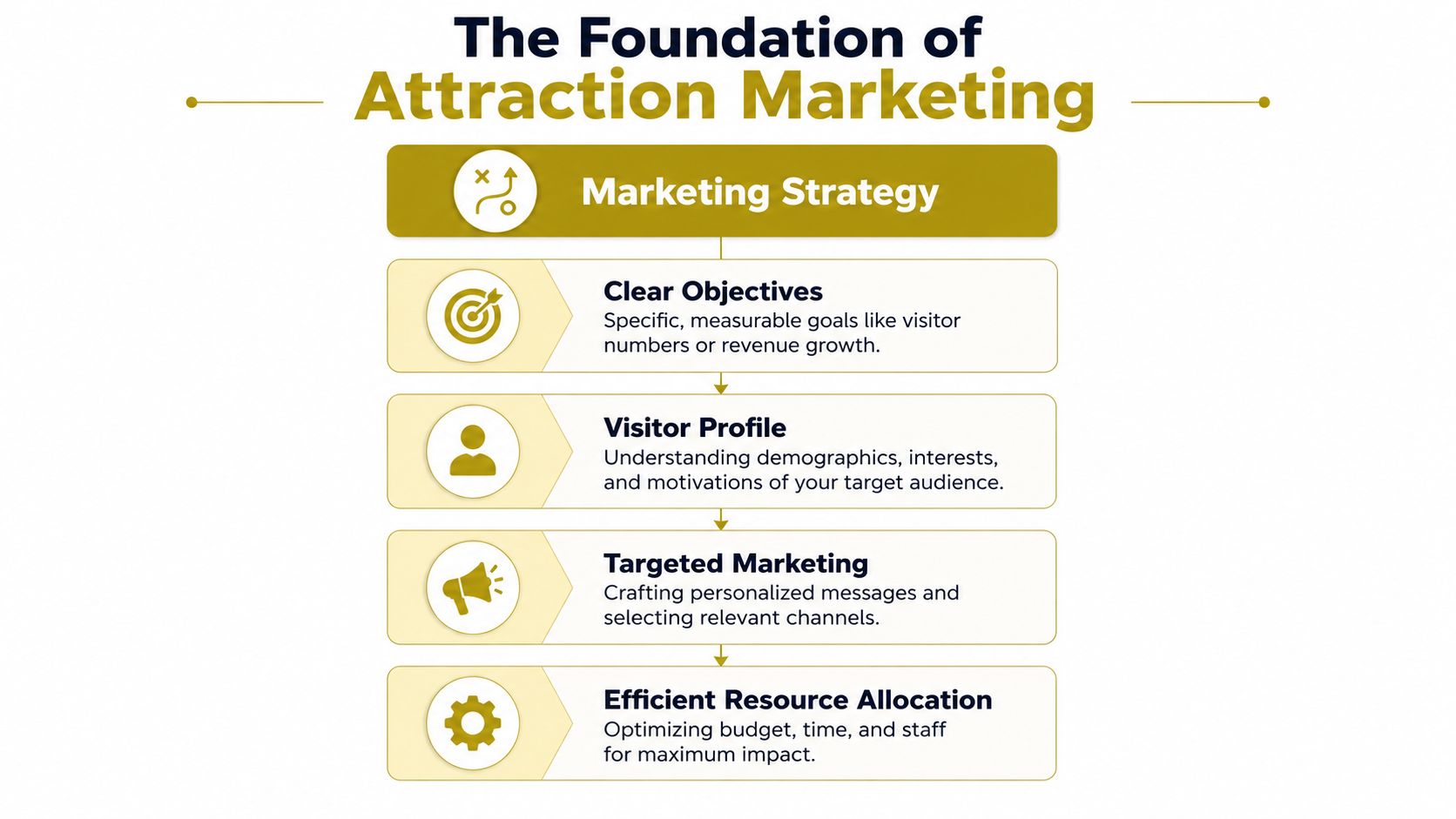
Most wasted marketing spend starts with a fuzzy objective. “Get more visitors” isn't a strategy. It's a wish. The job is to turn that wish into something a team can act on.
A useful objective tells staff what success looks like and what to prioritise this month instead of next month. For an attraction, that might be increasing weekday visits, growing advance bookings for a seasonal event, or lifting repeat attendance from recent visitors.
Start with a sharper objective
A good working objective is specific enough to influence your creative, budget and timing. For example:
- Off-peak recovery: Increase weekday ticket sales during a quieter period
- Exhibition launch: Drive advance interest before a new programme opens
- Repeat visitation: Bring past visitors back with a fresh reason to return
- Audience rebalance: Attract a segment that currently isn't responding
The point isn't the wording. The point is operational clarity. If your goal is weekday footfall, don't build a campaign around broad awareness only. If your goal is repeat visits, don't spend all your effort chasing brand new audiences.
Build personas around motivation, not just age
Demographics help, but they don't tell you enough on their own. Two visitors of the same age can behave completely differently if one wants a social, shareable afternoon and the other wants a quieter, more curated cultural experience.
UK market data gives a useful starting point. Visits to visitor attractions by under-35s in the UK have surpassed pre-pandemic levels by six percentage points as of 2025, while over-55s remain underrepresented, according to the Mintel UK visitor attractions market report. That tells you immediately that a generic audience strategy is weak. One segment is responding. Another needs a different invitation.
For teams new to segmentation, this detailed customer profiling guide is a sensible reference because it pushes you beyond surface-level labels.
You should also treat segmentation as a live commercial discipline, not a one-off workshop. A proper segmentation strategy for marketing decisions helps you align messaging, offer design and media spend around the audiences most likely to move.
Two useful personas for a UK attraction
| Persona | What drives them | What usually puts them off | What to market |
|---|---|---|---|
| Young independent explorer | Specific exhibition themes, novelty, active or immersive experiences, something worth sharing with friends | Vague messaging, tired creative, no clear hook, clunky mobile booking | Topic-led campaigns, time-limited events, sharp visuals, easy booking |
| Older returning cultural visitor | Comfort, quality, clarity, trust, reasons to revisit without hassle | Too much digital friction, lack of practical information, messaging that feels aimed only at younger audiences | Clear offers, reassurance, practical details, premium or guided experiences |
The first persona doesn't respond best to bland “day out” language. They need a hook. In the same Mintel material, one of the strongest triggers for child-free young independents under 45 is running an exhibition on a topic they were interested in, ahead of discounted entry. That's a significant practical lesson. Topic curiosity can outperform price-led messaging for this group.
If you only promote discounts, you can fill some gaps. If you promote relevance, you give people a reason to go now.
What this changes in practice
Once personas are clear, decisions get easier:
- Creative changes: One ad set can lead with an exhibition angle, another with comfort and ease.
- Landing pages improve: Each audience sees a stronger reason to book.
- Email becomes more useful: Past visitors can receive different messages based on likely interest.
- Budget stops spreading too thinly: You can back the audience most likely to move first.
That's the core value of profiling. It turns marketing from broad output into deliberate choice.
Your Integrated Marketing Mix for Maximum Reach
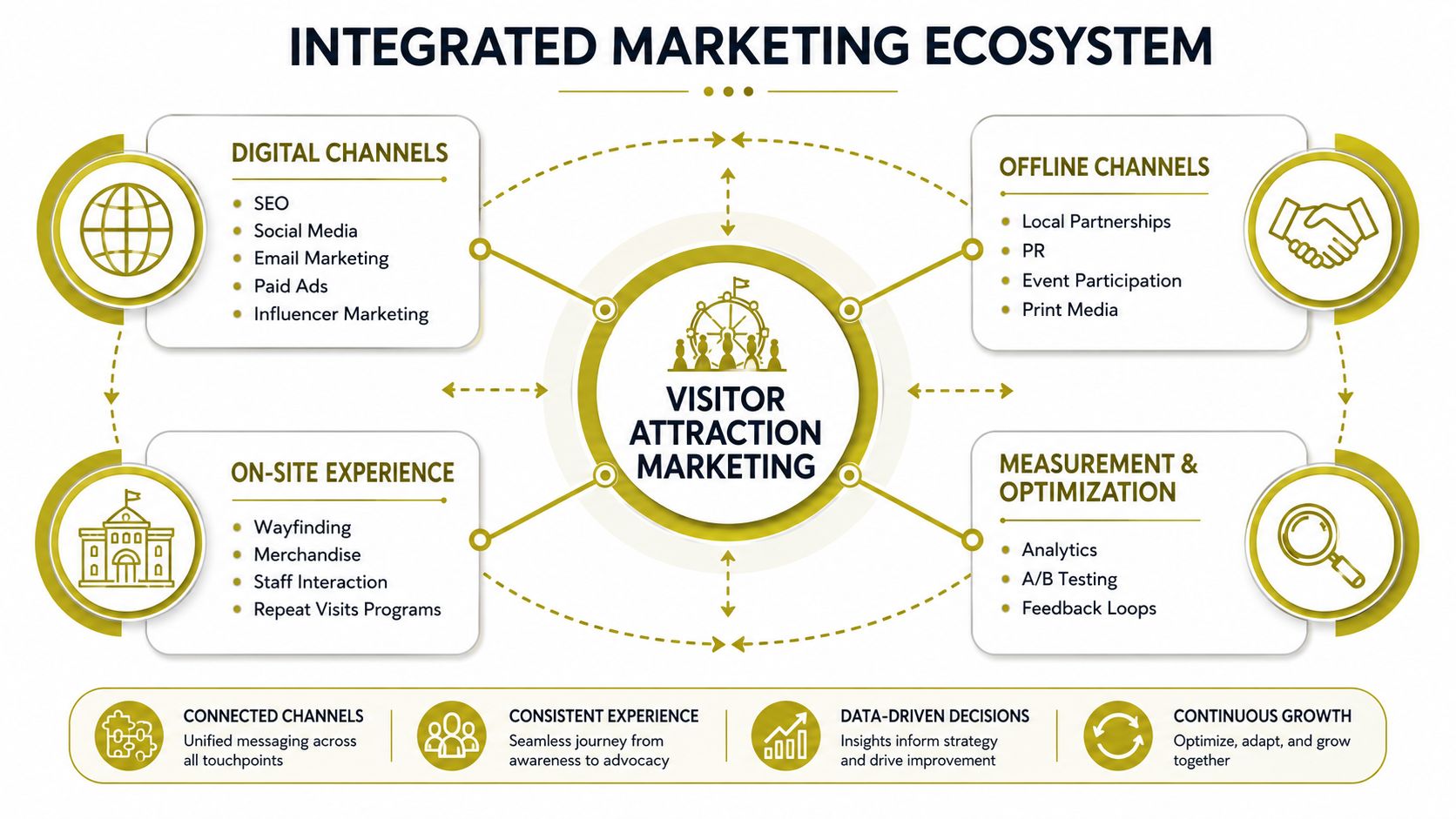
Most attractions don't need more channels. They need their existing channels to stop working against each other.
A visitor might see a press mention, search your name, land on the website, check Instagram, read reviews, then leave without booking because the ticket page is clumsy or the event description is flat. That isn't a traffic problem. It's an integration problem.
Historic attractions in England reported a 3.1% increase in total visitor visits in 2024 compared to 2023, with London up 8% year on year, and visitor or heritage centres showing 6% growth in admissions, but the same dataset says the sector remains 9% below 2019 pre-pandemic levels, according to Historic England's visitor attractions trends for 2024. Recovery is moving, but not evenly. That's why your mix has to do more than create awareness. It has to convert existing interest properly.
PR that starts with an angle
The biggest PR mistake attractions make is sending updates that are true but not newsworthy. A journalist won't cover something because you worked hard on it. They'll cover it if there's a real hook.
That hook might be:
- A cultural angle tied to a wider conversation
- A strong local story with regional relevance
- A first, rare or exclusive experience
- A seasonal contrast that gives editors a timely reason to run it
Think like a newsroom. What's the headline, not the internal memo? “New exhibition opens next month” is weak. A stronger story frames why people would talk about it, photograph it or debate it.
Content and SEO that answer booking questions
Search traffic is valuable because it often comes from active intent. But attractions often use their websites like brochures instead of sales tools. Every important page should answer practical and emotional questions. What is it? Why now? Who's it for? How long should we allow? Is it indoors, outdoors or mixed? Is it suitable for a specific group?
Useful search-led content usually falls into a few categories:
- Visit planning content such as access, parking, timings and rainy-day information
- Event and exhibition pages written with clear themes, dates and visitor benefits
- Local discovery content that connects your attraction to the area around it
- Evergreen guides that answer repeated public questions
A focused content marketing and SEO approach for SMEs should improve discoverability while also tightening what happens after the click.
A practical addition for repeat visitation is loyalty infrastructure. If memberships, stamp cards or return incentives matter to your model, a tool such as rewards program software can help smaller operators organise repeat-visit mechanics without turning the process into an admin burden.
Here's a short explainer that complements the mix:
Paid social that reflects actual intent
Paid social works best when it narrows the gap between interest and action. It works badly when attractions treat it as digital flyering.
Meta platforms are useful for different jobs. One campaign might build awareness around a fresh experience. Another might retarget people who viewed event pages but didn't book. Another might speak only to families within practical driving distance.
The creative itself matters more than many teams realise. A journalist-led principle helps here too. Lead with the strongest fact or visual first. Don't spend the opening seconds warming up.
Key judgement: If the first line of ad copy doesn't tell the audience why this is relevant to them, they'll scroll.
Email that behaves like a memory trigger
Email isn't old fashioned for attractions. It's underused. If someone had a good visit, you already have something precious: prior trust.
Email works well for:
- Announcing new exhibits to past visitors
- Reactivating lapsed visitors with a timely reason to return
- Promoting school holiday or seasonal experiences
- Selling memberships, guided visits or premium add-ons
The mistake is sending the same message to everyone. Segment by previous behaviour, likely interest and timing. A family that visited during a school holiday shouldn't get the same message as a couple who came for an evening event.
Partnerships that create borrowed trust
The right local partnership can outperform a lot of mediocre paid activity. Hotels, cafés, destination organisations, schools, complementary venues and credible local creators can all widen reach.
What works best is mutual value. Don't ask a partner to “share your post”. Build something usable. A joint itinerary. A themed local trail. A package tied to an event. A preview visit with a genuine editorial angle.
Integrated visitor attraction marketing achieves greater commercial strength. PR builds credibility. Content catches search demand. Paid social sharpens reach. Email reactivates memory. Partnerships extend trust. Each one supports the others.
Enhancing the On-Site Experience to Drive Conversions
The visit itself is part of the marketing. In many cases, it's the most persuasive part.
Attractions often think of marketing as everything that happens before arrival. That's too narrow. Once people are on site, you have the chance to create the moments that generate reviews, repeat visits, word of mouth and social sharing. If you waste that opportunity, your acquisition cost rises because every future booking depends on fresh effort.
Build for bragability
The strongest recent idea in this space is bragability. Not as a gimmick, but as a design principle. People share things that feel distinctive, visually strong or exclusive. They don't share generic competence.
The sector data points in the same direction. To maximise conversion success and reduce postponement, UK attractions need to optimise for bragability through limited-exclusivity experiences that create FOMO, and the sector's average Net Promoter Score rose to 69 in 2023/24, while technical execution still fails when mobile optimisation is neglected, according to the Historic England visitor attraction survey research.
That should change how you think about the on-site journey.
Where bragability shows up
It's rarely one giant installation. More often, it's a chain of deliberate moments:
- Arrival points: Clear signage, immediate visual payoff, no confusion at entry
- Photo-worthy details: A view, set piece, installation or exhibit moment people naturally want to capture
- Time-limited exclusives: Something visitors know won't be there forever
- Insider access: Behind-the-scenes elements, curator talks, keeper moments, guided add-ons
- Retail and refreshment tie-ins: Products or menus that feel linked to the visit rather than generic
A lot of teams overfocus on the main attraction and ignore the dead zones around it. Corridors, queues, exits and waiting areas can all support the story if you plan them properly.
The most shareable moment in your attraction should never happen by accident.
Mobile friction kills intent
Many attractions still lose bookings and upsells because the mobile journey is clumsy. That problem isn't abstract. It shows up when a visitor tries to book the next event while travelling home, redeem an offer on-site, open a digital guide or share something with friends.
Check the basics relentlessly:
| On-site conversion point | What often goes wrong | Better approach |
|---|---|---|
| Ticket upgrades | Hidden too late or hard to access on phone | Surface them clearly before and during visit |
| Interactive guides | Slow load times, awkward interface | Keep pages light, obvious and mobile-first |
| Review prompts | Generic follow-up or none at all | Ask at the emotional high point |
| Social sharing | No visual cue or hashtag guidance | Make sharing effortless and worth doing |
Bragability isn't fluff. It's conversion architecture. If people leave with a stronger story to tell, they do some of your marketing for you. If they leave mildly satisfied but with nothing memorable to share, you've delivered a serviceable day out and little more.
Measuring What Matters and Budgeting for Impact
A lot of SME attractions either over-measure vanity metrics or under-measure everything. Both create the same result. Unclear decisions.
You do not need a giant dashboard to run effective visitor attraction marketing. You need a short list of numbers that connect directly to business outcomes, plus the discipline to review them often enough to act.
Track the metrics that change decisions
Start with a handful of questions.
- Are people discovering the campaign?
- Are they showing buying intent?
- Are they booking?
- Are they coming back?
- Are certain audiences responding better than others?
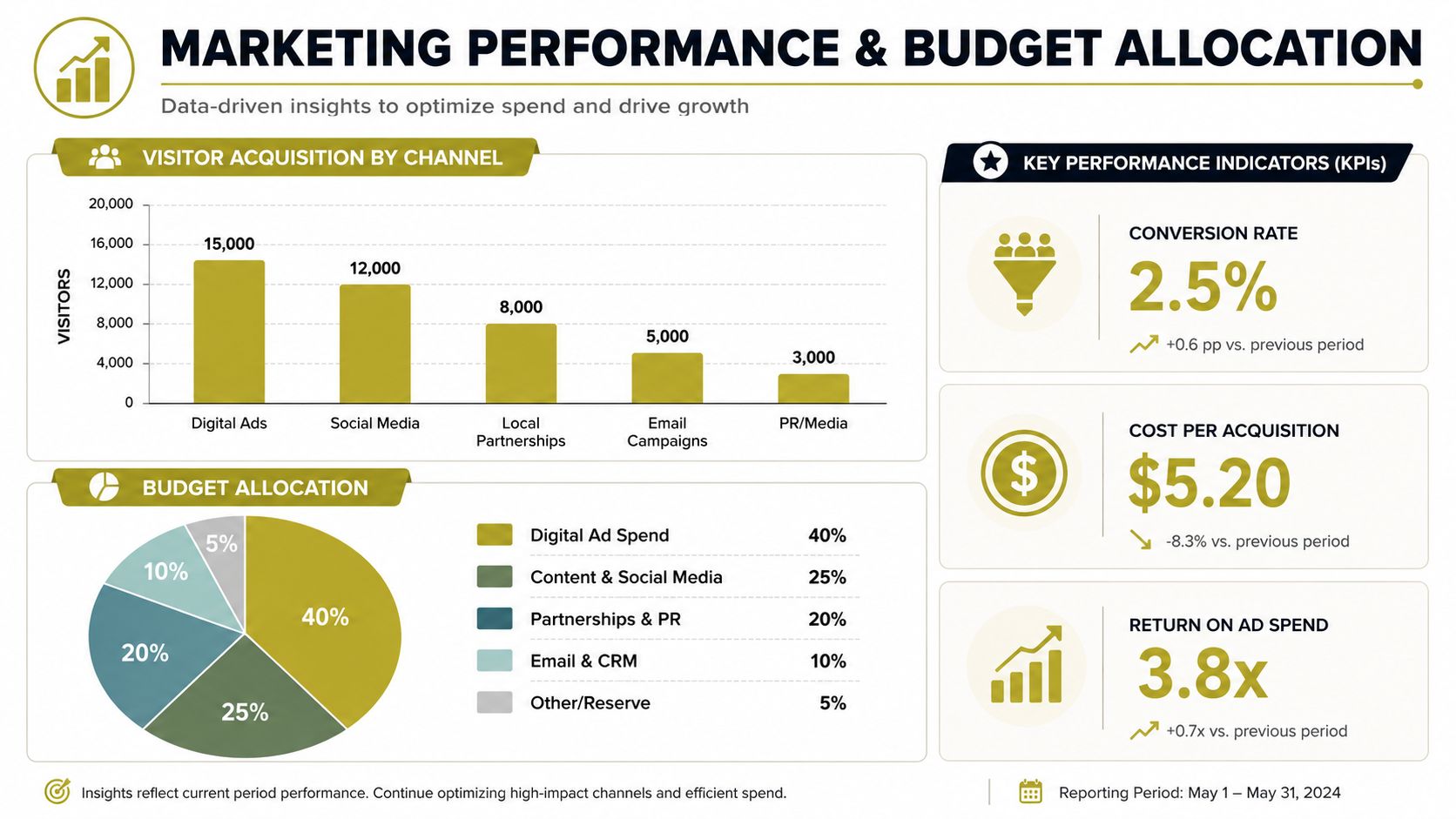
That leads to a practical KPI set:
| KPI | Why it matters | What it helps you decide |
|---|---|---|
| Website-to-ticket conversion rate | Shows whether traffic is turning into bookings | Whether the page, offer or audience targeting is right |
| Cost per acquisition | Reveals how expensive each booking is | Whether paid campaigns are efficient enough to scale |
| Email click-through to booking pages | Indicates message relevance to past visitors | Which segments and offers deserve more attention |
| Repeat visitor rate | Measures retention and long-term value | Whether programming and follow-up are strong enough |
| Engagement quality on social | Helps identify resonance, not just reach | Which themes or creatives deserve more budget |
If your team needs a practical starting point for social reporting, this guide on how to measure social media engagement is a useful framework.
Budget to segments, not habits
Budgeting usually gets distorted by routine. An attraction keeps funding the same channels because that's what it did last year. That's not strategy.
A more disciplined approach starts with audience response. One of the clearest UK signals is that under-35s have surpassed pre-pandemic visitation levels by six percentage points, while over-55s remain underrepresented. The same source also notes that 22% of historic attractions in England increased their marketing spend by 42-89% in 2023 to capture affluent consumers, according to the Visit England annual attractions survey analysis.
That doesn't mean every SME should spend more. It means your budget should follow opportunity. If younger audiences are moving, fund the campaigns, creative and formats that speak to them. If older audiences are lagging, test distinct offers and messaging instead of assuming one campaign fits all.
A practical SME budget model
Without pretending there's one perfect split, many attractions benefit from working across these buckets:
- Demand capture for paid search or paid social linked to immediate visits and events
- Content and creative for landing pages, video, photography and campaign assets
- PR and outreach for launches, seasonal moments and editorial coverage
- Email and CRM for reactivation, repeat visits and membership messaging
- Reserve budget for what emerges once the data starts talking
Measure weekly, not because weekly numbers are always final, but because weak campaigns become expensive when nobody corrects them.
A lean budget can still perform if the objective is sharp, the segmentation is real and the team is willing to cut what isn't working.
A Sample 90-Day Marketing Sprint to Boost Visitors
The simplest way to make this manageable is to treat it as a sprint, not an endless campaign. A ninety-day window forces decisions, keeps the team focused and gives you enough time to learn without drifting.
For this example, assume a small UK attraction wants to increase off-peak visits, sharpen its digital presence and build more repeat business before the next major seasonal push.
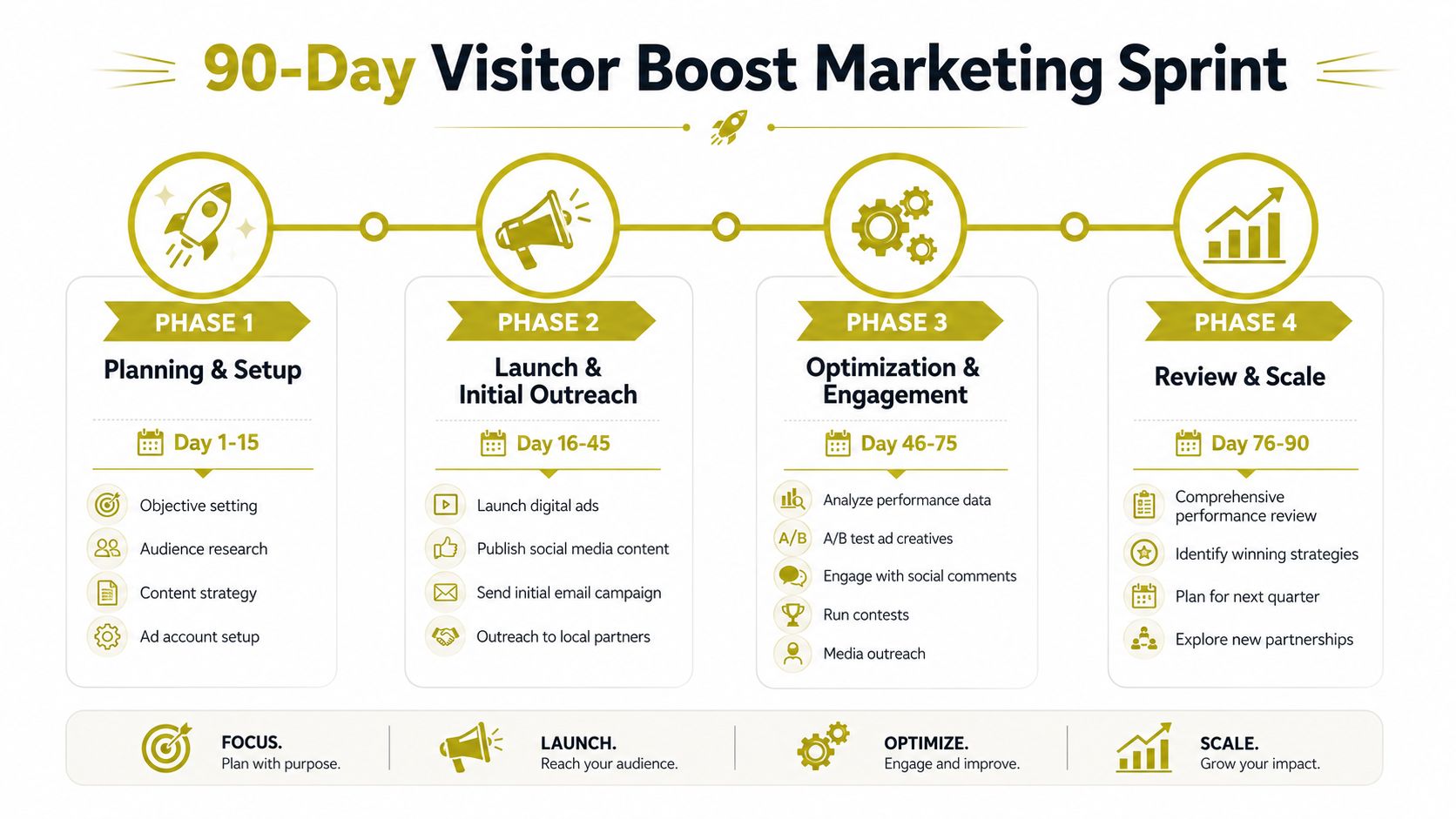
Days 1 to 30
The first month is about foundations. Don't launch noisy campaigns from a weak base.
Set up the basics first:
- Define one commercial objective: Pick one priority, such as weekday footfall or a specific event launch.
- Build two core visitor personas: One growth audience, one underperforming audience.
- Audit the website journey: Check event pages, booking paths, mobile experience and tracking.
- Create a campaign hook: Give the next promotion a clear story, not just a date and image.
- Prepare simple reporting: One dashboard or spreadsheet is enough if the inputs are clean.
This is also the stage to review your public-facing story. Carlos Alba, founder of Carlos Alba Media, is a former national newspaper editor with a 20-year career in national journalism, most recently as Editor of Sunday Times Scotland, as noted on his industry profile. That newsroom discipline is useful here because it reminds teams to sharpen the angle before they spend money pushing it.
Days 31 to 60
Now you put the market-facing work into motion.
Launch a focused campaign mix:
| Action | Why it matters | What to watch |
|---|---|---|
| Run a paid social test | Gives quick signal on message and creative | Click quality, landing page response, booking intent |
| Issue a strong local PR angle | Builds trust and reach beyond your own channels | Pick-up quality, referral traffic, local enquiries |
| Send a segmented email | Reactivates people who already know you | Opens are less important than clicks and bookings |
| Create one shareable on-site moment | Supports user-generated content and word of mouth | Photos, tags, reviews, staff feedback |
The main discipline in this period is consistency. Don't change everything every three days. Give each test enough time to show a pattern.
Days 61 to 90
The final month is where weaker teams drift and stronger teams improve. By now, you should know which stories, audiences and formats are generating intent.
Use the final stretch to:
- Reallocate spend: Put more behind the message that's driving action.
- Cut weak creative: If a visual or headline isn't landing, replace it.
- Refine the booking path: Remove friction the data or staff feedback has exposed.
- Plan the next reason to return: Start packaging the next exhibit, event or premium experience before this sprint ends.
- Capture learnings properly: Note which audience responded, which offer worked and which channel contributed best.
A sprint only works if you finish with decisions. Otherwise you've just created a busier quarter.
Good visitor attraction marketing is cumulative. One quarter improves the next if you treat every campaign as a source of evidence, not just a burst of activity.
If your attraction needs senior-level help turning good experiences into sharper stories, stronger coverage and better digital performance, Carlos Alba Media brings a specialist mix of PR, journalism-led storytelling and modern marketing execution. Everyone who works for Carlos Alba Media is a former national news journalist or has agency experience of working with international brands, which makes the advice direct, commercially grounded and built for organisations that need results without big-agency sprawl.