
You've searched pr job glasgow often enough to know the problem. One listing says PR Executive, another says Communications Officer, another looks like marketing with a press office label attached. Some roles want media relations. Others want SEO, paid social, stakeholder management, event delivery, and the confidence to brief senior people before lunch.
That confusion is normal. Glasgow is a strong PR city, but it's also a close-knit one. Titles vary, expectations vary, and weak applications get spotted quickly. The upside is that good candidates can stand out fast because hiring managers usually know exactly what they want.
Before you apply anywhere, clean up the basics. If a recruiter googles you, your digital footprint becomes part of the interview before you've had the call. A quick online reputation audit for job applicants is worth doing early, especially if your LinkedIn, portfolio, old social posts, and bylines don't yet tell one consistent story. If you're still building experience, it also helps to understand how media careers develop in practice, not just on job boards. This guide to internships in media is a useful starting point if you need a realistic route into the field.
Starting Your Glasgow PR Job Search
A sensible search starts with a narrower question than “where are the jobs?” Ask instead, what kind of PR work can I already prove I can do?
If you've worked on student media, small business social content, event publicity, newsletters, influencer outreach, or local press releases, you already have useful material. The mistake is treating that work as minor. In Glasgow, employers often care less about polish and more about whether you can spot a story, shape a line, and get something live without fuss.
Practical rule: Don't apply by job title alone. Apply where your evidence matches the daily work.
The city rewards relevance. If the role is agency-side, your application needs pace, variety, and evidence that you can juggle clients. If it's in-house, you'll need judgement, message discipline, and a sense of how communications fits wider business goals. If it's public sector or university-based, expect more emphasis on stakeholders, approvals, and careful tone.
Three things usually help at the start:
- Tighten your target list. Pick a small number of employers and study their work, rather than firing generic CVs at every vacancy.
- Sort your proof. Gather links, screenshots, coverage, campaign summaries, and anything that shows outcomes.
- Learn the local patch. Read Scottish outlets regularly so your examples don't sound imported from London templates.
That's how a messy search turns into a credible one.
Understanding Glasgow's Unique PR Scene
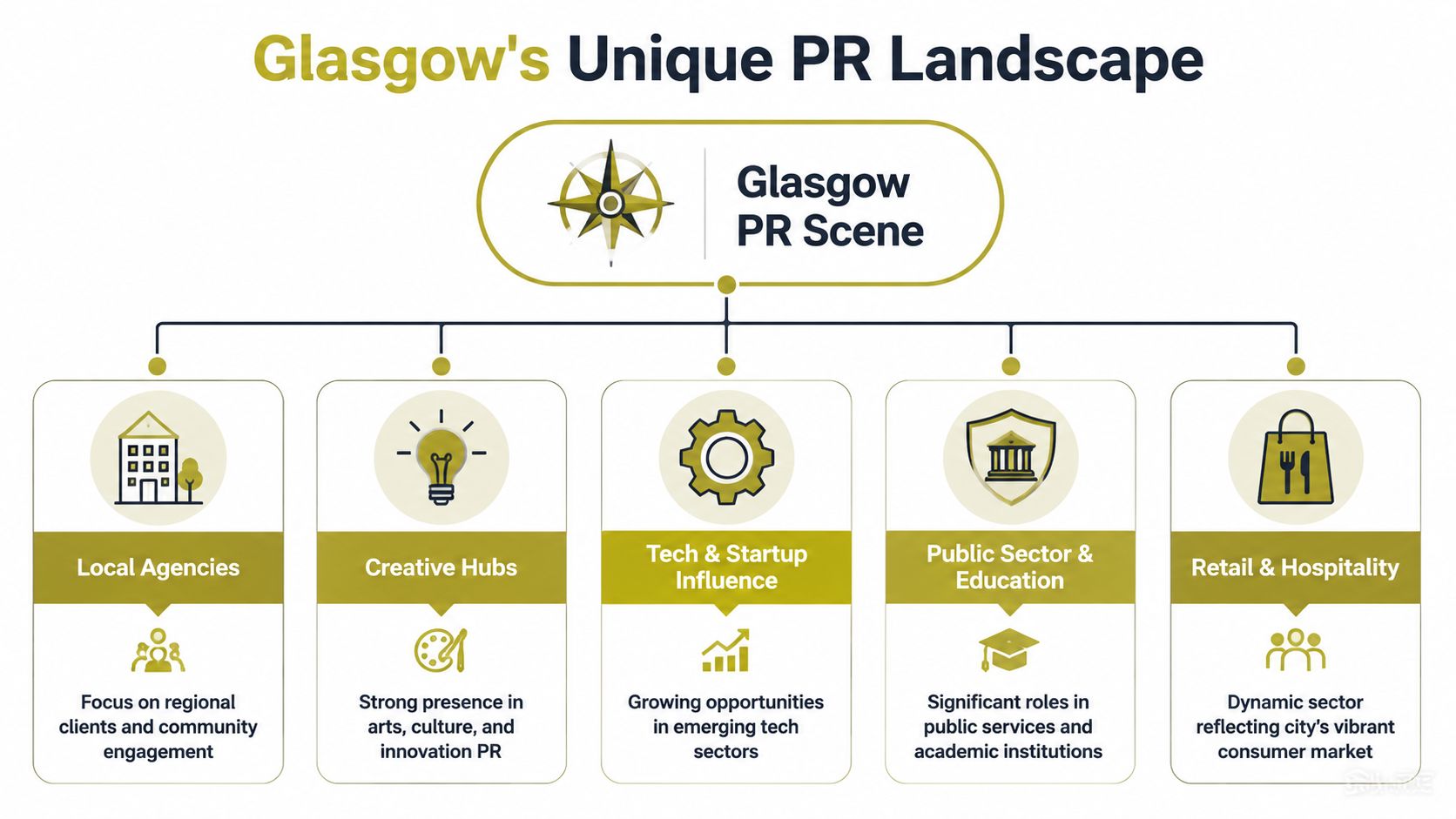
Glasgow isn't a side market. It has its own shape, pressures, and opportunities. According to UK PR employment trends, Glasgow is one of six UK cities outside London experiencing notable employment growth in PR, with a cluster of over 1,000 practitioners, within a national profession of around 94,000 people. That matters because it confirms what many practitioners already know. Serious PR careers are built here, not just started here.
The market runs on relationships
Glasgow's PR scene is professional, but it's also conversational. People move between agencies, in-house teams, journalism, public affairs, higher education, events, and brand-side roles. Your reputation travels. So does your work.
That creates a simple trade-off. A broad, generic candidate can disappear into the middle. A candidate who understands the local media mood, local business sectors, and the tone expected in Scottish communications gets remembered.
A helpful grounding point is understanding what a public relations agency does, because many Glasgow roles blend classic media relations with content, digital strategy, stakeholder work, and spokesperson support.
Where the work tends to be
In practice, Glasgow offers several clear routes:
- Independent agencies. These often suit candidates who like variety, fast turnarounds, and direct client exposure.
- In-house communications teams. Universities, public bodies, hospitality groups, retailers, developers, and cultural organisations all need communications support.
- Specialist consultancies. These tend to value sharper sector knowledge, stronger judgement, and cleaner writing.
- Hybrid digital-PR roles. Many employers no longer separate earned media from search visibility, content performance, and social distribution.
Glasgow rewards people who can move from story angle to press list to stakeholder note without acting as if those are different worlds.
What makes the city different
London habits don't always travel well. In Glasgow, overblown language can work against you. So can applications that mention national media but ignore Scottish titles, regional business coverage, or community context.
Employers often look for signs that you understand a few local realities:
| Part of the market | What employers often value |
|---|---|
| Agency work | Pace, story generation, client handling |
| Public sector and education | Clear writing, approvals discipline, stakeholder judgement |
| Consumer brands and hospitality | Local relevance, events sense, brand tone |
| Tech and start-ups | Simplicity, founder profiling, product explanation |
| Culture and retail | Visual instinct, partnerships, audience feel |
The strongest candidates don't pretend Glasgow is easy. They show they understand why it's competitive, connected, and full of opportunity for people who are useful from day one.
Crafting a CV That Gets You Hired
A Glasgow PR CV needs to read like evidence, not aspiration. Hiring managers have limited time, and many can spot padded communications language in seconds. If your document says you are “passionate about storytelling” but doesn't show where your work landed, what you wrote, who you pitched, or what changed as a result, it won't carry much weight.
Lead with outcomes, not duties
According to Glasgow PR job market data, 68% of local PR job listings prioritise quantifiable media wins over academic degrees, applicants with journalism backgrounds see 28% callback rates versus 9% for generalists, and 72% demand integration of digital skills like SEO and UX. The lesson is plain. Employers want proof that you can deliver and that you understand modern communications work.
That means replacing duty-led wording with result-led wording.
Bad version:
Helped with press releases
Supported campaigns
Managed social media
Wrote press materials and adjusted angles for local and trade media
Supported campaign delivery across earned and owned channels
Planned and published social content aligned to campaign messaging
If you have hard numbers from your own work and can verify them, include them. If you don't, stay qualitative and precise rather than making weak claims.
Build a CV like a newsroom file
A strong PR CV in this market usually includes these parts:
A sharp opening summary
Keep it brief. State your experience level, sectors you know, and what kind of work you've handled.Selected achievements
Use a short list near the top. Coverage secured, campaigns supported, content produced, events promoted, stakeholders handled.Experience with context
Show what the organisation does and what kind of audience or client work you supported.Digital capability
Mention tools and tasks plainly. Cision, Meltwater, GA4, Meta Business Suite, WordPress, Canva, LinkedIn campaign support, media monitoring, basic SEO research, reporting.Portfolio links
Bylines, press releases, campaign summaries, social examples, short case studies.
For formatting and structure, this guide on how to write a CV for British recruiters is useful because it keeps the document aligned with UK expectations rather than American resume habits.
Your CV should make it easy for someone to picture you handling a client, a journalist, and a deadline on the same day.
Tailor your portfolio to Scotland
A portfolio doesn't need to be huge. It needs to be relevant.
Include work that shows:
- Media judgement. Why this angle, why this outlet, why this audience.
- Writing range. Press release, comment piece, social copy, briefing note, event promo.
- Commercial awareness. Show you understand that PR serves a business goal, not just coverage for its own sake.
- Local fit. Scottish examples help. So do examples rooted in tourism, hospitality, property, retail, food and drink, higher education, or founder-led businesses.
If you're changing careers, create sample work. Draft a media note for a Glasgow hospitality launch. Write a reactive comment pitch for a Scottish business founder. Build a mini campaign summary around a local event. Good speculative work beats a vague CV every time.
How to Find and Win the Right Role
Many candidates still treat job hunting as an admin exercise. Search, click, attach CV, repeat. That approach misses how Glasgow works. The market is small enough that targeted effort stands out, and broad enough that there are several good routes in if you're realistic about where you fit.
According to Glasgow marketing, advertising and events listings, Scotland has seen a 22% rise in demand for media skills, but entry-level PR opportunities in Glasgow remain tight. The same data shows 40% of local PR jobs require 3+ years of experience, and only a handful of apprentice roles are typically available at any given time. So the challenge isn't only finding openings. It's bridging the experience gap in a way that feels credible to employers.
Choose the route that suits your current evidence
Different employers hire for different risks.
Agencies usually hire for pace and adaptability. They want to know if you can write clean copy, handle feedback, pick up sector detail fast, and stay calm when priorities shift.
In-house teams often hire for judgement. Can you represent one organisation consistently? Can you work with internal stakeholders who don't all want the same thing?
Freelance or contract work can be useful if you need proof quickly. Small businesses, charities, venues, and founders often need practical support with local publicity, social content, or launch messaging.
A simple way to think about it:
| Route | Best for | Common hiring concern |
|---|---|---|
| Agency | Variety, fast learning, client exposure | Can you handle pressure and feedback? |
| In-house | Brand ownership, deeper sector knowledge | Can you manage stakeholders well? |
| Freelance | Building evidence quickly | Are you organised and consistent? |
Network like a practitioner, not a fan
Networking in Glasgow works best when it's specific. Don't ask strangers to “pick their brain”. Ask a better question.
Try approaches like:
- Ask about the role mix. “How much of this team's work is media relations versus content and digital?”
- Reference something local. Mention a campaign, a spokesperson interview, or a piece of Scottish coverage that shows you pay attention.
- Make the follow-up easy. Send a brief message, not a life story.
Later in your search, this short video is a useful reminder that presentation matters as much as preparation.
A useful habit: Keep a live list of local agencies, in-house teams, journalists, and business organisations, then note who covers what and where your skills fit.
If you're junior, manufacture relevant experience
When entry-level roles are scarce, waiting for the perfect vacancy is a poor strategy. Better options include:
- Volunteer for a local charity or event and take on a defined communications task.
- Support a small business with a launch note, founder profile, or local media list.
- Write your own campaign samples based on real Glasgow sectors.
- Use student media or community platforms to build clips and confidence.
That kind of work won't replace a full-time role, but it often gives you enough proof to stop sounding hypothetical.
Nailing Your Glasgow PR Interview
An interview in PR is rarely only about personality. It's a working test. The employer is asking a quiet question throughout the meeting: would I trust this person with a client, a spokesperson, or a sensitive media call?

Expect practical questions
A good interview usually probes how you think, not just what you've done. Be ready for prompts such as:
- What makes a story newsworthy in Scotland rather than just broadly interesting?
- How would you turn a weak client brief into a stronger media angle?
- Which outlets would you target first for this announcement, and why?
- How would you handle a spokesperson who goes off message?
If the role includes client contact, you may be asked to rewrite a release intro, draft a pitch email, rank media targets, or respond to a mock issue. Keep your answers clear and calm. Hiring managers aren't looking for theatrics. They want judgement.
Show that you know the local media environment
Generic media awareness answers are a common failure point. If you say you “follow the news”, be able to name the outlets, formats, and types of stories that shape the Scottish conversation.
That includes:
- National and Scottish titles
- Broadcast output
- Business coverage
- Local and regional angles
- Relevant podcasts, newsletters, and trade media
Employers remember candidates who can connect a communications idea to a real outlet and a real audience.
This is also where media confidence matters. If a role involves senior stakeholders, spokespeople, or broadcast-facing work, employers may value candidates who are already comfortable with message discipline and live questioning. Practical preparation helps. These practical interview tips are worth reviewing before the meeting, and if your role is likely to involve spokesperson support or on-camera delivery, proper media training in Scotland gives useful insight into how interviews are handled under pressure.
Ask better questions at the end
The questions you ask say a lot about whether you think like a practitioner.
Good questions include:
- What does success look like in the first few months?
- How is the role split between media relations, content, and client or stakeholder work?
- What kind of stories tend to land well for your team?
- Where do previous candidates usually fall short?
Avoid questions that show you haven't read the job spec or the company's recent work. And don't oversell yourself. In Glasgow, calm competence lands better than performance.
Salary Expectations and Career Progression
Pay matters, but so does trajectory. A role that teaches you media handling, client management, content planning, and digital reporting can be worth more to your long-term career than a slightly higher salary in a narrow post. The key is knowing what the market looks like and judging offers properly.
According to current PR roles in Glasgow, the average Public Relations Representative salary in Glasgow is £45,128 per annum. Entry-level roles such as Student Communications Assistant start around £26,942, while more senior or specialised roles can command £42,000 or more, plus benefits.
Typical salary picture
Here's a practical summary based on the verified figures available.
| Role Title | Experience Level | Average Annual Salary Range |
|---|---|---|
| Student Communications Assistant | Entry level | £26,942 to £29,959 |
| Communications Officer (part-time, pro rata) | Mid level | £44,565 to £48,660 pro rata |
| Public Relations Representative | Market average | £45,128 |
| Specialist PR role | Senior or specialist | £42,000 plus benefits |
| Social Media Manager | Varies by scope | £25,000 to £45,000 |
How to judge an offer properly
Salary alone doesn't tell you enough. In PR, the better question is what the role will make you better at.
Look closely at:
- Access to senior people. Will you learn from experienced practitioners or be left to guess?
- Type of work. Media relations, crisis support, digital content, stakeholder handling, reporting, and strategy all build different muscle.
- Exposure to clients or decision-makers. Direct experience usually sharpens you faster.
- Training and feedback. Some teams coach well. Others don't.
A lower-paid role with serious mentoring can be a smarter move than a better-paid role where you become an admin layer.
What progression tends to look like
Career paths in Glasgow are rarely perfectly linear. People move from local media to agency, from agency to in-house, from events to communications, from digital content into broader PR. That's normal.
What tends to move people forward is a combination of:
- stronger writing,
- better strategic judgement,
- a more reliable media instinct,
- and evidence that they can handle pressure without drama.
The people who progress fastest usually become dependable before they become flashy.
For your target list, think broadly. Look at independent consultancies, public bodies, universities, hospitality groups, property firms, retailers, and founder-led businesses with growing profiles. Specialist agencies can be especially useful if you want close exposure to senior counsel and commercially focused work rather than layers of process.
If you want senior-level support from a Scottish-led team that understands both newsroom standards and modern digital PR, Carlos Alba Media is worth a look. The agency is known for specialist expertise, and its team includes former national news journalists and professionals with agency experience working on international brands. That mix is valuable for businesses that want sharp media judgement, clear messaging, and practical execution without big-agency overheads.