
The call usually comes when you’re busy. You’re between meetings, dealing with staff, or trying to get a proposal out the door. A producer from BBC Scotland wants a comment. A reporter at The Herald is writing about your sector. Maybe your company’s name has come up in a wider story and they need a response before deadline.
At that point, most business owners discover whether they have a media strategy or just a vague hope that they’ll “handle it on the day”.
That’s why media training scotland matters. In the Scottish market, one interview can travel quickly across print, radio, online and social. A decent appearance can raise your profile, attract interest and position you as the credible voice in your field. A weak one can make you sound evasive, unprepared or out of touch, even when the facts are on your side.
The skill is learnable. But it’s learned properly only when the trainer understands what happens in a newsroom, what makes an editor keep a quote, what makes a producer lose patience, and what journalists are really testing when they ask the question behind the question.
That insider perspective is where former national news journalists have an advantage. They know how stories are framed, how deadlines distort conversations, and how an apparently harmless answer can become the line everyone remembers.
That Phone Call Are You Ready for the Scottish Media
A Scottish business owner gets a call from a journalist asking for “just a quick comment”. Those five words are where trouble often starts.
The journalist may be perfectly fair. The problem is the setting. You’re answering cold, with no clear message, no agreed line, and no sense of what the actual story is. You start talking to be helpful. Then you over-explain. You add context nobody asked for. You wander into speculation. Now the interview has become a liability.
That’s not because journalists are trying to trap you. It’s because they’re trying to build a story at speed. They need a clean quote, a clear line and a response that works for the audience, not a board paper in spoken form.
Most bad interviews don’t fail because the spokesperson is dishonest. They fail because the spokesperson is unstructured.
In Scotland, that risk is sharper because the media environment is tight-knit. Reporters, producers and editors know one another. Stories don’t sit neatly in one lane. A trade issue can become a consumer story. A local complaint can become a national political row. A founder who thought they were speaking to one outlet can suddenly find the same issue discussed more widely by tea-time.
Good media training prepares you for that pressure before it happens. It teaches you how to slow the moment down without sounding obstructive, how to ask the right questions before you answer, and how to deliver a point that survives editing.
The best preparation also changes how you think. You stop treating media contact as interruption and start treating it as a professional scenario with rules, risks and opportunities.
That’s why newsroom experience matters. A former national journalist doesn’t just tell you to “be confident”. They tell you what a reporter is likely to do next, what line will make the cut, and what answer is going to cause you grief later.
Beyond Soundbites What Is Media Training Really
The phrase “media training” frequently evokes images of forced smiles, robotic phrases and a few tired tips about body language. Proper training has nothing to do with that.
It’s closer to a flight simulator for communication. You rehearse pressure before a live event. You make mistakes in a controlled setting. You learn what throws you off, what sharpens your answer, and how to stay useful under scrutiny rather than becoming defensive or verbose.

Message architecture comes first
If you can’t say clearly what you want the audience to understand, nothing else matters. Not your confidence. Not your posture. Not your experience.
A useful session usually starts by stripping your message down to three things:
- What happened: the plain-English version, without jargon
- Why it matters: why the audience should care
- What happens next: the action, reassurance or decision point
That sounds simple. It isn’t. Senior people often know too much. They load answers with background, caveats and internal language. Journalists need clarity quickly. Audiences need even more.
Delivery is about control, not polish
The second part is how you speak when the pressure rises. That includes pace, tone, brevity and the discipline to stop when the answer is complete.
What doesn’t work:
- Over-answering: saying three paragraphs when one sentence would do
- Defensive language: sounding irritated because the question feels unfair
- Corporate wording: using phrases nobody would ever say in real life
- Filler habits: “obviously”, “if I’m honest”, “to be perfectly clear”
What does work is calm control. You answer the question you can answer. You correct false premises without picking a fight. You move to the point you need on air or in print.
Practical rule: If an answer can’t survive being cut in half by an editor, it isn’t tight enough yet.
Understanding the game changes everything
The biggest difference between average training and useful training is whether the trainer can explain why a journalist asks a question in a certain way.
Former national news journalists can do that because they’ve sat on the other side of the table. They know the pressures, the formats, the editorial priorities and the shortcuts. That insight helps people prepare with more realism than generic presentation coaching ever will.
If you’re building sessions internally, it’s worth looking at resources on building effective training programs so the work doesn’t become an ad hoc workshop with no structure, no practice time and no measurable learning outcome.
Why Scottish Organisations Cannot Afford to Be Unprepared
The call usually comes at the wrong time. A producer wants a comment before the next bulletin. A reporter has heard about a complaint, a contract issue, a closure, a funding decision or a safety concern. They are already writing. Your side of the story has a short window.
That is why preparation matters in Scotland.
News here travels quickly across local, regional and national outlets, and context carries weight. A story in Glasgow can develop differently from the same issue in Aberdeen, Inverness or Edinburgh because the audience, political backdrop and local relationships are different. If your organisation works in health, education, transport, planning, energy or anything that touches public money, the margin for error gets smaller.
I have seen capable business leaders come unstuck because they assumed media pressure would look the same everywhere in the UK. It does not. A London-led brief often misses the Scottish angle, the wording that will jar locally, or the part of the story an editor here will push hardest.
That is where newsroom experience matters. A former national news journalist does not teach theory. They know which answers sound evasive, which claims need proof, and which lines a Scottish newsroom will lift straight into the headline.
The Scottish context changes the risk
In Scotland, reputation is often shaped by a tighter media environment and a stronger sense of proximity. Journalists, stakeholders, customers and public bodies are often closer to the story than spokespeople expect. If you mishandle one interview, the problem is rarely contained to one outlet.
Public scrutiny also arrives in sectors that do not always see themselves as high risk. Councils and NHS boards know this already, but the same pressure applies to universities, housing providers, hospitality groups, founders seeking investment, regulated firms and manufacturers dealing with operational issues. One poor interview can turn a manageable issue into a question about competence, judgment or honesty.
A neutral interview can do damage too. If the spokesperson rambles, hides behind jargon or answers the wrong question, the journalist still files. They just file without giving you much benefit of the doubt.
Journalists do not wait for your confidence to catch up with the story.
Opportunity can be mishandled just as easily
Training is not only for bad days.
Scottish organisations also lose value on good news because the spokesperson cannot explain why the announcement matters. A funding round, expansion, acquisition, new contract or senior hire should produce clear coverage. Instead, many interviews produce flat quotes that are accurate but forgettable. Editors cut them because they add nothing.
The practical trade-off is simple. Media training takes time away from operations, but untrained interviews waste opportunities you have already spent money creating through PR, marketing or business development. If you are investing in visibility, the person speaking for the organisation needs to be ready.
That applies to formats beyond press and broadcast. Podcasts can feel relaxed, but they create a permanent record and often expose weak messaging more clearly than a short radio clip. If that channel matters to you, this guide to strategic podcast interviews is worth reading.
Preparation also belongs in wider risk planning. For organisations reviewing response procedures, issue management and leadership readiness, media work should sit alongside broader thinking on business resilience in Scotland.
The core point is blunt. In Scotland, you do not get much credit for being unprepared. You get judged on the interview you gave, the quote that ran, and the impression you left.
From One-to-One Coaching to Virtual Group Sessions
The format matters more than many Scottish organisations think. I have seen a capable chief executive handle a board room with total confidence, then lose control of a five-minute broadcast interview because the training format did not match the pressure they were about to face.
Choose the format around the interview risk, the spokesperson’s role, and the kind of scrutiny they are likely to get. Convenience matters, but it should not be the deciding factor.
Media Training Formats Compared
| Format | Best For | Key Benefit | Typical Scenario |
|---|---|---|---|
| One-to-one executive coaching | CEOs, founders, senior spokespeople | Personalised feedback on message discipline and interview control | A chief executive preparing for a difficult announcement |
| Group workshop | Marketing, comms and leadership teams | Shared message consistency across multiple people | A business wanting everyone to handle press enquiries the same way |
| On-camera simulation | Broadcast spokespeople and subject experts | Realistic practice under recording pressure | TV, radio or online video interviews |
| Virtual group session | Teams spread across Scotland or the UK | Fast access and lower disruption to diaries | Remote leadership teams needing a common media framework |
| Crisis communications drill | Regulated sectors and high-risk organisations | Pressure-testing responses before a live issue hits | Product recalls, service failures, legal disputes or public complaints |
What each format is good at
One-to-one work is where senior spokespeople improve fastest. There is nowhere to hide. That is the point.
A trainer with newsroom experience can stop a weak answer in real time, challenge the wording, and show the speaker exactly where the quote would fail in a bulletin or a news report. That level of correction is harder to do in a room full of colleagues, especially when the most senior person is present.
Group sessions solve a different problem. They help when several people may speak publicly and the risk sits in inconsistency rather than individual performance. One person overexplains, another sounds defensive, and someone else strays into language that creates problems for legal, regulatory, or reputational reasons. Training together exposes those gaps quickly.
Virtual group sessions have a clear place as well. They are useful for organisations with teams spread across Scotland, hybrid leadership groups, or diary pressure that makes in-person work difficult to schedule. The trade-off is straightforward. They save time, but they only work if the trainer runs them with discipline and puts people under enough pressure to reveal bad habits.
One warning about convenience
Virtual training can become too polite. People stay muted, answers get shorter, and the session slips into discussion instead of rehearsal. That leaves teams feeling better briefed without being any better prepared.
A useful setup includes:
- Live questioning: direct challenge, follow-ups, and interruptions
- Recorded playback: speakers need to hear their pace, tone, and padding
- Scenario design: interviews based on realistic Scottish media scrutiny in your sector
- Decision pressure: limited prep time, because that is how many real requests arrive
Some organisations also use a digital coaching platform to support follow-up practice between formal sessions, especially where several spokespeople need ongoing development rather than a one-off workshop.
If the need is senior spokesperson coaching, broadcast rehearsal, or board-level interview prep, it helps to compare formats against specialist executive media training services. Carlos Alba Media sits in that category, with teams made up of former national news journalists or agency professionals who have worked with international brands. That mix brings newsroom realism and commercial context, which is what good spokespeople need.
What Happens in a Media Training Session
A good session is not a motivational talk. It’s practical work. People usually leave slightly surprised by how demanding it is, which is a sign the training was worth doing.
The work before the camera goes on
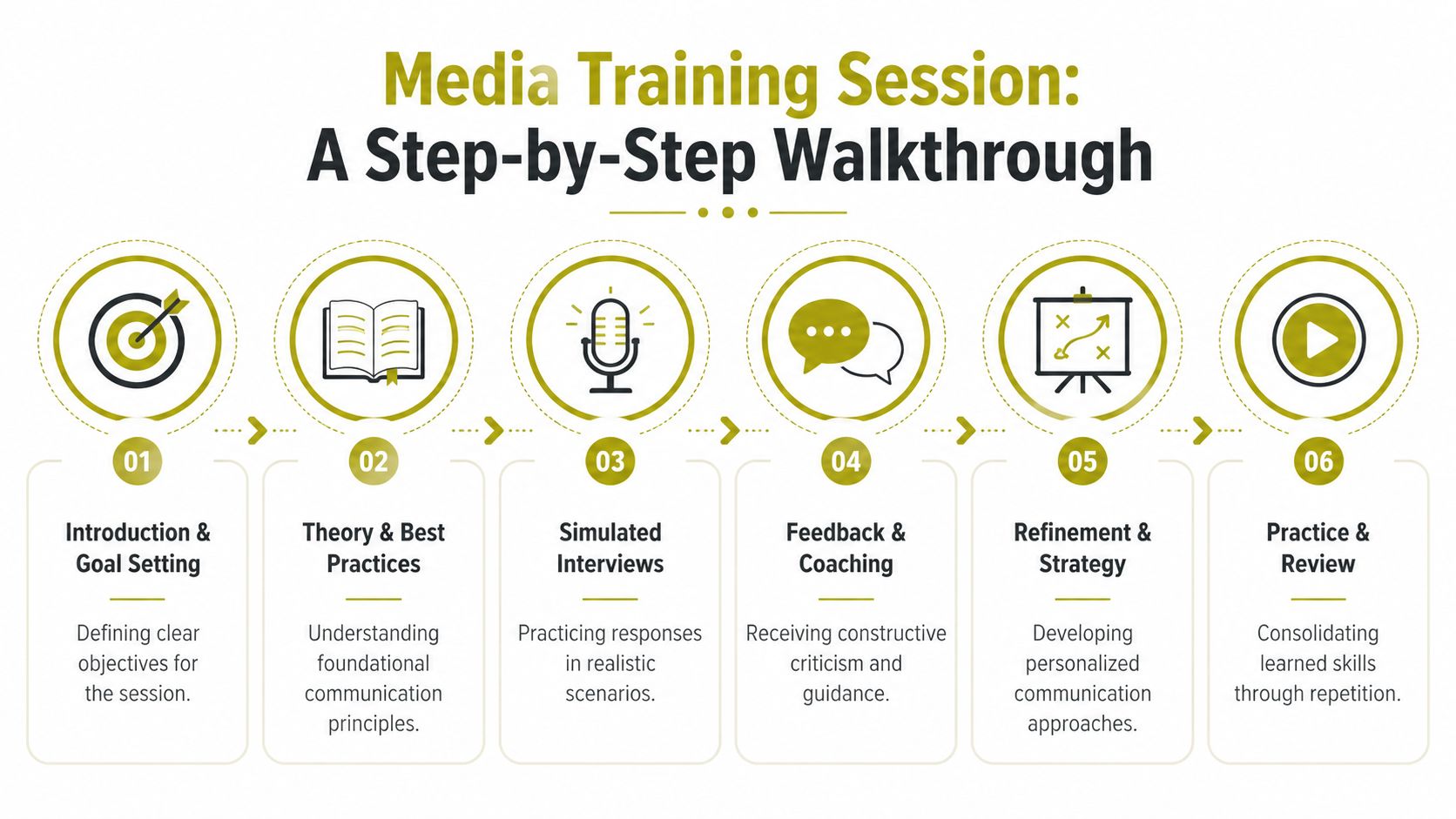
The useful part often starts before the session itself. The trainer reviews your organisation, current issues, likely lines of questioning and the outlets that matter to you. A founder doing regional business press needs one type of preparation. A public-facing executive dealing with broadcast and regulatory attention needs another.
Then comes message development. Not slogan-writing. Proper message building.
That usually means agreeing:
- The core line you want any audience to remember
- The evidence or explanation that supports it
- The safe boundaries around topics you shouldn’t speculate on
- The fallback wording for difficult, incomplete or legal-sensitive areas
How journalists think during an interview
Here, newsroom experience pays off. A former reporter or editor can tell you what’s happening in the interviewer’s head.
They’re listening for the line that advances the story. They’re testing whether you’ll answer directly. They’re noting whether you sound credible, human, and in command of your brief. They’re also judging whether they trust you enough to come back next time.
A journalist rarely needs your whole story. They need the part that makes their story work.
That’s why rambling hurts you. It doesn’t show expertise. It shows lack of editing.
Pressure practice and honest critique
Then comes the part often necessary. Simulated interviews.
You’ll usually face a mix of styles:
- Straight interview: a fair, informed journalist seeking comment
- Sceptical interview: sharper follow-ups and challenge
- Hostile interview: interruption, repetition and pressure on weak points
- Broadcast-style hit: short answers with no room for scene-setting
The point isn’t to catch you out. The point is to reveal your habits under pressure. Do you fill silence? Do you repeat the question’s language when it’s badly framed? Do you start strong and then talk your way past the useful quote?
Playback matters because memory is unreliable. People often think they sounded calm when they looked defensive, or think they were concise when they spoke for far too long.
The review should be candid. Not rude, not theatrical, just accurate. Keep this. Drop that. Shorten this answer. Don’t use that phrase again. Start with the point. Stop apologising for the question.
That’s how real improvement happens.
How to Choose the Right Media Trainer in Scotland
A polished trainer can still be the wrong trainer.
I have seen organisations buy a pleasant half-day session, get a roomful of people feeling better about interviews, then watch the same spokespeople freeze, ramble or over-answer when a real journalist calls. Confidence is useful. It is not the same as readiness.
In Scotland, the margin for error is smaller than many teams realise. The media market is compact. Reporters, producers and press officers talk to each other. A weak interview on a local issue can travel into national coverage fast, particularly if the subject touches public money, regulation, jobs or community impact.

What to check before you hire anyone
Start with the trainer’s actual newsroom background. Ask where they worked, what they edited, what kinds of interviews they handled, and whether they have dealt with live broadcast, political scrutiny, crisis coverage or legal risk. General communications experience is not enough on its own.
The reason is simple. A former national news journalist knows how interviews are framed before you enter the room. They know which answer becomes the clip, which phrase becomes the headline, and which evasions irritate an interviewer enough to sharpen the next question. That judgment cannot be faked with presentation skills.
Scottish context matters too. A good trainer should understand the difference between speaking to BBC Scotland, STV News, local radio, trade press and a central-belt business audience. They should know when a UK-wide message sounds imported, vague or tone-deaf in a Scottish interview.
Ask direct questions before you book:
- Who delivers the training, and what newsroom roles have they held?
- Will they tailor scenarios to our sector, risks and likely media asks?
- Will interview practice be recorded and reviewed properly?
- Can they challenge senior spokespeople, not just coach beginners?
- Do they understand Scottish political, public sector and regional sensitivities?
One test matters more than any brochure. Ask the trainer how a journalist would use one of your answers. If the reply is woolly, theoretical or full of communications jargon, keep looking.
Price is part of the decision, but realism is the bigger issue. Cheap sessions often cut the part that changes behaviour: hard questioning, replay, line-by-line critique and message rebuilding. Expensive training can also miss the mark if it is all performance coaching and no editorial judgment.
There is useful evidence that structured training improves results. The University of Strathclyde’s benchmark programme for Scottish tech SMEs, as shown in its media training benchmark reference, reported an 85% uplift in on-camera delivery metrics. The number matters less than the method. Practice under pressure, followed by specific correction, works.
If you are comparing providers, review firms with clear newsroom credentials and a track record in spokesperson coaching, such as these media training companies in the UK and Scotland. Then check who will be in the room with your team. That is the decision point. Not the logo, not the slide deck, and not the sales pitch.
Your Media Training Questions Answered
Who actually needs media training
Any person who might end up speaking for the organisation needs it. That usually includes the CEO, founders, senior directors, subject specialists, operations leads, charity spokespeople and regional managers.
In Scottish media, the call often goes to whoever knows the detail, not whoever looks best on a website. I have seen strong technical experts lose a good interview because they answered like they were in an internal meeting. Media training fixes that gap. It turns expertise into answers a journalist can use quickly and accurately.
Is media training only for crisis situations
No. It matters in routine coverage as much as in a difficult story.
A funding announcement, a planning row, a trade press comment request, a podcast interview, a BBC Radio Scotland slot, or a local paper asking for reaction all carry risk and opportunity. The job is to help spokespeople stay clear, stay accurate and avoid handing over lines that weaken the story or create a new problem. Crisis work is part of that, but it is only part.
How quickly do people improve
Usually within one session, if the training is demanding enough.
The first change is not confidence. It is control. Answers get shorter. The key point comes earlier. Weak phrases disappear. People stop filling silence, stop repeating the question, and stop giving a journalist three possible headlines when only one helps them.
That said, improvement depends on how hard the session is pushed. Light coaching can make people feel better without making them interview-ready.
What sets one provider apart from another
The dividing line is newsroom judgement.
A trainer with real editorial experience knows what a producer, reporter or desk editor is listening for, what will be cut, and which phrase will become the headline. That matters far more than polished slides or generic presentation tips. In Scotland, it also helps to understand the difference between national, regional and sector press pressures, and how public sector scrutiny or political context can change the tone of an interview fast.
Carlos Alba Media states that its media training is delivered by former national news journalists and senior agency practitioners. That is the right basis for this work because the trainer needs to do more than encourage. They need to interrupt weak answers, test claims, and explain how the interview would play in a real newsroom.
What should you do next
Work out who gets the call if a journalist phones tomorrow. Then ask a harder question. Would you trust every one of those people to handle a live interview, a hostile follow-up, or a rushed quote request without causing trouble?
If the answer is no, there is a training issue to fix.
If your business needs practical, newsroom-led support, talk to Carlos Alba Media. They work with organisations across Scotland and beyond on media skills, spokesperson coaching and crisis communications, with training informed by former national news journalists and senior agency experience.