
You've probably got a decent business and a story nobody outside it knows. Perhaps you've watched a competitor with a thinner offer collect the trade press features, the conference slots and the local radio interviews, and wondered what they're paying for. Usually they aren't buying column inches at all. They've hired someone to turn what they do into something a journalist's audience will read, and to pick up the phone when a story turns difficult.
That second half of the job matters more than is often expected. In a market where only 35% of people say they trust news overall (Reuters Institute Digital News Report 2025), protecting how your organisation is seen carries as much weight as promoting it. PR helps an organisation get accurate information in front of the audiences that matter, through channels those audiences already trust, and it limits the damage when something goes wrong. A single confusing or unanswered story can undo years of careful visibility.
So what does that work involve, day to day? It starts with understanding what PR is for.
What PR Does in Plain Terms
Take a Scottish manufacturer with a better product that only its existing customers know about. A rival with a weaker product keeps appearing in the trade title everyone in the sector reads and in the regional business pages. Nothing about the rival's product is superior. It has someone turning its activity into news, and answering the phone when a reporter needs a comment.
Think of PR as a translator and an introducer working together. Your organisation knows its own news, its expertise, its data, its decisions. PR turns that into a story a journalist, customer, investor or regulator will read, understand and believe, then puts it in front of the right person at the right outlet.
Three working functions sit inside that:
- Getting seen. Building awareness among people who don't yet know you exist.
- Getting believed. Earning third-party credibility when an independent outlet publishes the story on its own terms.
- Staying trusted. Protecting reputation when a story turns difficult, whether the cause is a complaint, a data breach or a bad quarter.
Two terms worth knowing before anything else. Earned media is coverage you don't pay for directly, where a journalist or editor chooses to publish. Owned media is everything on your own turf: your website, your newsletter, your social channels. Earned coverage borrows someone else's credibility; owned channels give you control of the wording.
Here's the quick test. Ask three customers what you do and why they should believe you. If their answers are vague, or worse, wrong, PR has work to do. Paid advertising can buy attention, but it can't buy that.
The Main PR Activities and What Each One Delivers
PR isn't one job. It's a set of activities that share a purpose but need different skills, and most organisations need only some of them at any one time. The table below is the map: each row is a distinct activity, what it involves, what it delivers and who it reaches.
| Activity | What it involves | What it delivers | Main audience |
|---|---|---|---|
| Media relations | Pitching stories, press releases and expert comment to journalists | Third-party coverage and credibility | Journalists, readers, viewers and listeners |
| Spokesperson and media skills training | Preparing people for interviews and on-camera work | Consistent, confident answers | Founders, executives and staff |
| Crisis communications | Holding statements, spokesperson protocols and an update cadence | Faster, consistent information during incidents | Customers, regulators, media and staff |
| Brand and message development | Defining what the organisation stands for and how it describes itself | A consistent identity across channels | All stakeholders |
| Digital and social PR | Content, social posting and online reputation monitoring | Visibility where audiences search and share | Customers, search users and followers |
| Internal communications | Briefing staff so they can answer questions accurately | Employees who understand and advocate for the organisation | Employees |
Read the table by outcome, not by order. If your problem is that nobody has heard of you, the top two rows matter most. If people have heard of you and don't believe you, the brand and message row does the heavy lifting.
How the rows combine in practice
Take a tourism campaign. Media relations is the engine: press releases and pitches, plus relationships with travel, culture and sports journalists built up domestically and internationally, which is how that work ran on the VisitScotland campaign. On its own, though, a press release reaches a fraction of the people who might book.
So the same campaign adds a social strategy, content and assets built for each platform, and partner amplification, engaging event organisers, local tourism boards, hotels, airlines and cultural institutions to align messaging and share it. Each partner reaches an audience the campaign could never have bought.
The rule that saves budgets: choose the activity that matches the outcome you need, then staff it properly. Running five rows badly is worse than running one well.
A start-up usually needs media relations and message development. A regulated business needs crisis protocols before it needs coverage. A consumer brand living on search traffic needs digital PR. Nobody needs all six at once.
PR Versus Advertising, Marketing and Search
A regional firm launches a new service. Paid search captures the people already looking for it. Media relations wins a feature in a trusted trade title. Now the same searchers see the firm named by a publication they respect, and the click they were about to make carries more weight. That small scene explains the difference better than any definition.
Advertising buys space and controls the wording. PR earns coverage that an independent editor chooses to publish. You lose control of phrasing and timing. What you gain is a third party saying the thing for you, and audiences treat those two cases very differently.
Cost and timing follow from that. An advert appears on a set date in a fixed slot, and you can book it again next month. PR depends on news value and editorial judgement. Coverage can land in a week or never, and no honest practitioner will promise a specific outlet or a sales number. That unpredictability is the price of independence, and independence is the entire asset.
Marketing is the wider plan covering product, price, place and promotion, and PR handles the public credibility component of it. Search is a channel rather than a rival. Digital PR produces the stories, data and expert comment that earn links and mentions, which can help visibility, though rankings are never a PR guarantee. If you want the search side of the picture in detail, this guide helps you compare organic search and paid ads and see where each discipline fits.
Use paid channels when you need immediate direct response. Use PR when you need belief from audiences who distrust adverts. Use both when a launch needs attention and action together.
One framework makes these decisions easier: the split between owned, earned and paid media, which sorts every channel by who controls it and who vouches for it. Judge the mix by what it reduces or produces: less confusion about who you are, more measurable response when people encounter you. Counting articles tells you almost none of that.
Why Trusted Channels Matter for Reputation
A claim about your organisation carries different weight depending on where people encounter it. On your own website, it reads as something you say about yourself. In an established news outlet, it has survived questions from someone with no obligation to repeat it. Coverage therefore works like a character reference: the value lies partly in the message and partly in who is prepared to vouch for it.
That distinction matters because public confidence in news is uneven. Trust in UK news overall was 35% in the Reuters Institute's 2025 Digital News Report, which placed the UK 32nd among 48 surveyed markets. A low overall figure can mislead, though. It does not mean every channel carries the same level of trust.
| Measure | Figure | Source and year |
|---|---|---|
| Overall trust in UK news | 35% | Reuters Institute Digital News Report, 2025 |
| Television as a trusted source | 69% | Ofcom study, 2024, cited by the Office for Statistics Regulation |
| Radio as a trusted source | 68% | Ofcom study, 2024, cited by the Office for Statistics Regulation |
| Printed newspapers as a trusted source | 66% | Ofcom study, 2024, cited by the Office for Statistics Regulation |
| People who saw statistics in the news several times a week | 60% | Ofcom study, 2024, cited by the Office for Statistics Regulation |
The Office for Statistics Regulation, citing Ofcom's 2024 study, reports television as the most trusted source at 69%, followed by radio at 68% and printed newspapers at 66%; it also found that 60% of people in the UK saw statistics in the news at least several times a week, while only 4% said they had never seen any.
The practical lesson is that editorial channels reduce uncertainty for an audience. Readers, listeners and viewers know a journalist can challenge a claim, ask for evidence or leave it out altogether. That scrutiny gives credible coverage its value. It also creates the risk. If your figures are vague, your spokesperson is unprepared or your announcement has little news value, the same scrutiny can expose the weakness rather than build trust.
Relevance decides what reach is worth
The trade-off often missed is that a big audience is not automatically the right one. A local radio interview heard by people in the area you serve can achieve more than a national mention seen by a large audience with no reason to act. The measure that matters is whether the outlet is trusted by the people whose opinion affects your outcome: customers, investors, regulators or recruits.
Practical rule: pick channels by the audience's trust, not by the size of the audience. Then prepare the evidence and the spokesperson before you pitch, rather than after a journalist says yes.
The outlet mix matters for the same reason. A feature in a specialist trade title can build confidence among people who understand your sector, while a national broadcast appearance can establish wider recognition. Most organisations need a spread of coverage rather than one trophy placement, because the different types of media coverage perform different jobs as recognition grows.
How a PR Campaign Runs from Brief to Coverage
PR starts before any pitch, with the organisation's character and what it stands for. Get that wrong and everything downstream, from the pitch to the spokesperson's answers, wobbles. Every piece of work we take on at Carlos Alba Media begins with helping a client define its brand's character and what it stands for, because no media decision can be made sensibly before that.
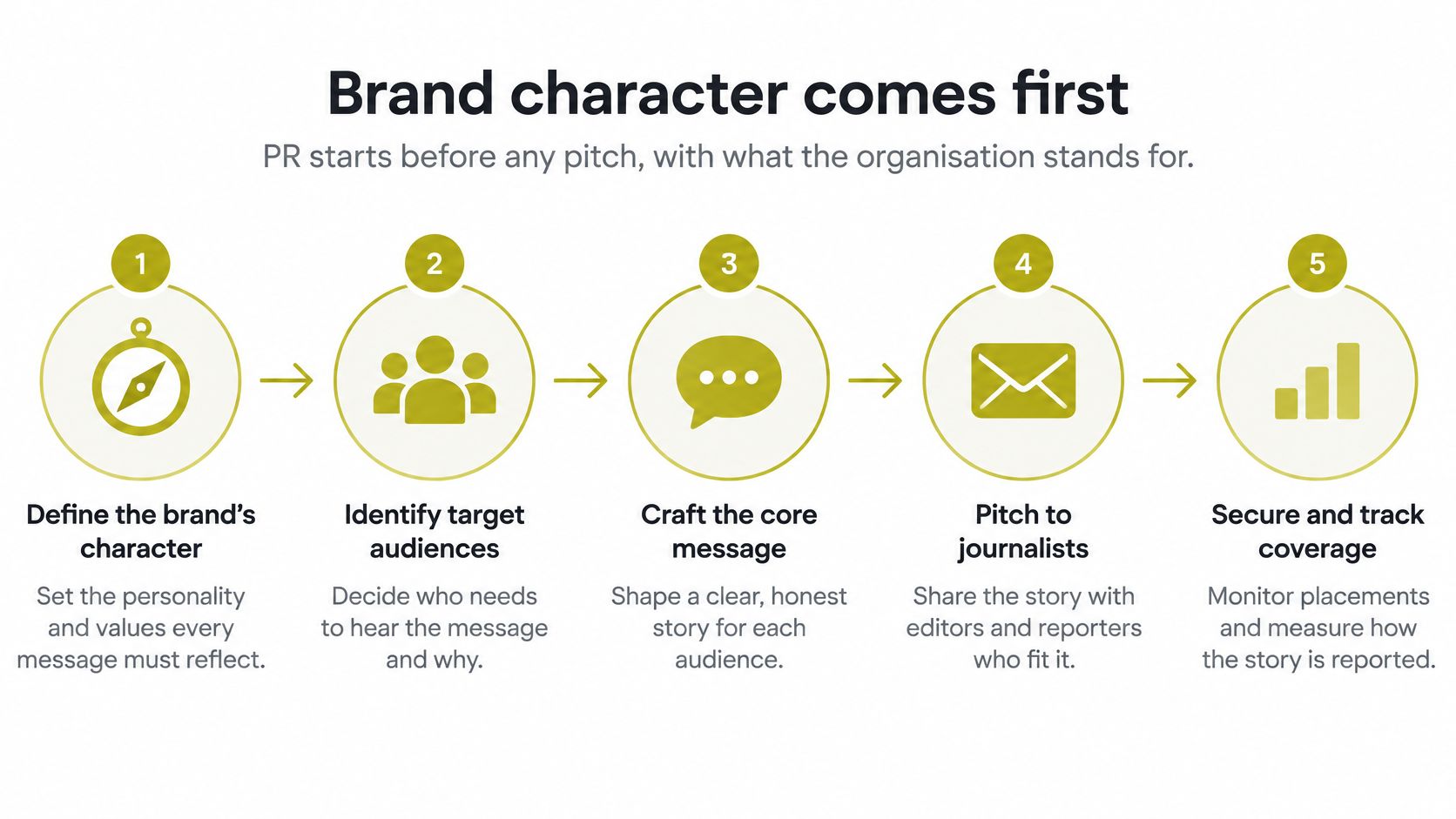
A campaign is a chain of dependent decisions. Skipping a link early on means the later ones hold nothing. Here is the working sequence, in the order it usually runs.
- Define the character and the message. Decide what the organisation stands for and the tone it uses. This constrains every later choice, from which outlets to approach to how a spokesperson handles a hostile question.
- Set one clear objective. Enquiries from a named sector, investor awareness, recruitment applications. One objective, written down, so the result can be judged later instead of argued about.
- Map the audiences and the outlets they trust. Identify the specific journalists who cover your topic, not the general news desk. Generic press releases fail at this stage.
- Find the story. Link your expertise, data or activity to something the journalist's readers already care about. A new product is not news. A new product that changes what customers pay, or solves a problem the sector has complained about for years, is.
- Prepare the evidence and the spokesperson. Verified facts, named sources, quotes that survive being read aloud, and interview practice where the stakes justify it.
- Pitch and place. Write the release, then tailor each pitch to the person receiving it and follow up with a relevant angle rather than broadcasting to a list.
- Monitor, correct and respond. Watch coverage as it lands, correct errors quickly and answer follow-up questions while the journalist still cares.
- Review against the objective. Compare the result with the baseline you set at step two, then feed what worked into the next campaign.
The recurring slip is skipping step four. A pitch with no story behind it spends the goodwill you will need next quarter, and journalists remember who wastes their time. The second slip is sending the same release to unrelated outlets, which teaches journalists to ignore your name. Both mistakes reduce trust in everything you send afterwards, including the stories that deserve coverage.
Notice what the sequence is really doing. Steps one to five reduce confusion: they force the organisation to know what it is, what it wants and what it can prove before anyone asks. Steps six to eight produce the visible part, the coverage, and then test whether it moved the objective. Judged this way, a campaign succeeds when it changes something measurable, not when it fills a scrapbook. Ten clippings that produce no enquiries are worth less than two placements that do.
Digital discovery and social promotion run alongside the same sequence rather than after it, because the story now lives in search results and social feeds as much as in print. UK journalism training increasingly blends traditional reporting with search, social and data skills, and research on UK journalism curricula published in Education Sciences found that 15% of surveyed journalists worked in communications and media relations. People who have sat on both sides understand what a newsroom will and won't run.
That is why the industry leans so heavily on newsroom experience. Carlos Alba Media is founded and run by a former national newspaper editor, and the consultancy's work draws on that newsroom insight, so pitches are shaped by people who know how a desk decides what runs and what gets spiked. The practical effect for a client is fewer wasted pitches and faster answers when a journalist pushes back.
How PR Protects Reputation When Something Goes Wrong
A fire alarm does not put the fire out. It tells people what is happening, where to go, and who is in charge. Crisis PR works the same way. It is a trust and risk function: it reduces confusion while the facts are still moving, instead of collecting articles after a damaging version of the story has already settled.
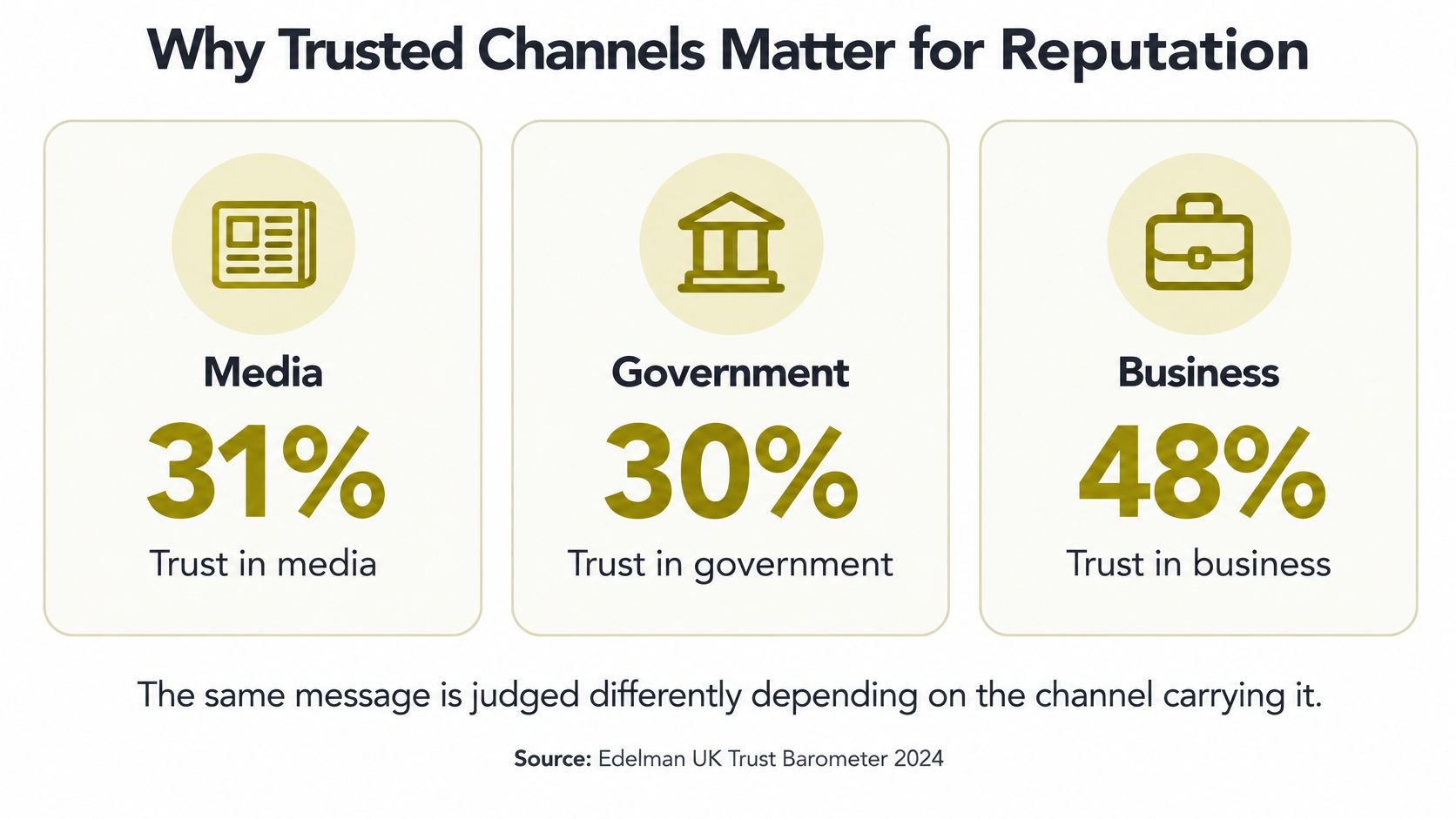
The UK is a low-trust market. The 2024 Edelman UK Trust Barometer reported trust at 31% for media, 30% for government and 48% for business, placing the UK among the least-trusting countries surveyed, as Press Gazette reported on the findings. In that climate, silence and inconsistent answers cost more than the original problem. People fill the gap themselves.

Smooth talking is not the protection. The protection is an incident-response system agreed before the phone starts ringing. In order, it means:
- Identifying risks in advance. What could plausibly go wrong in your operation, and who would be affected first.
- Assigning decision rights. One person who can approve a statement, named before the incident, so nobody waits for a committee at 11pm.
- Preparing verified holding statements. Draft language that says what you know, what you don't and when you'll next update, checked by a lawyer where needed.
- Setting spokesperson protocols. Who speaks, on which subjects, and what they do when a question falls outside their knowledge.
- Monitoring misinformation and stakeholder questions. Watching what's being claimed and what people are asking, so the next update answers it.
- Updating as facts change. A cadence of updates, even when the update is that nothing has changed since 3pm.
A holding statement works like a hospital waiting-room update. It names what is confirmed, what is still unknown, and the time of the next bulletin. Fast, consistent, evidence-based information shrinks uncertainty. Uncertainty is the space where misleading narratives grow. UK government crisis-communication guidance makes the same point, with aims that include keeping stakeholders informed, maintaining public trust and supporting reputation recovery.
When the crisis starts online
A technical failure or a claim posted by a customer can travel through search and social before any journalist calls. News, web search and social media are the places people check when a controversy breaks. A slow or contradictory reply on those channels leaves room for a worse account to spread, and a correction issued days later rarely catches the first version.
The first holding statement has to reach your own channels at the same time it reaches a reporter. That means a pre-agreed page on your site, a social post and a staff briefing going out together, not in sequence over three days. Staff who hear the facts only from a customer screenshot will repeat the screenshot.
In a crisis, PR's job is to keep information accurate, timely and understandable. A damaging fact stays on the record. Any adviser who promises it will vanish is selling you a bigger problem.
Judge the response by whether confusion fell, not by how many clips you collected. For regulated and high-risk organisations, the indicators worth tracking are response time, correction time, message consistency across channels, how accurately journalists report the facts, stakeholder sentiment and the share of priority audiences reached. If those move the right way, the risk function did its job.
How to Measure What PR Actually Delivers
Most PR reporting counts reach, impressions or advertising-value equivalents. Those numbers show visibility. They don't show whether anyone changed their mind or did anything differently, and an advertising-equivalent figure is a valuation method, not a result.
The Chartered Institute of Public Relations recommends evaluating PR through research, defined objectives, benchmarking, metrics and a process for improving performance. In practice that means separating three levels of result.
| Level | What it covers | Example measure |
|---|---|---|
| Outputs | Articles, broadcast mentions and reach | Number of placements in target titles |
| Outtakes | Message recall and perceived credibility | Pre- and post-campaign awareness survey results |
| Outcomes | Enquiries, trust, sales or policy influence | Tagged landing page visits and enquiries by sector |
Outputs are the easiest to count and the least informative on their own. Outtakes tell you whether the message landed and whether the audience found it credible. Outcomes are the commercial or reputational change you were paid to produce.
Setting a baseline you can defend
Before any campaign, record where you stand: unaided awareness, share of voice against named competitors, sentiment, referral traffic, qualified enquiries, stakeholder confidence. Then compare after a defined period, ideally against a control period or a comparable market.
Attribution needs plumbing, not guesswork. Give each campaign its own tagged landing page. Track enquiries by sector or postcode so you can see which coverage produced them. Test the spokesperson's message with a small panel before the interview, and rerun the awareness or trust survey afterwards.
A small number of placements in a trusted trade or local outlet can be worth more commercially than a high-reach mention that reaches the wrong people. Judge the result against the objective you set, not against a competitor's clipping file.
On the VisitScotland campaign, measurement covered website traffic, social media engagement, conversion rates and media share of voice, with activity correlated against tourism sector recovery data. That's the shape of a defensible report: activity, response and context in the same frame.
Our guide to how to measure PR effectiveness goes further into the tracking setup.
Deciding Whether PR Can Help Your Organisation
Audiences don't hold their view of you steady. A 2026 survey of 1,000 UK social-media users found trust had increased for 19%, stayed the same for 49% and decreased for 33% over the previous 12 months, according to Sprout Social's UK pulse survey. Visibility alone doesn't secure belief.

Three questions will tell you whether PR is the right spend.
- Do you need to be understood or believed, rather than known? If awareness is already high and conversion is weak, the problem is credibility, and that's PR territory.
- Is there a specific audience whose opinion moves your numbers? A sector's buyers, a regulator, an investor group, a pool of specialist recruits. Name them. If you can't, the campaign has no target.
- Would a difficult story reach your customers faster than you could explain it? If yes, you need protocols in place before it happens.
If the honest answer is that you need an immediate, direct sales response, paid channels will serve you better and PR should support them rather than lead.
A sensible first move is small: one objective, one baseline measure, one campaign, then a review. Carlos Alba Media works with organisations facing a communications challenge or a media crisis, and the work has spanned campaigns for clients including Scottish Enterprise, ScotRail, RBS, EDF Energy, Rolex, Johnnie Walker, Cala Homes, VisitScotland, Tourism Ireland, Patek Philippe, SEPA and SSE, across hundreds of projects of different sizes. A first conversation can start with people who know how a newsroom decides.
If you're facing a communications challenge, a difficult story, or a market that doesn't yet know what you do, Carlos Alba Media can help. We're a Scottish-led PR and digital marketing agency with teams in London and Glasgow, and we offer a free consultation with one of our public relations experts. Visit Carlos Alba Media to start the conversation.