
Half of UK businesses had experienced a cyber security breach or attack in the previous 12 months, a rate that climbs to 70% of medium-sized businesses and 74% of large ones, according to the government's Cyber Security Breaches Survey 2024. That number sits underneath every enterprise technology deal in the country. The buyer across the table isn't weighing a feature list against a competitor's. They're weighing operational risk, and they want to know what happens to their data when something goes wrong.
Enterprise tech PR is the discipline that answers that question in public, on the record, before the sale is signed. It's less about announcing a product and more about building a case that holds up when someone leans on it.
What Enterprise Tech PR Is and Why It Matters
Think of it as a translation layer. On one side sits an engineering team with something difficult: an identity platform, a data pipeline, scheduling software for ports. On the other side sits a finance director, a reporter and a procurement panel, each asking a version of the same question in a different dialect. What changes for me, and can you prove it?
Enterprise tech PR is communications that earn credibility for complex products sold over long sales cycles. A consumer launch is built around a moment: a date, a photograph, a price. An enterprise story is built around a record. It has to survive a technical follow-up, a reference call and a journalist checking your numbers with a rival before publication.
The stakes are bigger than most founders assume. Government estimates show the UK digital sector generated £177.2 billion in gross value added in 2024, equal to 6.8% of total UK GVA, and its inflation-adjusted GVA grew 3.3% between 2023 and 2024 against 1.1% across the wider UK economy, according to the digital sector economic estimates. Measured from 2010 to 2024, the sector's real GVA rose 152.2%, from £69 billion to £174 billion in 2023 prices.
What those numbers change about your story
Technology is no longer a specialist beat. A sector worth nearly one-fifteenth of the UK economy gets covered by business editors, regional reporters and policy correspondents, not only by trade titles. That widens the audience for a launch, a funding round, a hiring plan or a new office in Glasgow or Leeds.
It also raises the bar. If your announcement sits inside a national growth story, the person writing about it will ask what it does for productivity, jobs, investment or regional output. Engineering detail alone doesn't answer that question.
The question worth carrying into every announcement: what changes for the customer, and how would we prove it?
Matching Messages to Each Buyer Segment
Founders tend to describe their market as one audience. The adoption data doesn't support that. The UK Innovation Diffusion and Adoption Survey, covering 4,595 businesses, found that adoption of at least one of 20 tracked technologies ran at 80% among large businesses and 48% among microbusinesses. That's a 32-percentage-point spread within a single national market.
| Audience | Adoption rate | Message that lands | Evidence to publish |
|---|---|---|---|
| Large businesses | 80% | Integration, governance and resilience | Deployment results across multiple sites |
| Medium-sized businesses | 71% | Measurable productivity gains | Before-and-after operating metrics |
| Small businesses | 63% | Cost and skills barriers are manageable | Time-to-deploy figures and support model |
| Microbusinesses | 48% | Simple onboarding with clear next steps | Case study from a firm of similar size |
| London | 65% | Regional growth and access to talent | Named local customer results |
| South West | 47% | Practical adoption with local support | Regional customer example with setup time |
| Northern Ireland | 42% | Proven, low-risk first steps | Pilot results from a comparable organisation |
The size gap decides your opening line
A large buyer usually has a security function, an architecture review board and a procurement team. Their questions are about control, audit trail and what happens at 3am when a dependency fails. Lead with a story about onboarding ease and you'll lose the room in the first minute.
A five-person firm has the opposite concern. They want to know who answers the phone in week one, what happens if the founder is on holiday, and whether the implementation will consume the only two people who understand their systems. Many of those firms meet technology through a managed service provider rather than a direct sales team, so the channel becomes part of the proof. Anyone building that route will find the guidance on webinars and referral tactics for MSPs useful for turning partner relationships into predictable pipeline.
Regional evidence matters for the same reason. London recorded 65% adoption, against 47% in the South West and 42% in Northern Ireland, per the same survey. A case study from a City fintech doesn't reassure a manufacturer in Devon. Where you have regional customer evidence, use it. Where you don't, name the local constraint rather than implying it doesn't exist.
The rule behind every row
Any claim you put in front of a buyer or a reporter should name four things: the technology category, the implementation context, the baseline metric and an independently verifiable result. That's the difference between "clients see faster reporting" and "a six-site logistics operator cut month-end reporting from nine days to two, and their finance director will confirm it."
Before pitching any segment, answer three checks. Who is the reader? How mature is their adoption? Which single number would change their mind? If you can't answer the third, you don't have a story yet.
How an Enterprise Technology Story Gets Made
A story doesn't appear because a company deserves one. It appears because someone did the work in a particular order, and skipped nothing on the way.
The whole process rests on two moves that everything else depends on. Without them, the rest is decoration.
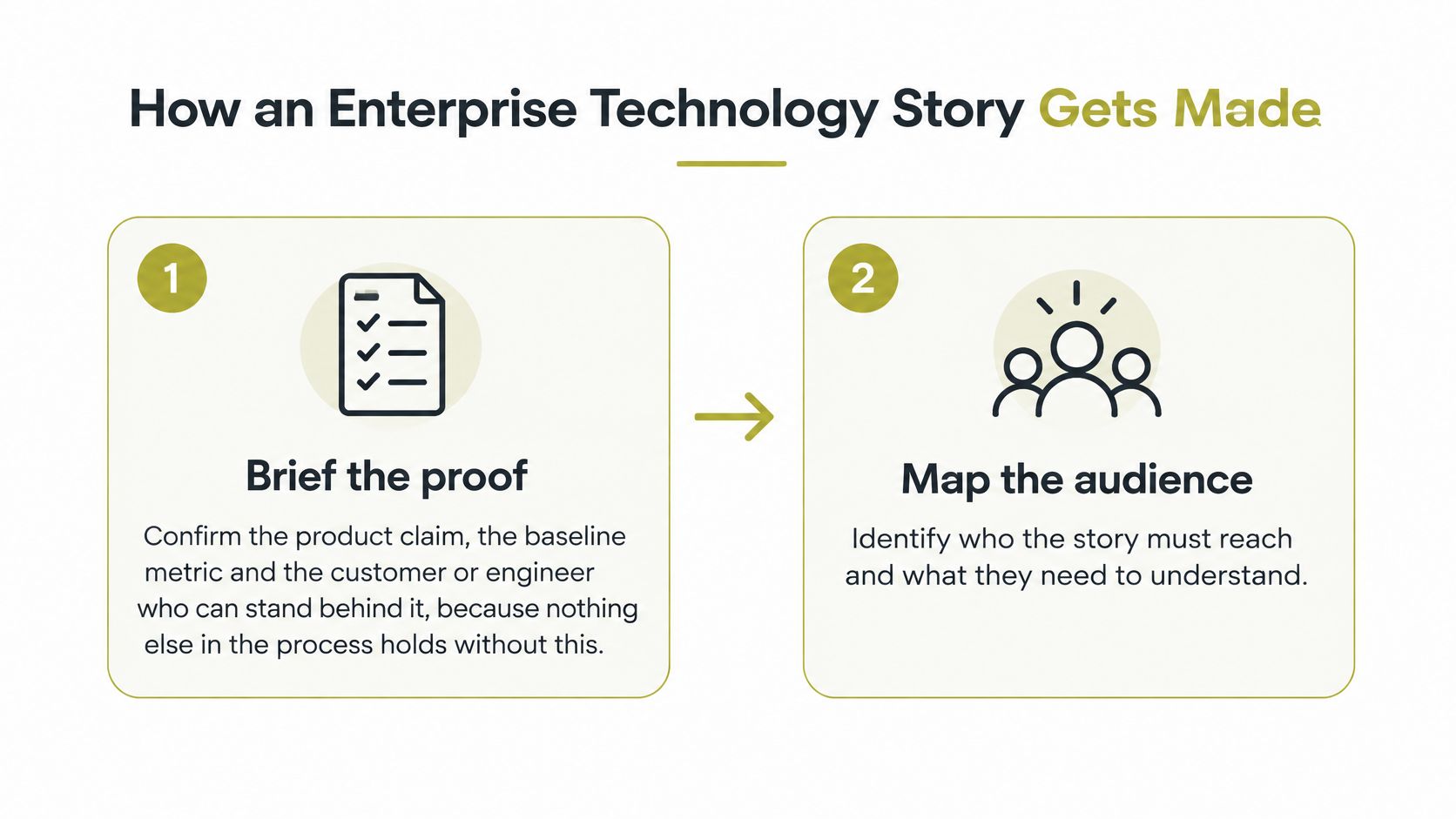
Brief the proof. Confirm the product claim, the baseline metric and the named customer or engineer who will stand behind it. Everything downstream depends on this, which is why it comes first and why skipping it wastes the rest of the work.
Map the audience. Choose the buyer segment and the titles that reach it, whether trade, national, regional or broadcast. A story aimed at everyone reaches nobody, and a title that never covers your category won't start now.
Shape the angle. Connect the product to a business issue such as productivity, jobs, investment or regulation. A general business editor needs a reason their readers care, and "new software" isn't one. We help clients publicise their work to potential customers, industry partners, regulators and investors, and each of those groups hears the angle differently.
Build the materials. Produce a one-page fact sheet, a spokesperson brief and a short data note a reporter can check in an afternoon. Journalists work to deadlines, and the source who makes verification easy gets quoted again.
Pitch through relationships. Work from a database of contacts across journalism, business and public administration, and send each title the version of the story it would run. The same email to forty desks reads as a mailshot, and it gets treated like one.
Measure and follow up. Track coverage, the buyer conversations it starts and the questions it raises, then update the proof as new data arrives. Coverage without a follow-up plan is a screenshot, not a result.
The angle is the part that most often fails. A useful test is whether the story could run with your logo removed, and whether a general business editor would still see news in it. If the answer depends on your product name, the angle needs another half hour of work. There's a practical guide to what makes a story newsworthy if you want the test in more detail.
Turning Technical Claims Into Credible Proof
AI has become the clearest example of a market where the claims outrun the evidence. About 35% of UK businesses with 10 or more employees reported using at least one AI technology in 2026, compared with roughly 12% in late 2023, according to Office for National Statistics analysis of AI in UK businesses.
The adoption curve is steep, the depth is shallow
The same analysis found that the average number of AI technologies used by adopting firms rose only from about 1.4 to 1.6, with usage concentrated in internal functions such as HR, finance and tax. More firms are trying AI. Most aren't doing much with it yet.
That gap is the story. Buyers and reporters have moved past "are you using AI" to harder questions. What business problem did it solve? What governance sits around it? What changed for employees, customers and risk exposure? A press release that answers none of these is a press release about a press release.
Practical rule: if a claim can't survive a call to the customer named in it, it isn't a claim. It's a risk.
Weak claims and the evidence-led version
Generic phrases cost you credibility with exactly the audience you want. Replace them with more specific language.
| Claim type | Weak version | Evidence-led version | Document to hold ready |
|---|---|---|---|
| Security | We are secure | Named controls such as two-factor authentication coverage and detection times | Control coverage list and certification status |
| AI capability | AI-powered platform | Narrow outcome with a stated baseline, such as hours saved in one workflow | Baseline metric, method and validation record |
| Performance | Industry-leading speed | Measured deployment time against a stated starting point | Test conditions and date of measurement |
| Customer results | Trusted by leading brands | Named or anonymised outcome with a verifiable metric | Customer sign-off and permission status |
Five things sit behind any claim you want a sceptical reader to accept: baseline metrics taken before the work started, independent validation where a third party can check the result, data provenance so the origin and handling of the inputs are clear, human oversight showing who reviews the output, and sector-specific compliance for regulated buyers.
Data provenance is not a niche concern. In 2024, 99% of UK businesses with at least 10 employees handled digitised data, according to the UK Business Data Survey 2024, which means nearly every buyer has something at stake in how your system treats it.
Regulated buyers will also send a security questionnaire before they send a purchase order. It helps to see how vendor WiFi security questionnaires are structured, because your answers become part of the record you're building. Good case study development does the same job from the customer side, turning a result into something a journalist or procurement panel can verify.
State the limits too. Say what the product doesn't do and where the results were measured. A claim with a boundary reads as honest, and honest claims get repeated.
Communicating a Cyber Incident Without Losing Trust
Breach risk in the UK is both widespread and unevenly handled. The latest UK Cyber Security Breaches Survey found that 43% of businesses experienced a cyber breach or attack in the preceding 12 months, while only 47% reported using two-factor authentication, 36% a staff virtual private network and 30% user monitoring, according to the Cyber Security Breaches Survey. The same survey estimated 19% of businesses were victims of cybercrime, around 267,000 UK businesses.

That gap between how often breaches happen and how few basic controls are in place is where enterprise technology communications does its real work. It's also why "we take security seriously" reads as noise to anyone who has sat through a procurement review.
The clock starts before you're ready
The Information Commissioner's Office states that reportable personal-data breaches generally must be reported within 72 hours of discovery under Article 33 of the UK GDPR. Seventy-two hours is not enough time to invent a position, agree a tone of voice and brief a board. It is just enough time to execute a plan you wrote in calm conditions.
Silence is a choice with costs attached. A recent UK survey reported that one in five businesses had kept a serious cyber incident from authorities, while AI-driven attacks had more than doubled over the preceding year and affected a quarter of organisations, as Insurance Business UK reported. Waiting for the investigation to close is a strategy, but it isn't a safe one.
The order of notification
Decide the sequence before anything happens. In most enterprise incidents it runs internally first, then to affected customers, then to the regulator within the legal window, then to the media. Contracts often set out customer notification timescales, so read them before you need them.
Separate confirmed facts from working hypotheses in every conversation, and label them out loud. "We know X. We don't yet know Y. Here's when we'll update you" preserves more trust than a confident statement you have to withdraw by lunchtime.
Holding statement skeleton: what happened, what it affects, and when the next update will come. Three sentences, no adjectives, issued within hours rather than days.
It helps to see the sequence in action rather than read it as a checklist.
Pre-approved technical fact sheets, executive holding statements and customer-update workflows cut the risk of contradictory messaging during a live incident. Bring the board in early, keep legal advice in the room for every notification decision, and write the recovery milestones down so you can report against them rather than improvise. We've completed more than 100 crisis management projects and run 24/7 media crisis management in partnership with UK media lawyers, and the pattern is consistent: the organisations that communicate well are the ones that prepared badly for the breach and well for the disclosure. More on our PR in crisis work covers how that support is structured.
Why Newsroom Experience Changes Enterprise Coverage
The UK journalism profession is large and specialised. Analysis by the National Council for the Training of Journalists of Office for National Statistics Labour Force Survey data estimated 101,500 working journalists in 2022. Of those, 39,900 (39%) were newspaper, periodical and broadcast editors, while 61,600 (61%) were journalists and reporters.
That split tells you something useful about how coverage happens. Reporters file and editors decide. A communications team that has only ever written for marketing approval tends to pitch the reporter and forget the editor, which is where a lot of good enterprise stories die.
What a newsroom trains you to do
Newsroom work is a defined professional environment: editorial judgement, reporting, fact-checking, deadlines and storytelling built for an audience that owes you nothing. That last part is the one most marketing teams underestimate.
It shows up in small decisions. Which claim survives a hostile follow-up? Which number will a business editor ask for first? What's the version of this story a broadcast producer can put a founder on air to talk about for three minutes without a prop? These aren't content questions. They're editorial ones.
The workforce is also highly qualified, which reinforces how specialist the job is. Analysis reported by Press Gazette, drawing on NCTJ research and ONS Labour Force Survey data, found that around 89% of UK journalists held a degree-level or higher qualification, compared with 48% of the overall UK workforce.
Every consultant at Carlos Alba Media is a former national print or broadcast journalist, and one client has received coverage in most national newspapers and online media through the business. That background isn't a badge. It's a working method.
Three questions to ask any PR adviser
Whether you hire in-house or retain an agency, ask these before you sign anything.
- Who has pitched national desks? Not pitched a press release to a wire service. Sat with a news editor and argued for a story.
- How have you handled a story that turned against a client? The answer should involve a decision made under time pressure, not a list of techniques.
- Which technical specialists do you work with? Enterprise stories need someone who can tell a load balancer from a load-bearing wall.
The limit is worth stating plainly. Journalism experience does not replace technical understanding. Pair the newsroom skill with a product specialist who can explain the architecture in plain English, and brief that person properly before any interview.
Decide on Your First Enterprise Story
You don't need a full communications strategy to start. You need one decision: pick a single buyer segment from the adoption table and write one story for it. Everything below follows from that choice.
- Write the proof sheet. Use the claim format from the AI section: technology category, implementation context, baseline metric, verifiable result. Get the customer's written permission before you draft the headline, not after.
- Test it on a sceptic. Hand the sheet to a former client or a reporter you trust and ask them to break it. If they can, a journalist will.
- Prepare the holding statement before launch. A question about the claim can then be answered the same day, rather than becoming the story.
- Decide who owns it. An in-house lead, a specialist adviser or both, with one named person accountable for the numbers.
If you're a SaaS business, the argument for using customer stories to grow ARR maps neatly onto that proof sheet, since both depend on a specific customer with a specific before-and-after.
Carlos Alba Media is a Scottish-led PR and digital marketing agency with teams in London and Glasgow, working from pre-revenue start-ups through to established organisations. Clients don't need to be based in Scotland to use the service, which matters if your buyers are concentrated in the South East or the Midlands.
Return to the question this all started with. What changes for the customer, and how would we prove it? Answer both in the same paragraph and you have a story a journalist can file.
Enterprise tech PR rewards companies that can show their working, and Carlos Alba Media was built for exactly that. Every consultant is a former national print or broadcast journalist, so your claim gets tested by people who spent careers deciding what a headline can bear, and we've completed more than 100 crisis management projects for organisations that needed the answer ready before the question arrived. If you're preparing a launch, a funding announcement or an incident response plan, we can build the evidence file, shape the angle and place it with the titles your buyers read. Visit Carlos Alba Media to start the conversation.