
You've got a happy customer, a result you're proud of, and a sales team asking for proof they can send to the next prospect. Then someone asks for the baseline figures, the customer goes quiet on approvals, and the draft stalls at a paragraph of general praise. That gap between a good outcome and a case that survives scrutiny is where most case study development fails.
Treat every case study as a claim. If you can't show what the situation looked like before, what changed, over what dates, and why your work plausibly caused it, a careful buyer, funder or journalist won't trust the headline. The process below is built to close those gaps before drafting starts, not after.
The Seven-Stage Development Process at a Glance
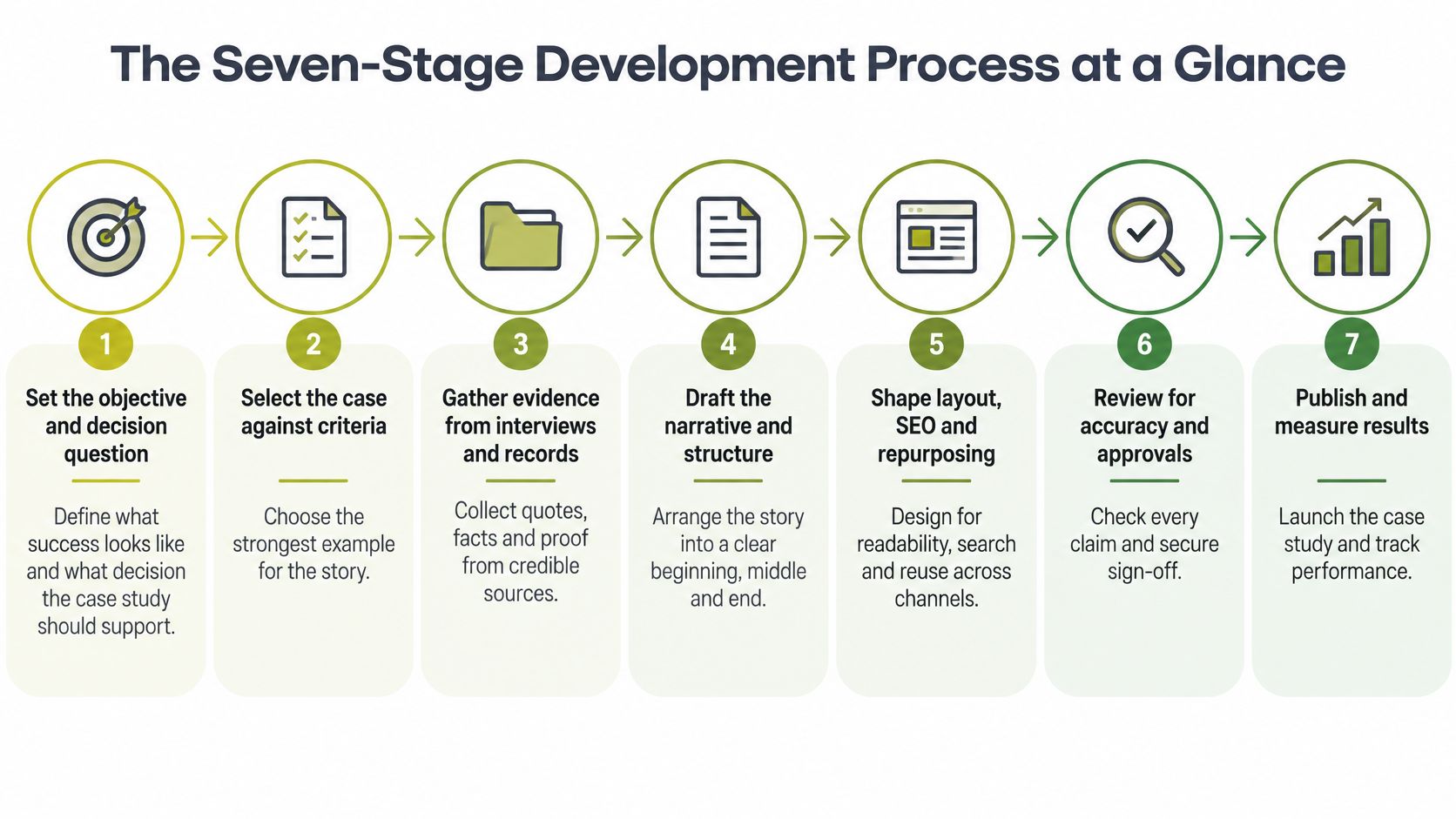
Good case studies follow a predictable sequence. You set the objective and decision question, select the case, collect evidence, interview stakeholders, draft, verify, then design and publish. Skipping early stages doesn't save time. It moves the delay to sign-off, when missing numbers are hardest to fix.
Stages 1 and 2 decide most outcomes. Strong writing can't rescue a case with no baseline, no access to data, or a customer who won't be named. I'd stop a project at stage 2 rather than write around a weak example and hope nobody asks questions.
Who Owns Each Stage
A founder or marketing lead usually owns the objective because they know which decision the case must support, such as winning similar buyers or reassuring a funder. An analyst or operations lead owns evidence because they can pull dated figures from the CRM, finance system or web analytics. A writer then owns interviews and drafting, while an editor and the customer contact share verification.
Keep this table open while the project runs and tick off the output, not just the activity.
| Stage | Output | Typical time | Owner |
|---|---|---|---|
| 1. Set objective and decision question | One-sentence brief with a measurable outcome | Half a day | Founder or marketing lead |
| 2. Select the case | Shortlist scored against written criteria | 1-2 days | Marketing lead with account team |
| 3. Collect baseline and outcome evidence | Dated metrics and a source list | 1-2 weeks | Analyst or operations lead |
| 4. Run stakeholder interviews | Two to four recorded interviews and approved quotes | About 1 week | Writer |
| 5. Draft the narrative | Draft with headline result, results lines and quotes | 3-5 days | Writer |
| 6. Verify claims and approve | Claims log and customer sign-off | 1-2 weeks | Editor and customer contact |
| 7. Design, publish and repurpose | Web page, PDF, press pitch and social cut-downs | 1-2 weeks | Designer and PR lead |
Plan for the Upper End
Adding those stage times gives five to eight weeks in total. Four to six weeks is the best case for a small team with ready data and a responsive customer.
Planning rule: Verification is the stage most often delayed, because customers take longer to approve quotes than planned. Build that wait into your launch date.
Book the customer's reviewer at the brief stage, agree a response deadline, and name a deputy. That one habit prevents most late-stage drift.
Setting Objectives and Choosing the Right Case
A Glasgow hotel group wants more corporate event bookings. A Scottish tech SME needs to build credibility with investors. Each case study should begin with a sentence naming its reader, the decision that reader faces, and the measurable outcome the story must show. If you cannot define those three elements, the case is not ready for evidence collection.
SMEs make up the large majority of UK private-sector businesses, so readers will recognise the constraints on time, data and budget that shape a transferable lesson. Choose a case for the strength of its evidence, not the unusualness of its success.
Score Candidates Against Five Criteria
- Measurable outcome: There is a clear before and after, with dates and a base figure.
- Named approver: A contact can approve quotes and figures in writing.
- Reusable lesson: A buyer in a similar position could apply the approach.
- Recent result: The outcome happened recently enough to remain relevant.
- Accessible data: Your team can obtain records that support the claim.
Use consumer insights research to define the reader and the result they care about. A finance director may focus on cost and risk, while an operations lead may prioritise time saved and fewer errors. Set the audience before selecting the proof, so the case answers a real decision rather than showcasing whatever result is easiest to find.
Write the Theory of Change Early
Draft three short lines before collecting data: what was done, how it should work, and what outcome would indicate success. This gives the team a testable explanation and reduces the risk of selecting only favourable results. Keep the expected outcome distinct from the evidence: a plausible mechanism is not proof that the work caused the result.
Reject a case supported only by a press mention. Coverage demonstrates visibility, not commercial effect. Check regulated-sector constraints at the start, too. Financial, health or legal clients may require compliance review before any outcome is named publicly, and late review can delay design and approval. Choose a case only when its intended lesson, available records and approval route all fit the reader's decision.
Running Stakeholder Interviews That Yield Usable Evidence
One interview gives you one version of events. Speak to three or four people instead, including the decision-maker who bought, the day-to-day user, a colleague who saw the problem first, and a partner or supplier where relevant. Their differences are useful, because they show where the evidence is solid and where memory is doing the work.

Run the Interviews in Five Steps
- Agree consent first: Confirm recording permission and quote-approval rights in writing before the call.
- Send questions in advance: Give interviewees time to find dates and figures.
- Record and transcribe: Transcribe within 48 hours while context is fresh.
- Start before the solution: Ask what was happening, who noticed first, and what it cost.
- Press for specifics: Ask for numbers, dates and named examples, including what changed in the first 90 days.
Lock the interview guide and coding rules before the first call. The UK Government's Magenta Book approach, summarised in the UK Statistics Authority analytical leadership guidance, recommends completing and time-stamping evaluation plans, protocols and statistical analysis plans before outcome data are collected or analysed. Changing questions or metrics after seeing results invites retrospective storytelling, where you select only favourable outcomes or confuse activity with impact.
Recognise a Weak Quote
Avoid leading questions such as "Wasn't the new process much faster?" They produce agreement, not evidence. Be wary, too, of an interviewee who only remembers the good parts.
"The team was brilliant and everything improved quickly."
That quote tells a buyer nothing checkable. Aim for 25 to 60 words containing a specific detail, number or comparison. Every claim in the draft should trace back to a transcript line or a dated record, so keep an audit trail linking each claim to its source from day one.
Proof Checks Before You Publish
The claim most often challenged isn't the story. It's the percentage. A reader asks, percentage of what, from when, and compared with what? If the draft can't answer, the result looks selected rather than measured.
Check Each Metric the Same Way
| Metric | How to report it | Check before publishing |
|---|---|---|
| Revenue or sales growth | £ amount, start and end dates, percentage with the base stated | Seasonality, price changes and promotions in the same period |
| Conversion rate | Rate with the number of sessions or leads behind it | Did the traffic source mix change during the period? |
| Cost saving | £ per month and hours saved, with the method stated | Was it measured before the project began? |
| Lead volume | Count of leads and the share that were qualified | Sales acceptance rate from the customer's own team |
| Jobs created | Number of roles and start dates | Were the roles created because of this project or already planned? |
| Customer satisfaction | Score, sample size and survey dates | Response rate and whether unhappy customers were included |
| Media coverage | Number of items and named outlets | Label it as visibility rather than a commercial outcome |
Apply four minimum evidence points before you claim causation. You need one baseline, one outcome measure, one independent or customer-side source, and one explanation of the mechanism linking the work to the result. Then test rival explanations such as seasonality, pricing, competitor activity or wider market change.
SME-scale attribution is still possible without complex modelling. Compare matched periods, use a unique landing page or code, link interview answers to recorded actions, and cross-check analytics against CRM and finance figures. Label anything short of that standard as an estimate, not proof. This practical guide to how to measure PR effectiveness is useful when you separate outputs from commercial outcomes.
Trust is fragile here. Recent UK retail findings reported in the SAP Emarsys report coverage state that 57% of UK consumers report little or no trust in brands using AI responsibly, and only 19% feel they receive enough value in return for their data. Unsupported claims land badly with that audience.
Disclose AI Without Undermining the Case
Add a provenance layer to the piece itself. State which evidence came from the customer, which metrics were extracted automatically, whether AI helped draft or visualise the story, and who verified the claims. The YouGov UK media attitudes to AI report found that 86% of UK respondents say brands should disclose when AI is used.
Frame disclosure around human accountability, not as a warning label. Name the person who checked figures with the customer and keep customer approval central. A documented approval route helps, and the WebinOne content governance guide offers a useful model for tracking who reviewed each version. Regulated firms should also check claims against the UK advertising rules in the CAP Code before publication.
Narrative Template and Your First Case
Treat the case study as a sequence of claims readers can check. Open with a headline that names one result and the period it covers. Then explain the challenge before introducing the solution, so readers can see what changed and assess whether the result follows from the work.
Walk Through the Template in Order
Begin with customer context: sector, team size, revenue band if approved, and starting metrics. Describe the challenge in the customer's own words, recorded before the outcome was known. Then set out what was done, by whom, and when. Include decisions that were rejected, since they show how the approach was chosen rather than just presenting a successful result.
Separate outcomes into sales, costs, time saved, jobs, or customer satisfaction. Give each measure its own figure, baseline, and period. Newcastle University's REF 2021 impact case study reports more than £4.5 million in additional annual sales, over £1 million in additional annual profits, and at least 13 new jobs. Distinct measures let readers judge which outcomes matter to them and whether the evidence supports the headline.
| Block | What to include | Regulated-sector addition |
|---|---|---|
| Headline result | One number, its period and the customer's name | Record the approval status of the figure |
| Customer context | Size, sector and starting metrics | State licensing or regulatory status where relevant |
| Challenge | The problem in the customer's own words | Note the risk the customer was managing |
| Approach | What was done, by whom and when | Name the review step and who signed it off |
| Results | Separate lines for each measure with baseline and period | Mark estimates and state the method |
| Quote | 25 to 60 words with a number, date or named example | Check the quote against sector claim rules |
| Proof and sources | Source list linked to each claim | Keep an audit trail for compliance review |
| Next step | What a comparable buyer should do next | Add any disclaimer the sector requires |
Use two specific quotes: one near the challenge to establish that the problem was real, and another near the results to explain what changed in daily work. Each should include a number, date, or named example. A quote should add evidence or context, not repeat praise already expressed in the surrounding copy.
Write Honestly About Friction
Include a candid account of what did not work or took longer than planned. Data access may have taken three weeks, adoption may have lagged in one team, or an early tactic may have been dropped. Explain what happened and how it affected the work. Acknowledging friction helps readers distinguish a measured account from a success story that leaves out the conditions behind the result.
Use numbers in place of superlatives. “Sales soared” gives a reader nothing to check. “Monthly enquiries rose from 42 to 71 between March and June (illustrative figures)” identifies the measure and period, while making clear that the figures are illustrative. The more precisely a claim is stated, the easier it is to compare with the baseline and challenge if the evidence does not support it.
A case study earns trust when it shows its working, including the parts that were slower, smaller or less tidy than planned.
For a web page, aim for 1,200 to 1,800 words, using short paragraphs and a subheading every 150 to 200 words. That gives room to explain the baseline, the mechanism behind the outcome, and its limitations. A shorter draft can still be useful, but check that it explains the change rather than listing activity without showing what it achieved.
Editorial Judgement Is the Difference
Deciding what to leave out matters as much as deciding what to include. The Reuters Institute UK journalists research found that 46% of surveyed journalists had worked in the industry for more than 20 years. That experience informs the editorial questions a case must withstand: where a figure came from, whether the account is balanced, and whether the evidence is strong enough to support the claim.
Teams without time for interviews and drafting can ask Carlos Alba Media for help with digital content and PR, combining newsroom questioning with commercial presentation.
Start with the customer whose result has the clearest measurable evidence. Confirm in writing that they will approve quotes and figures, identify the source for the baseline, and book the first interview. Set those steps before drafting a headline, so the story begins with evidence the customer can check.
Layout, SEO and Repurposing Across PR and Social
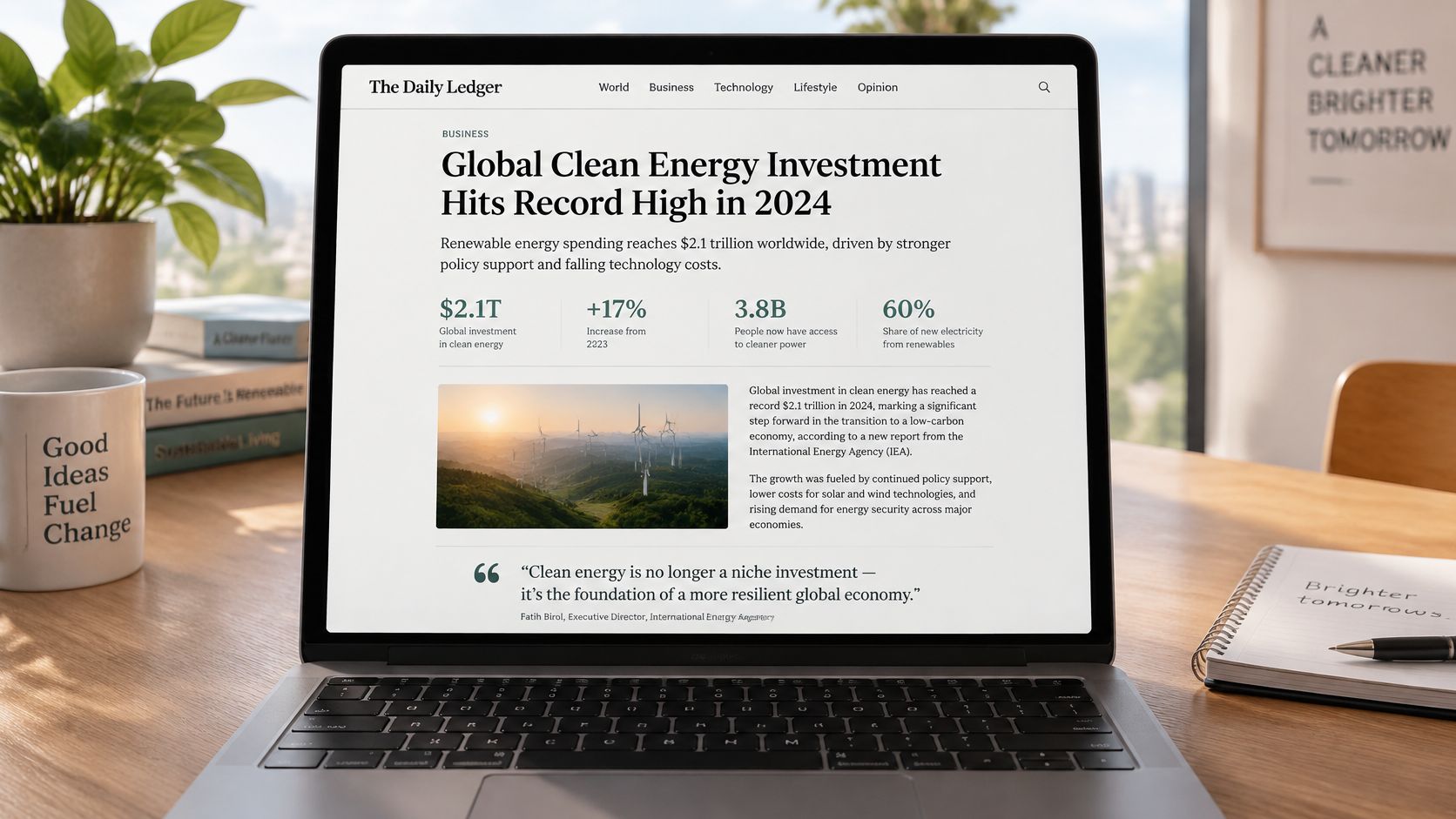
Design the page so the result is visible before the reader scrolls. Put the headline result first, then a one-line summary, a strip of three or four key numbers, and the narrative below. That order serves busy buyers who scan, while still giving careful readers the full evidence.
Make Each Case Findable
Give each case its own URL and a descriptive title that carries the result. Target the customer's sector and problem, such as a Scottish hospitality case study, and link the page from the relevant service page. This guide on SEO content creation covers how that internal linking supports discovery.
Use alt text on every chart and keep key numbers in the body text, not only inside images. Search engines and screen readers can't rely on a graphic alone, and journalists often copy figures directly from text.
The short video below is a useful prompt for thinking about how a written case can be adapted for other formats without changing its claims.
Repurpose in a Fixed Order
- Master draft: Lock the verified web version first.
- One-page PDF: Create a sales version with the same figures and dates.
- Press pitch: Offer a named spokesperson and one verified figure.
- Social cut-downs: Build one quote card per platform.
- Video script: Write a 60-second version from the approved quotes.
- Sales slide: Add the headline result and baseline to the deck.
For a structured approach to adapting approved material, you can reuse existing content with VeloCMS while keeping the master wording under editorial control. Keep a record of which version went to which channel. If a figure is corrected, you'll know every copy that needs updating.
If you need case studies that can withstand questions from buyers, funders and journalists, Carlos Alba Media can run the interviews, build the proof pack and draft the story for approval. Visit Carlos Alba Media to discuss your strongest customer result and turn it into evidence your sales team can use.