

Newsjacking is inserting a brand's relevant comment, data or expert view into a live news story while journalists and audiences are still paying attention. Timing carries the tactic: 70% of surveyed UK journalists reported they regularly use social media to discover potentially newsworthy events, sources, information or opinions, so a credible, attributable line filed while a story is still moving can reach a reporter's source list, and the same line filed tomorrow is dead copy.
That figure comes from the Reuters Institute's study of UK journalists, and it sets the bar for everything below.
It's 9.20 on a Tuesday. A regulator has published a decision that touches your sector, your phone is showing three alerts, and a colleague has forwarded the story with one word: "comment?" You have a view. You're just not sure whether sharing it makes you the expert in the piece or the opportunist in the replies.
That doubt is worth taking seriously, because it's aimed at the wrong risk. Teams worry about being too slow. The damage usually comes from having nothing useful to add, at any speed. The honest answer to what is newsjacking lies in the decision to press send, not in the definition.
Newsjacking Defined and Where the Term Came From
Working definition: inserting a brand's relevant comment, data, expert view or creative angle into a live news story while journalists and audiences are still paying attention.
David Meerman Scott popularised the term in his 2011 book, Newsjacking: How to Inject Your Ideas into a Breaking News Story and Generate Tons of Media Coverage. Read the definition again and note what's missing. The brand doesn't create the event, doesn't buy the audience and doesn't wait to be asked. It connects expertise it already holds to a story that already exists, quickly enough to be useful to a reporter on deadline.
Picture a lifeguard already in the water when someone shouts for help. Not a stronger swimmer arriving after the rescue. Timing is the qualification.
The UK audience makes that urgency concrete. Ofcom reported that 68% of UK adults consumed news through online sources in 2023, while 47% used social media for news (Ofcom's news consumption research). News arrives in feeds that refresh all day, which is why a comment can be entirely accurate and still worthless if it lands after the interest has drained away.
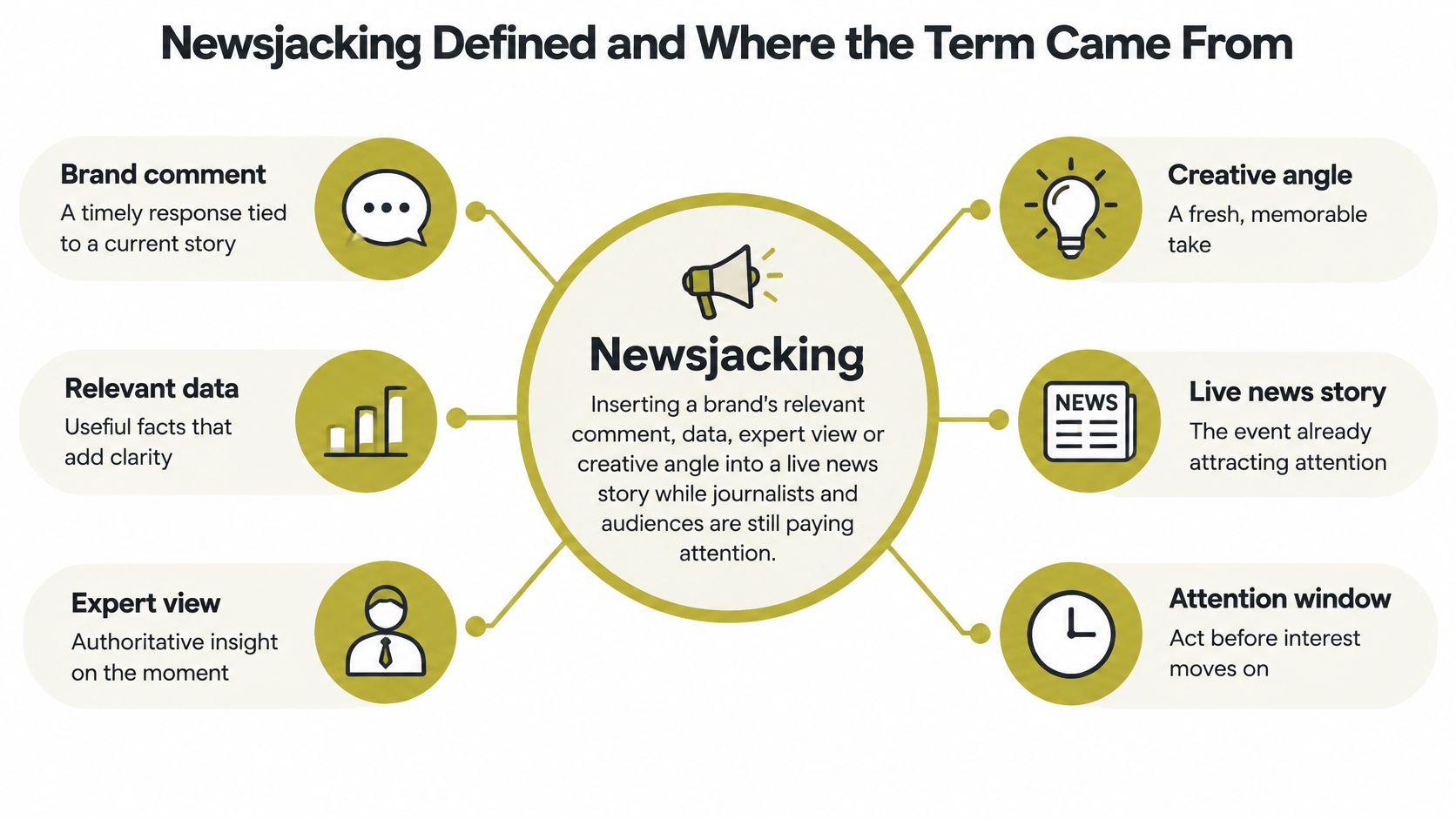
Three things have to be true before you respond:
- A genuine connection. Your specialist knowledge has to bear directly on this story, not on an adjacent theme you'd like to talk about.
- A concise insight. One or two sentences that improve a reader's understanding of what just happened and why it matters to them.
- Delivery while the story is developing. A pre-cleared quote and a named spokesperson who can pick up the phone.
Newsjacking parts company with trend-chasing. A brand posting about a trending hashtag it has no professional link to is doing something else, and journalists can tell within a sentence.
Watching the wires yourself is a plumbing job as much as an editorial one. Any team building a monitoring feed meets the practical constraint of designing ingestion within rate limits well before the first alert lands in a shared inbox.
Run this test on any headline: could a reporter use my comment in the next hour? If not, you're writing marketing copy with a news hook sellotaped to it.
Newsjacking Examples and What Made Them Work
In February 2013, the lights went out in the Superdome during the Super Bowl. Oreo's social team posted a one-line tweet and a single image of a biscuit being dunked in the dark. The product was in the picture; the sales pitch wasn't. It worked because the brand said something about a moment an enormous audience was already watching, in fewer words than anyone else managed that night.
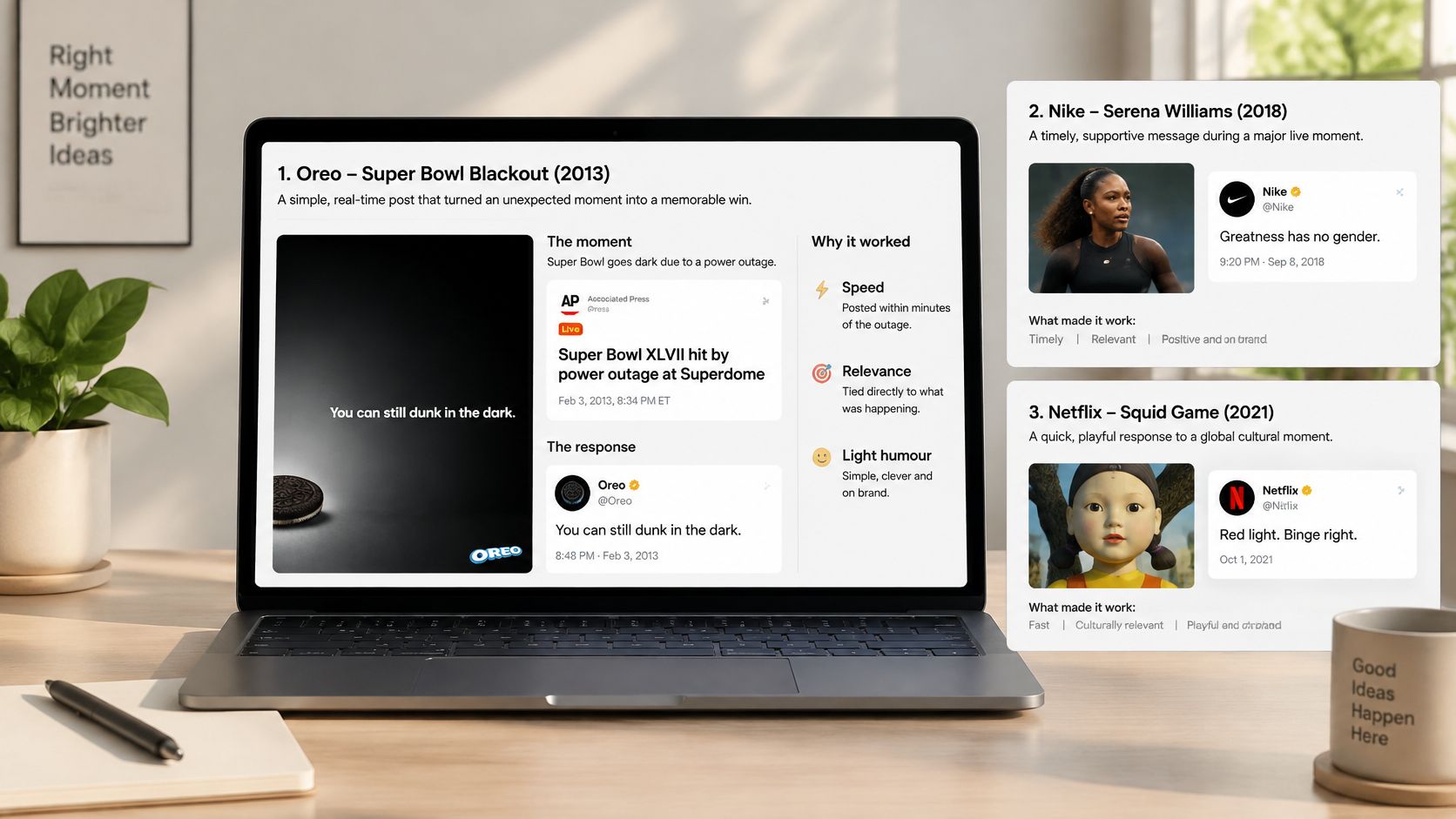
Nothing about that post required the company to own the story. It required three things any SME can supply: a fast decision, an angle that fits and restraint about the product.
The pattern repeats across story types. The credible angle changes with the subject. The risk doesn't.
| Story type | Credible angle | Risk to avoid |
|---|---|---|
| Sporting event or cultural moment | Insight on travel, ticketing or audience behaviour | Turning the result into a product plug |
| Weather or transport disruption | Practical advice for customers and visitors | Selling during the disruption |
| Regulatory or policy change | What it means for your sector and its customers | Claiming compliance you haven't checked |
| Economic data release | Analysis of what the figures mean for SMEs | Predicting outcomes without evidence |
| Tragedy or public-safety incident | Verified safety information only, where you can genuinely help | Any commercial message at all |
Say a Scottish travel operator watches a rail line close on the Friday before a bank holiday weekend. The response that helps is practical: which routes still run, which coach or ferry alternatives exist, what to do about an existing booking. The response that fails is a discount code pinned to a disrupted journey.
Take a financial adviser asked about a Bank of England rate decision. Explaining what the change means for a household with a variable mortgage, using the published figures, is a public service. Telling readers to book a review call turns the same paragraph into an advert.
A short walkthrough of the tactic, and how the timing looks from the newsroom side:
The PR campaign examples worth studying all share three things: a clear connection to the story, a contribution a stranger could use without buying anything, and a set of facts you'd be happy to have checked line by line.
The Ethical Test to Run Before You Comment
A resignation lands at 8.40am, your sector is named in the second paragraph, and by 8.47 someone has asked for a line. The newsroom clock rewards the useful comment. In a 2022 New Statesman Media Group survey, cited in Press Gazette's round-up of PR expert views, newsjacking was regarded as less unethical than practices such as clickbait and greenwashing. The reputational damage comes from adding no public value to a story people care about.
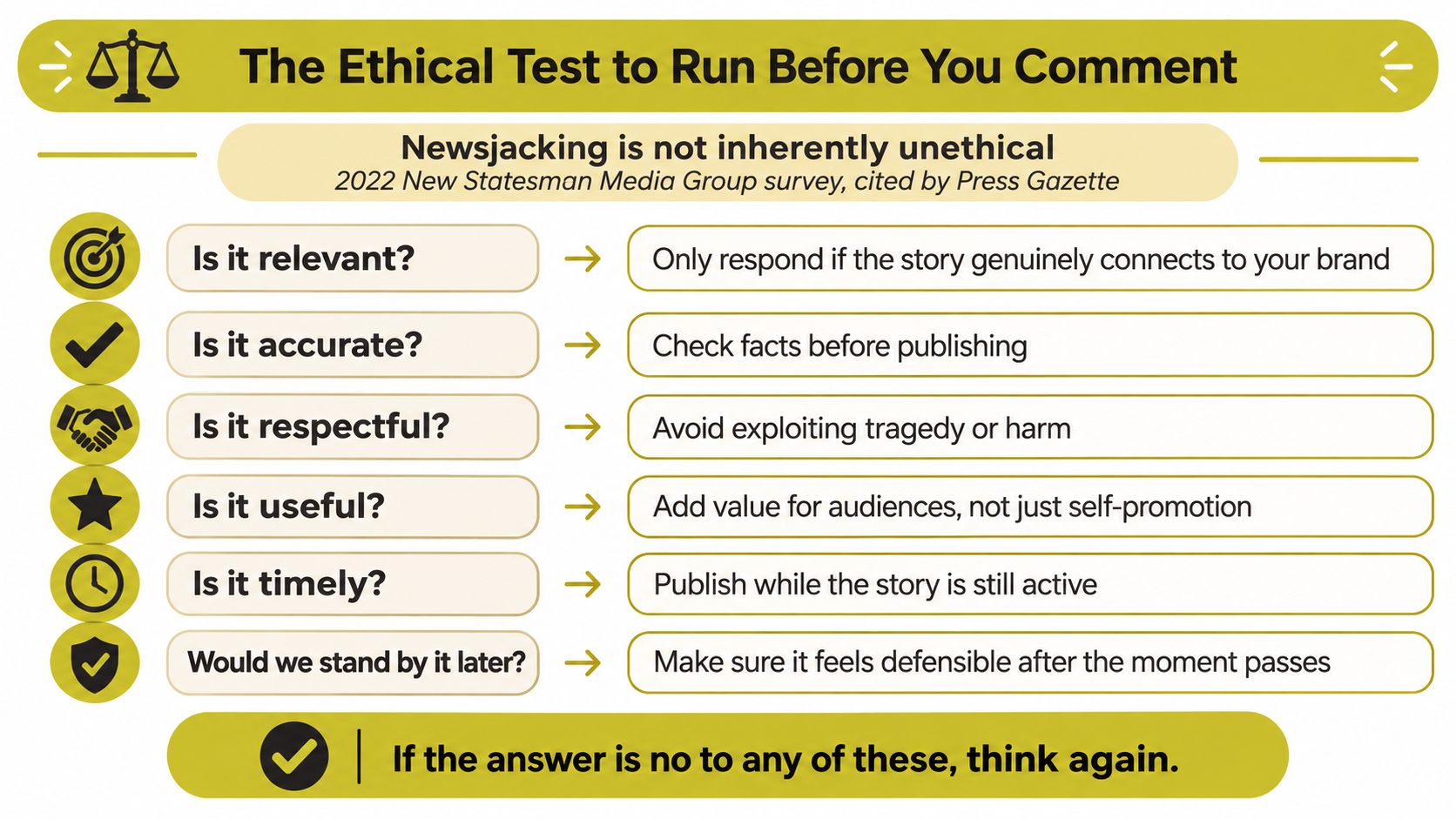
Work through four checks in this order, and stop at the first one you fail.
- Human impact. Is anyone grieving, injured or in danger? If yes, stop, unless what you're publishing is purely safety information that helps people act.
- Legitimate connection. Does your specialist knowledge bear on this story, or on a related subject you'd prefer to be asked about?
- Informs or sells. Strip out the product mention. Does the comment still tell a reader something they didn't know about the event and what it means for them? If it collapses without the pitch, it was a pitch.
- Approval. Does a senior person need to sign this off, and do the claims need legal review? Decide that before the story breaks, not while you're typing.
The contexts where this gets tested are predictable. An accident closes a road: check one fails, so the only acceptable post is verified travel information. A political controversy flares: check two often fails, because party politics rarely needs your sector's view. A public-health scare: check three fails when a clinic turns guidance into a service offer. A local Scottish planning decision: check four fails when nobody wants to send a contentious comment to the lawyers at 5pm on a Friday.
Regulated claims sit in the highest-risk category, because in sectors such as finance and health an unverified line becomes a compliance problem as well as an embarrassment. Carlos Alba Media's media law and ethics guidance is the reference point for that side of the check.
The do-not-post rule: if you can't improve someone's understanding of the story or offer them meaningful help, stay out of it. Silence is a decision you can defend. A bad comment follows your brand around for years.
Running a Response Across Channels
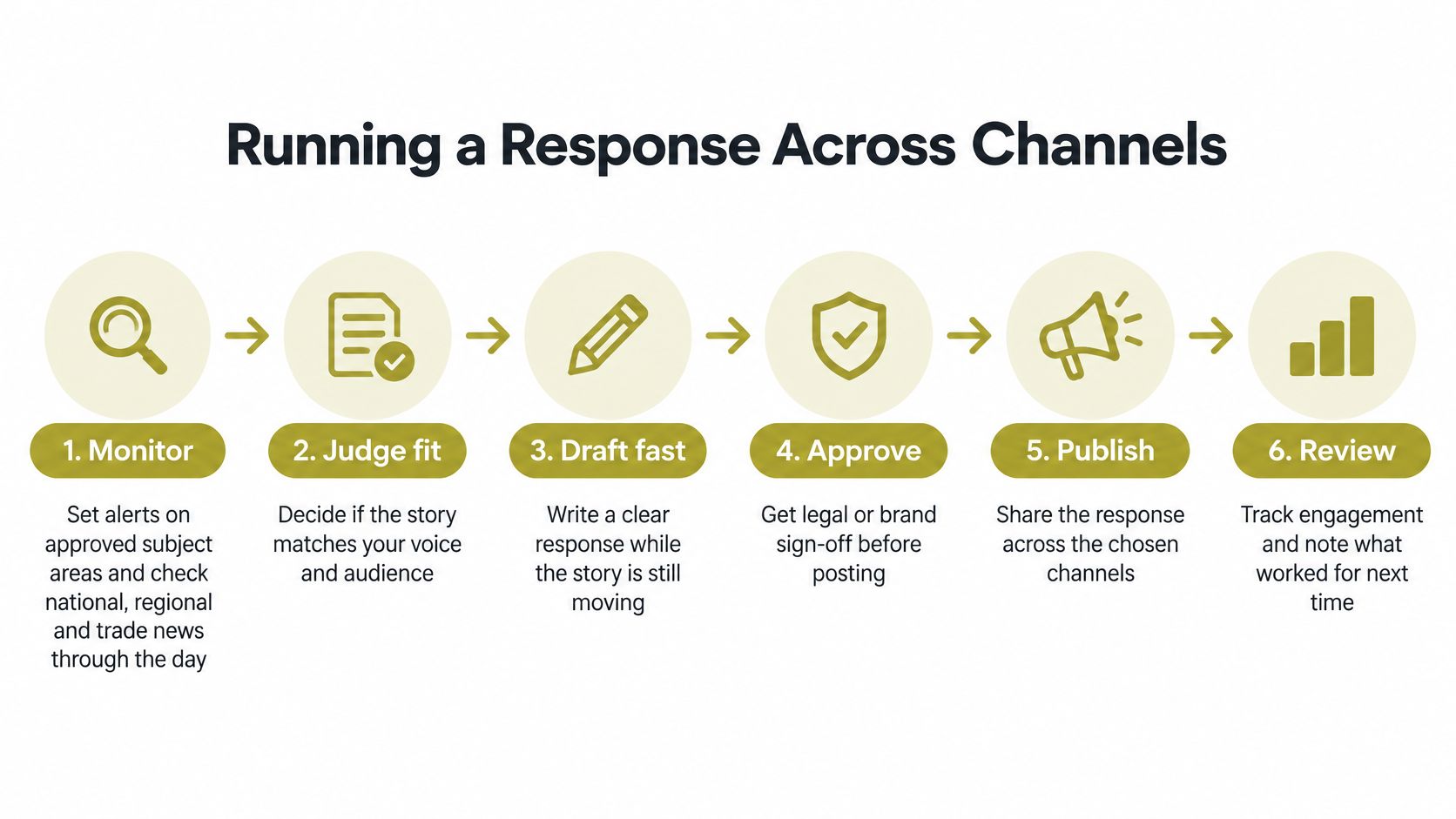
The routine matters more than the inspiration. Here's the sequence I'd build, with the reason each step exists.
- Monitor. Set alerts on named subject areas and check national, regional and trade news through the day. The window is set by when the story peaks, not by when you get to your desk.
- Judge fit. Ask what your expertise adds that the headline doesn't already say: regulatory consequence, cost impact, technical detail, what it means in one region.
- Pre-clear the material. Keep approved evidence, statistics and sign-off routes ready, so nobody is drafting from scratch under pressure at 9.15am.
- **Draft. ** One quotable comment of one or two sentences, one supporting data point with its source, and a named spokesperson available for interview. Nothing else.
- Check and approve. Verify every figure yourself. Send high-risk topics to legal or compliance even when it costs you twenty minutes, because a correction costs more.
- Publish. Email the comment to journalists covering the story, post a short evidence-led update on social, and link to a page carrying the sources and context.
Set the service level in minutes, not days. A response that takes three days isn't newsjacking, it's commentary.
Adapt one idea across each channel
The audience is already fragmented. Reuters Institute data reported in Cision's guide to how journalists use social media puts news websites or apps as the main online news source for only 22% of respondents, down 10 percentage points since 2018, and the same guide cites Grayling's 2025 trends report in which 49% of UK business leaders ranked online media as a communications priority, against 6% for print and 5% for broadcast.
That spread is why one insight needs several formats. Rewrite the same point for a newsroom pitch, a LinkedIn post, a short video and a rapid-response FAQ page. If you're coordinating several messages at once, planning and tracking hashtag campaigns keeps the versions consistent instead of contradictory.
Prepare the spokesperson, not just the statement
Brief the human being, not only the words. Each spokesperson needs one approved line, one defensible fact, a clear sense of where their expertise stops, and a plan for the question that drifts into politics or speculation.
Our PR and social media work runs on that brief, because a spokesperson who knows their limits sounds authoritative and one who improvises sounds like a liability.
Stop once the story has moved on. Yesterday's comment, reposted today, reads as noise and teaches journalists to ignore your next email.
Why Timing Decides Whether a Response Gets Seen
A story reaches the public through several doors at once: newsroom inboxes, social feeds, search results, aggregators. A response published while the topic is still circulating gets found in more of them. Ofcom's work on social media as a gateway to news shows how heavily discovery now runs through platforms and intermediaries rather than front pages. Inside those feeds, placement decides exposure. Items near the top draw substantially more views and are remembered far better than the same items sitting further down.
Speed alone rescues nothing. Latency decides whether your response is eligible to be seen; public value decides whether anyone is glad it was. A fast reply that adds nothing to the story still trains journalists and readers to skip you, and it does so in front of more people. Publish while attention is climbing and a useful comment has a chance to be discovered, read and recalled. Publish after the decay and the same words reach almost nobody.
| Metric | What it shows | How to track it |
|---|---|---|
| Response latency | Time from the story's first peak to your comment | Minutes, reviewed after each response |
| Journalist uptake | Stories that quote or source your comment | Count per story |
| Headline or lead inclusion | Your point appears in the headline or first paragraph | Share of pickups |
| Referral traffic | Visits from coverage to your landing page | UTM-tagged links in analytics |
| Qualified enquiries | Leads matching the service you offer | Count per story, not total visits |
| Message retention | Whether audiences recall your point | Short recall survey or comment sentiment |
Read that table as a funnel rather than a scorecard. Coverage volume on its own rewards the controversial take, which is exactly the behaviour that damages trust. If journalist uptake is high but qualified enquiries are zero, the comment was interesting but commercially irrelevant. If referral traffic is strong and retention is weak, the message didn't survive contact with the audience.
The row to check first is the top one. When response latency is measured in hours rather than minutes, fix the workflow before you rewrite the quote, because a slow process will waste your best line every time.
Decide Whether to Newsjack Your Next Story
The decision in plain terms: if you have a specialist with a clear view on a subject that reaches the news regularly, set up monitoring and pre-clear your evidence. Comparing free and enterprise monitoring options is a sensible first afternoon's work. If nobody can respond within the hour, skip breaking news and build a planned commentary calendar instead. Where tragedy, legal exposure or regulated claims are involved, default to silence until review is complete.
The harder question is what you add. Speed decides whether a comment gets seen; public value decides whether it deserves to be. A comment filed on time that teaches the reader nothing is where the reputational damage sits, because it marks you out as someone chasing coverage rather than contributing to the story. I would advise any business to stay quiet on a story it can't advance rather than publish quickly and get quoted as filler.
Start small: pick three approved subject areas and one named spokesperson, then run a single response on a story that fits and measure what happened.
Carlos Alba Media works with businesses that don't have that capacity in-house. Carlos Alba founded the agency after a 20-year career in national newspaper journalism as a multi award-winning former national newspaper editor. Its consultants are former national print and broadcast journalists, so the judgement about what a reporter will use comes from people who have made that call on deadline.
If a story is breaking in your sector and you can't decide whether you hold a legitimate comment or a reputational risk, the agency can help you make that call quickly. It offers a free consultation with one of its public relations experts for anyone facing a communications challenge or a media crisis, whether you need a comment drafted under deadline or a decision to stay quiet defended properly. Visit Carlos Alba Media to arrange that conversation before the next story lands.