
More than 285,000 full-time-equivalent roles sit within UK organisations' in-house marketing functions, according to the CIM and PwC market-size study. Internal marketing isn't the small alternative to a vast agency industry. It's a substantial operating model in its own right.
But that doesn't mean building a department is the right move for your business. The useful marketing agency vs in house comparison starts with the work you need done, the skills it requires and the management time you're prepared to give it. For an owner-led business, that last cost can be the biggest omission from the spreadsheet.
Why the Agency or In-House Question Keeps Coming Back
Many UK businesses buy some marketing support from outside while keeping internal capability. A survey of manufacturers reported by Machinery Market points to outsourcing as part of how businesses approach marketing, rather than a replacement for every in-house role.
Consider a Scottish technology SME. Its commercial lead knows the product, customers and sales objections, but may not have the time or media contacts to develop a national story. Hiring a whole department to address that gap could mean paying for capacity the business does not yet need. The commercial lead's time is also a marketing cost, even if it never appears in the budget.
In-house marketing means employing people whose workload, development and performance you manage. An agency provides an agreed service under contract, with defined responsibilities and limits on what is included. Neither model removes the need for someone inside the business to set priorities, supply information and make decisions.
A practical default is a hybrid: keep internal ownership of the brand and business priorities, then buy external capabilities that the team lacks or cannot deliver with the time available. That boundary can change as needs and resources change. The decision is less about assigning the whole function to one side, and more about matching each piece of work to the people who can deliver it without overlooking the founder's unbooked hours.
Agency and In-House Marketing Side by Side
| Criterion | In-house team | Agency |
|---|---|---|
| Cost basis | Salaries, National Insurance, benefits, tools and overheads | Monthly retainer or project fee, usually with a defined scope |
| Expertise | Deep product and customer knowledge; breadth limited by who you can hire | Specialists across PR, SEO, content and paid media available within the agreed service |
| Speed to start | Recruitment can take months before output begins | Onboarding may take weeks once scope, access and the brief are agreed |
| Control | Direct line management, brand ownership and approvals | Shared delivery control governed by account management and contract terms |
| Scalability | Growth means hiring, training and carrying fixed costs | Flexible up or down for campaigns, subject to capacity and notice periods |
The table compares operating arrangements, not guaranteed quality. An excellent internal marketer can outperform an unsuitable agency, and an experienced specialist can solve a problem that has stalled inside a well-resourced department.
In-house staff have proximity. They can hear a sales call, challenge a product claim and get an answer from the managing director without arranging another meeting. Agencies offer breadth and an outside perspective, but you have to invest in helping them understand the business.
An in-house team is fixed capacity you must keep busy, while an agency is variable capacity you must brief well.
Speed means more than a start date
An agency with an available team can begin without a recruitment process. That doesn't mean it can publish accurate work before receiving product information, customer evidence, account access and approval authority.
Equally, an internal appointment isn't productive because the employment contract has started. Someone must explain the proposition, introduce stakeholders, resolve priorities and provide the tools to work. Recruitment and onboarding are different jobs, and both need an owner.
For a broader checklist of these structural trade-offs, you can compare marketing models with Keywordme. Use the comparison to challenge assumptions about your own workload, rather than treating either model as faster.
Consider a hypothetical product launch with six weeks until announcement. A media specialist with relevant contacts and available capacity could begin shaping the story while an employer starting from scratch is still recruiting. But if the founder can't confirm the claims or approve an interview, that external advantage disappears.
Before choosing, separate the deadline into practical dependencies:
- Evidence ready: Product claims, customer permissions and supporting material are available.
- People available: The spokesperson can attend preparation sessions and interviews.
- Approval clear: A named person can approve the announcement without circulating it indefinitely.
- Delivery booked: The people doing the work have confirmed capacity, not merely expressed enthusiasm.
Control needs a working system
Direct line management makes changing priorities easier, but it doesn't automatically produce good decisions. An internal marketer can still receive contradictory instructions from sales, operations and the chief executive.
With an agency, control should be explicit. Define response expectations, reporting cadence, approval routes, account ownership and escalation before signing. Distinguish an urgent reputational issue from a routine copy amendment so everything doesn't enter the same queue.
Your business should retain ownership of its domain, advertising accounts, analytics properties and customer records. Give the agency appropriate access rather than allowing critical accounts to exist solely under an employee's or supplier's login. Put handover arrangements in writing while the relationship is healthy.
Now consider a different scenario: a product-led firm changes its messaging weekly as customers test new features. An embedded marketer who attends product discussions and hears customer feedback may be the better daily operator. Bringing an external team into every small decision could create more coordination than useful work.
That doesn't rule out external support. It means the agency should handle a defined specialist task rather than act as an expensive relay between internal departments.
Scale should follow demand
An agency can add campaign capacity without creating permanent posts, but flexibility isn't unlimited. Additional work needs available people, an agreed fee and a realistic schedule; reductions may require notice.
An internal team offers dedicated attention, but you carry its cost between campaigns. If your workload consists of intermittent launches followed by quieter periods, identify what permanent staff will do between those peaks before hiring.
Our explanation of how a digital marketing agency works is useful when translating a broad ambition into a deliverable scope. The important question is what the team will own, from planning through execution and measurement.
Agency quality varies, and so does internal leadership. A precise brief, sensible contract and capable decision-maker matter more than the label on the organisation chart.
What Each Model Really Costs Over Twelve Months
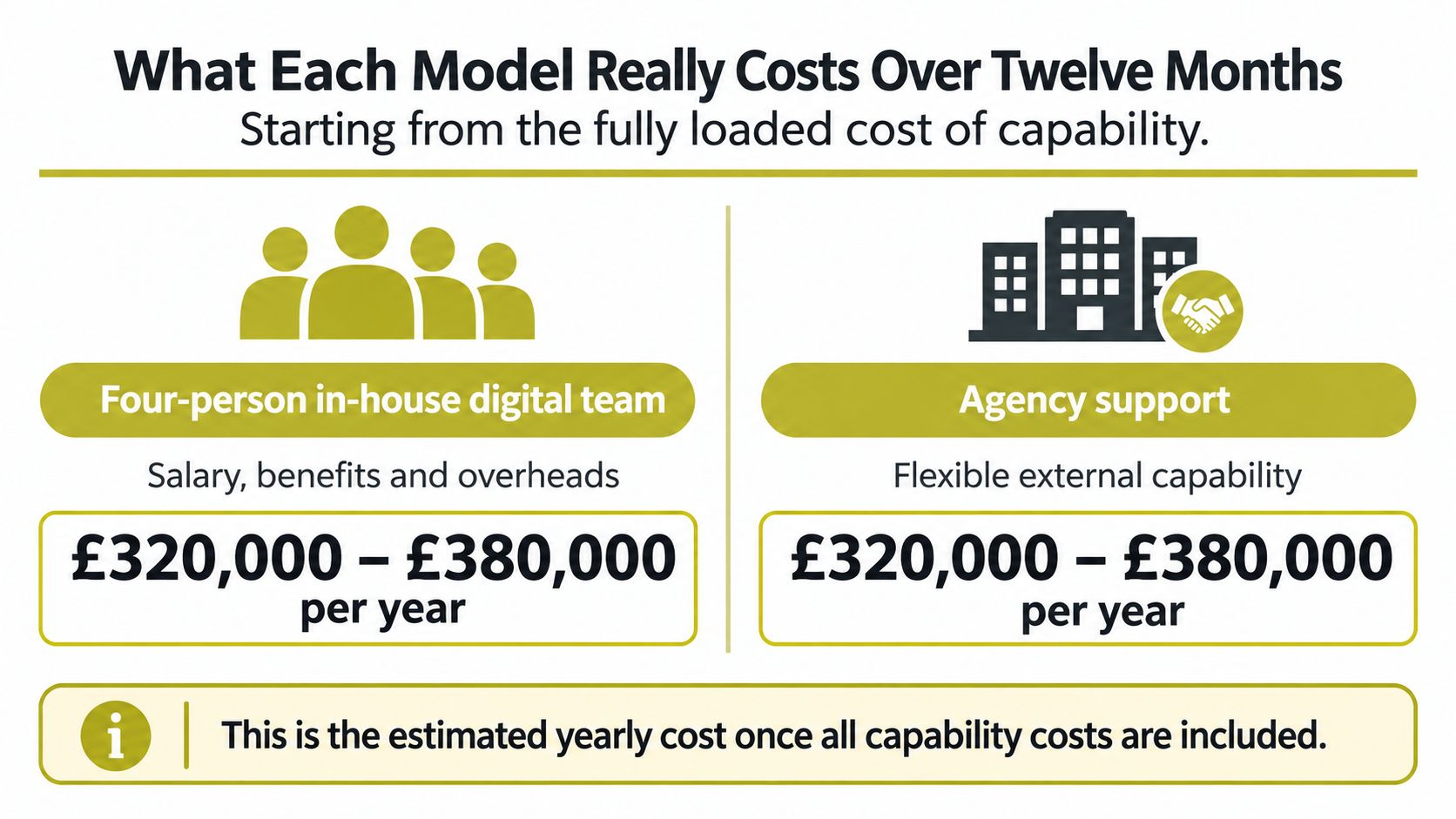
£320,000 to £380,000 for a four-person in-house digital team, compared with £60,000 to £180,000 for agency support, is the annual comparison in a published UK analysis of agency and in-house costs. The in-house estimate includes salaries, employer National Insurance, benefits, software, training and overheads. The agency range is for a retainer covering comparable multi-channel delivery.
These are indicative ranges, not quotes. An agency retainer does not provide exclusive access to a whole department, so check the proposed capacity and deliverables before treating the scopes as equivalent.
Build a complete cost sheet
| Cost element | In-house digital team | Agency retainer |
|---|---|---|
| Annual cost for comparable multi-channel scope | Fully loaded employment cost for the required roles | Annual contracted fee for the matched scope |
| Included in the figure | Salaries, employer National Insurance, benefits, software, training and overheads | Named team, strategy and delivery where included in the contract |
| Hidden costs to add | Recruitment, leave cover, management time and additional tooling | Briefing time, approval delays, onboarding and duplicated tools |
Check what each figure already covers. Don't count software twice if it is included in the employment estimate, and don't assume an agency fee includes advertising spend, website development or specialist production unless the proposal specifies it.
An internal team can make financial sense when its roles have useful, sustained work throughout the year. Agency support can cost less when demand fluctuates or the requirement is concentrated, such as a PR launch, reputation issue or technical SEO audit. A hybrid arrangement is often a practical starting point: retain internal ownership of ongoing priorities and buy external capacity for defined specialist work.
Price the work that nobody invoices
Your own time is part of the comparison. Record hours spent writing briefs, chasing assets, editing copy, attending meetings and making decisions. Assign those hours a consistent internal value, whether you use an agency or an in-house team.
This is an opportunity-cost estimate, not an extra cash payment. Keep it separate from expenditure, but don't treat it as free because it does not appear on a supplier invoice. Founder time diverted into routine coordination is time unavailable for other business decisions.
Use the digital marketing pricing and packages information to frame the scope discussion, rather than comparing headline fees alone. Price both models over twelve months against the same deliverables, include the value of your time, then compare cost per qualified opportunity or attributable revenue against total cost.
Where Expertise and Senior Counsel Matter Most
Expertise is a practical capability, not a job title. Strong product writing does not automatically prepare someone to handle a hostile interview, diagnose an indexing problem or judge whether a story is ready for a national news desk. The decision should turn on who can handle the task, and who has authority to approve the work.

A UK creative-employer skills analysis found that 42% of advertising and marketing employers experienced digital-skills shortages and 22% reported skills gaps in their existing workforce. It also reports Gartner findings that 59% of marketing leaders lacked sufficient budget to execute their strategy, while 22% said generative AI had reduced their reliance on external agencies.
For a business weighing the options, the practical response is to separate work that needs informed judgement from work that needs efficient production. Keep strategic decisions and approvals close to the business where useful, and bring in specialist input for gaps that a generalist or tool cannot cover. A hybrid arrangement can preserve internal knowledge while giving the team access to senior counsel when it matters.
Buy the missing judgement
Internal staff build valuable product and customer knowledge. Their constraint is often breadth. A capable generalist does not automatically bring specialist depth across PR, technical SEO, paid media, content and crisis response. Hiring for every skill can be difficult to justify when demand is uneven, while relying on one employee for all of them creates a capability gap.
AI can assist with outlines, variations and routine drafting. Human judgement remains necessary to decide whether a sensitive allegation deserves a response, whether a claim is supportable and how a spokesperson should answer a difficult question.
Specialist depth matters most when the task is rare, high-stakes or time-sensitive.
National media work requires editorial judgement as well as contacts. The practitioner must recognise news value, test the evidence, anticipate objections and prepare the spokesperson. No supplier can guarantee an independent editor's decision.
Carlos Alba Media's team description says that everyone on the team is either a former national news journalist or has agency experience working with international brands. The business's consultants are former national print and broadcast journalists, and Carlos Alba has led hundreds of PR and digital marketing projects for organisations of all sizes. These credentials help a buyer assess relevant experience, but they do not replace a clear brief or agreement on who will do the work.
Examine the people behind the proposal
Our founder is a multi award-winning former national newspaper editor, and every consultant on our team is a former national print or broadcast journalist, so those credentials are concrete to assess alongside the proposed working relationship. Ask who will handle the account day to day, who provides senior review and how the team will coordinate with internal staff. Senior counsel has value when it reaches the people making decisions, rather than appearing only in a pitch.
For another perspective on the agency and internal-team choice, watch the discussion below.
Before committing, make the capability conversation specific:
- Delivery team: Establish who will perform the work and who supplies senior review.
- Difficult story: Discuss how the team would assess a challenging allegation, prepare a response and coordinate approvals.
- Work allocation: Identify what stays internal, what can be automated and what needs an external specialist.
- Evidence of value: Judge relevant coverage, sound advice and qualified enquiries, not the volume of documents produced.
Which Model Fits Your Stage and Goals
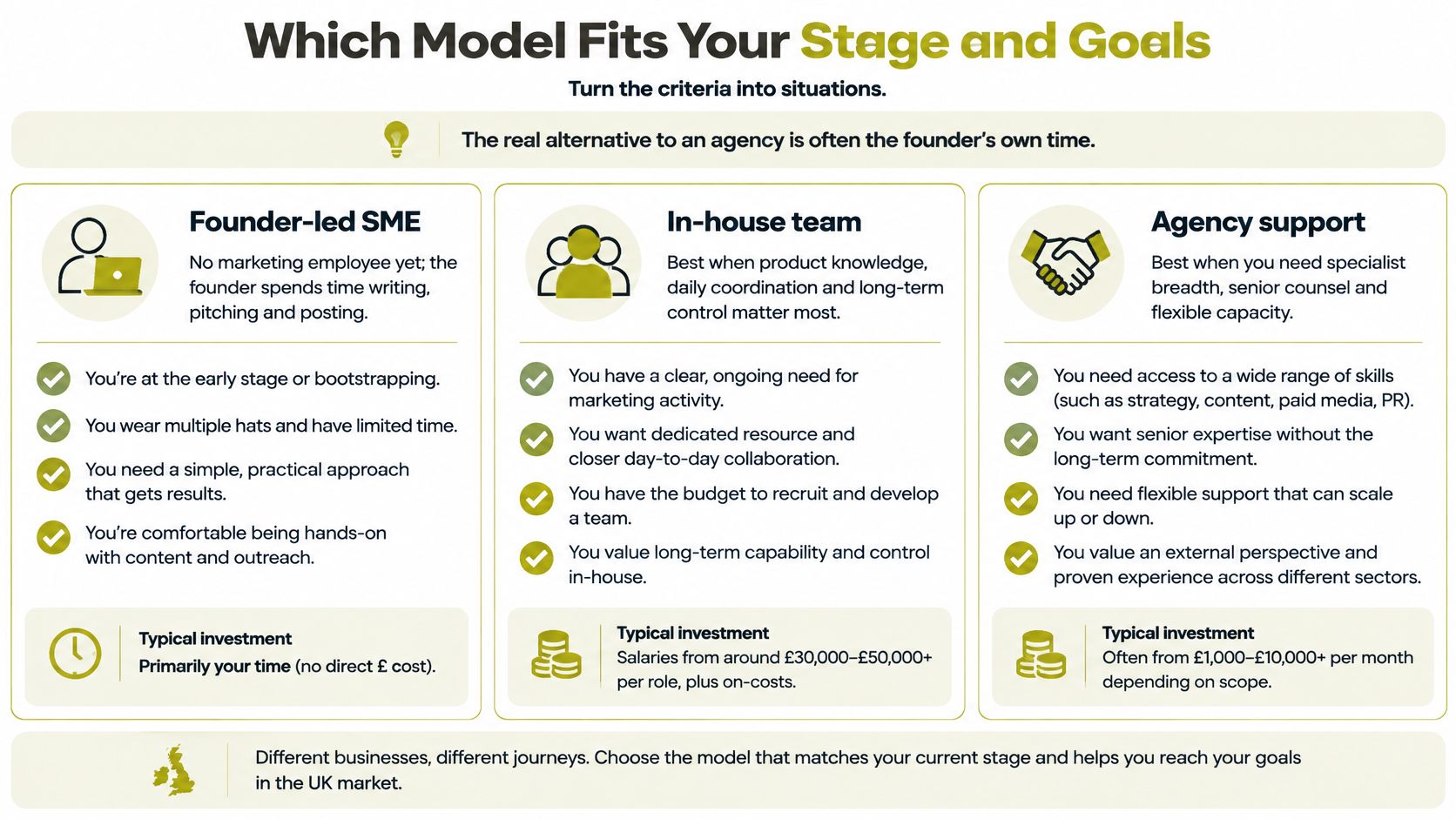
For many SMEs, the alternative to an agency isn't an employee. It's the owner writing posts after work, pitching journalists between sales calls and putting campaigns aside whenever a customer problem takes priority.
UK SME research reported by Business in the News found that 65% of in-house marketing was carried out by business owners, while 58% of SMEs spent less than £250 per month on marketing. That makes executive attention central to the decision, especially where the business has no specialist staff.
Match the model to the actual bottleneck
| Business situation | Likely fit | Why it fits |
|---|---|---|
| Owner writes most marketing with no specialist staff | Agency on a targeted retainer | A specialist fee can cost less than the founder time it replaces |
| Steady, multi-channel demand across the year | In-house team | Sustained use of the required roles can justify the fixed cost |
| Product launch, media relations or reputation risk | Agency | Adds specialist media judgement and crisis readiness |
| Product-led firm with fast customer feedback | Hybrid, with in-house ownership and agency specialists | Keeps insight and approvals internal |
| Seasonal or campaign-based demand | Agency | Provides capacity for peaks without year-round payroll |
| Export or new-market expansion | Agency for launch, in-house for ongoing work | Adds market-specific capability without immediately making it permanent |
The owner-led case needs care. If the founder enjoys writing and produces commercially useful material efficiently, removing that contribution may be unnecessary. The better purchase might be editing, distribution or media advice rather than wholesale replacement.
Equally, outsourcing won't fix an unclear offer. A business still needs to know whom it serves, why those customers buy and what action the campaign should encourage.
Use this stage-based comparison to identify the role you need, rather than the organisation chart you think a growing business ought to have.
Recognise when the current arrangement is failing
Set an owner-time ceiling that reflects your commercial responsibilities. The warning sign is not spending time on marketing, but repeatedly abandoning higher-value work to keep routine delivery moving.
- Slow turnaround: Useful material waits for drafting, review or publication until its relevance has passed.
- Missed campaigns: Launches arrive without agreed messages, assets or distribution.
- Reputation exposure: Nobody owns sensitive enquiries or spokesperson preparation.
- Owner overload: Logged marketing hours exceed your agreed ceiling and displace sales, hiring or customer work.
- No measurable outcome: Reports show activity, but nobody can explain whether it attracts suitable prospects.
For outbound-led businesses, evaluating cold email agency fit from H2 offers a narrower procurement lens. Apply that channel-specific scrutiny to the service you're buying rather than assuming a general marketing retainer covers every discipline.
A minimum viable hybrid can be straightforward: one internal decision-maker, a clear source of customer insight and external help for a defined bottleneck. Keep sensitive information and regulated sign-off under appropriate internal control.
A start-up can begin with a targeted project before adding recurring commitments; our digital marketing for start-ups guidance addresses that early-stage choice. Growing firms can appoint an internal lead once coordination becomes a sustained job, while established brands can retain their department and buy specialist support for national visibility or demanding campaigns.
Test Both Models Before You Commit
Build a brief before making a staffing decision
A useful test compares the same job under different operating arrangements. It shouldn't pit a fully specified agency proposal against an imaginary employee who can do everything.
Log the work over four weeks. Record the owner's and team's time spent planning, drafting, editing, approving and reporting. The common slip is estimating from memory, which misses fragmented work and makes the current arrangement look cheaper than it is.
Map the missing capabilities. List PR, SEO, content, paid media and crisis response, then mark each gap as recurring or occasional. Don't convert every missing skill into a permanent role; an intermittent requirement may justify a project instead.
Identify decisions that must stay inside. Assign ownership of customer insight, commercial priorities, approvals and regulated sign-off. The mistake is outsourcing delivery without appointing anyone who can make binding decisions for the business.
Make the alternatives genuinely comparable
Price a hire and an agency scope over twelve months. Give both options the same brief, required outcomes and resource assumptions, then compare cost per qualified enquiry or opportunity. Don't approve the hire before establishing that enough suitable work exists to justify the role.
Write down the service levels. Specify response expectations, reporting cadence, account ownership, handover requirements and escalation routes. Signing first and resolving those details later leaves both sides relying on different assumptions.
Set a six-month review date. Assess qualified enquiries, coverage quality and executive hours saved against a baseline established before work begins. Avoid a brief so vague that any collection of posts, meetings or reports can be presented as success.
Define a qualified enquiry in language sales and marketing both accept. Record enquiry sources in your customer relationship management system, and distinguish direct attribution from work that supports a longer buying decision.
Don't dismiss useful PR because it doesn't produce an immediate form submission, but don't accept potential audience size as proof of commercial impact either. Assess whether the coverage reached a relevant audience, communicated the intended message and supported a useful next action.
If a communications challenge or media risk is already live, a free consultation with one of our PR experts is a sensible next step.
Carlos Alba Media offers specialist PR and digital marketing support through our London and Glasgow-based teams, and you don't need to be based in Scotland to work with us. Visit Carlos Alba Media to discuss which capabilities your business should retain internally and where external expertise could help, or request a free PR consultation if you're facing a communications challenge or media crisis.