

A realistic 2026 UK SME brochure site can cost roughly £1,500 from a freelancer to £6,000 or more from an agency, depending on the scope and level of delivery. Premium studios can sit considerably higher.
You've probably seen the problem already. You ask for a “simple five-page website” and receive three proposals that barely resemble one another. One supplier quotes a figure that looks appealing, another asks for several thousand pounds, and the third talks about strategy, conversion and content before showing you a price that feels difficult to justify.
The mistake is comparing the totals before comparing the work. Web design services pricing reflects far more than the number of pages. It reflects who is doing the thinking, how many disciplines are involved, what happens after launch, and whether the provider is adapting a template or building a digital sales asset around your business.
Why Three Quotes for the Same Site Look Nothing Alike
You've just received three quotes for a five-page business website. One is £1,200, another is £4,500, and the third is £9,000. All three suppliers say they can deliver a “professional website”. You're left wondering whether two of them are overcharging or whether the cheapest one has missed something important.
Usually, the brief is the problem. “Five pages” tells a supplier how much content might need a home, but it says nothing about the quality of the user experience, the condition of the existing copy, the level of accessibility testing, the analytics setup, the number of stakeholders, or the complexity of the content management system.
A low quote may cover a theme, basic configuration, client-supplied copy and limited revisions. A larger proposal may include discovery, sitemap planning, UX wireframes, copywriting, visual design, development, browser testing, SEO structure, training and post-launch support. Both quotes can be honest. They are selling different definitions of a website.
Practical rule: A price comparison is meaningless until every supplier is quoting against the same deliverables, responsibilities and ownership terms.
The difference also comes from the provider's working method. One freelancer may configure an established WordPress theme. A local agency may customise the design and bring in a copywriter, developer and SEO specialist. A premium studio may architect the site around a positioning problem that the original brief never identified.
Before you negotiate a number, document what you're buying. Carlos Alba Media's web design process is a useful example of why a website project involves more than arranging five pages on a screen. Ask every provider to explain the stages, people involved, revision limits, testing, handover and ongoing support. Once the brief has a shared definition, the price gap becomes much easier to judge.
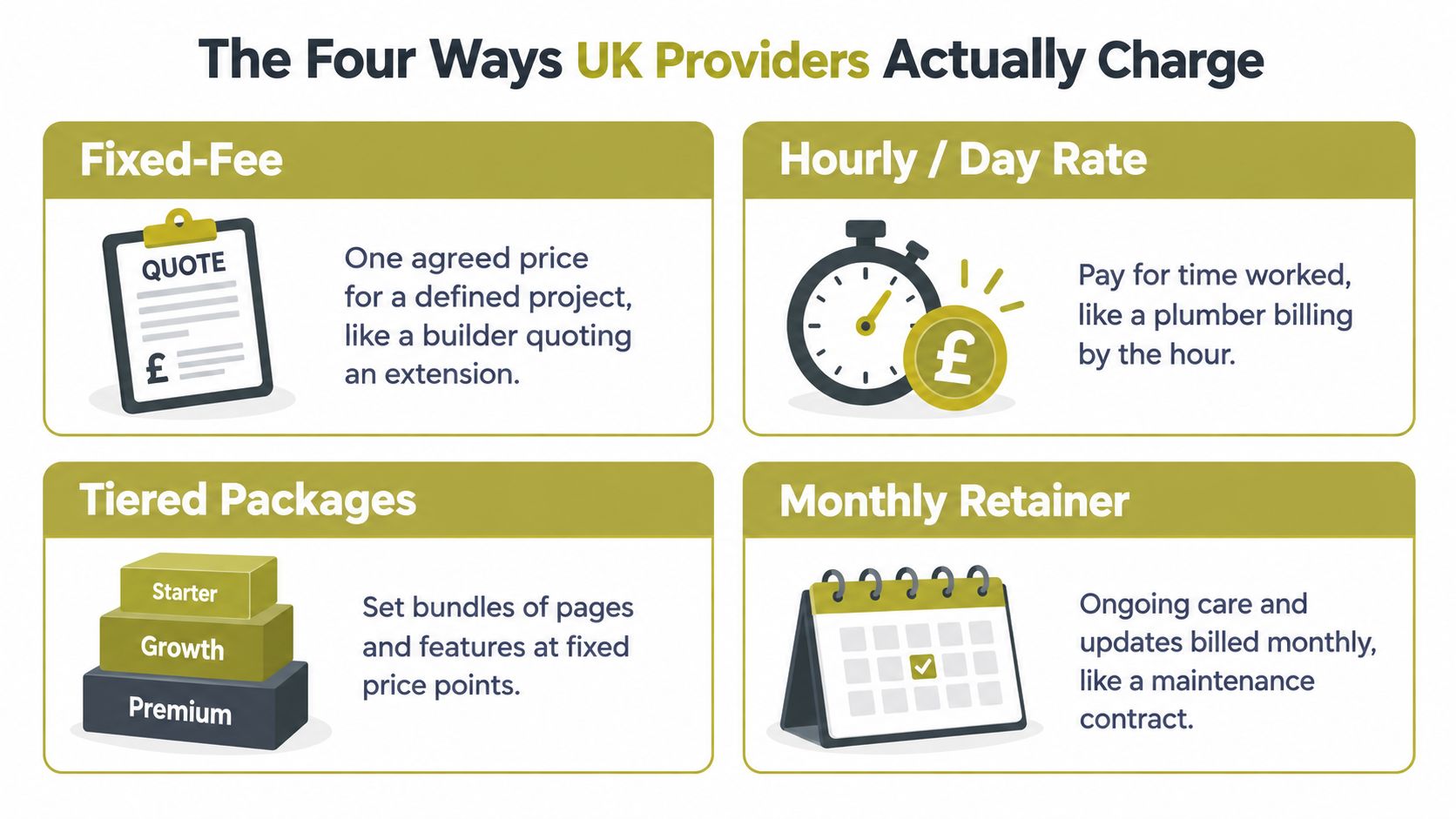
The Four Ways UK Providers Actually Charge
UK providers generally use four pricing models. Choose the model that matches the certainty of your project, not the one with the most attractive headline figure.
Fixed-fee projects
A fixed fee is like a builder quoting for a defined kitchen extension. You agree the work, price and expected outcome before construction starts. This model suits a well-scoped brochure site where the page list, functionality, content responsibilities and approval process are clear.
The predictable failure mode is scope creep. Add a booking system, rewrite every page, introduce a second language or change the design direction, and the original quote no longer describes the same project. Ask for a change-control process before signing.
Hourly or day-rate work
An hourly or day rate works more like a plumber diagnosing a fault. You pay for the time required, which makes sense when discovery is uncertain, technical problems are likely or the provider is developing bespoke functionality.
The risk is an open-ended bill. Set a discovery cap, require written approval before additional work and ask for a weekly record of time spent. This approach is valuable for solving a defined problem, but it needs active management.
Tiered packages
Tiered packages resemble a builder offering standard, upgraded and premium extension specifications. Each level bundles a different amount of strategy, design, content, functionality and support.
Packages help an SME choose quickly, particularly when the business knows its marketing objectives but hasn't finalised every detail. The drawback is package lock-in. You may pay for features you don't need or discover that a necessary feature only appears in the next tier.
For a simple way to compare what different website options include, review SiteSelf plan options, then ask a bespoke supplier to map its proposal against the same requirements.
Monthly retainers
A monthly retainer is a maintenance contract. You pay for continuing care, security updates, content changes, landing pages, testing or iterative improvements rather than a single delivery event.
Retainers suit businesses that expect the website to evolve. They're a poor fit when the provider performs only occasional minor updates and nobody reviews whether the retained time is producing useful work. Retainer inertia is the common trap. Define the monthly outputs, unused-time policy and cancellation terms.
What a Realistic UK SME Web Build Costs in 2026
The phrase “five-page WordPress website” hides the actual workload. A properly managed build may involve discovery, a sitemap, UX decisions, visual design, copywriting, development, responsive implementation, browser testing, SEO foundations, accessibility checks, training and handover.
The available UK benchmarks show why no single price is universally correct. One market guide places a basic one-to-five-page brochure site at roughly £3,700 to £8,600 with a freelancer and £5,700 to £14,100 with a specialist agency. Another benchmark places brochure websites at £1,500 to £3,000 from freelancers and £3,000 to £6,000 from agencies. These ranges are published in the UK website cost guide from Opace.
A separate UK cost guide places small-business sites around £1,500 to £5,000, agency builds around £3,000 to £30,000 or more, and standard SME brochure sites in the £3,000 to £8,000 range. Its explanation is the important part: CMS complexity, responsive implementation, SEO structure, analytics, forms, e-commerce and custom functionality increase the work involved. See the UK web design cost guidance from DotGo.
| Workstream | Freelancer | Local Agency | Premium Studio |
|---|---|---|---|
| Discovery and sitemap | Often concise or client-led | Structured discovery and planning | Strategic research and detailed architecture |
| UX and visual design | Template adaptation or focused design | Custom design with wider review | Senior creative direction and bespoke system |
| Copy and content | Often supplied by client | Editing or copywriting support may be included | Positioning-led copy and content planning |
| WordPress or Webflow build | Single implementer | Design and development roles may be separated | Specialist development, QA and project management |
| SEO, analytics and accessibility | Basic setup varies by quote | Usually scoped as defined deliverables | More comprehensive technical and content preparation |
| Training and handover | Basic handover | Documented handover may be included | Formal training, governance and support planning |
| Indicative total | Market can range from hundreds to low-thousands | Commonly low-thousands to several thousand | Premium work rises with strategy and custom scope |
The 2026 census of 769 UK web-service providers found a median of £513 for freelancers, £949 for local agencies, and £2,950 for premium studios for a local agency-style five-page business site, while well-reviewed premium sellers charged around £4,500. Those figures from the UK web design pricing study are useful market markers, not promises for every project.
As the site grows, the same workstreams expand. A 20-page site creates more content, templates, navigation decisions and quality checks. E-commerce and bespoke builds move into materially higher territory, with typical UK ranges of £5,000 to £20,000 or more for e-commerce and £12,000 to £50,000 or more for bespoke projects, as outlined in Appjet.ai's estimation guide.
Freelancer, Local Agency or Premium Studio
The right supplier depends on the risk you're prepared to carry. Price is only one part of that risk. You also need to consider continuity, specialist coverage, senior attention and what happens when the project stops behaving like the original brief.
| Tier | Typical 2026 Price (Brochure Site) | Skills Covered | Main Risk |
|---|---|---|---|
| Freelancer | Median £513, with broader small-business benchmarks from £1,500 to £3,000 | Design, build and basic setup may sit with one person | Limited resilience and narrower specialist cover |
| Local agency | Median £949, with agency brochure benchmarks around £3,000 to £6,000 | Design, development, content, SEO and account management may be shared across a team | Senior involvement can vary |
| Premium studio | Median £2,950, with well-reviewed premium sellers around £4,500 and more complex work priced higher | Strategy, UX, design, development, QA and project management | You may pay for depth beyond your actual requirements |
The freelancer wins when the project is straightforward and you can provide clean copy, images, decisions and feedback. That arrangement becomes fragile when the freelancer is ill, overloaded or asked to solve a copywriting, SEO and technical issue at the same time.
A local agency usually gives you broader coverage and a clearer delivery process. You'll still need to ask who will attend meetings, who writes the copy and who performs quality assurance. The agency name doesn't guarantee that a senior practitioner will work directly on your site.
A premium or specialist studio makes sense when the website carries a serious positioning, conversion or reputational burden. You're paying for judgement across several disciplines, not just for a more decorative homepage.
For SMEs considering offshore development, the Hire developers mexico resource from HireDevelopers.com can help frame the supplier conversation around technical capability and delivery location. It doesn't remove the need to check ownership, communication, project management and quality assurance.
The price gap is rarely explained by logo size. It usually reflects multidisciplinary time, the number of decisions made before development and the cost of preventing avoidable rework.
Why Senior Expertise Commands a Higher Fee
A senior editor costs more than a junior reporter because the editor spots weak evidence, sharpens the angle, protects accuracy and makes decisions before an error reaches publication. The same principle applies to a serious website.
A senior web lead can challenge a vague proposition, identify the wrong audience, simplify a confusing navigation structure and stop a visually attractive page from becoming a poor sales tool. A senior UX practitioner can expose friction before the developer builds it. A senior project lead can keep five stakeholders from pulling the work in five directions.
That's why a £6,000 agency quote is not just a £3,000 freelancer quote with a logo added. The difference may represent senior scoping, content direction, UX decisions, responsive design, development, browser testing, analytics and a documented handover. If those activities are absent from the cheaper quote, the saving is real, but so is the missing work.
The newsroom parallel
Carlos Alba Media is specialist by design. Everyone who works for Carlos Alba Media is a former national news journalist or has agency experience working with international brands. That background matters because newsroom work trains people to identify what matters, question unclear claims, work to deadlines and communicate with different audiences.
UK journalist-led consultancies use newsroom experience as a capability signal. One Manchester consultancy states that its team are all former journalists, with careers spanning local and regional newsrooms to Fleet Street, as described by Marco Richards. Its team profile also presents former journalists and more than a hundred years of combined newsroom experience as a core part of its positioning.
Cheap delivery removes judgement first. The invoice for fixing the consequences arrives later.
The practical test is simple. Ask who will make the important decisions on your project. If the answer is always “the team” or “someone from production”, you don't yet know what you're buying. The web design best practices from Carlos Alba Media reinforce the broader point that performance and conversion depend on decisions made before launch, not only on the finished visual design.
Sample Package Breakdowns for Common SME Budgets
Treat packages as benchmarks, not fixed menus. A supplier should be able to explain what changes between tiers and why the extra work matters to your business.
| Package | Indicative Price | Pages | Typical Inclusions |
|---|---|---|---|
| Entry | £1,500 to £3,000 | Around five | Templated or lightly customised design, basic on-page SEO, standard forms and limited revisions |
| Growth | £4,000 to £6,000 | Around eight to ten | Custom WordPress or Webflow build, CMS training, copywriting support, analytics and broader QA |
| Conversion | £12,000 to £50,000 or more for bespoke scope | Defined by user journeys rather than page count | Strategy, UX research, custom components, conversion planning, technical development and launch support |
Entry
This suits a new or small business that needs a credible online presence without extensive content or complex functionality. Expect to supply much of the copy and imagery, accept an established template structure and work within a defined revision process.
It won't usually include deep customer research, extensive copywriting, custom integrations or a detailed conversion programme. Ask whether the site will be exported to a platform you control and whether the quote includes training.
Growth
This is the sensible middle ground for many established SMEs. The supplier has room to improve the information architecture, shape the messaging, customise the design and configure analytics instead of just placing supplied content into a theme.
Check the meaning of “copywriting support”. It could mean editing your draft, writing selected pages or developing the full site copy. Those are different services and should appear separately in the proposal.
Conversion
This tier is for a business where the site must support a defined commercial or reputational objective. The work may involve research, user journeys, custom components, content strategy, technical integrations and a more deliberate launch process.
Bespoke UK projects commonly sit in the £12,000 to £50,000 or more range, according to the cost guidance cited earlier. Don't buy this tier because it sounds impressive. Buy it when the cost of weak positioning, poor usability or an unsuitable technical foundation is greater than the additional project fee.
Reading a Quote for Hidden Costs and Red Flags
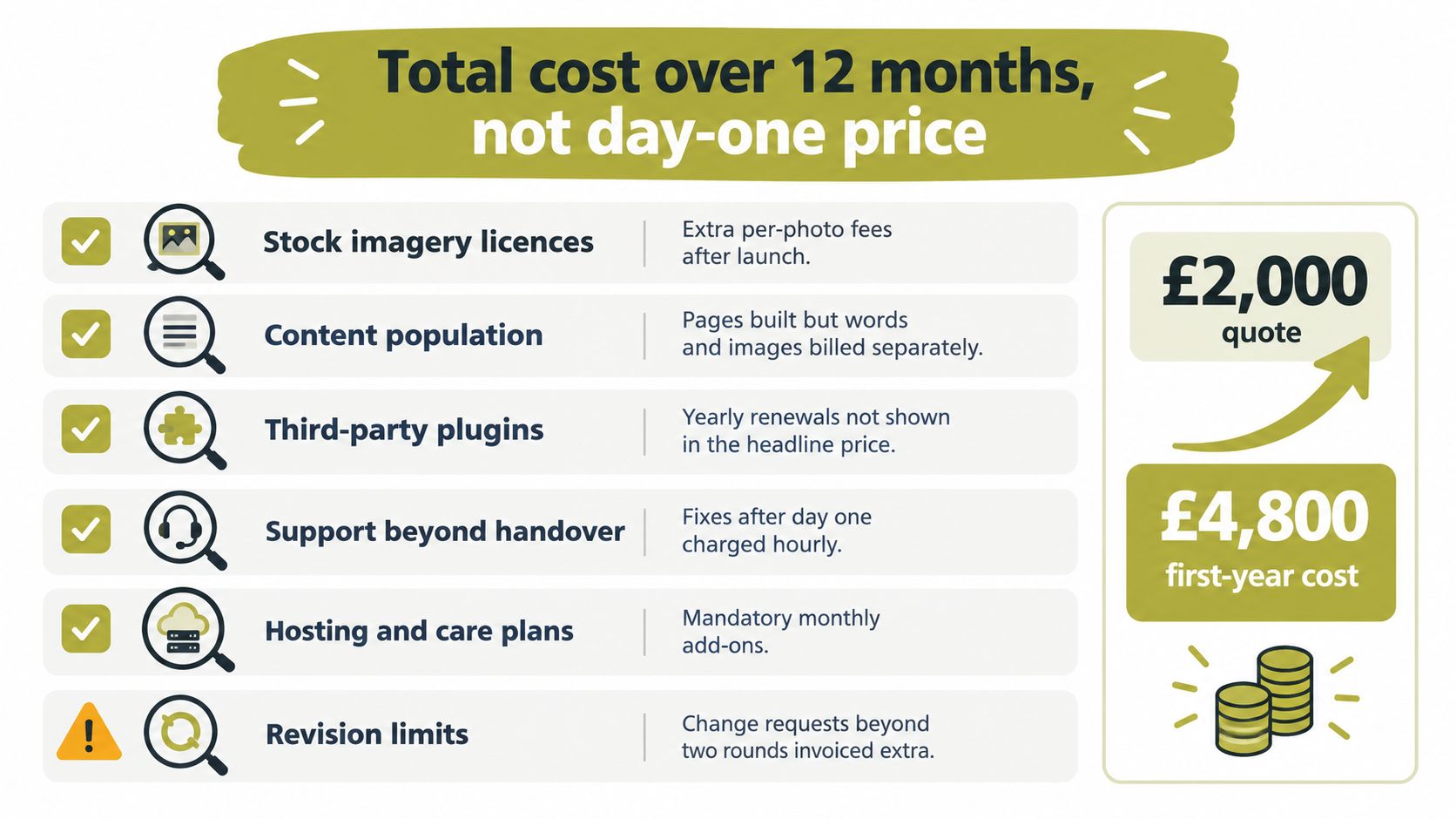
The cheapest quote is not automatically the best value. Calculate the total cost over the first year, including hosting, licences, content, support and the work you'll have to arrange yourself.
Look for these lines before you compare totals:
- Hosting and domain: Confirm who pays renewal fees, who controls the accounts and whether the site can move if the relationship ends.
- Theme and plugin licences: Ask which premium tools are included and what happens when their renewal is due.
- Content: Establish whether copywriting, editing, image sourcing and content population are included.
- SEO baseline: Check whether the supplier is setting page titles, headings, redirects, indexation controls and analytics, or only claiming that the site is “SEO-ready”.
- Accessibility: Ask whether the provider performs checks and whether remediation is included if problems are found.
- Testing: Confirm which browsers, screen sizes, forms and devices will be tested.
- Post-launch support: Get the support window, response times and hourly charges in writing.
Questions that expose weak proposals
If a proposal says “bespoke”, ask which components are genuinely custom and which come from a theme or library. If discovery is described vaguely, ask for its outputs. You should receive something concrete, such as a sitemap, page priorities, user journeys or content requirements.
If the quote allows one revision round, ask what counts as a revision and what happens when a stakeholder changes direction. If there's no CMS handover, ask who will update pages after launch. If ownership clauses are missing, ask who owns the code, design files, copy, domain and hosting accounts.
Watch the explanation of performance too. A provider should be able to discuss speed, mobile implementation and usability without hiding behind a generic promise. This guide to web performance gives you useful terminology for that conversation.
The visual below captures the commercial issue. A low day-one price can become expensive once omitted work appears as separate change requests.
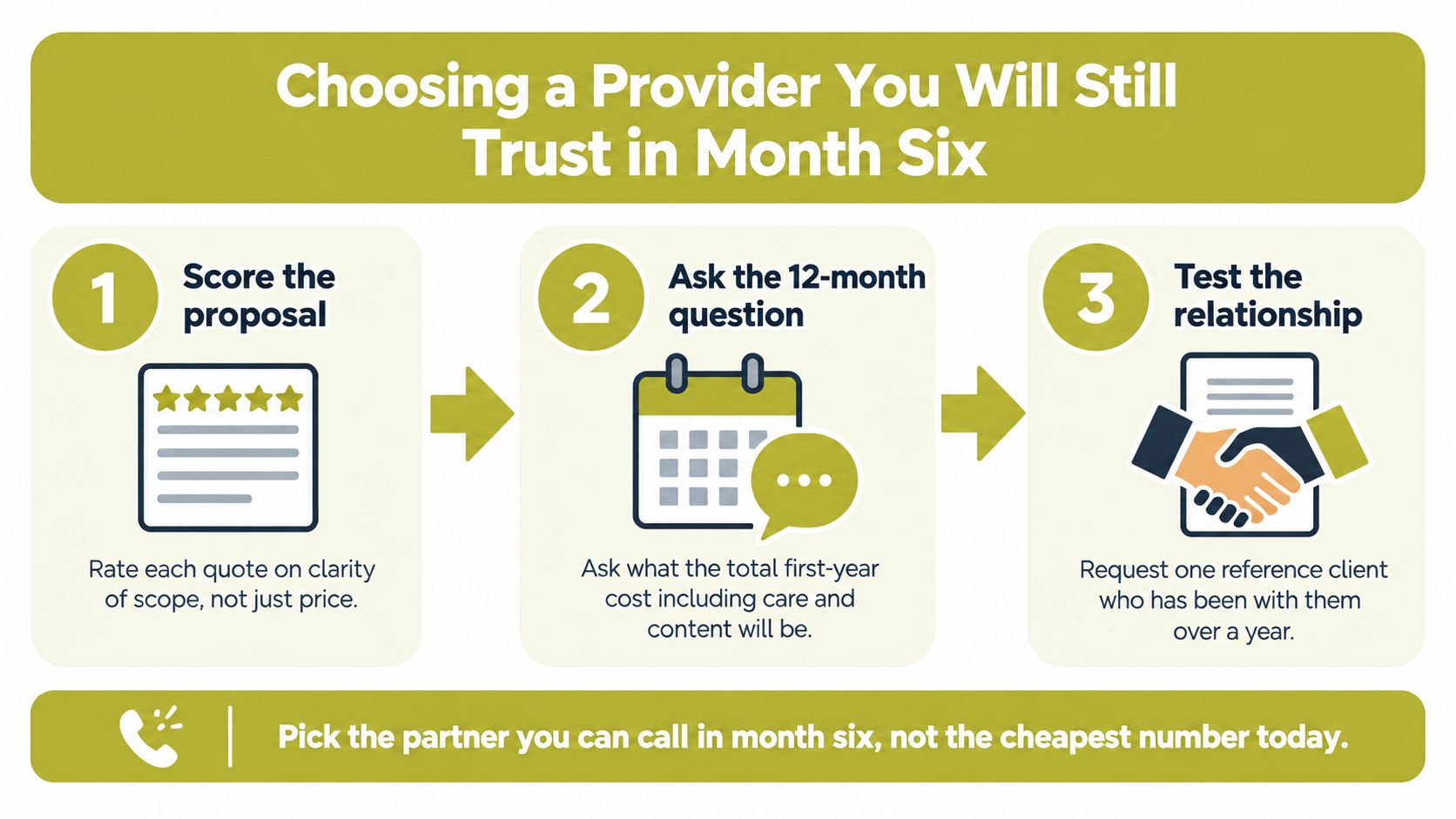
Choosing a Provider You Will Still Trust in Month Six
Use three filters in your next supplier meeting.
First, score transparency
Mark each proposal against the same questions. Are the deliverables explicit? Are content responsibilities clear? Are revision limits stated? Does the price include testing, analytics, training and handover? Does your business retain ownership of the domain, design files and website?
A lower quote with clear exclusions is safer than a higher quote wrapped in vague language. At least you can budget for what remains.
Second, prioritise senior involvement
Ask for the names and roles of the people who will deliver the project. Team size is a weak buying signal. A smaller specialist team with direct senior involvement may give you more useful judgement than a larger agency where your project is passed between departments.
You're buying decisions, not a timesheet. Find out who approves the sitemap, challenges the messaging, reviews the user experience and signs off the build before launch.
Third, test the relationship
Have one direct conversation with the person responsible for delivery. Explain the business problem in plain language and listen to the questions they ask. A capable provider will want to understand customers, positioning, existing assets, internal approval and future maintenance before promising an outcome.
Ask for a reference client who has worked with the provider beyond the initial launch. The required infographic below summarises the decision process, including the importance of considering the first-year cost and relationship.
For a UK SME, value for money means realistic pricing, honest scope, documented ownership, a proper handover and a partner who flags problems early. As a working mental model, budget around £1,500 from a freelancer, £3,000 to £6,000 from a local agency, and £6,000 or more from a premium studio, while remembering that the census medians and published market guides show wide variation by scope and reputation.
If you're comparing quotes now, put each one into a single scope document, ask every supplier to answer the same ownership and support questions, and choose the person who can explain the trade-offs without selling you features you won't use.
Carlos Alba Media combines web design and development with SEO, UX, brand strategy and senior digital counsel, so your website brief can be judged against its commercial and reputational purpose. Visit Carlos Alba Media to discuss a UK SME web project with a team whose experience spans former national news journalism and agency work for international brands.