
You're in the meeting, the camera light's already on, and the journalist has just asked the question your team hoped wouldn't come up. The room goes quiet. This is the moment public speaking coaching earns its keep, because the difference between a flat answer and a line people repeat later is usually not talent, it's preparation, structure, and repetition under pressure. If you're also looking for practical support on the anxiety side, social anxiety self-help strategies can help you separate nerves from the delivery work that changes performance.
The Moment That Changes Everything
A founder walks into a studio thinking the interview will be friendly. Ten minutes later, the host asks about margins, hiring, or a delayed launch, and the founder starts talking in circles. The answer isn't catastrophic, but it's forgettable, and forgettable is expensive when you're trying to win trust.
That same founder can sound completely different after proper coaching. Not more “confident” in the vague motivational sense, but tighter, clearer, and harder to derail. The useful shift is simple, the speaker knows the point, says it cleanly, and doesn't waste words getting there.
Practical rule: if a message can't survive a sharp question, it wasn't ready for the room.
That's why I like newsroom-style coaching. In a newsroom, nobody gets praised for feeling brave. They get praised for staying on message, answering the question, and keeping control of the line. That discipline matters whether you're facing a reporter, a board, or an investor.
The essential work happens before the mic goes live. You rehearse the line, kill the filler, sharpen the structure, and practice the awkward follow-up. When that's done properly, the speaker stops depending on adrenaline and starts relying on method.
What Public Speaking Coaching Actually Is
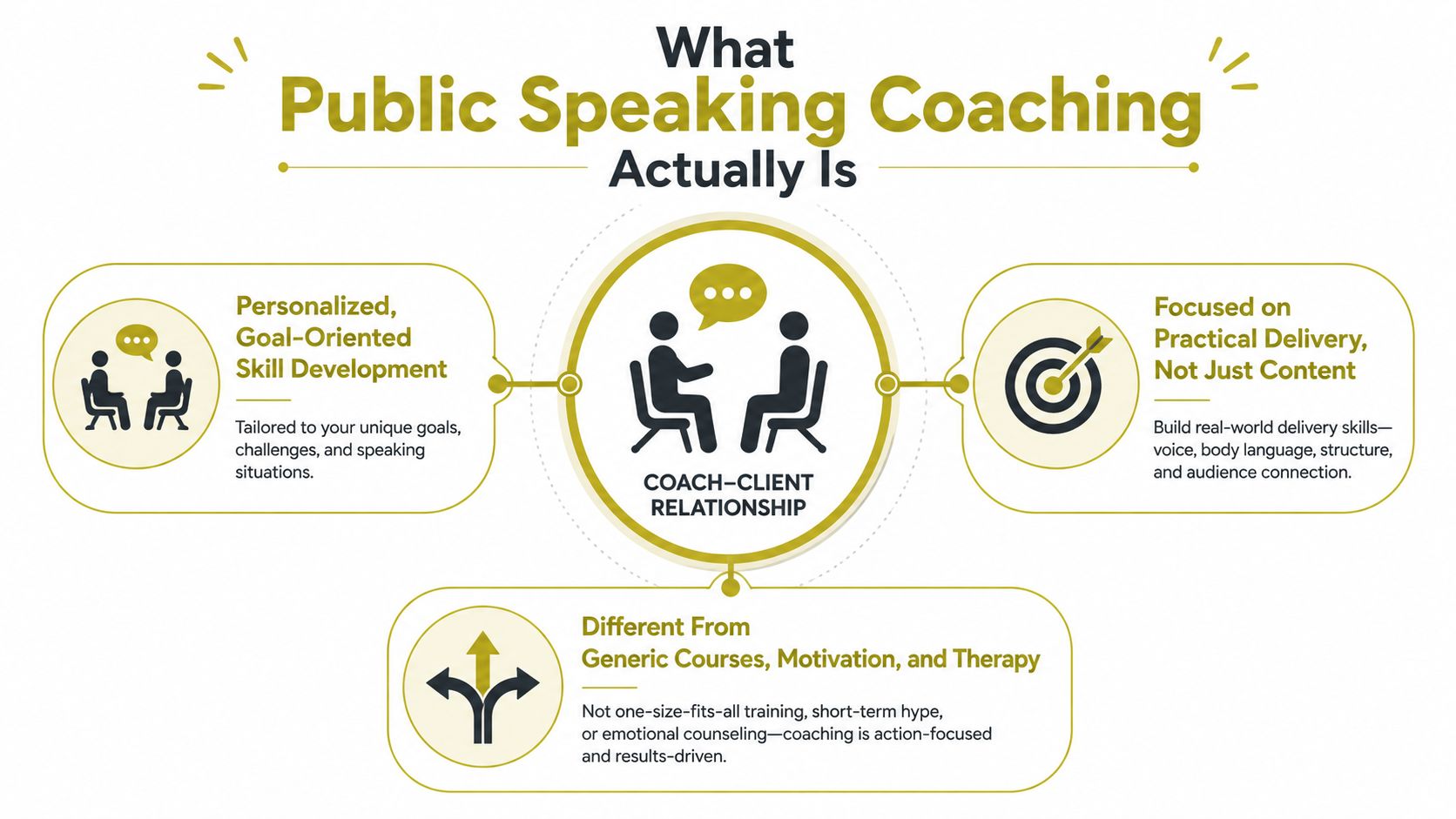
Public speaking coaching is not a pep talk, and it's not therapy. It's a practical service that helps someone shape a message, deliver it clearly, and stay steady when the situation gets messy. The best coaches work on observable behaviour, because that's what audiences react to.
The three parts that matter
First, there's the message. A speaker needs one core point, a supporting sequence, and a clear ask or conclusion. If the audience can't restate it afterwards, the message wasn't ready.
Second, there's the delivery. That means pace, pause, eye contact, voice control, gesture economy, and how the speaker handles slides or notes. These are not cosmetic extras, they're the mechanics that stop a talk from drifting.
Third, there's situational control. A good coach prepares people for hostile questions, time pressure, technical failures, and the moment a room turns cold. That's where rehearsal under timed conditions matters more than reading a list of tips.
A serious coach watches what happens in the room, gives precise feedback, and then makes the speaker repeat the improvement straight away. That's the difference between learning and hoping. It's also why a newsroom-led model makes sense for interview training, media handling, and crisis preparation, including the specialist work done by Carlos Alba Media through interview and executive communications coaching.
Useful test: if a coach can't tell you what changed from the first run to the third run, they're selling encouragement, not coaching.
Why Demand Has Surged Across the UK
The UK market for public speaking coaching isn't niche. A 2023 YouGov RealTime survey reported that 49% of UK adults had some form of fear around public speaking, and 15% described it as an outright phobia, while 57% of women and 39% of men said they had some fear of it (YouGov RealTime survey summary). That's not a fringe problem, it's a mainstream skills gap.
Fear is common, and work keeps forcing the issue
A later Preply and Censuswide survey of 2,007 UK working-age adults in 2025 found that 21% actively hate and avoid public speaking, while another 35% still do it despite fear or dislike (Preply and Censuswide survey summary). Put bluntly, a lot of people are speaking before they feel ready, and that's exactly when coaching becomes useful.
Workplace exposure matters too. LinkedIn Learning's 2022 research, cited in industry analysis, found that 60% of professionals need to speak publicly at least monthly, while 45% speak publicly weekly or more (industry analysis of LinkedIn Learning research). Once speaking becomes a recurring requirement, it stops being a personality issue and becomes a job skill.
Toastmasters has helped normalise that reality. Toastmasters International reports more than 350,000 members in 140 countries (Toastmasters scale reference). That scale tells you something basic, public speaking development is mainstream professional training.
Who feels the pressure most
Founders feel it when they pitch. Executives feel it when they front staff or investors. Spokespeople feel it when a reporter is waiting for a clean answer. The demand isn't about becoming theatrical, it's about becoming dependable under pressure.
The case for coaching in the UK is straightforward. A large share of adults are uneasy about speaking, and modern work keeps putting them in front of people anyway. If you need to lead, sell, persuade, or reassure, coaching is a rational investment in performance, not an admission of weakness.
Formats and Techniques That Actually Work
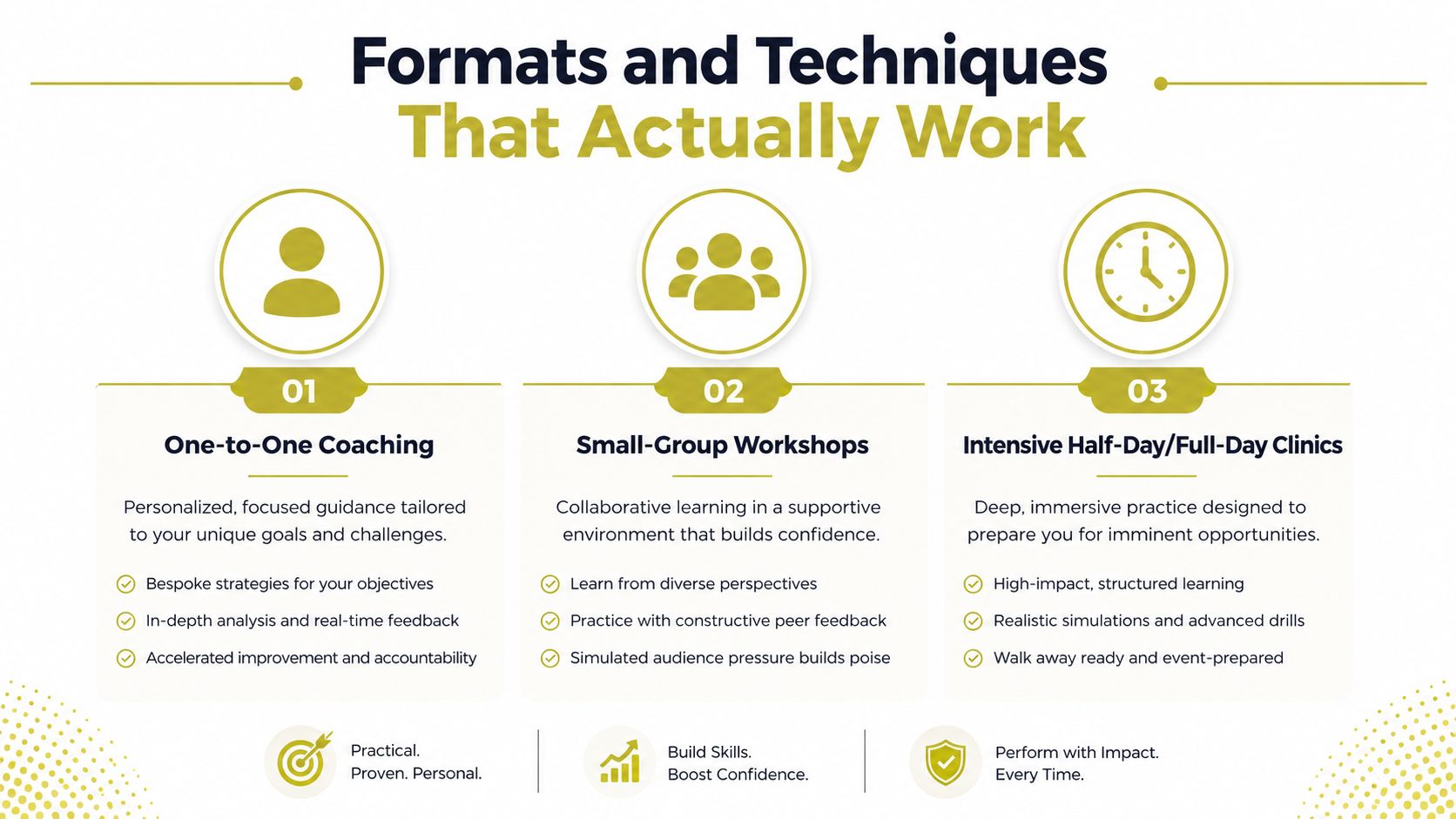
Pick the format that matches the situation, not the one that sounds most polished. A one-to-one session is for a person who has one high-stakes moment coming up and needs precise correction. A small group works better when a whole team has to present with some consistency.
Matching coaching formats to real situations
| Format | Typical Duration | Best For | Main Trade-Off |
|---|---|---|---|
| One-to-One Coaching | One-off or ongoing | Founders, executives, spokespeople preparing for a specific appearance | Narrower perspective, less peer input |
| Small-Group Workshops | Half-day or full-day | Teams, leadership groups, sales groups | Less individual drilling time |
| Intensive Half-Day or Full-Day Clinics | Concentrated session | Imminent interviews, launches, conferences | Fast progress, limited long-term follow-through |
Timed rehearsal loops matter in every format. So does video playback, because most speakers underestimate what they're doing with their face, hands, and pace. If you're preparing for a broadcast appearance, the internal guide on how to prepare for a media interview is the right companion reading before you book a session.
Techniques that belong in the room
A coach should use timed practice runs rather than endless discussion. They should also drill Q&A, because that's where many individuals lose shape. For on-camera work, the speaker needs simulation, not theory.
A good session also checks whether the speaker can keep the same core message in different rooms. That matters in sales pitches, panel discussions, internal updates, and interviews because the audience changes, but the standard doesn't. The speaker still has to stay clear.
Decision rule: if your event is coming soon, choose intensity. If your team needs consistency, choose repetition.
What Happens Inside a Coaching Session
A proper session starts with diagnosis, not flattery. The coach asks what's coming up, what the speaker wants the audience to remember, and where things normally go wrong. Then the speaker talks, because you can't improve what you haven't seen.
The practical rhythm
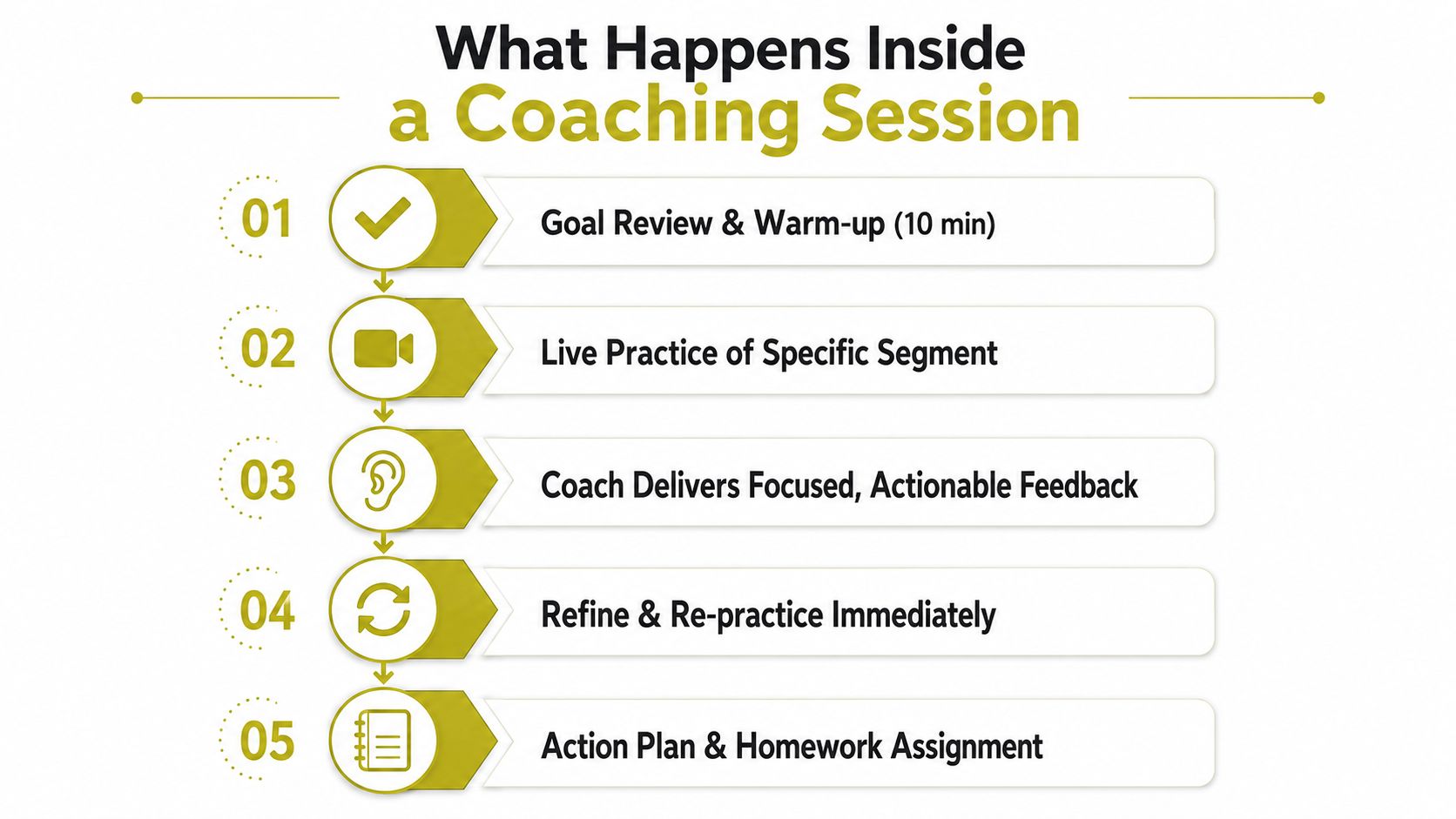
A strong session usually follows a cycle. First comes a short warm-up and goal review. Then comes a live run of a key segment, not the whole thing. After that, the coach gives targeted feedback and the speaker repeats the segment immediately.
That repeat matters. It's where the body learns the new pattern. A speaker doesn't fix pacing by hearing advice once. They fix it by running the line, hearing the issue, and running it again with a better rhythm.
Exercises that should show up
The 60-second message drill forces discipline. The speaker has one minute to say the core point clearly, which exposes rambling fast. The pause-and-replace exercise helps strip out filler words by replacing them with silence, breath, or a clean transition.
For broadcast preparation, the hostile-question drill is essential. A coach throws pressure questions at the speaker so they can practise staying on argument rather than reacting emotionally. That's where broadcast media training earns its keep, because televised or recorded answers need control, not improvisation.
The speaker should leave with one written action plan, not a pile of vague notes.
Video helps too. If you want a live example of the wider environment around event broadcasting and presentation setup, the professional UK event broadcast guide is useful background before you walk into a filmed event. The point isn't the gear, though, it's whether the speaker can hold shape when the setup changes.
Measured Coaching Beats Confidence Coaching
The room does not reward pep talks. It rewards control, timing, and a message that lands cleanly under pressure. Good public speaking coaching starts with a baseline, then fixes a small set of delivery habits and checks whether they changed.
A recent expert review cites studies showing objective baseline measurement can produce 35% greater improvement than subjective assessment, and structured accountability can increase improvement by 65% (expert review on leadership speaking coaching). Buyers should care about that because it points to a plain truth, measured work improves faster than opinion-led reassurance.
What measured coaching looks like
It starts with recorded reality. The speaker gives a baseline performance, the coach identifies the weak points, and both sides agree on what better looks like. The targets are concrete, clearer pacing, fewer filler words, tighter structure, stronger handling of questions, or cleaner transitions between points.
Progress is then checked against those targets, not against how the speaker feels after the session. That distinction matters because many speakers leave a session feeling better without becoming clearer. High-stakes settings punish that gap, especially when the audience includes investors, regulators, journalists, or senior stakeholders.
A live event can change under your feet. The professional UK event broadcast guide is a useful reminder that the technical setup, camera position, and room conditions can shift the moment a production goes live. Coaching should prepare the speaker for that kind of disruption, then test whether they stay composed and readable anyway.
Why the difference matters
A motivational session may leave someone feeling braver. Measured coaching leaves them speaking in a way other people can follow, remember, and respond to. That is what wins interviews, protects reputation, and keeps a pitch from drifting off course.
The strongest coaching treats confidence as a by-product of changed delivery, not as the main goal. First the speaker changes the delivery. Then the room changes back.
Choosing a Coach in the UK
Start with the outcome you need, then judge whether the coach can deliver it. A broadcast interview calls for someone who understands media pressure and hostile questioning. A keynote calls for structure, pacing, and control of the room. A team presentation calls for consistency across multiple speakers.
Questions worth asking before you book
- How do you measure progress? If the answer is vague, move on.
- Do you use video playback? Good coaches usually do, because the camera tells the truth.
- Who have you prepared in real speaking situations? Classroom teaching is not the same as interview prep.
- What happens between sessions? Strong coaching includes repetition, not just conversation.
- Can you work on message, delivery, and Q&A separately? If not, the service is probably too shallow.
Former journalists are often strong for interview work because they know how questions are asked and how pressure builds in the room. Voice and performance specialists are useful when the main issue is projection, breath, or presence. The right choice depends on the gap you need to close, and on the setting where the speaker will be judged.
For a newsroom-led option, Carlos Alba Media's executive communications coaching fits the interview and crisis-preparation brief because the agency says it's led by a multi-award-winning former national newspaper editor and staffed by former national news journalists and agency-experienced communicators. That background matters when a speaker has to stay composed under scrutiny and answer cleanly under pressure.
A cheap option usually means limited feedback and little follow-through. An expensive one is not automatically better. Judge by specificity, repetition, and whether the coach has handled real-world pressure, not by how polished the website looks. If you want to rehearse answers before a known appearance, a mock interview with real-time talking points can help between sessions, but it should support coaching, not replace it.
Where AI Fits and Where It Does Not
AI can help with rehearsal. It can count filler words, flag pacing problems, and spot patterns in structure more quickly than a tired human can. Used well, it gives a speaker more reps between sessions, which is useful.
A 2025 research paper on expert perspectives on AI-assisted public speaking shows the topic is now part of coaching workflows rather than a novelty (AI-assisted public speaking research paper). That matters because buyers are already experimenting with it, often without knowing what it's good for and what it can't do.
Where AI helps
It's strong as a rehearsal partner. If you want to practise a script, test a talk track, or spot habits such as rushing or overusing filler words, AI can do useful pattern detection. It can also support repetition between live coaching sessions, which makes human feedback go further.
A tool like mock interview with real-time talking points is useful when someone wants to rehearse answers before a known appearance. That's a narrow, practical use case, and it's worth using for preparation.
Where AI falls short
AI doesn't read the room. It doesn't know when a journalist is baiting you, when an investor is sceptical, or when a crisis answer needs restraint rather than speed. It can't judge reputation risk the way an experienced human coach can.
That's the core issue in trust-sensitive settings. Media interviews, investor meetings, and crisis messaging depend on audience nuance, judgement, and on-camera credibility. AI can support the drill, but it can't replace the person who knows when a line sounds evasive, overexplained, or too rehearsed.
If you're buying coaching for the UK market, treat AI as a multiplier, not a substitute. Use it for repetition, scoring, and pattern spotting. Keep a human coach for the things that matter most, judgement, pressure, tone, and whether the speaker sounds credible when it counts.
Carlos Alba Media works in that human-led lane. The firm says it's run by a multi-award-winning former national newspaper editor, and that its team includes former national news journalists and agency-trained communications professionals, which is exactly the sort of background you want for interviews, founder appearances, and crisis responses. If your next speaking moment is a funding round, a broadcast appearance, or a difficult stakeholder briefing, book a short introductory call, send over the calendar dates, and ask for a coaching plan that focuses on the delivery problem.
If you need public speaking coaching that's built around live interviews, founder pitches, and on-camera delivery, Carlos Alba Media can work through the message, the questions, and the pressure points with you. Visit Carlos Alba Media and ask for a practical plan for your next speaking moment.