

You may be dealing with this right now. Applications need to move. Open day attendance is softer than you'd like. Governors or trustees want evidence that marketing spend is justified. At the same time, one poor parent complaint, one mishandled local issue, or one muddled website journey can undo months of work.
That's why choosing a marketing agency for education isn't the same as hiring a generic digital supplier. In education, marketing sits much closer to reputation, public accountability, and long-term trust than it does in many other sectors. A school, college, university, training provider, or EdTech company doesn't just need attention. It needs confidence.
The agencies worth speaking to understand both sides of that equation. They can help you drive enquiries, improve conversion paths, sharpen messaging, and strengthen visibility. They also understand that education audiences judge tone, credibility, safeguarding signals, and clarity of communication very differently from retail or lifestyle buyers.
Why Education Marketing Requires a Specialist Partner
The UK education market is too important, and too competitive, to treat marketing as a bolt-on service. The sector is one of the largest in Europe by market scale. Education exports were worth £29 billion in 2021, and the global education marketing services market is forecast to expand by USD 51.28 billion between 2023 and 2028 at 11.21% CAGR, according to Research and Markets' education marketing market analysis.
That matters because education leaders are no longer buying leaflets, a few social posts, and the occasional press release. They're buying judgement. They need a partner that can connect digital acquisition, brand positioning, admissions realities, and stakeholder trust.
Education buyers don't behave like ordinary consumers
A parent choosing a school isn't making an impulse purchase. A university applicant isn't only responding to paid media. A board evaluating a training provider isn't judging you on creative flair alone. These audiences weigh signals such as outcomes, quality, professionalism, safety, values, and public reputation.
That creates a very different brief for a marketing agency for education. The work has to do several jobs at once:
- Build confidence first: The brand has to look credible before it asks for action.
- Make the next step easy: Open day booking, prospectus download, enquiry forms, and admissions contact paths must be clear.
- Stand up to scrutiny: Messaging has to hold together across website copy, social channels, local press, and in-person events.
- Support multiple audiences: Parents, students, staff recruits, partners, alumni, and local communities often need different proof points.
A lot of agencies can run ads. Far fewer can handle those layers without oversimplifying them.
The difference between activity and strategy
One of the most common mistakes I see is institutions buying outputs instead of outcomes. They commission a website refresh, some SEO work, or a campaign burst without deciding what the work is meant to move. The result is usually busy reporting and weak strategic progress.
Practical rule: If an agency talks mainly about channels before it talks about your audiences, decision journey, and trust barriers, it's probably selling production rather than strategy.
Specialist education agencies tend to be stronger because they recognise the sequencing. They know when to lead with reputation, when to sharpen conversion, and when to push acquisition harder. They also know that strong education marketing often depends on better storytelling, not just more promotion.
That's where a newsroom mindset can help. Teams with former journalists or senior agency people often ask better questions, find the key angle faster, and turn vague institutional claims into stories that parents, students, and stakeholders will genuinely believe. If you're reviewing broader marketing strategies for education, that's a useful lens to keep in mind before you compare suppliers.
First Steps Before You Search for an Agency
Most education organisations start the agency search too early. They look outward before they've done the internal work. That usually leads to woolly briefs, mismatched proposals, and procurement rounds full of agencies answering the wrong question.
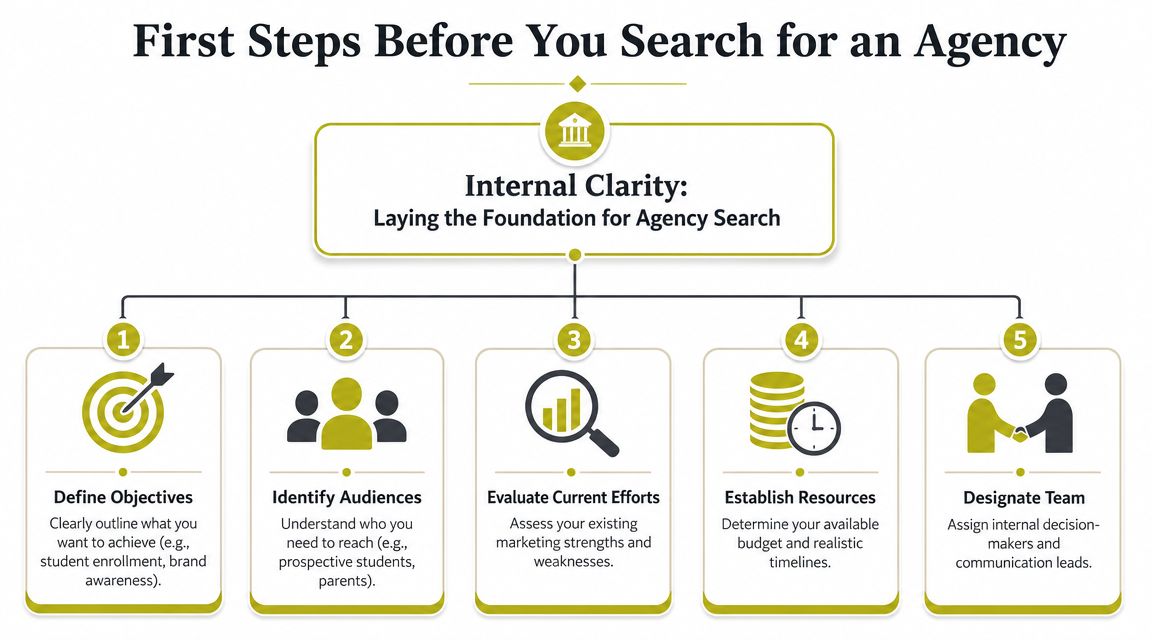
Decide what problem you're actually solving
“More enrolment” is not a brief. It's an ambition.
A school may need better parent-facing communication and stronger local visibility. A university faculty may need qualified postgraduate enquiries in a specific subject area. An EdTech firm may need meetings with institutional buyers, not consumer traffic. Those are different commercial and communications problems, and they require different agency mixes.
Start by writing down the single most important outcome for the next planning cycle, then the two supporting outcomes behind it.
A simple way to frame it:
- Primary outcome: What must change first?
- Secondary outcome: What would support that change?
- Operational constraint: What is likely to get in the way?
For example, “increase sixth form applications” is incomplete. “Increase qualified sixth form applications while improving parent confidence and reducing friction on the admissions journey” is a brief an agency can work with.
Reputation or lead generation first
This is the question many agency websites dodge, but it matters. In the UK, sector context from the Department for Education and Ofsted shows that reputation, safeguarding, and quality are central decision factors for parents and institutions, as noted by The Education Agency's discussion of lead generation versus reputation in education marketing.
If trust is weak, lead generation gets more expensive and converts worse.
That doesn't mean every institution should pause demand generation. It means you should be honest about your starting point. If your website feels dated, your messaging is generic, reviews or local sentiment are patchy, or your safeguarding and pastoral signals are buried, reputation work may need to come before scaling paid acquisition.
Prioritise services in the right order
You don't need everything at once. You need the right stack for your situation.
Consider the shortlist below and rank each item as urgent, important, or later:
- Website and UX: If users can't find admissions information, term dates, course pages, or contact routes, other activity will leak value.
- SEO and content: Useful when you need discoverability, authority, and stronger answers to common questions.
- Paid search and paid social: Best when the offer is clear, the landing pages are solid, and tracking is in place.
- PR and media relations: Important when reputation, leadership profile, local trust, or issue management affect decision-making.
- Social media management: Helpful if it supports community confidence and reinforces your message, not if it becomes a posting treadmill.
- Crisis communications: Essential for organisations with public scrutiny, complex stakeholders, or live reputational risk.
For many teams, documenting this on one page is enough to sharpen the entire buying process. If you need a framework for that exercise, Carlos Alba Media has a practical piece on how to create a content marketing strategy that's useful for turning broad aims into a working plan.
Get your internal house in order
Before you invite agencies in, settle three things internally:
- Who signs off: One final decision-maker is better than six informal vetoes.
- Who owns delivery: The agency needs a named day-to-day contact.
- What success looks like: If leadership wants reputation gains but admissions wants immediate volume, say that early.
That clarity won't make the decision easy. It will make it honest.
How to Find and Evaluate Potential Agencies
A Google search is a starting point, not due diligence. The agencies that rank well aren't always the agencies that fit education best. Some are excellent operators. Others are good at selling themselves.
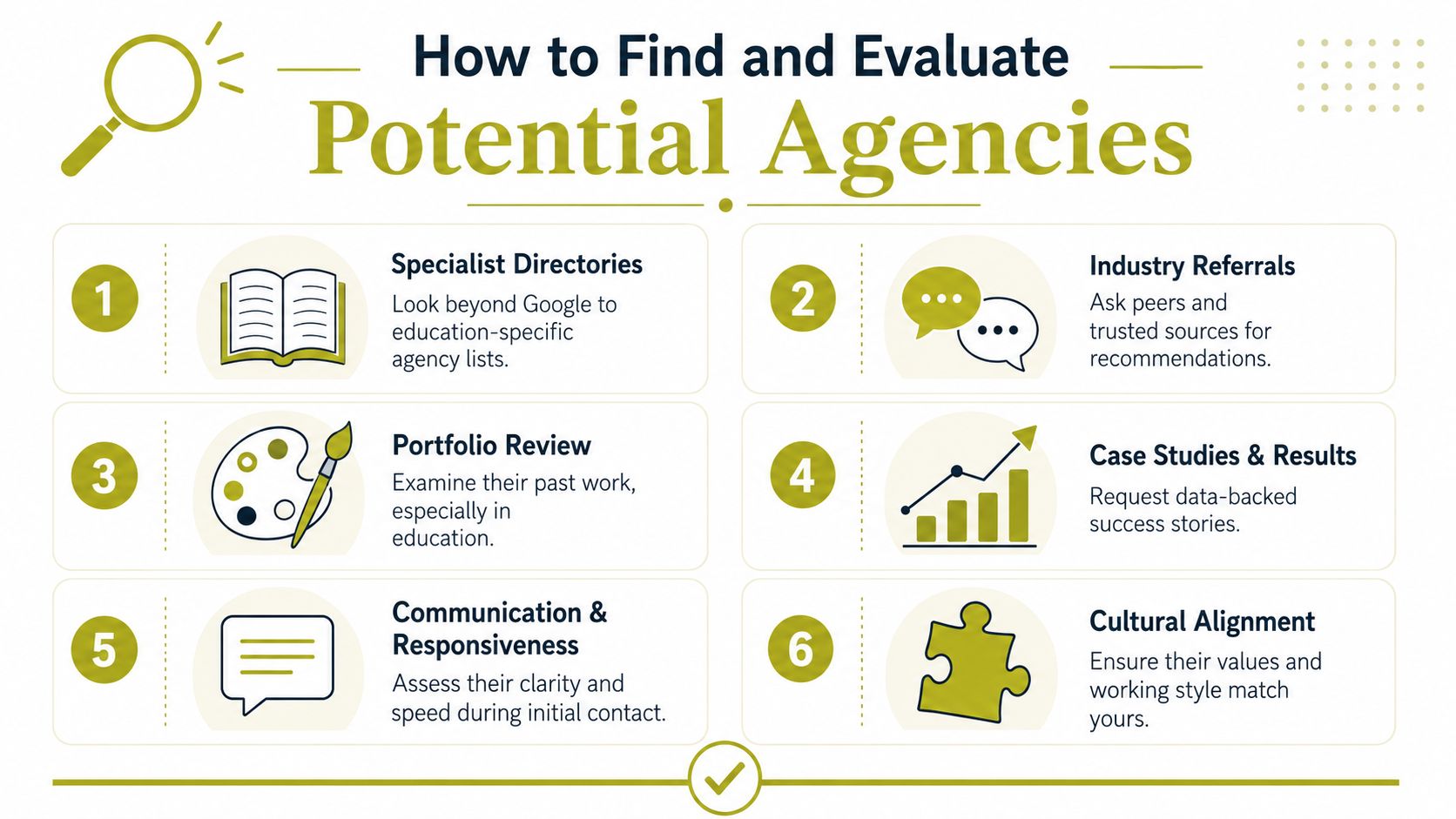
Look for method, not theatre
The strongest agencies can explain how they'll reach and convert the right audience. For UK education campaigns, the strongest operating model is a multi-channel funnel with account-based targeting for institutions, paid search for lead capture, and events for trust-building, according to Rubicon Agency's view on effective EdTech and education campaign structure. They should also be wary of single-channel dependence and vanity metrics.
That immediately gives you a filter. If an agency proposes “we'll sort your Instagram” as the answer to a more complex recruitment or reputation issue, keep looking.
What to examine before the pitch meeting
Don't just read testimonials. Interrogate the way the agency thinks.
Use this checklist:
- Sector understanding: Can they speak intelligently about the difference between marketing a school, a university department, a training provider, and an EdTech business?
- Audience nuance: Do they understand that the decision-maker may not be the end user?
- Measurement maturity: Can they define meaningful outcomes beyond impressions and traffic?
- Creative judgement: Is the work clear, credible, and appropriate for an education setting?
- Media and story sense: Can they identify what's interesting, distinctive, and defensible in your offer?
- Senior involvement: Will experienced people do the thinking, or only attend the pitch?
Agencies often win business with strategy and service it with juniors. Ask who will write, advise, analyse, and report once the contract starts.
Background matters more than many buyers realise
Education marketing often lives or dies on message discipline, issue handling, and the quality of the narrative. This is one reason founder background matters. Teams built by former national news journalists or agency professionals who've worked with international brands tend to bring two useful habits. They know how to find the angle, and they know how to defend it under scrutiny.
That's relevant in education because claims are tested harder. Parents, local media, public bodies, academic stakeholders, and procurement teams all ask tougher questions than the average consumer buyer.
One option in this space is Carlos Alba Media, a Scottish-led PR and digital agency whose team includes former national news journalists and people with agency experience on international brands. For an education client, that kind of background usually matters most in PR, crisis communications, content, leadership profiling, and message development rather than in ad buying alone. There's also a useful guide on how to choose a PR agency that helps buyers separate sector fit from polished sales language.
Red flags you shouldn't ignore
Some warning signs appear early if you know what to watch for:
- One-size-fits-all proposals: If the same deck could be shown to a gym chain or estate agent, it's not education strategy.
- Channel obsession: Strong agencies discuss audiences, proof, offer, and conversion architecture before they discuss posting frequency.
- Weak questioning: If they don't ask about admissions capacity, stakeholder sensitivity, term cycles, or governance, they don't understand the operating context.
- Vague reporting promises: “More awareness” isn't a reporting framework.
The right agency should feel commercially sharp and institutionally aware at the same time.
The Art of the Brief and Asking the Right Questions
A poor brief creates poor proposals. It gives agencies room to fill gaps with assumptions, and you end up comparing documents that look detailed but answer different versions of the problem.

What a useful brief includes
You don't need procurement jargon. You need enough clarity for an agency to think properly.
Include these elements:
- Organisation context: Type of institution, market position, geography, and any sensitivities.
- Business objective: What needs to change, and by when.
- Audience groups: Prospective students, parents, employers, staff recruits, alumni, institutional buyers, or regulators.
- Current challenges: Weak website conversion, unclear messaging, low enquiry quality, limited PR visibility, internal capacity issues.
- Scope of work: Strategy, content, SEO, PR, paid media, web support, social, events, or crisis support.
- Practical constraints: Budget range, procurement process, approvals, term-time realities, and key deadlines.
- Success measures: What you want reported, reviewed, and improved.
Three brief examples
A school brief might say: improve local reputation, increase open event bookings, and tighten parent communications across website, social, and press activity.
A university brief might say: raise postgraduate enquiry quality in selected subject areas, improve landing page performance, and strengthen thought leadership for academic spokespeople.
An EdTech brief might say: generate meetings with UK education decision-makers, build category credibility, and support sales through case-led content and targeted outreach.
Buyer's shortcut: If you can't explain the challenge in one paragraph, the agency won't be able to solve it in a proposal.
A short explainer on briefing and agency conversations can also help align internal stakeholders before meetings start:
Questions that expose real capability
Most first meetings are full of soft questions and rehearsed answers. Change the tone. Ask things that force the agency to show its working.
Try these:
What would you fix first if you had only one quarter with us?
This reveals whether they can prioritise.Where do you think we're losing trust or momentum in our current journey?
Good agencies will usually identify a website, messaging, or process issue quickly.How would you balance reputation work with demand generation in our case?
If they treat this as a false choice, they may be too generic for education.What would you need from our admissions, leadership, or safeguarding teams to make this work?
This tells you whether they understand internal dependencies.What would you report monthly, and what would you review quarterly?
Reporting discipline often separates serious agencies from busy ones.Which parts of the work would be led by senior staff?
Ask for names and roles, not just job titles.
Listen for diagnosis, not slogans
The best answers aren't always the flashiest. You want to hear clear reasoning, sensible trade-offs, and some willingness to challenge your assumptions.
If an agency can't tell you what not to do, it probably hasn't thought hard enough about what you should do.
Understanding Agency Pricing and Contracts
Education buyers often ask the wrong pricing question. They ask, “What do you charge?” The better question is, “What commercial model fits the problem we're trying to solve?”
Different scopes need different structures. Ongoing reputation work, SEO, and content usually don't behave like a one-off website build or a short paid campaign.
Agency pricing models compared
| Model | Best For | Pros | Cons |
|---|---|---|---|
| Monthly retainer | Ongoing PR, content, SEO, social, strategic support | Predictable access to a team, continuity, easier planning, better for iterative work | Can drift if scope is vague, requires regular review |
| Project fee | Website redesigns, campaign launches, messaging projects, brand work | Clear deliverables, easier procurement, defined start and end | Less flexible if priorities change, may exclude implementation support |
| Performance-linked pricing | Selected lead generation or media outcomes where tracking is mature | Aligns incentives, can sharpen accountability | Hard to define fairly in education if attribution is weak or multiple teams affect outcomes |
What to pin down in the contract
Most frustrations come from ambiguity, not price alone. Check the detail.
- Scope boundaries: List what is included, what counts as extra work, and what depends on your internal team.
- Meeting rhythm: Set reporting dates, review points, and escalation routes.
- Approval process: Delays inside your organisation can wreck delivery. Put sign-off rules in writing.
- Exit terms: Avoid contracts that lock you in without sensible break clauses or review windows.
- Ownership: Confirm who owns content, creative assets, website work, and paid account data.
If you're comparing paid media proposals specifically, external references such as dynares' guide on PPC pricing can help you understand how agencies structure management fees and what questions to ask around media handling. For a broader view across PR and digital support, Carlos Alba Media also outlines digital marketing agency pricing packages in a way that's useful for benchmarking scope.
Cheap agency fees can become expensive if you end up paying again for strategy, measurement, or corrective work that should have been built in from the start.
Measuring Success and Proving ROI
Many education partnerships become vague. Reporting turns into a bundle of charts, channel updates, and platform screenshots. Everyone stays busy, but nobody can say clearly whether the work is improving institutional outcomes.
That's a mistake, and the sector already shows the problem. In higher education marketing, only 46% of marketers track cost per inquiry and 43% track cost per enrolled student, according to UPCEA's report on gaps in higher education marketing measurement.
A specialist agency should close that gap. It should connect brand, content, SEO, paid activity, and admissions performance to a measurable pipeline wherever that's possible.
What to measure depends on the job
Not every institution needs the same dashboard. A school concerned about local confidence needs different evidence from an EdTech company selling into trusts or a university recruiting to a specialist programme.
Use a KPI framework that ties metrics to the actual brief.
| Goal | Useful measures | What the metric tells you |
|---|---|---|
| Brand trust and visibility | Share of voice, media coverage quality, branded search trends, event attendance quality | Whether the institution is becoming more visible and credible |
| Enquiry generation | Enquiry volume, lead quality, source mix, cost per inquiry | Whether demand activity is producing relevant prospects |
| Admissions performance | Application starts, application completion, offer acceptance patterns, cost per enrolled student | Whether marketing is helping move prospects through the funnel |
| Website performance | Landing page conversion rate, form completion, key page engagement, target-region traffic quality | Whether digital journeys are making action easier |
| Stakeholder communications | Response consistency, sentiment themes, leadership visibility, press handling effectiveness | Whether communications support confidence beyond recruitment |
Build reporting around decisions
A report should help you decide what to change next. It should do more than document what happened.
That means monthly reviews should answer practical questions such as:
- Which audience is responding best, and why
- Which messages are attracting attention but not action
- Where users are dropping out of the journey
- Whether reputation work is strengthening later-stage conversion
- What should be cut, improved, or scaled
This is also why conversion literacy matters. If your team needs a clearer grounding in website performance, LeadBlaze's guide on how to measure conversion rates is a useful external primer for understanding what your agency should be explaining in plain English.
The real test of agency value
A marketing agency for education earns its keep when it helps leadership answer three questions with confidence:
- Are we being seen by the right people?
- Are those people trusting what they see?
- Is that trust turning into meaningful action?
If the agency can't help you answer all three, it's probably delivering activity more than progress.
Carlos Alba Media works with organisations that need PR, digital marketing, content, web support, and reputation management delivered with senior-level judgement. If you're reviewing agency options for your education organisation and want a conversation grounded in strategy, messaging, and measurable outcomes, you can explore Carlos Alba Media.