
51% of UK adults said they used AI search tools in their personal lives to find products, services or advice in September 2025, according to Which? consumer research conducted by Yonder. For marketers, that makes AI search visibility a customer acquisition question, not an experimental side project.
Learning how to appear in AI Overviews starts with a practical distinction: making a page eligible isn't the same as earning a citation, and earning a citation isn't the same as winning a customer. Your job is to publish answers that can be found, checked and attributed to your organisation, then measure those outcomes separately.
What Makes a Page Eligible for AI Overviews
What would make your page worth citing rather than a competitor's? Start with whether it gives a useful, verifiable answer to the question someone searched.
The opportunity is substantial. Swarm Labs' UK market overview estimates that roughly 30% of UK searches display an AI Overview, while citing Ofcom evidence that Google is used by approximately 82% of UK adults. Those measures describe different things, but both put AI visibility firmly within everyday search marketing.
Google AI Overviews formally launched in the UK on 15 August 2024. This isn't a future-only optimisation exercise.
Page requirements for AI Overview citation
Treat these as yes-or-no audit questions, not a formula that guarantees selection. A missing author won't explain every lost citation, but an anonymous page with unsupported claims gives readers little reason to trust it.
| Requirement | What to check on the page | Common gap |
|---|---|---|
| Direct answer near the top | A two to three sentence answer to the core question above the first heading | Answer buried after a long introduction |
| Descriptive headings | Each H2 names the question it answers | Clever headings that hide the topic |
| Attributable claims | Every statistic has a named source, date and geography | Figures with no source link |
| Visible authorship | A named author or organisation with relevant expertise | Anonymous, generic copy |
| Dated and reviewed content | A last reviewed date beside time-sensitive facts | Figures that are years out of date |
| Consistent business facts | Name, services and details match across the site and third-party profiles | Conflicting details between sites |
| Crawlable and indexable pages | Pages can be crawled and indexed, and aren't blocked | Key answers only in images or scripts |
| Structured data matches text | Markup describes only content visible on the page | Markup for content that isn't on the page |
You don't need a special AI markup layer to begin. You need accurate content, an identifiable organisation and a technically accessible page.
For a complementary implementation resource, Stimulead's AEO tactics for AI-generated summaries can help organise an optimisation checklist. Assess any tactic against the page's usefulness, rather than treating formatting as a shortcut.
First check: read the opening lines without the rest of the page. If they don't answer its core question before the sales pitch, rewrite them.
How to Build an Answer-Ready Page Step by Step
Start with a page you can improve properly, rather than generating a library of loosely related articles. A focused answer with supporting evidence is more useful than broad coverage that never reaches a conclusion.
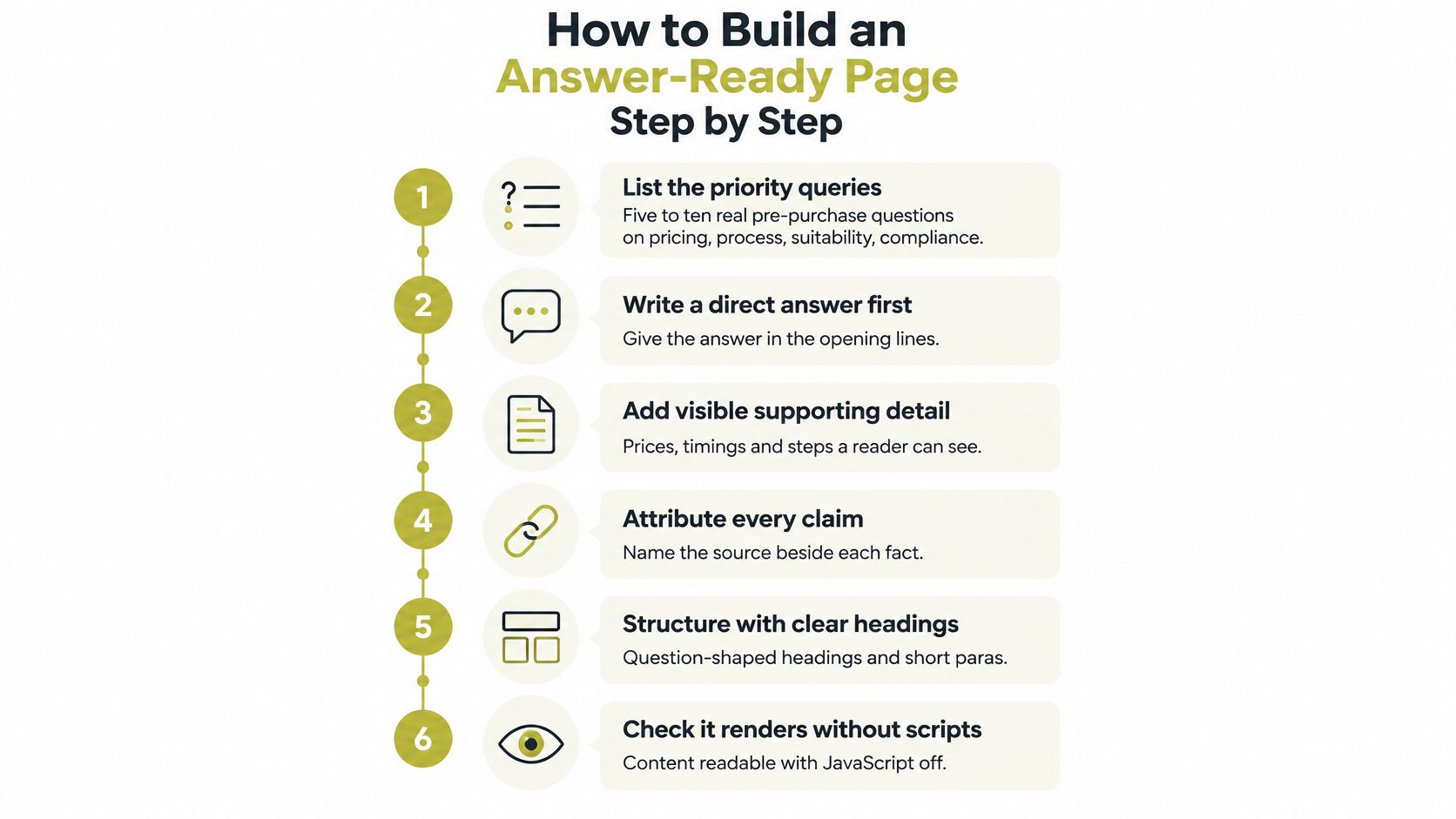
Use this workflow to organise the rewrite.
Build the answer before polishing the copy
List the priority queries. Choose five to ten genuine pre-purchase questions from enquiry emails, sales calls and Search Console, covering pricing, process, suitability or compliance. Don't start with keywords alone, because a search term doesn't always reveal what the buyer needs resolved.
Map what each answer must prove. Write down the claims, supporting documents and qualifications needed for each question. The common mistake is assigning everything to a general service page, leaving no individual answer complete.
Draft a concise opening answer. Aim for about 40 to 60 words as an editorial working target, not a Google requirement. Give the conclusion and its main condition immediately, rather than using the opening to announce that the topic is complicated.
Attribute material claims. Record the source, publication date and responsible author or organisation, adding geography, definitions and denominators where relevant. A statistic without its date may look persuasive while giving the reader no way to judge whether it still applies.
Give each H2 a distinct question. Answer it in the first two sentences, then explain the reasoning or process. Don't split one answer across several sections to fit more keywords into headings.
Put limitations beside the claim. If a price excludes delivery, say so beside the price; if findings cover only Scotland, keep that boundary beside the finding. Footnotes shouldn't carry qualifications that change the meaning of the answer.
Record substantive reviews. Add a visible last reviewed date and maintain a short change log explaining what changed and why. Don't refresh a date unless someone has checked the underlying information.
Test conversational variants. Try versions involving Scotland, UK SMEs, cost, suitability and follow-up questions. Revise any passage that needs surrounding promotional copy to make sense.
Review the finished passage
A finished section should contain a question-shaped heading, an immediate answer and the evidence needed to support it. Where a sourced number helps, include its date and scope; don't add statistics merely to make the page look authoritative.
Practical rule: A reader should be able to lift a section into an email without losing the qualification that makes its answer accurate.
For further editorial approaches, use CitationOS articles on answer engine optimization as a comparison resource. Carlos Alba Media's SEO content creation guidance also helps connect question-led writing with a coherent site structure.
Technical Checks That Matter and the Myths to Drop
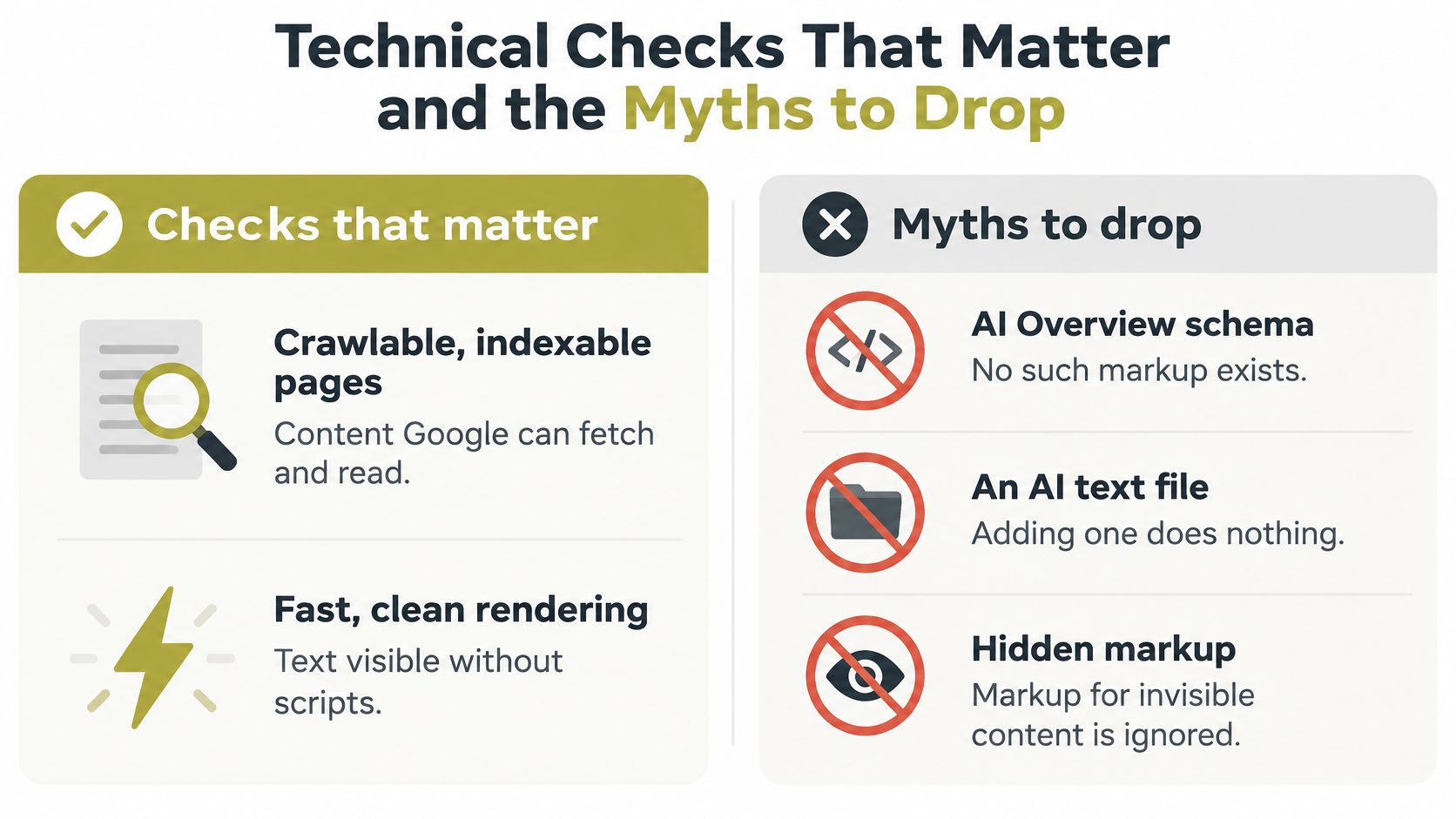
Chasing an AI Overview schema, creating an AI text file and marking up information readers can't see are poor starting points. Google's AI features documentation states that no special AI markup, AI text file or new machine-readable file is required, and structured data must match visible content.
That doesn't make technical SEO irrelevant. It means the technical work should help Google access and understand a useful page, not imitate a secret inclusion mechanism.
Separate content problems from access problems
Work in two stages. First, resolve the search intent with original answers, authoritative references and internal links to relevant supporting pages.
Then validate the technical layer:
- Crawling and indexing: Use Search Console's URL Inspection tool to check access, indexing status and the selected canonical URL. Look for unintended robots restrictions or noindex directives.
- Rendering: Compare the live page with the rendered version available to Google. Keep essential answers in accessible text, rather than relying on images or fragile interactive components.
- Mobile experience: Run PageSpeed Insights and inspect the page on a phone. Carlos Alba Media's Core Web Vitals explanation helps prioritise performance fixes.
- Page meaning: Check descriptive titles, headings and contextual internal links. Validate that structured data describes what a visitor can read.
Locally meaningful evidence deserves the same care. Say a Scottish hotel group publishes an explainer about deposits: it should distinguish its booking policy from applicable consumer rules, cite the relevant regulator's guidance and record when that guidance was checked.
Use a ten-minute triage per priority page: inspect crawl status, indexing, mobile performance and visible-content alignment. Fix access failures before debating smaller copy changes, but don't expect a fast page to compensate for an unhelpful answer.
Trust Signals Readers and Search Systems Can Verify
Some readers will not accept an answer just because Google displays it. Ofcom's 2025 qualitative research found reluctance among some UK users because of concerns about inaccurate answers, unclear sourcing, privacy and ethical implications.
Treat inclusion as a trust and citation-quality problem. I would record a citation and a click as separate results: being named shows a system could point to you, and a visit shows someone chose to check. A cited line only helps if the reader can see who made the claim and why they are qualified to make it.
Make responsibility visible
- Visible authorship: Name the author or accountable organisation, explain their role and link to relevant published work. Give the job, verified years of experience and type of work, rather than a label such as highly experienced.
- Dated evidence: Separate the date of a finding from the date someone reviewed your page. A recent review does not turn an older survey into current evidence.
- First-party documentation: Explain how you collected case data, what you measured and what you excluded. Remove confidential information without removing the method needed to interpret the result.
- Corroboration: Compare consequential claims with regulators, national statistics bodies or named institutions. Independent coverage can support reputation. Primary evidence still has to carry a technical or legal claim.
- Consistent brand facts: Reconcile your organisation's name, services, locations and descriptions across your website, directory profiles and media coverage.
Show expertise through the work
Carlos Alba Media is led by Carlos Alba, a multi award-winning former national newspaper editor. Its work is built on newsroom insight and senior-level counsel, so readers can judge that expertise from the campaigns described, not from a biography that only asserts it.
The VisitScotland campaign work included strategic communications planning, audience segmentation and targeting, a multi-platform social media strategy, and content marketing and asset creation. Naming those tasks gives a reader something specific to assess.
Use markup only where it matches text a visitor can read. For a wider reputation checklist, see the guidance on how to build brand trust.
Test the result with a colleague. Can they identify the author, date and source of a claim in under thirty seconds?
Local and Question-Led Pages for UK SMEs
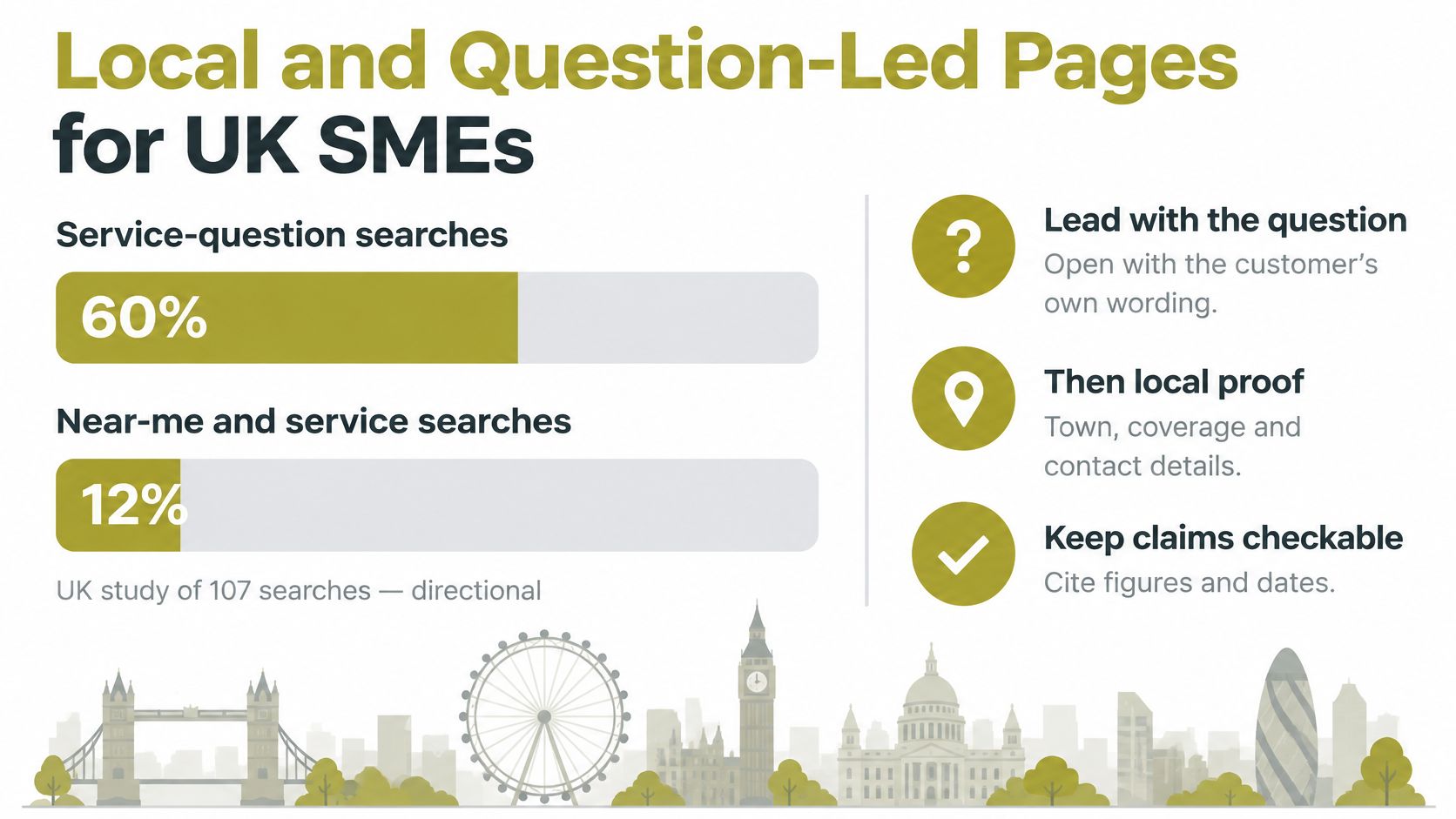
A local page that only chases "near me" can miss the queries where an AI Overview is more likely to appear. In a UK sample of 107 searches, Lekker's local search study found AI Overviews in 60% of service-question searches, compared with 12% of near-me and service searches. The sample is small and not national. Treat the gap as directional, not a forecast for your town or sector.
I would spend the next page on the buying question, not on another "agency near me" variant. An Overview on the query still does not mean your URL was cited, your name was used, or anyone clicked. Those are separate outcomes. Check each one when you review the page.
AI Overview appearance by search type
| Search type | Share with an AI Overview | Page to build |
|---|---|---|
| Service-question searches on pricing, process or compliance | 60% in the study described above | Explainer pages that answer each question with sourced detail |
| Near-me and direct service searches | 12% in the study described above | Local proof pages with case studies and location-specific service detail |
Those figures are appearance rates inside each search type in that sample. They are not shares of all UK searches.
Turn local knowledge into useful explanations
Start from a question a customer asks. A hospitality business can explain cancellation terms, accessibility, or what happens after a booking, instead of publishing interchangeable town-name pages that say the same thing.
Add Scottish or UK context only where it changes the answer. Cite the authority behind a regional rule, and keep that rule separate from your own policy. A "best in Glasgow" line needs evidence of that comparison. Without it, the claim is easy to ignore and hard for a citation to defend.
Write so the page still helps someone who never buys. Put the offer in a labelled service section, then tie it to a case study, a documented process, or other proof of delivery. Readers and search systems can check that proof. A vague boast they cannot check is a weak citation.
Tourism, hospitality, professional services and regulated work fit this pattern because people need practical answers before they choose a provider. The same pages give a sales team something accurate to send.
Test these question types first:
- Pricing: What determines the cost, and what's excluded?
- Process: What happens after an enquiry or booking?
- Suitability: Who is the service appropriate for?
- Compliance: Which requirements apply in the customer's location?
- Risk: What can go wrong, and how is it handled?
On each published page, note three things in the same review: whether an Overview showed for that question, whether your page was the cited source, and whether the visit produced a click or an enquiry. A visible answer with no citation, or a citation with no click, tells you a different fix.
How to Measure Citations and Clicks Over 14 Weeks
Create a fixed weekly panel of 12 to 20 UK queries covering informational, commercial, local and regulated questions. This is a practical monitoring range, not a statistically representative sample of UK search.
Keep the wording, location settings and recording method consistent. For each query, save whether an Overview appeared, cited domains and URLs, whether your brand was named, whether your page was linked, and whether the answer was accurate.
Measure attribution separately
The Government Communication Service account of the ONS evaluation describes 12 population-statistics queries monitored weekly for 14 weeks, with a 97% citation rate for ONS URLs but only 62% explicit mentions of ONS or Office for National Statistics. Those findings concern that particular panel, but demonstrate why a linked source and a named organisation are different outcomes.
Record both. Also inspect whether the answer preserves your qualifications, uses current information and describes your organisation correctly.
A citation without clear attribution can distribute your information without giving your organisation equivalent recognition.
Metrics to record in the weekly citation panel
| Metric | Where to record it | What it tells you |
|---|---|---|
| Citation rate | Weekly panel of UK queries | Whether your URL is cited at all |
| Named brand mention | Weekly panel, noting whether the name appears | Whether the answer attributes your organisation, not just links to it |
| Answer accuracy | Manual check of each cited answer | Whether figures and caveats are reproduced correctly |
| Clicks and engaged sessions | Search Console for clicks; analytics for engaged sessions, segmented by landing page against a baseline | Whether visibility turns into visits and engagement |
| Enquiries and assisted conversions | Analytics against a pre-change baseline | Whether the work produces business results |
Define your citation-rate denominator before starting. Record both the share of all panel queries citing your page and the share of Overview-present queries citing it, so changes in Overview availability don't distort your interpretation.
AI-feature traffic sits within Search Console's overall Web performance reporting, rather than providing a clean attribution trail for every enquiry. Compare UK landing-page clicks with a pre-change baseline, then use analytics and enquiry records to examine downstream outcomes.
For commercial context, you can browse AI search lead data from SourceLoop, while keeping external comparisons separate from your own results.
Run the panel across the monitoring period and annotate substantial releases. Rising citations with flat clicks may indicate exposure, but don't claim improved brand recall without measuring it; qualified enquiries and assisted conversions provide the commercial test.
Audit One Priority Page This Month
Choose a page that answers a genuine pre-purchase question and assign someone responsibility for improving it. Use a checklist to keep the work focused.
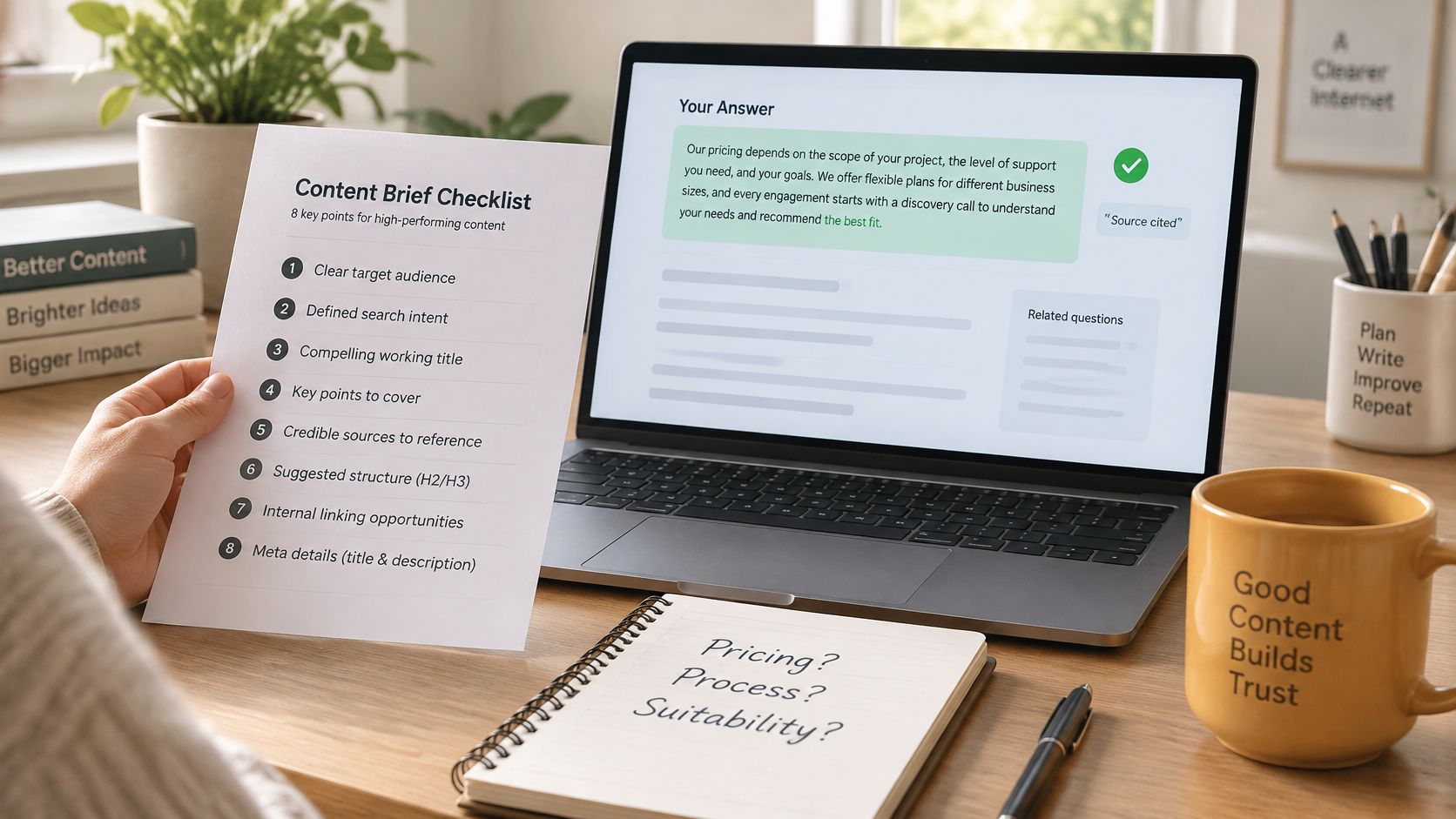
Apply the eligibility checks to that page, then fix the most consequential gaps: an obscured answer, unsupported claims, unclear ownership or blocked access. Record the starting position before publishing, including priority-query citations, named mentions and Search Console clicks.
AI Overviews reward pages that answer clearly, prove their claims and say who stands behind them. Treat that as an editorial principle, not a promise of inclusion.
Where capacity is limited, Carlos Alba Media offers digital content marketing with SEO, web design and development, social media marketing, media crisis management and media skills training. Our media exposure service crafts and places news articles, features, interviews and focus articles in high circulation publications, and arranges appearances on national TV and radio, providing opportunities for third-party corroboration without guaranteeing AI selection.
Use the video alongside the practical page review.
Keep the initial scope narrow enough to finish. At week eight, review one primary measure: the citation rate for the page's priority query, using the same recording method as your baseline.
Carlos Alba Media combines newsroom expertise with SEO-led content, digital communications and website development to make business information clearer and easier to verify. Visit Carlos Alba Media to discuss a priority-page audit and a practical plan for improving your visibility in AI-generated search answers.