
You're probably dealing with the same problem most hotel GMs are dealing with right now. A guest had a decent stay, then left a sour review about something small, a late reply sat unanswered on Google, and your OTA visibility slipped just enough that the next booking felt harder than it should've been. That's the reality of hotel online reputation management now, it's not a side task, it's part of the booking engine.
The mistake is treating reviews like after-the-fact commentary. In practice, they're live commercial signals, and the hotels that win are the ones that monitor, triage and respond with the discipline of a newsroom desk, not the mood of a front desk at 11pm. If you want the plain-English definition first, what is reputation management is a useful starting point before you build the system.
What Hotel Online Reputation Management Actually Means in 2026
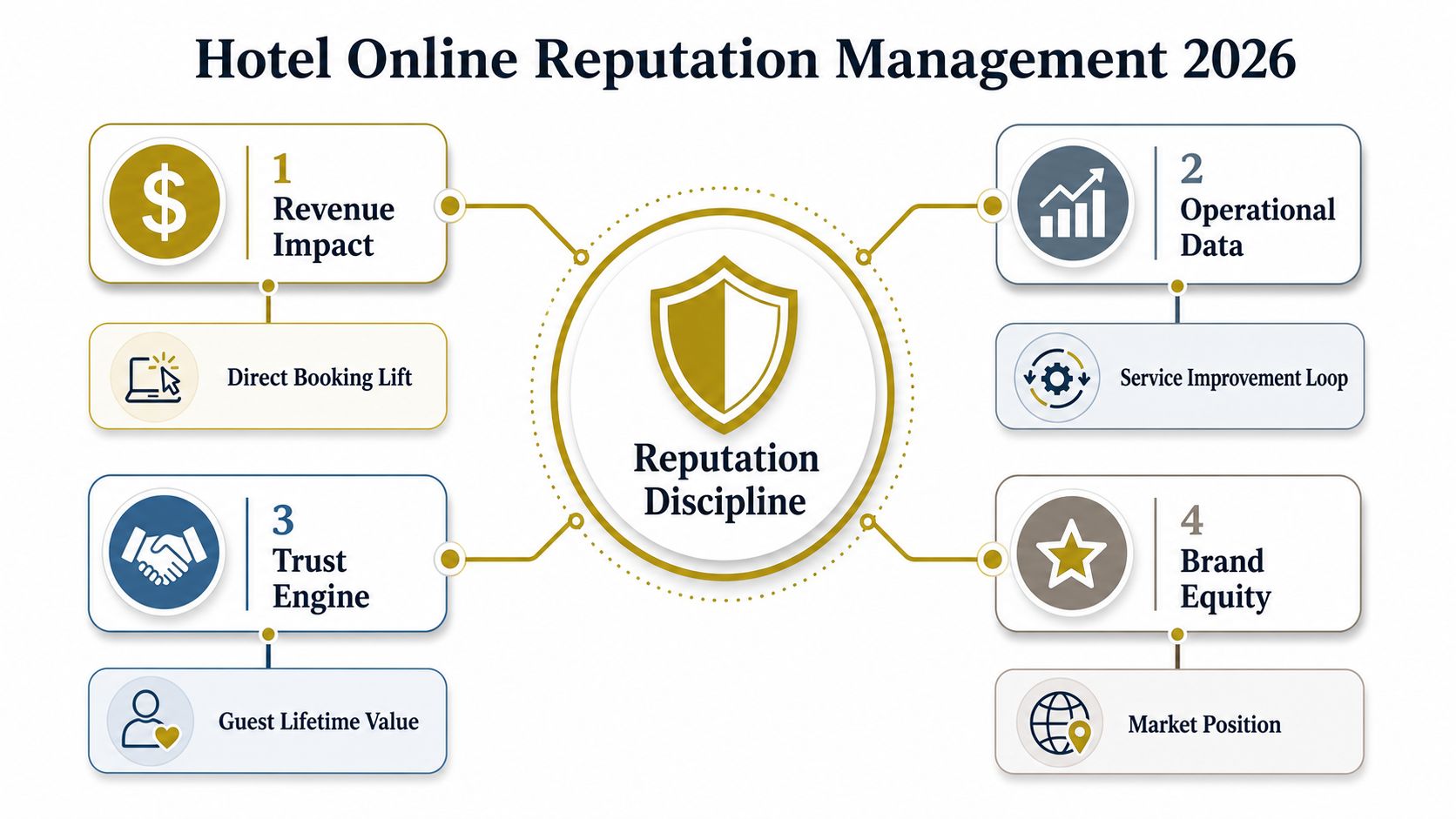
Stop thinking of reputation as the aftermath of a bad stay. In 2026, hotel online reputation management is a working commercial process, one that sits beside revenue management, distribution and guest experience, because it shapes whether people click, compare, book and come back. Revinate's 2025 hospitality benchmark shows 22.42% average guest engagement with hotel messaging, and it reports that personalized responses increase booking likelihood by 77% Revinate. That's not soft marketing language, that's a booking lever.
Reputation is a system, not a cleanup job
A hotel that only reacts to bad reviews is already behind. The stronger approach is to treat every guest signal as a story, a complaint, a praise point, a photo upload, a profile mismatch, a delayed reply, and move it through a clear triage process before it damages conversion. The European Commission's tourism guidance says hotels should track review sites, reply in a timely manner and use campaigns to boost reviews, which is the right operating mindset for UK properties competing across Google, Booking.com and TripAdvisor European Commission guidance.
A good hotel doesn't wait for a reputation problem to become visible. It watches the signals, fixes the service break, and makes the reply part of the recovery. That matters because the guest journey now stretches beyond checkout, and the hotel that answers cleanly often looks more trustworthy than the hotel that was silent.
A practical way to frame it is simple.
Practical rule: if a review, listing error or social mention can influence a comparison page, it belongs in your reputation process.
Carlos Alba Media's newsroom-style approach fits this model because the work is about deciding what matters first, what needs a public reply, and what needs an operational fix. The company's founder is a former national newspaper editor, and the team says it works with senior practitioners rather than generic marketers, which is exactly the kind of discipline this job needs.
The Surfaces and Signals You Must Monitor
Most hotel teams monitor too many things badly or too few things well. The answer isn't a scattered checklist, it's a central monitoring stack with clear priority levels, so the duty manager knows what gets checked daily and what gets reviewed weekly. A research paper on reputation architecture describes the effective setup as multichannel feedback collection, centralised analytical monitoring and prioritised responses within defined time windows WJARR paper. That's exactly how a practical hotel operation should think.
What deserves daily attention
Google Business Profile, Booking.com, TripAdvisor, Expedia and social mentions on Instagram or TikTok are not equal, but they all matter. Google and the OTAs influence search visibility and the decision page, while social mentions shape perception before a guest even reaches the booking stage. TrustYou-style aggregators help consolidate the noise, but they don't replace the habit of looking at the original source.
| Core Surfaces for UK Hotel Reputation Monitoring | What it influences | Suggested review cadence |
|---|---|---|
| Google Business Profile | Local search visibility, map clicks, trust | Daily |
| Booking.com | OTA conversion, comparison decisions | Daily |
| TripAdvisor | Reputation depth, traveller confidence | Daily |
| Expedia | OTA ranking signals, package comparison | Daily |
| Instagram and TikTok mentions | Social proof, brand feel, shareability | Weekly |
| Aggregators such as TrustYou-style dashboards | Pattern spotting, sentiment themes | Weekly |
The smart move is to separate signal from noise. A one-off social post with no traction is not the same as a repeated complaint about check-in delays or a listing error that changes how your property appears in search results. Track the recurring themes, not just the star average.
Surnex's South Carolina SEO resource is a useful reminder that search visibility depends on structured local signals, not wishful thinking, and the same logic applies when your hotel pages need to stay competitive in a busy location Surnex resource.
A strong monitoring stack tells you where the booking leak is coming from. A weak one just tells you that something is wrong.
A second point that often gets missed is listing hygiene. If photos, amenities, pricing or contact details are stale, you're creating conversion loss before the review even lands. The best reputation teams keep the profile accurate because a bad listing can do just as much damage as a negative review.
A Newsroom-Style Review Response Workflow
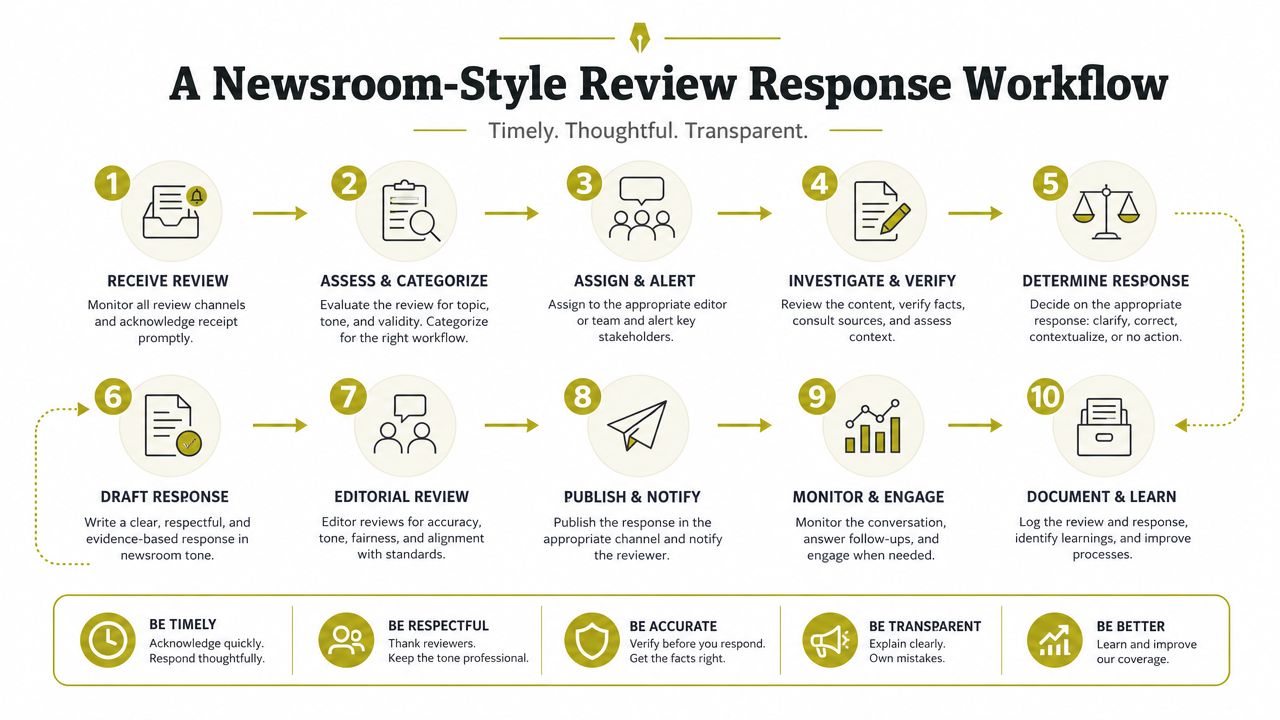
The reply itself matters, but the workflow matters more. Hotels that handle reviews well don't let them sit in an inbox until someone feels like answering them, they move through an alert, categorise, draft, approve, publish and log chain. That is how a newsroom desk works, and it's how a busy hotel can keep pace without turning every response into a committee meeting.
Triage first, then write
Start by sorting the review into one of five buckets, service failure, stay disruption, factual correction, praise, or escalation risk. If it's a factual correction, fix the listing or the underlying process at once. If it's a service failure, write a public reply that acknowledges the issue, avoids defensiveness and shows that the hotel took action.
LocalHQ's review tracking for businesses is a practical example of the kind of tooling that helps small teams keep the queue visible instead of relying on memory and sticky notes.
Use this response order.
- Acknowledge the guest's point. Keep it plain and specific.
- State the action or apology. Don't over-explain.
- Move offline if resolution needs personal details. Give a named contact.
- Log the theme. That's how one reply becomes an operational fix.
- Close the loop internally. A recurring complaint needs a change, not just a nice sentence.
A short public reply is often enough. Long, over-written responses sound defensive and draw attention to the wrong part of the story. If the issue affects other guests, the public reply should show that the hotel understands the pattern and is dealing with it.
Use a human voice, not corporate wallpaper. For a noisy room complaint, write, “We're sorry the room wasn't as quiet as expected. We've shared this with the team and would welcome a direct message so we can look at the details.” For slow Wi-Fi, say, “That shouldn't have happened, and we're reviewing the connectivity issue with our provider.” For overbooking, the tone must be sharper and more accountable, because the guest's trust has already taken a hit.
A good internal reference point is how to respond to criticism, which is the right kind of thinking if your team needs a steadier voice under pressure.
Five response rules that save you from sloppy replies
Keep it short. Guests read for sincerity, not length.
- Thank the guest by name where the platform allows it, because generic replies look automated.
- Apologise for the experience, not necessarily for blame you haven't verified.
- Never argue in public, even when the review is unfair.
- Use one named follow-up contact when the issue needs offline handling.
- Feed recurring themes into training, because the same complaint twice is already a process issue.
The same response discipline applies to praise. Thank the guest, mention a detail, and invite them back without sounding scripted. Praise reviews are marketing assets, but only if they sound credible.
Proactive Reputation Building Beyond the Review Card
The lazy advice is to ask for more reviews. That's not enough, and in some cases it makes the operation look needy rather than confident. The better move is to build a property that naturally generates evidence, search presence and third-party validation, so guests arrive with trust already formed.
Earn proof before the stay ends
A hotel can create reputation lift through location pages, event-led content, local partnerships, media coverage and on-property moments people want to share. That means writing clear pages for rooms, spa access, parking, dog-friendly policies, family stays and transport options, because the booking decision often happens at the detail level, not the brand level. It also means tying content to local events, so your property shows up when travellers are planning around a concert, sporting fixture or seasonal trip.
One useful discipline is a quarterly rhythm. Build one local story, one seasonal landing page, one press angle and one guest-facing campaign each quarter, then measure what gets traction. A hotel near a major venue, for example, can turn an event weekend into an owned-content opportunity instead of waiting for random review volume to do the work.
Use PR to support the reputation layer
Third-party coverage still matters because it gives your hotel a layer of credibility that a review widget can't manufacture. Regional press features, tourism body partnerships and targeted lifestyle placements make the property look active, relevant and trusted. That's where senior newsroom-style counsel helps, because the angle, timing and proof points have to be right.
Carlos Alba Media is a useful example of that model in practice. The agency's reputation work includes monitoring what's being said across the internet, building positive content to strengthen authority, and dealing with damaging material that affects search perception. That combination matters because reputation is no longer only about replying well, it's about shaping what shows up before the guest ever clicks into the review section.
A small hotel can launch these plays quickly.
- Refresh the top five landing pages so they answer booking questions before a guest asks them.
- Pitch one local story to regional press or a tourism partner.
- Create one shareable on-property moment, such as a signature welcome, tasting or local experience.
- Build one review request flow that feels personal, not spammy.
The point isn't volume for its own sake. The point is to reduce dependence on post-stay pleading and create a stronger reputation footprint across search, social and press.
Crisis Management When the Story Is Not Your Fault
Most reputation advice falls apart. Rail strikes, storms, power cuts, staffing shortages and amenity failures can all create a wave of negative reviews that have nothing to do with your usual service standard, and treating those reviews like normal complaints is a mistake. The UK market is especially exposed because domestic guests factor transport reliability and flexibility into their trip decisions, so disruption lands harder than many hoteliers want to admit.
Decide the response before the review appears
The first decision is simple, public reply or offline resolution. If the complaint is about a visible disruption that affected multiple guests, reply publicly and explain the context without sounding like you're making excuses. If the guest needs rebooking, compensation or personal follow-up, move it offline quickly and assign one person to own the case.
Use this working rule.
If the issue is systemic, the public reply should show control. If the issue is personal, the public reply should show respect and move the conversation elsewhere.
A rail strike does not need a defensive speech. It needs a pre-written template, a named point of contact and a clear escalation path. Severe weather calls for guest safety language, flexible rebooking and a visible duty manager. A power cut needs immediate transparency, because guests care less about the technical cause than about whether the hotel is in control of the situation.
What not to do when reviews surge
Don't pile identical replies under every negative comment. That looks mechanical and amplifies the problem. Don't argue about whether the hotel could have predicted the disruption, because guests judge what happened, not your internal planning meeting. Don't hide behind vague phrases like “unforeseen circumstances” if the guest is clearly describing a real failure they experienced.
Instead, keep the message disciplined. Acknowledge the event, recognise the inconvenience, state the immediate action and give the guest a route to follow up. If a complaint wave hits after one bad night, the hotel should review whether the problem is operational, communicational or both, and then update the template before the next shift starts.
For hotels that need specialist support during a high-risk incident, how to develop a crisis communications plan is the right reference point for building the escalation structure and the spokesperson discipline.
The practical crisis checklist is short.
- Pre-draft disruption replies for rail, weather, power and supplier issues.
- Name one spokesperson for media-sensitive problems.
- Track the review spike daily until the issue stabilises.
- Record the operational failure so it doesn't repeat next month.
- Brief the front desk and reservations team so everyone gives the same message.
A hotel that handles disruption cleanly can protect trust even when the stay itself was messy. A hotel that improvises usually ends up compounding the original problem.
KPIs and Reporting That Actually Predict Bookings
A good dashboard doesn't try to measure everything. It measures the handful of reputation signals that tell you whether bookings are getting easier or harder to win, and it makes the monthly conversation practical for the GM, revenue lead and front-of-house manager. The same pattern recognition that helps you catch a service issue early should also tell you whether the reputation work is paying off.
The metrics worth checking every month
The core set is small, review velocity, sentiment themes, response rate, response time and OTA ranking shifts. Add direct booking conversion if you can tie it to the same reporting view, because that's where reputation becomes commercial. The TrustYou guidance already points hotels towards tracking recurring complaints, using PDCA and keeping profiles current, which means the KPI conversation should always end in a fix, not just a chart TrustYou guide.
The monthly report should answer four questions.
- What changed in review volume? A dip can mean lower guest engagement or a gap in the post-stay ask.
- What themes appeared again? Repeated complaints matter more than isolated grumbles.
- How fast did we respond? Slow replies signal drift, even if the tone is fine.
- Did OTA visibility improve or slip? If ranking weakens, the problem is not just sentiment.
Run the meeting like an operations review
Don't turn the review meeting into a marketing showcase. Sit the duty manager, front desk lead and revenue lead in the same room and read the reviews aloud, especially the recurring ones. Then assign the fix, the owner and the review date. If a cleanliness comment appears across several platforms, that belongs in housekeeping training. If a room-type complaint keeps surfacing, that belongs in the inventory or maintenance review.
Carlos Alba Media's operating model is relevant here because the company's work is built around monitoring, response discipline and quick issue handling across multiple channels, which is exactly the kind of process a hotel needs when reputation starts affecting booking flow. In practice, that means your monthly meeting should feel like a newsroom handover, not a vanity report.
Meeting rule: if the team leaves the room without one operational action, the report was decorative, not useful.
Set the agenda in one page. Start with the scorecard, move to the themes, then end with two service actions and one communication action. If nothing changed, say so. If something got worse, say that too.
Your First 30 Days and Tools Worth Considering
Start with a 30-day plan, not a giant transformation project. Week one, audit every major review surface and fix any listing errors. Week two, write response templates and train one duty manager to own the queue. Week three, push one proactive content or PR asset. Week four, hold the first monthly review and choose one operational change from the feedback.
For tools, begin with the free dashboards you already have, Google Business Profile, OTA back offices and platform alerts. Add a mid-tier reputation suite only if it helps you centralise monitoring and speed up replies, not because a sales demo sounded clever. If you're considering outside support, Carlos Alba Media's reputation monitoring tools page is a practical place to understand how monitoring can be structured alongside response and content work.
Three priorities should come first.
- Get your monitoring in one place so nobody is guessing.
- Write responses in advance for the common problems.
- Turn one recurring complaint into one operational fix before the month ends.
That's how reputation work starts paying for itself, by making the hotel easier to trust, easier to book and harder to criticise for the same avoidable issues twice.
If you want a sharper reputation process, Carlos Alba Media can help you build the monitoring, response and crisis framework around your hotel's real booking pressures. Visit Carlos Alba Media if you want senior PR and digital support that treats reviews, listings and disruption like the commercial signals they are.