
The phone rings just after 2am. A Glasgow hotel has a flood in the basement, the Wi‑Fi is down, a guest has posted a video from reception, and the manager on duty is trying to work out whether this is an operations problem, a safety problem or a reputation problem. In that first ten minutes, emergency crisis management is not about producing a polished statement, it's about deciding what's true, who needs to act, and what must be protected first.
That's where a newsroom-trained eye changes the game. A former national newspaper editor doesn't start with spin, they start with verification, timing, impact and who will be asking questions next. For UK SMEs, that instinct is often the difference between a contained incident and a week-long scramble that spreads across staff chats, inboxes, customer channels and the press.
What Emergency Crisis Management Really Means for an SME
A lot of owners think crisis management begins when the statement goes out. In practice, it starts the moment a founder gets the wrong call at the wrong time, whether that's a contaminated product alert, a data breach, an employee allegation or a fire that knocks a site out of action.
For an SME, emergency crisis management is the full discipline of preparation, response, communications, legal control and reputational repair. It covers the operational side, the human side and the public side, because those are rarely separable once an incident is live. The UK context matters too, because the Civil Contingencies Act 2004 created the modern national framework for crisis coordination, with Category 1 responders, Category 2 responders and local resilience forums working together across public bodies and utilities, which shows how seriously the UK treats shared emergency duty. That same multi-agency logic is useful inside a small business, even if the team is only five people strong. HR role in business resilience is a useful adjacent read because HR often becomes the hidden centre of gravity when staff welfare, messaging and continuity collide.
Practical rule: if the incident changes what people can do, what customers can trust or what regulators may ask for, it's a crisis, not a routine issue.
The newsroom lens matters because it strips away wishful thinking. The first questions are simple, who knows, what's confirmed, what's missing and what happens if the story leaves your control before lunch.
The Crisis Lifecycle From First Signal to After-Action Review
Crisis work is easier when you treat it as a sequence rather than a blur. Small teams often fail not because they lack effort, but because they don't know which phase they're in, so they overreact early and underperform later.
Signals and activation
The first signal is rarely dramatic. It's a spike in calls, a supplier silence, a complaint thread, a key system outage or a staff message that sounds more serious than usual. The job at this point is to decide whether to activate the plan, not to debate every possible outcome.
The Civil Contingencies Act 2004 is built around preparation and coordination, and that same discipline helps SMEs. The plan should say who has authority to trigger the response, who gathers verified facts and how quickly the first briefing goes out. That matters because the first version of the story usually shapes everything that follows.
Acute response, stabilisation, recovery and review
Once the response is active, the priority becomes control. That means protecting people, reducing uncertainty, keeping communications aligned and making sure the decision-maker isn't buried in noise. As the incident stabilises, the work shifts to service restoration, customer care, supplier reassurance and regulator-facing follow-up where needed.
Recovery is not the same as closure. A business can reopen, republish or resume trading while the trust damage is still unfolding. That's why crisis plans need a review stage built in, because the plan should change after each incident, not sit untouched in a shared drive.
The UK framework is useful here because it assumes cooperation across responders, not heroics from one person. SMEs don't have the luxury of separate command layers, so one person often wears two or three hats. That makes clarity of role more important, not less.
The team that learns fastest usually recovers fastest, because it updates the playbook while the details are still fresh.
Types of Crises That Catch UK SMEs Off Guard
The incidents that hurt SMEs most are often the ones nobody treated as a written scenario. Bigger firms can absorb that mistake for a while, but small organisations feel the pressure immediately because the same person may be fielding customers, staff, suppliers and media at once.
Operational, people and external shocks
Operational crises are the obvious ones, but they're still under-planned. IT outages, supply chain failures and product recalls can stop trading, trigger customer anger and create a backlog of decisions before the team has finished its first call. The reputational risk pattern is usually speed, people assume silence means concealment, even when the problem is that no one has the facts yet.
People incidents are harder because they blend internal risk with public exposure. Data breaches, allegations about conduct and executive misconduct rarely stay inside the company for long once they hit social media or a journalist's inbox. That's where a newsroom instinct helps, because the question is not just what happened, but what is likely to be alleged next.
External shocks move differently. Adverse media, activist scrutiny and regulatory action can arrive with little warning, then spread because other parties fill the gap first. In those cases, the 24-hour trajectory is often defined by who speaks first and whether the first public version is credible.
Local emergencies and the social layer
Flooding, fire and civil disruption bring a different kind of pressure because they affect access, movement and safety. The practical risk is that people can't get in, can't get out or can't get the information they need in time. That's also where social media accelerates the timeline, because a single video or frustrated post can make an operational problem look like negligence if no one is actively managing the narrative.
The right response usually depends on whether the issue needs a runbook or a broad framework. Recurring, high-likelihood risks deserve a written, tested procedure. Less predictable events still need a template, a decision chain and a communications lead who knows how to work under pressure.
Roles, Legal Touchpoints and the Newsroom Lens
A small business does not need a committee. It needs a clear incident lead, a communications lead, a legal contact, an operations lead and a senior spokesperson who can make decisions quickly and speak without drifting into speculation.
That structure matters because crisis communication is never just communication. In the UK, you have to think about defamation risk, sector-specific regulatory duties, GDPR and personal data exposure, staff welfare, and the point at which an early public comment becomes legally awkward. If the incident could reach journalists or spread on social channels, you want specialist media judgement early, not after the message has already been framed by someone else.
Carlos Alba Media is a relevant example of the kind of newsroom-led specialist that fits this need, because its own media exposure page says “our team consists of former national newspaper and broadcast journalists”, which is a different skill set from generic marketing. The agency also positions itself around 24/7 media crisis management with UK media lawyers, which is the kind of support that becomes useful when facts are still moving and the legal position can't be guessed. For social spend and channel choices that need to stay realistic for smaller firms, affordable social media costs for SMEs is a practical budgeting reference to keep around while you plan channel response.
A separate UK crisis advisory model can be seen on the legal crisis management service page, where the point is not to replace internal ownership but to add senior media and legal judgement when stakes rise.
Weber Shandwick's UK-relevant social media crisis management report found that in-house counsel devoted only 2.4% of their time to social crisis planning and that 47% spent no time personally preparing for such events, while 21% said they were very involved, which explains why specialist external support is often treated as a strategic asset rather than a luxury. Source
Practical rule: if the story could move faster than your internal sign-off chain, you need pre-agreed escalation and a spokesperson who can speak with authority.
Frameworks You Can Adopt This Week
The most useful crisis system for an SME is simple enough to use at midnight and disciplined enough to stand up in front of a regulator, customer or reporter. A four-part loop works well in practice, Prepare, Detect, Respond, Recover, because it keeps the team focused on action rather than theory.
Build the plan around one source of truth
Start with a one-page crisis plan. It should name the incident lead, the communications lead, the legal contact and the backup contact for each role. It should also define escalation thresholds, so nobody has to debate whether the issue is “serious enough” while the incident is already spreading.
The single most important operational habit is to maintain one shared log with version control. The UNHCR information-management framework treats crisis response as a pipeline of collecting, storing, cleaning, analysing and sharing data, which is exactly how SMEs should think about incident notes, call records, contact lists, situation reports and partner updates. That means you want timestamped entries, a clear source field and a place to record what has been confirmed, what is still pending and what has been corrected.
Practical rule: if two people can update the same incident note at once, you don't have a log, you have a confusion machine.
Use KPIs that actually tell you something
Track operational indicators that matter in a live incident, like call-answer time, emergency-service response time, evacuation progress, shelter occupancy and route congestion. Those are not vanity metrics, they are signals that tell you whether capacity is breaking or holding.
A basic holding statement template should cover three things, what happened in plain language, what you're doing now and where people should go for updates. Keep it factual, short and reviewable by legal before publication if the issue is sensitive. The point is to buy time without sounding evasive.
For a practical planning guide, the crisis communications plan resource is a useful reference if you need a structure that a non-lawyer can follow under pressure.
| Lifecycle Stage | Key SME Action | Typical Output | Lead Role |
|---|---|---|---|
| Prepare | Define roles, thresholds and contacts | One-page plan | Owner or director |
| Detect | Verify the first signal and log facts | Incident record | Incident lead |
| Respond | Release holding statement and assign tasks | Internal briefing and public update | Communications lead |
| Recover | Restore service and track stakeholder fallout | Recovery note and customer follow-up | Operations lead |
Two Real-World Mini Case Studies and What They Teach
A Scottish hospitality brand was hit with an adverse media story that could have spiralled if it had gone unanswered. Instead of waiting for the story to be interpreted elsewhere, the business put a senior spokesperson in front of it within the hour, used its own channels to publish a single verified account of events and kept the message consistent across staff and customers.
That approach did not erase the problem. It did something more useful, it prevented the rumour spiral from becoming the main story. The newsroom lesson is simple, the press is a channel, not the enemy, and if you treat it like a hostage negotiation, you usually lose the timing battle before the first quote lands.
The second case is the one SMEs dread because it's so common. A growing business went quiet during a social media storm, assumed silence would reduce attention and let other people define the facts. By the time it re-emerged, the narrative had hardened, the customer relationship was damaged and the company spent months rebuilding trust with partners and clients.
That pattern is expensive because early choices echo beyond the incident itself. They affect recruitment, partnerships and whether people believe your next announcement. Once a business looks slow, evasive or disconnected, every subsequent message has to work harder.
Carlos Alba Media's newsroom-led model fits this kind of work because it is built around people who understand deadlines, verification and the pressure of live coverage. That matters more than polished language when the situation is still moving.
Running an Honest Post-Incident Review
Teams either skip the review or turn it into a box-ticking exercise. Both waste the chance to improve, and both leave the next incident exposed to the same mistakes.
Capture the record while the incident is still fresh
During the incident, keep a running record of decisions, timestamps, messages sent, stakeholders contacted and any changes to the facts. Also note what the team believed at the time, because hindsight can flatten decision pressure and hide where information broke down.
Schedule the formal review within 14 days while the memory is still fresh. The agenda should separate decision quality from outcome, because a good process can still produce a difficult result, and a lucky outcome can hide a weak process. That distinction matters if you want the next plan to be better rather than just cleaner on paper.
Review access, inclusion and communication gaps
The blameless review should ask who was reached, who wasn't and why. That includes accessibility, language access, digital exclusion and whether people with access and functional needs could realistically receive the warning, leave the site or get help. The House of Commons debate on supporting underserved communities in emergency management highlights that low-income people and people with access and functional needs may not have the resources to evacuate or use aid, and that emergency managers also report gaps in representation and DEI awareness that limit engagement with marginalised communities. House of Commons debate on underserved communities in emergency management
A useful review output is a short action list with owners and deadlines. Update the plan, refresh the contact tree, tighten the escalation thresholds and sign off the revised version at board level. If trust was damaged, the trust rebuild guidance is worth using as a follow-up framework because the recovery phase often lasts longer than the incident itself.
Your Crisis Readiness Checklist and Common Questions
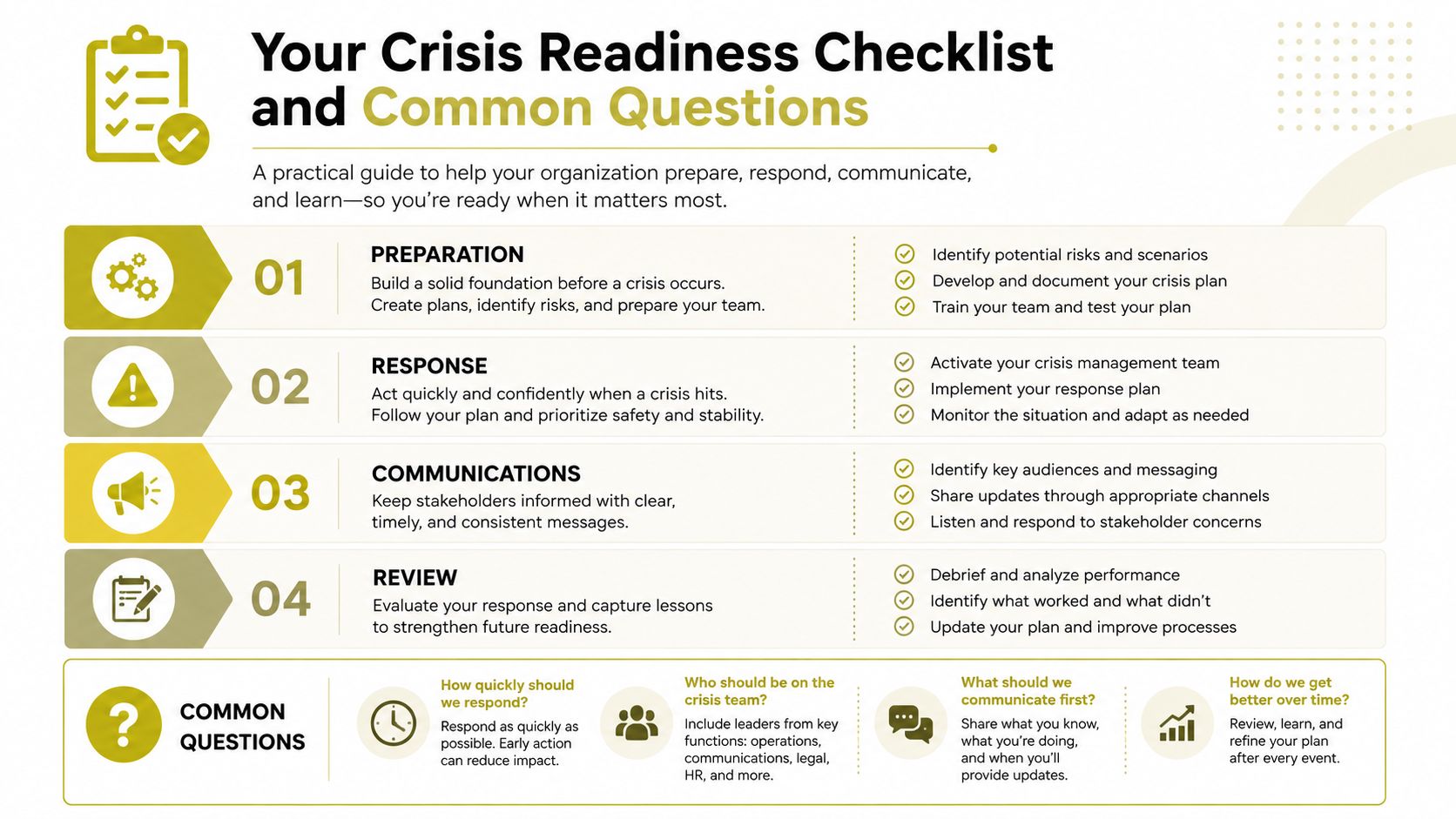
A usable readiness check is short. Preparation, named roles, escalation thresholds and a current contact list. Response, a tested holding statement and one shared log. Communications, a spokesperson who can speak clearly and a channel plan that matches the audience. Review, a formal debrief, action owners and plan updates signed off after the incident.
If the plan lives only on a shared drive, it won't help at 2am.
The questions SMEs ask most often are predictable. How often should the plan be tested, at least often enough that the team remembers its role without looking it up. When should specialist help come in, before speculation outruns verification or legal exposure starts to rise. What about social media speed, accuracy comes first, but speed still matters because silence leaves room for others to define the story. What if the crisis happens outside UK business hours, the escalation chain still has to work. How do you make it work for people with access or functional needs, by testing warnings, exits, channel choice and support arrangements before the incident happens.
The strongest partner in a live incident is usually the one that understands deadlines, verification and the pressure of live coverage. That's why a newsroom-led crisis adviser can raise the quality of your response when time is short and the clock is moving.
If you want a crisis desk that combines newsroom judgement with practical UK media and legal support, speak to Carlos Alba Media. They work with SMEs, founders and regulated organisations that need fast, senior-level crisis communication when an incident is already moving. If you're ready to harden your plan before the next call comes in, visit their site and start the conversation.