

You're probably doing what most founders do when they start looking for a digital marketing agency in London. You open ten tabs, skim a dozen websites, see the same promises on every page, and end up none the wiser. Everyone says they do SEO, paid media, content, social, strategy, growth, performance and “results”. Very few explain how they think.
This is the core issue. Choosing an agency isn't a design preference or a procurement exercise. It's a judgement call about who gets to influence your pipeline, your message, your reputation and, in many cases, your budget discipline.
The market is crowded for a reason. IBISWorld projects 7,723 businesses in the UK digital advertising agency sector in 2026, with a market size of £24.7 billion and revenue growing at a 10.1% CAGR over the five years through 2025 to 2026. That tells you two things. First, demand is real. Second, noise is inevitable.
The founders who hire well don't get seduced by polished decks. They learn to spot strategic judgement. They test whether an agency can connect activity to revenue, not just traffic. They look at who will work on the account. And they pay close attention to whether the people in the room ask sharp questions or merely rush to prescribe channels.
That matters even more if you want senior-level thinking without London-agency theatre. Teams with real newsroom, brand and international-agency experience often bring something many conventional agencies lack. They know how to interrogate claims, shape a credible narrative and decide what matters when budgets are tight.
Navigating the Crowded London Agency Landscape
A founder I meet this problem in one of three states. Burned by an agency that produced reports but not growth. Overwhelmed by too many agencies that look interchangeable. Or under pressure from the board to “sort marketing” quickly.
London makes that harder, not easier. The city is full of capable shops, but it's also full of agencies that are good at selling the idea of momentum. Nice branding. Confident jargon. Busy dashboards. Thin strategic substance.
Why most shortlists are weak
Most agency searches start with the wrong filter. Founders search by service line. SEO agency. PPC agency. Social media agency. That's too narrow too early.
Your business doesn't need “SEO” in isolation. It needs a route from visibility to enquiry, from enquiry to qualified opportunity, and from opportunity to revenue. If an agency can't explain that chain in plain English, they're not a growth partner. They're a supplier of activity.
Most agencies sell outputs because outputs are easy to package. Founders should buy decision-making quality.
The other mistake is trusting portfolios at face value. A portfolio tells you what an agency wants to show. It doesn't tell you who did the work, whether the account was profitable, whether the strategy held up after six months, or whether the client stayed.
What to look for instead
Use this simpler lens when assessing any digital marketing agency London shortlist:
- Business understanding first: Do they talk about your model, margins, sales cycle and customer behaviour before channels?
- Measurement discipline: Can they define success without reaching for vanity metrics?
- Team depth: Will senior people stay involved after the pitch?
- Narrative quality: Can they sharpen your message, not just distribute it?
- Honesty: Do they acknowledge trade-offs, limits and likely timeframes?
London has plenty of agencies serving serious clients. That's precisely why your filter has to improve. The right choice won't be the loudest. It'll be the one that thinks clearly under scrutiny.
First Step Define Your Own North Star
If you don't know what winning looks like, an agency will define it for you. Usually in a way that flatters their service mix.
That's how founders end up paying for motion instead of progress. They ask for growth, the agency hears “more channels”, and six months later everyone is discussing impressions, click-through rates and content calendars while the sales team still complains about lead quality.
Start with your own commercial brief. Not a fluffy brand manifesto. A working document that tells any agency exactly what problem they're being hired to solve.
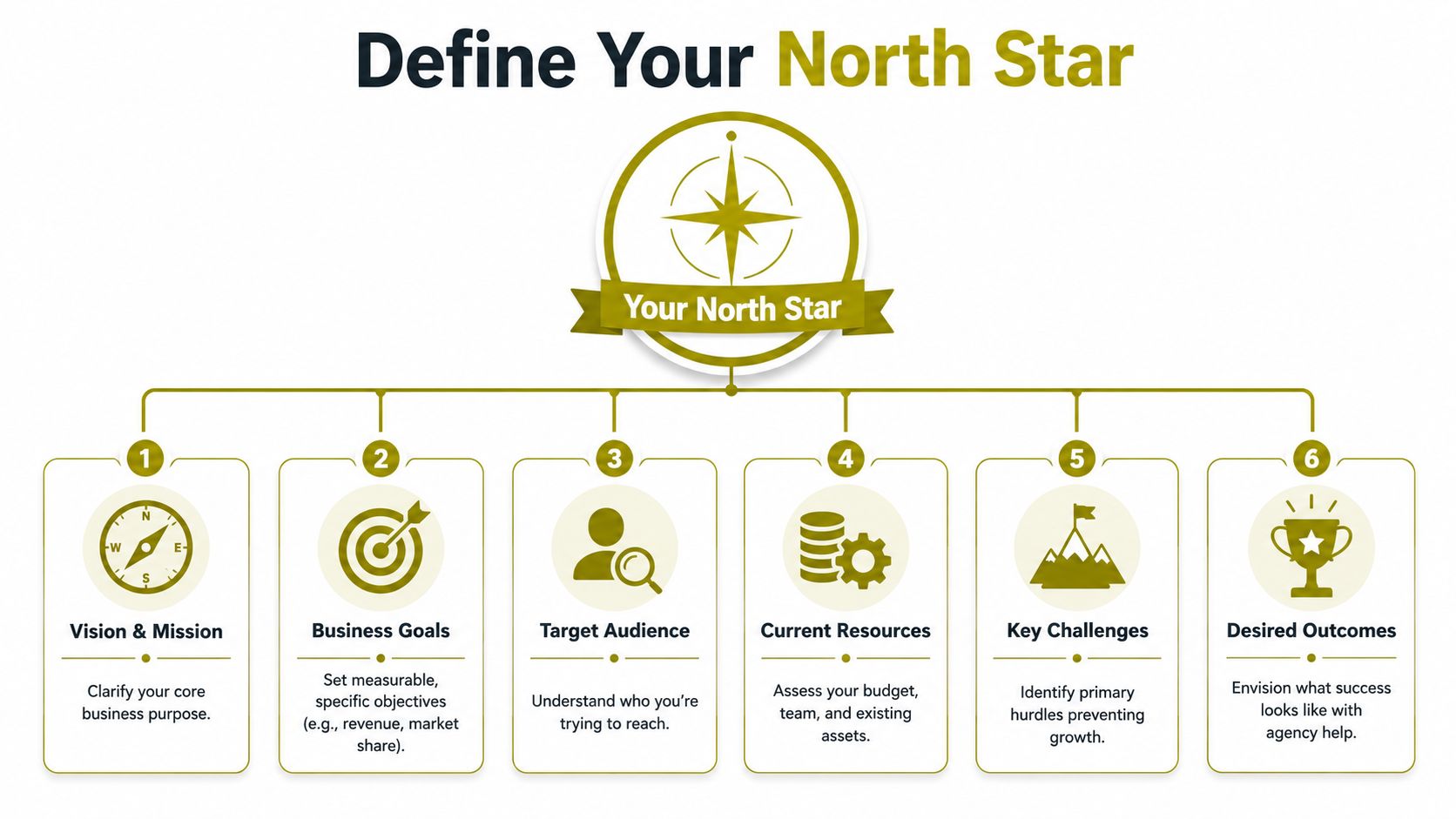
Define outcomes before channels
Write down the answer to these questions before you contact anyone:
What must marketing deliver?
More leads is too vague. Better questions are: do you need more sales conversations, better quality enquiries, lower customer acquisition cost, stronger repeat demand, or clearer positioning in a crowded category?Which numbers matter inside your business?
If your commercial team lives and dies by lead quality, booked calls or closed revenue, that's the reporting structure your agency should work backwards from.Where are you constrained?
Sometimes the issue isn't traffic. It's conversion. Or weak messaging. Or a slow sales follow-up process. Don't outsource a demand problem when your real issue is operational.
Get realistic about budget and buying level
The London market can be expensive, especially at the premium end. Digital Agency Network's London benchmarks show many leading agencies listing 50 to 249 employees, minimum project budgets of $10,000+, and typical hourly rates of $100 to $149. That's useful because it tells you where some agencies are positioned, not what you must spend.
For many SMEs, the right question isn't “what does an agency cost?” It's “what level of seniority do we need, and where can we avoid unnecessary overhead?”
A founder should decide early whether they need:
| Need | Better fit |
|---|---|
| Strategic reset | Senior consultant or specialist agency |
| Execution across several channels | Full-service team with clear lead strategist |
| Short, defined project | Fixed-scope engagement |
| Ongoing testing and reporting | Retainer with named account lead |
Audit your internal reality
Agencies fail when founders outsource thinking they still need to own. Be blunt about what your business can and can't support.
- Internal speed: If your team takes weeks to approve copy, campaigns will stall.
- Sales follow-up: If leads sit untouched, marketing gets blamed for a sales problem.
- Assets: Weak website pages, confused offers and poor tracking will limit any agency.
- Decision-maker access: If the agency can't speak to the person who owns revenue, strategy drifts.
Practical rule: If you can't explain your offer, margin logic and ideal customer in one page, don't brief an agency yet.
Write the brief an adult would respect
A strong brief contains:
- Commercial target: What business outcome matters most.
- Audience definition: Who you need to reach and who you don't.
- Offer clarity: What you sell, why people buy, and what objections keep showing up.
- Current state: What's already running, what's failed, and what's missing.
- Constraints: Budget, timings, internal capacity, compliance issues.
This changes the power dynamic. You stop being the founder who can be dazzled. You become the buyer who can evaluate.
How to Vet an Agency's Real Expertise
Most founders vet agencies backwards. They start with branding, client logos and case studies. Those things matter, but they're weak evidence on their own.
A better approach is forensic. Who exactly will handle your account? What have they done before agency life? How do they think under pressure? Can they challenge your assumptions without sounding defensive?

Look past the founders and into the delivery team
Agency websites love senior bios. That's not enough. Ask for the names and roles of the people who will perform the work, join reviews and make day-to-day calls.
Then do the obvious thing many buyers skip. Check their LinkedIn profiles.
You're looking for signs of judgement, not just tenure:
- Real operating experience: Have they worked with serious brands, difficult categories or complex campaigns?
- Editorial instinct: Can they shape a message that earns attention instead of merely buying it?
- Specialist depth: Do they understand the channels they're selling, or are they broad generalists?
- Consistency: Does the proposed team match the expertise the agency claims on its homepage?
This is one reason specialist teams can stand out. Carlos Alba Media, for example, is relevant here because its staff are described as former national news journalists or agency professionals with experience working on international brands. That mix matters. Journalists are trained to interrogate claims, find the story, understand audience tension and spot weak evidence fast. In marketing, that often translates into sharper messaging, stronger positioning and better editorial standards. If social is part of your mix, you can compare that lens with London social media marketing services.
Retention tells you more than one shiny result
Case studies can be selectively framed. Retention is harder to fake as a quality signal. Whitehat SEO's London agency guidance notes that top agencies report 97% client retention, and that's a better indicator than isolated campaign wins because it reflects service quality, reporting discipline and whether clients keep trusting the work over time.
Ask direct follow-up questions such as:
- How long do clients usually stay?
- Why do they leave when they leave?
- What do you do in month two that you don't do in month one?
- Who owns reporting, response times and escalation?
If an agency talks endlessly about wins and gets vague about retention, be careful.
Test whether they're thinking beyond old-channel playbooks
A lot of agencies still sell the classic stack as if buyer behaviour hasn't changed. SEO, PPC, social, content. Fine. But incomplete.
Serious agencies should be able to discuss how discoverability is shifting across AI-assisted search, social platforms and non-Google environments. You're not looking for buzzwords. You're looking for a practical answer to a simple question: how will you help my brand stay findable when attention is fragmented?
An agency that can only talk about rankings may already be behind. An agency that can explain discoverability across platforms, content formats, brand search demand and conversion paths is more likely to be thinking like an adviser, not a channel vendor.
The Crucial Questions to Ask During the Pitch
The pitch meeting is where most founders become too polite. Don't. You're not there to admire slides. You're there to test judgement, honesty and commercial discipline.
Use questions that force specificity. The best ones make weak agencies uncomfortable because they can't hide behind process diagrams.
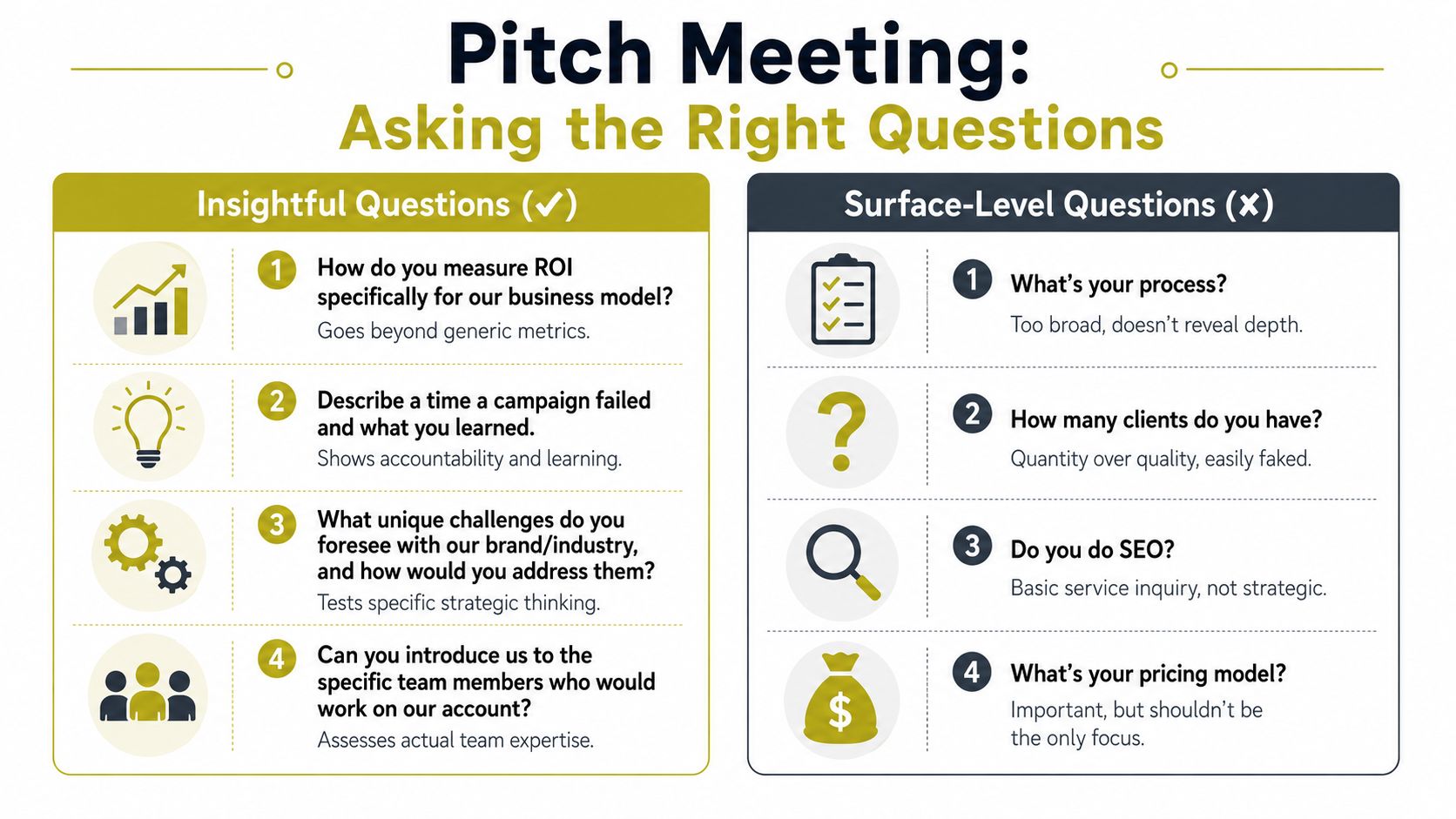
Four questions worth asking
Walk me through a campaign that failed and what changed afterwards.
Good answer: they describe a real problem, own the mistake, explain what they learned and show how the operating model improved.
Bad answer: they claim nothing meaningful has failed, or they blame the client for everything.How will you connect your work to revenue in our business model?
Good answer: they talk about lead quality, sales stages, conversion friction and reporting that connects marketing activity to commercial outcomes.
Bad answer: they fall back on impressions, traffic and engagement without linking any of it to pipeline.Which metrics will you report on every month, and which ones are noise?
Good answer: they distinguish leading indicators from vanity metrics and explain why.
Bad answer: they throw every dashboard metric at you because more numbers look impressive.Who exactly will work on our account after this pitch?
Good answer: named people, defined responsibilities and access to decision-makers.
Bad answer: “our team” will support you.
Here's a useful benchmark for what a serious answer should orbit around. Industry guidance on agency operating models argues that strong agencies focus on pipeline efficiency, measuring ROAS, cost per lead, customer acquisition cost and pipeline value, not just traffic. It also cites a practical 30% appointment-to-sale conversion rate as an operational benchmark. You don't need an agency to mirror that exact model, but you do need one that thinks in those terms.
Bring in outside scrutiny
This short video is worth watching before any pitch because it sharpens your questions about accountability and measurement.
If you want a second opinion before you commit, speaking with a digital marketing consultant in London can help pressure-test an agency proposal without jumping straight into a full retainer.
What green flags actually sound like
A strong pitch usually includes some version of the following:
- They challenge the brief: Not to be awkward, but to improve it.
- They discuss trade-offs: They explain what they won't prioritise and why.
- They talk about sequencing: They know what has to happen first.
- They define reporting cadence clearly: Daily execution, monthly reporting and quarterly planning is a sensible rhythm when the work warrants it.
One line to remember: If an agency promises ROI before they've audited your funnel, they're selling confidence, not evidence.
Decoding Pricing Models and Contractual Small Print
Pricing confuses founders because agencies often bundle three different things into one monthly number. Strategy. Production. Account management. If those aren't separated clearly, you can't tell what you're paying for.
That's why some retainers feel expensive and some “cheap” projects turn into an endless stream of change requests. The problem usually isn't the number. It's the fuzziness.
The three common models
Here's the straightforward breakdown:
| Model | Best for | Watch out for |
|---|---|---|
| Retainer | Ongoing campaigns, optimisation, reporting | Vague scope, junior delivery hidden behind senior sales |
| Project fee | Website rebuilds, audits, launches, messaging work | Weak handover, undefined revisions, no post-launch support |
| Performance-linked model | Businesses with strong tracking and agreed attribution | Misaligned incentives, disputed definitions of success |
A retainer can work well if you need continuity and regular decision-making. A project fee is cleaner when the outcome is defined. Performance models sound attractive, but they can become messy if attribution is disputed or if sales execution sits outside the agency's control.
What the contract must spell out
Don't sign anything until the statement of work answers these questions in plain language:
- Deliverables: What exactly will be produced, reviewed and delivered?
- Named roles: Who is the strategist, who executes, and who signs off?
- Reporting cadence: When are reports sent, what's covered, and who attends reviews?
- Approval process: How quickly must your side respond?
- Revisions and scope: What counts as included, and what triggers extra fees?
- Exit terms: Notice period, handover responsibilities and access to accounts or assets.
- Data ownership: Who owns ad accounts, creative files, landing pages and reporting dashboards?
Founders often get caught. The agency says “we'll be flexible”, but the contract is silent on the details that matter when the relationship gets strained.
Ask how the contract handles changing search behaviour
One clause worth discussing in 2026 is strategic adaptability. Search behaviour is fragmenting. Some agencies still write scopes as if Google is the whole game.
Found's explanation of an AI-first Everysearch approach is useful here because it frames discoverability beyond Google, across AI assistants and social platforms. You don't need to buy that exact positioning. You do need your agency to explain how the contract allows strategy to evolve if buyer discovery shifts during the engagement.
For founders comparing options, reviewing digital marketing agency pricing packages can also help you see how different agencies package strategy, delivery and reporting.
Contracts don't create trust. They document whether both sides understand the job the same way.
If the commercial terms are vague, the relationship will become vague. And vague agency relationships nearly always drift into frustration.
Your Final Agency Selection Checklist
By the time you reach a final shortlist, stop asking “which agency do I like most?” Ask “which team has earned the right to advise us?”
That subtle shift matters. The best agency relationship isn't built on charm. It's built on clarity, candour and competence under pressure.
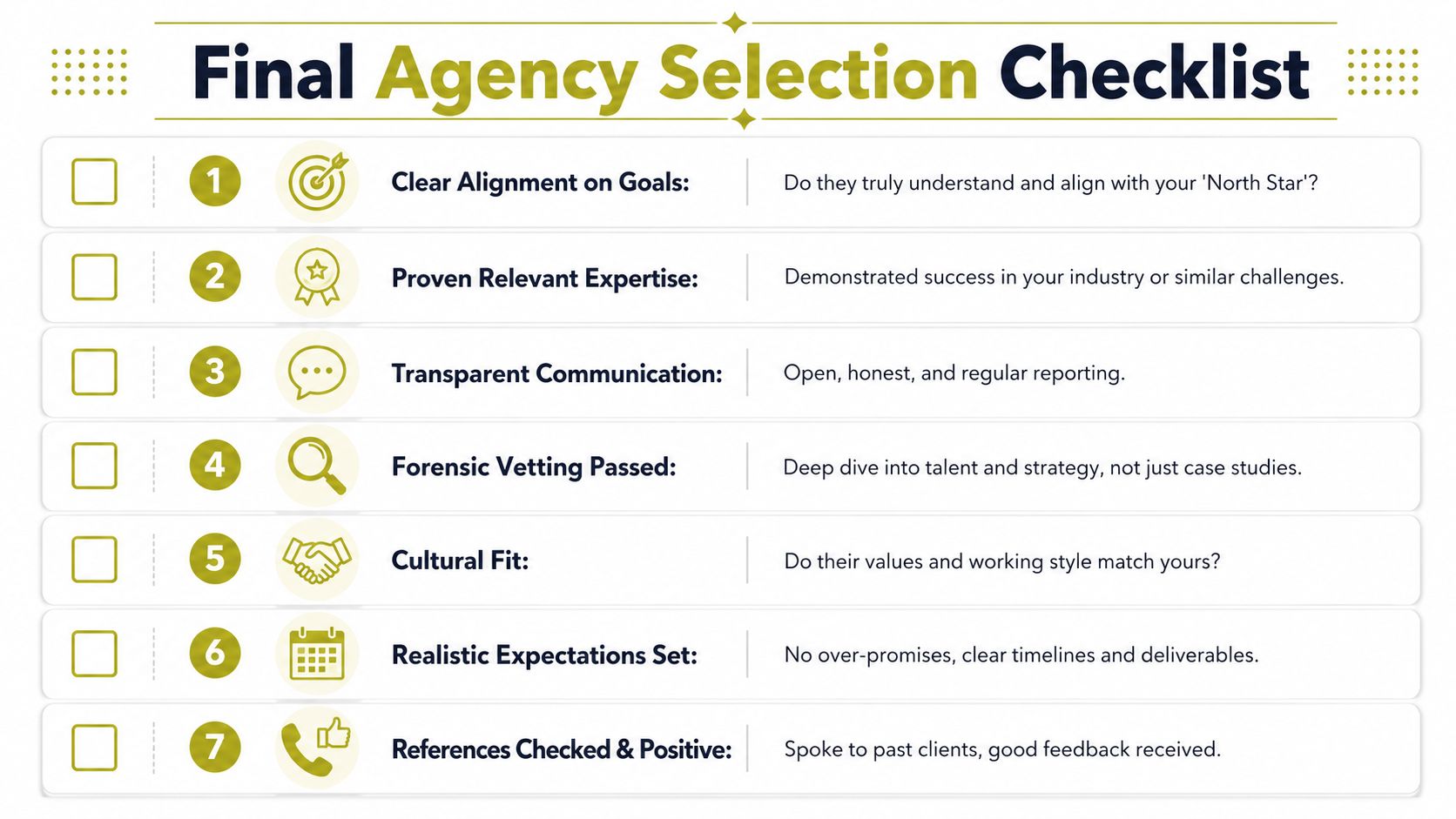
Use a scorecard, not gut feel alone
Create a simple scoring sheet for your final two or three agencies. Score each one on a consistent scale using these categories.
Strategic acumen
- Did they understand the business model?
- Did they identify the primary constraint, not just recommend channels?
- Did they explain how activity turns into pipeline or revenue?
Team and expertise
- Did you meet the people likely to run the account?
- Does the team bring relevant depth, such as editorial, brand, paid or technical capability?
- Did their backgrounds suggest mature judgement rather than just agency jargon?
Commercial discipline
- Was the scope clear enough to manage properly?
- Were metrics tied to business outcomes rather than vanity metrics?
- Did pricing match the level of seniority promised?
Communication and fit
- Did they answer difficult questions directly?
- Did they challenge your assumptions constructively?
- Could you imagine handling a bad month with them without drama?
The shortlist test most founders skip
Before you choose, ask each finalist for one thing in writing. A short summary of what they believe your main growth problem is, what they'd prioritise first, and what they would deliberately not do in the opening phase.
That document tells you more than a pitch deck. It shows whether they can think crisply without leaning on presentation theatre.
You should also compare their perspective against wider market thinking. If you want another external reference point, AdStellar's 2026 performance marketing agency insights are worth reading alongside your shortlist because they sharpen what to expect from a commercially serious performance partner.
A practical final pass
Use this quick yes-or-no screen before signing:
- Clear goals: They reflected your commercial priorities accurately.
- Relevant expertise: Their team has solved similar problems before.
- Transparent reporting: You know what will be measured and when.
- No inflated promises: They gave realistic timelines and constraints.
- Operational fit: Your internal team can support the engagement.
- Contract clarity: Scope, ownership and exits are properly documented.
- Confidence under scrutiny: Their answers improved when challenged.
The right digital marketing agency in London won't just sell you activity. They'll improve the quality of your decisions.
If an agency leaves you feeling dazzled but still unclear, keep looking. If they leave you feeling slightly more exposed but far more certain, that's usually a good sign.
If you want senior-level support without big-agency sprawl, Carlos Alba Media is one option to consider. It's a London-based PR and digital marketing agency founded by former national newspaper editor Carlos Alba, with teams that include former national news journalists and agency professionals who've worked with international brands. That background is useful if you need clear positioning, disciplined messaging, media credibility and digital work tied to commercial outcomes rather than vanity reporting.